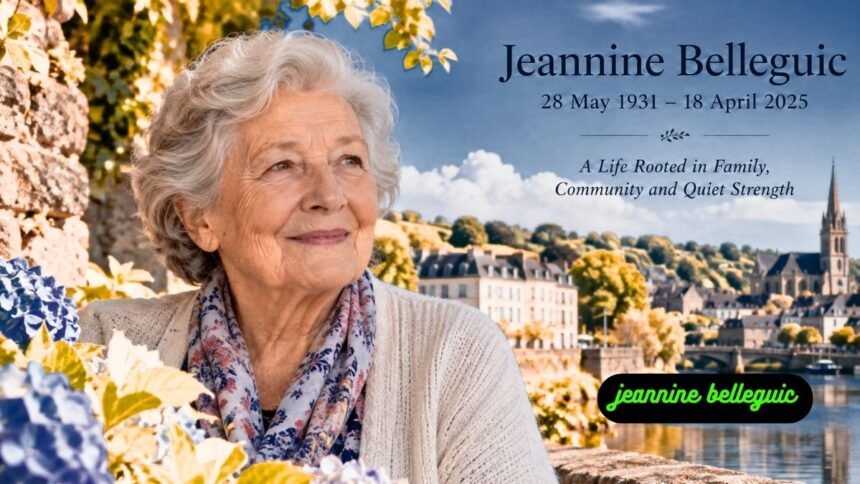
Jeannine Belleguic was a private French woman whose name has become increasingly visible in online searches, despite no reliable evidence that she was a celebrity, entertainer, politician, or other public figure. French records identify her birth name as Jeannine Joséphine Annick Bleuzen. She was born on 28 May 1931 in Quimperlé, in the Finistère department of Brittany, and died in Lorient on 18 April 2025, aged 93. Her funeral notice later identified her under her married name, Jeannine Belléguic, née Bleuzen.
Her surviving public record therefore differs from a conventional celebrity biography. It is built mainly from civil death records, an obituary, funeral details, and family genealogy. Those documents offer meaningful information about her family and regional connections while also setting clear limits on what can responsibly be said about her private life.
Who Was Jeannine Belleguic?
Jeannine Belleguic was born Jeannine Joséphine Annick Bleuzen in Quimperlé. Her formal civil death entry records her birth on 28 May 1931 and her death in Lorient on 18 April 2025. An Ouest-France funeral notice identifies her as Jeannine Belléguic, née Bleuzen, linking the birth surname in the civil record to the married surname commonly used in online searches.
A publicly accessible Geneanet family tree identifies Jean Charles Belleguic as her husband and names three children: Gilles, Catherine and Pierre-Yves. Because Geneanet trees can contain user-contributed material, such information deserves more caution than an official civil record. In this case, however, the family relationships are also reflected in reporting based on her funeral notice.
What the evidence does not establish is equally important. No dependable record shows that Jeannine had a public career or celebrity connection.
The Private Life of Jeannine Belleguic
Most of Jeannine’s life remains outside the type of documentation normally used to construct modern celebrity profiles. No substantial archive of interviews, verified social-media accounts, press appearances, professional biographies, or public statements is attached to her name.
That absence should not be converted into claims that she intentionally rejected fame or deliberately maintained a particular lifestyle. A limited public record tells us only that her personal life was not extensively documented online.
What survives instead is largely family-centered. Her obituary records relatives across several generations, while memorial pages connect her with Quimperlé, Lorient and Guidel. The documentary picture is therefore one of a private person remembered through family and local records rather than through a public profession.
This distinction matters for responsible biography writing. Privacy is not an invitation to fill missing decades with assumptions about personality, hobbies, finances, beliefs, or relationships.
Early Life and Background of Jeannine Belleguic
The strongest evidence about Jeannine’s early background comes from the French death record. It gives her full birth name, Jeannine Joséphine Annick Bleuzen, and records her birth in Quimperlé on 28 May 1931.
Quimperlé is therefore not simply a location inferred from her funeral. It is a documented starting point in her biography and later became the setting for her 2025 funeral.
A Geneanet family tree adds genealogical context, identifying Mathurin Guillaume Bleuzen and Cécile Françoise Marie Tanguy as her parents and placing Jeannine within a larger Bleuzen family. Because this material is user-maintained genealogy rather than a primary civil certificate displayed in the source, it should be presented as genealogical evidence rather than treated with the same certainty as the official death index.
No similarly strong public documentation establishes her education, occupation, or detailed childhood experiences. Responsible research therefore stops before turning regional and genealogical context into an invented personal narrative.
Marriage and Partnership With Jean Charles Belleguic
Genealogical material identifies Jeannine Bleuzen as married to Jean Charles Belleguic, who was born in Quimperlé in 1924 and died in 1979. The same family tree identifies Gilles, Catherine, and Pierre-Yves as their children.
Her funeral announcement provides additional evidence for the marriage through the traditional French naming style used in the notice. She was presented as Madame Jean-Charles Belléguic, née Jeannine Bleuzen, linking her directly to Jean-Charles while preserving her birth surname.
However, no reliable archive of interviews or public appearances exists from which to reconstruct the dynamics of their marriage. Statements that they had a particularly romantic partnership, shared certain personal values, or played defined emotional roles in each other’s lives would go beyond the evidence.
The facts establish a marriage and family. They do not give an outsider access to the marriage’s private character.
Jeannine Belleguic’s Role Behind the Scenes
Describing Jeannine as a powerful “behind-the-scenes” figure would create a type of celebrity narrative unsupported by the sources.
What can be established is that the family notice places her within a large multigenerational family. The sources identify three children, six grandchildren, and ten great-grandchildren. These facts show family continuity across several generations without requiring assumptions about how Jeannine raised, advised, or influenced individual relatives.
This is an important difference between evidence and interpretation. Family size can be documented. Claims that she was the emotional center of the family, made major household decisions, inspired particular careers, or shaped specific values would require testimony or another credible source.
A trustworthy biography can acknowledge the obvious significance of her position within the family tree while resisting the temptation to invent private conversations or character traits.
Family Life: Raising the Next Generation
Jeannine’s family is one of the best-documented areas of her public record.
The Geneanet tree identifies her children as Gilles Belleguic, Catherine Belleguic-Coulis and Pierre Yves Belleguic. The funeral notice likewise names Gilles, Catherine, and Pierre-Yves and identifies six grandchildren: Philippe, Marie, Charlotte, Anne-Gaëlle, Camille, and Jean-Victor. The notice also refers collectively to ten great-grandchildren.
These details provide an unusually clear view of several generations while still respecting the limits of the source. The great-grandchildren, for example, are acknowledged collectively rather than individually in the information reviewed.
Having children, grandchildren, and great-grandchildren makes family continuity an important part of Jeannine’s surviving record. It does not, however, establish exactly how she approached parenting or grandparenting. Descriptions of her as strict, nurturing, traditional or unusually influential would require evidence that the public documents do not provide.
Philanthropy and Community Engagement
No strong public source reviewed establishes Jeannine Belleguic as a philanthropist, charity official, campaigner, donor or community leader. For E-E-A-T purposes, assigning philanthropic interests to make a private biography seem more substantial would be misleading.
Her funeral notice does reveal something different: a network of people and care services associated with the final period of her life. Reporting based on the notice says her family thanked a companion, a doctor, staff at Résidence Edilys and the hospital-at-home service in Lorient.
Those acknowledgments document a community of care surrounding Jeannine. They should not be reinterpreted as evidence of her own charitable work.
This is a useful example of why careful wording matters. A funeral notice can demonstrate relationships with caregivers and local institutions without proving participation in philanthropy, volunteering, or organized community activity.
The Power of Privacy: Influence Without Publicity
Jeannine’s limited digital footprint illustrates how easily the modern internet can turn privacy into mystery.
Her lack of interviews, career profiles and social-media documentation does not necessarily mean she made a conscious decision to “avoid publicity.” She was born in 1931, decades before online personal branding became commonplace, and the surviving sources do not tell us how she personally viewed privacy.
What they do show is that a person can leave a meaningful documentary footprint without being publicly famous. Birth and death information, family genealogy, funeral arrangements and memorial notices can preserve essential parts of an individual’s identity long after a lifetime spent largely outside media coverage.
In Jeannine’s case, privacy should therefore be treated as a feature of the available evidence, not romanticized as an established philosophy she deliberately followed.
Public Curiosity and Misconceptions About Jeannine Belleguic
The biggest misconception surrounding Jeannine Belleguic is the assumption that a frequently searched name must belong to a celebrity or someone connected with a famous public figure.
The available evidence does not support that conclusion.
Researchers should also watch for an identity problem. French death records contain another woman named Jeannine Gisèle Marcelle Belleguic, born in Bordeaux in 1941 and deceased in 1987. She was a different person. The Jeannine discussed in this article was born Jeannine Joséphine Annick Bleuzen in Quimperlé in 1931 and died in 2025.
The distinction demonstrates why birth dates, maiden names, locations, and death dates matter when researching private individuals. Matching a surname and first name alone can easily produce a false biography.
Online repetition should never be treated as verification.
Legacy and Future
Jeannine Belleguic’s documented legacy is primarily genealogical and commemorative.
She died on 18 April 2025 at age 93. Her funeral took place one week later, on 25 April, at Église Notre-Dame de Quimperlé, and family-notice reporting states that she was buried at Saint-David Cemetery.
Her surviving records identify three children and multiple later generations. That family record is more concrete than attempts to assign her a public legacy she did not demonstrably pursue.
Future research may uncover additional civil archives or authenticated family material. Until then, the responsible account remains limited to what the evidence supports: her identity as Jeannine Bleuzen, her marriage into the Belleguic family, her children and descendants, her strong documentary connection to Brittany, and the details surrounding her death and funeral.
Conclusion
Based on the reliable sources reviewed, Jeannine Belleguic was not a celebrity or a documented associate of a major public figure. She was Jeannine Joséphine Annick Bleuzen, born in Quimperlé on 28 May 1931 and later known as Jeannine Belléguic. She died in Lorient on 18 April 2025 at the age of 93.
Her public record is modest but meaningful. Genealogical and funeral sources identify her husband, Jean Charles Belleguic, three children, six grandchildren and ten great-grandchildren. Her funeral returned the story to Quimperlé, where the ceremony was held at Notre-Dame Church.
The most accurate way to understand Jeannine Belleguic is therefore not through an invented celebrity narrative, but through the surviving evidence of family, place and remembrance. Preserving those limits makes her biography more trustworthy, not less complete.
FAQs,
1. Who was Jeannine Belleguic?
Jeannine Belleguic was a private French woman born as Jeannine Joséphine Annick Bleuzen in Quimperlé, Brittany, in 1931. Her public record mainly comes from French civil, family, and funeral records.
2. When was Jeannine Belleguic born?
She was born on 28 May 1931 in Quimperlé, Finistère, France.
3. When did Jeannine Belleguic die?
She died on 18 April 2025 at the age of 93. The civil death record places her death in Lorient, Morbihan.
4. What was Jeannine Belleguic’s maiden name?
Her birth surname was Bleuzen. Her funeral notice identifies her as Jeannine Belléguic, née Bleuzen.
5. Who was Jeannine Belleguic’s husband?
Genealogical records identify her husband as Jean Charles Belleguic, born in 1924 and deceased in 1979.
6. Did Jeannine Belleguic have children?
Yes. Family and genealogy records identify three children: Gilles, Catherine and Pierre-Yves.
7. Was Jeannine Belleguic a celebrity?
No reliable evidence reviewed establishes her as a celebrity or other nationally recognized public personality. Her searchable record primarily consists of civil, memorial, funeral and genealogical information.
8. Where was Jeannine Belleguic’s funeral held?
Her funeral was held on 25 April 2025 at Église Notre-Dame de Quimperlé. Family-notice reporting states that the burial followed at Saint-David Cemetery.