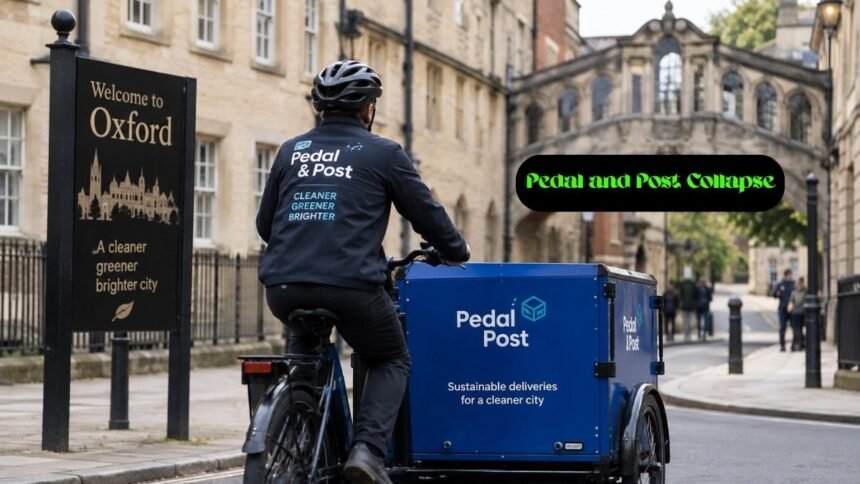
The Pedal and Post Collapse marked the end of one of Oxford’s best-known experiments in low-emission urban logistics. Founded in 2013 by Christopher Benton, Pedal & Post developed from an Oxford cycle-delivery operation into a business handling last-mile parcels, medical deliveries, micromobility support and other logistics work using cargo bikes and electric vehicles. The company later expanded into London, announcing its launch there in July 2025.
Only months later, the business announced that it could no longer continue after losing a major customer. Both its Oxford and London operations closed, and founder and CEO Christopher Benton confirmed that approximately 60 employed and self-employed workers were affected. The company subsequently entered creditors’ voluntary Liquidation on 20 February 2026.
This article examines the Pedal and Post Collapse. This contract loss triggered the crisis, the company’s rapid expansion, its dependence on major customers, the impact on workers and parcel deliveries, and what the closure means for the wider cargo-bike logistics sector.
What Was Pedal & Post?
Pedal & Post was an Oxford-based logistics company built around the idea that many urban deliveries traditionally carried out by vans could instead be completed using bicycles, electric cargo bikes and low-emission vehicles.
Its operations went considerably beyond ordinary cycle courier work. The company offered same-day and last-mile delivery services, worked in medical logistics, supported parcel carriers and provided services for micro-mobility companies. Its own materials described work involving storage, battery charging, maintenance, deployment and transportation of e-scooters and e-bikes.
By 2023, Pedal & Post was reported to be delivering around 1,000 packages per day in Oxford with approximately 25 cycle riders and annual turnover exceeding £500,000. It had relationships with businesses including major parcel companies and positioned itself as a practical alternative to diesel-powered last-mile delivery.
That makes the Pedal and Post Collapse significant beyond the loss of a Creditors’ individual courier company. It represented the failure of an established operator that had spent years trying to demonstrate that cleaner urban freight could work commercially at scale.
How Pedal & Post Built Its Business
From an Oxford Idea to an Established Courier Operation
Christopher Benton’s involvement with cargo bikes reportedly began before Pedal & Post’s formal incorporation. Ethex reported that Benton ran a small coffee business from a bicycle trailer in Oxford in 2012 before seeing the wider potential of cargo bikes for urban deliveries. The company was then established in 2013.
Oxford was a natural environment for the model. Congested streets, large numbers of cyclists, university institutions and growing environmental concerns created demand for delivery methods that required less road space and produced fewer direct emissions.
Pedal & Post eventually expanded into commercial parcel delivery, healthcare, and university logistics.
University College Oxford, for example, participated in a project designed to consolidate multiple parcel deliveries before completing the final stage by cargo bike. The broader university scheme sought to reduce repeated van movements through central Oxford.
Medical and Specialist Deliveries
The company also developed experience in medical logistics. Its services included movements between Oxford and London, with rail travel forming part of some low-emission delivery chains.
Pedal & Post described projects involving Oxford institutions and healthcare services, while local reporting after theBenton’s noted that the company had transported important medical items as well as ordinary parcels.
This diversity matters when analyzing the collapse. Pedal & Post was not simply dependent on individuals ordering local bicycle deliveries. It had built relationships across parcel logistics, healthcare, universities and micromobility.
The Expansion Before the Collapse
One of the most striking elements of the Pedal & Post Collapse is how quickly it followed an important period of expansion.
In 2023, Pedal & Post sought outside investment to expand its operations. Industry reporting said the company aimed to raise approximately £450,000 through crowdfunding, while other promotional material discussed a maximum raise of around £500,000. At the time, the company had ambitions to expand its Oxford operations and move into additional markets.
The company continued developing its profile. In 2024, Pedal & Post announced that it had won the Sustainable Medium Business of the Year category at the Oxford Climate Awards.
Then came London.
In July 2025, Pedal & Post formally announced its London launch. It planned to operate a growing fleet of e-cargo bikes, trikes, and electric vans, and said it expected the London business to complete more than 100,000 zero-emission deliveries annually.
Approximately six months later, the business was closing.
The sequence demonstrates an important difference between operational growth and financial resilience. Expanding into a new city may increase revenue opportunities, but it also brings additional staffing, premises, fleet, and management requirements. Public evidence does not establish that the London expansion itself caused the failure, so it would be misleading to blame the collapse on expansion alone.
The confirmed trigger was the loss of a major customer.
Why Did Pedal & Post Collapse?
Loss of a Major Client Was the Immediate Trigger
Pedal & Post said it lost a major client early in 2026 and, after reviewing its options, could no longer sustain the business.
Benton separately explained that smaller logistics businesses can depend heavily on a relatively limited group of major customers. He said Pedal & Post relied on roughly five or six significant clients and that losing one could make continued operations financially impossible.
This provides the clearest fact-based explanation of the collapse.
A logistics network carries significant ongoing obligations. Riders or drivers must be paid, premises need to operate, vehicles require maintenance, insurance and technology systems continue generating costs, and management expenses do not disappear immediately when a contract ends.
When a major customer disappears, revenue can fall much faster than those costs.
Was the Lost Client Voi?
Pedal & Post’s public closure statement did not identify the client.
However, multiple Oxford reports connected the contract loss to micromobility company Voi. Cherwell reported that it understood the lost customer to be Voi, while the Oxford Clarion reported that a Voi contract accounted for approximately 36% of Pedal & Post’s profit.
Pedal & Post had publicly listed Voi among the major micromobility companies it worked with, providing services such as vehicle storage, charging, maintenance, and redistribution.
For accuracy, the distinction matters: Pedal & Post directly confirms the loss of a major client, while local reporting identifies that client as Voi.
Customer Concentration and Business Risk
The Pedal and Post Collapse illustrates a classic problem facing smaller business-to-business companies: customer concentration.
A company can appear diversified because it performs many different services, yet still depend financially on a small number of contracts.
Pedal & Post handled parcels, medical goods, university freight, and micromobility work. Still, Benton’s comments indicate that only five or six major customers formed an important part of its commercial structure.
If one account contributes a large proportion of the profit needed to support Post’s infrastructure, losing that customer affects more than the workers directly assigned to the contract.
Vehicles, depots, administrative teams and operational systems were built to support a certain scale. Revenue can therefore fall immediately while much of the cost base remains.
That does not prove the PostCo’s was badly managed, nor does the available evidence justify claiming that any single strategic decision caused the failure. It does show why concentrated customer exposure can turn the cancellation of one major contract into an existential event.
What Happened to Pedal & Post Employees?
Around 60 workers across Oxford and London lost their jobs when Pedal & Post closed.
Benton confirmed that the workforce included both employees and self-employed personnel.
The employment impact is particularly notable because the business had positioned itself as attempting to provide better working conditions in a logistics industry where self-employed courier arrangements are common.
Benton told Zag Daily that operating as what he considered an ethical employer could be difficult in a sector dominated by self-employment models. He argued that cargo bikes’ lower operating costs helped the company support better employment practices.
Whatever the broader debate around courier employment models, the collapse had substantial immediate human consequences for a relatively small regional company.
Impact on Evri and Local Deliveries
The closure also affected parcel delivery operations in Oxford.
Evri had used Pedal & Post as an e-cargo-bike delivery partner. Following the shutdown, Evri said the closure had happened without notice from its perspective and caused temporary disruption for a relatively small number of local customers.
Evri subsequently reorganized its delivery operations and said it was restoring normal service.
This led to some online confusion around whether Evri itself was in financial trouble. That conclusion was incorrect.
The company that entered Liquidation was Pedal & Post Ltd, not Evri.
This distinction matters for readers searching the Pedal and Post Collapse because parcel delays linked to the closure did not mean the much larger national carrier had collapsed.
Pedal & Post Liquidation Explained
Closing operational sites and entering Liquidation are related but legally distinct events.
Pedal & Post stopped operating first. The formal corporate winding-up process followed.
Companies House records show that Pedal & Post Ltd entered a creditors’ voluntary Liquidation, with the winding up commencing on 20 February 2026. Brett Barton and Margaret Carter were appointed as insolvency practitioners.
The Gazette also recorded that company members passed the necessary resolution to wind up the business voluntarily and appoint joint liquidators.
As of September 2026, Companies House still lists the company as in Liquidation rather than dissolved.
That means the corporate process of dealing with the company’s remaining affairs has continued beyond the operational shutdown.
Did Cargo Bikes Cause Pedal & Post to Fail?
There is no solid evidence that Pedal & Post collapsed because cargo bikes were technically ineffective.
In fact, Benton explicitly rejected the idea that the closure demonstrated a failure of cargo-bike logistics. His explanation focused on the commercial consequences of losing a major customer rather than problems with bicycle delivery itself.
Pedal & Post had operated for more than a decade and completed substantial delivery volumes. In 2023, public investment material said it was handling roughly 1,000 packages per day in Oxford.
The company had also worked with major parcel carriers, healthcare organizations and Oxford institutions.
The evidence therefore points toward a tension between operational viability and business-model resilience.
Cargo bikes may successfully carry urban freight while the company operating them can still face contractual, financing or revenue-concentration problems.
What the Collapse Means for Sustainable Logistics
Pedal & Post’s closure raises broader questions about how low-emission logistics businesses scale.
Urban freight operators compete in a sector where customers are highly sensitive to price, reliability, and delivery speed. Environmental benefits may help win contracts, but they do not eliminate the need for sufficient margins, predictable demand, and a balanced client portfolio.
Evidence also suggests the challenges extend beyond one company. Another UK cargo-bike operator, Zedify, had previously entered administration amid concerns surrounding volumes and operating costs, according to logistics reporting.
That does not establish that cargo-bike businesses are inherently unviable. Large delivery companies continue to experiment with and invest in low-emission urban delivery.
Instead, the Pedal and Post collapse shows that sustainability credentials alone cannot protect a business from ordinary commercial risks such as dependence on contracts, fixed costs, and sudden revenue losses.
Pedal & Post’s Legacy
Pedal & Post’s corporate story ended in Liquidation, but its operational legacy is broader.
The company spent years demonstrating cargo-bike delivery across several demanding categories, including standard parcels, university freight, healthcare and mobility operations.
Oxford City Council listed Pedal & Post among businesses supplying zero-emission courier services, and the company participated in projects intended to reduce conventional vehicle movements within Oxford.
Its blue cargo bikes became a visible part of Oxford’s delivery landscape. At the same time, collaborations with colleges demonstrated how freight could be consolidated and moved into dense urban areas without requiring a separate van journey for every carrier.
The failure therefore leaves two different conclusions.
Commercially, Pedal & Post could not survive losing a critical client.
Operationally, however, it showed that cargo bikes could do serious logistics work rather than serving only as a niche alternative for small packages.
Conclusion
The Pedal and Post Collapse was ultimately driven by a financial problem rather than a simple rejection of sustainable delivery, after building an Oxford cargo-bike operation, expanding its services, and entering London in July. The company concluded that it could no longer operate sustainably, closed its Oxford and London sites and left around 60 workers without their roles.
Its formal creditors’ voluntary Liquidation began on 20 February 2026, and the company remains listed in Liquidation.
The strongest lesson, then, is not that cargo-bike logistics failed. Pedal & Post operated the model for years and helped prove its practical usefulness. The collapse instead illustrates the vulnerability created when Oxford’s relatively small logistics business depends heavily on a limited number of major commercial contracts.
FAQs,
1. What happened to Pedal & Post?
Pedal & Post stopped trading in early 2026 after losing a major customer. Its Oxford and London sites closed, and the company subsequently entered creditors’ voluntary Liquidation.
2. Why did Pedal & Post collapse?
The company said losing a major client made the business financially unsustainable, despite attempts to find a way to keep operating.
3. Was Voi the client Pedal & Post lost?
Pedal & Post did not name the client in its public closure announcement. However, Oxford media, including Cherwell and the Oxford Clarion, reported that the contract was with micromobility operator Voi.
4. How many jobs were lost in the Pedal & Post Collapse?
Around 60 employed and self-employed workers across Oxford and London were affected by the closure.
5. When did Pedal & Post enter liquidation? House records show that the creditors’ voluntary Liquidation commenced on 20 February 2026.
6. Did the collapse mean Evri went bust?
No. Evri remained operational. Pedal & Post was one of its local e-cargo-bike delivery partners, and the closure temporarily disrupted some Oxford deliveries.
7. When was Pedal & Post founded?
Pedal & Post Ltd was incorporated on 7 May 2013, although founder Christopher Benton had been experimenting with bicycle-based commercial activity before the company’s formal creation.
8. Does the Pedal and Post Collapse prove cargo-bike delivery does not work?
No. The available evidence points to the loss of a major commercial customer as the immediate cause of the shutdown. Pedal & Post had successfully carried out cargo-bike deliveries for many years across parcels, medical logistics, and other services.