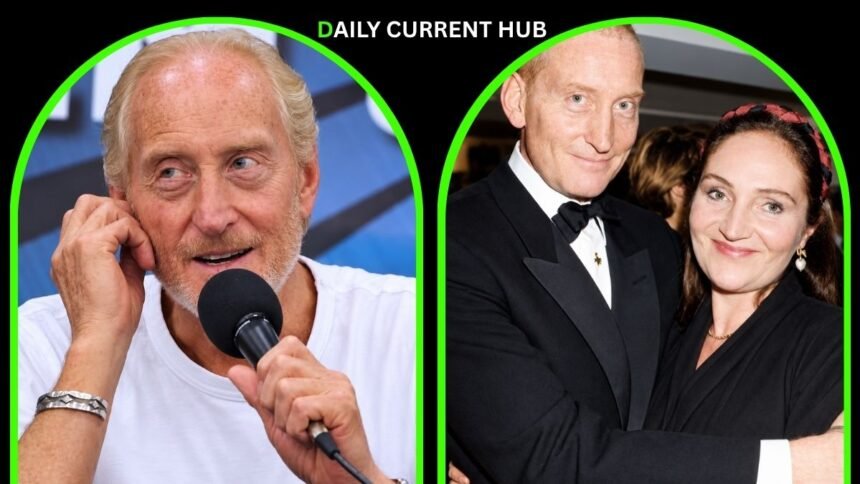
Charles Dance has built one of the most recognizable careers in British acting, moving from the Royal Shakespeare Company to major roles in The Jewel in the Crown, Game of Thrones, The Crown and numerous films. Long before that international recognition, however, he built a life with Joanna Haythorn, the sculptor who became his first wife.
Haythorn and Dance married in 1970 and had two children, Oliver and Rebecca. Their marriage spanned more than three decades, including the years in which Dance went from a developing stage actor to a prominent screen star. The couple divorced in 2004. Dance has subsequently spoken with unusual openness about the breakup, acknowledging that his own infidelity contributed to the marriage ending.
Unlike her former husband, Joanna Haythorn never developed a comparable public-facing celebrity profile. That makes accuracy particularly important. Her story is best understood through the limited but meaningful facts established by reputable interviews and profiles rather than the unsupported details that sometimes circulate online.
Profile Summary
| Detail | Verified information |
|---|---|
| Full Name | Joanna Haythorn |
| Also referred to as | Jo Haythorn |
| Profession | Sculptor |
| Known For | First wife of English actor Charles Dance |
| Marriage | Charles Dance, 1970–2004 |
| Children | Oliver Dance, born 1974; Rebecca “Becky” Dance, born 1980 |
| Age / Date of Birth | No reliable mainstream source establishes an exact birth date |
| Former Residence | The family lived in Somerset during part of the marriage |
| Public Profile | Primarily known through her marriage to Dance; maintained a limited media presence |
| Known Philanthropic Interests | No well-sourced personal philanthropic programme has been established in major public reporting |
| Social Media Presence | No verified public social-media account has been reliably established |
| Later Life | Dance said in a 2024 interview that Haythorn had died roughly a decade earlier; a precise publicly verified date was not given |
Who Was Joanna Haythorn?
Joanna Haythorn was a sculptor whose public recognition is closely connected with her long marriage to Charles Dance. Yet describing her simply as “Charles Dance‘s ex-wife” leaves out an important verified part of her identity: she had her own artistic profession.
An older profile of Dance reported that he met Joanna at art school and that they married when he was 23. Dance had studied graphic design before committing himself fully to acting, meaning their relationship began well before his eventual status as a major television and film performer.
Haythorn did not build her career through celebrity interviews, reality television, or a public personal brand. Consequently, the documentary record surrounding her is narrower than it is for Dance. That should not be mistaken for evidence that her life lacked substance. It simply means responsible biography has to distinguish between what newspapers and interviews actually record and what later websites may have inferred.
The Private Life of Joanna Haythorn
Haythorn occupied an unusual position: she spent decades married to an increasingly famous actor without becoming a conventional celebrity herself.
That distinction became particularly relevant after Dance achieved major recognition through The Jewel in the Crown in 1984. Dance later reflected that the sudden attention surrounding him did not affect him alone. He acknowledged that increased scrutiny also reached his wife and children, and that they had not necessarily expected it when his career began.
That statement provides a stronger basis for understanding Haythorn’s privacy than speculation about her personality. There is no need to label her shy, secretive or publicity-averse without direct evidence. What we can observe is that her media footprint remained small even as her husband became increasingly recognizable.
Her relative absence from celebrity culture is therefore part of the factual story. Public interest in Joanna Haythorn largely developed because of Dance’s career and his later reflections on their marriage rather than through a publicity campaign led by Haythorn herself.
Early Life and Background of Joanna Haythorn
Reliable reporting provides only a limited picture of Haythorn’s early years.
One useful detail comes from an older Evening Standard profile, which states that Dance met Joanna at art school. The connection is notable because Dance originally pursued visual art and design before acting became his profession.
Mainstream profiles do not firmly establish Haythorn’s exact birth date, parents, childhood home, or detailed educational history. For an E-E-A-T-focused biography, those gaps should remain gaps unless primary records or reputable sources emerge.
Her documented profession as a sculptor is more firmly established. Both The Guardian and The Independent have referred to her as a sculptor.
However, there is no similarly strong public record documenting a comprehensive list of exhibitions, gallery representation, major commissions, or awards. Claims assigning specific artistic achievements to Haythorn therefore require more evidence than is presently available in major published profiles.
Marriage and Partnership With Charles Dance
Joanna Haythorn and Charles Dance married in 1970.
Their marriage covered almost the entire period during which Dance established his professional reputation. He joined the Royal Shakespeare Company in the 1970s and later became widely known through screen work, particularly The Jewel in the Crown in 1984. The Guardian notes that Dance had already married Haythorn by the time his RSC career developed.
That chronology matters. Haythorn did not enter Dance’s life after international fame arrived. Their relationship preceded the period when television audiences began treating him as a star.
The couple later lived in Somerset. When discussing the final stage of their marriage, Dance recalled that they had separate studies at opposite ends of their large home, describing how distance had developed between them.
His account comes from his perspective, not Haythorn’s, and should therefore be treated as his recollection rather than as a complete account of what both partners experienced.
Joanna Haythorn’s Role Behind the Scenes
Celebrity biographies frequently describe spouses as the “secret behind” a famous person’s success, but such language can easily become unsupported.
In Haythorn’s case, there is a more concrete statement to work with. After their divorce, Dance publicly described his wife as having been highly supportive of his career.
The chronology also shows that their marriage encompassed difficult years familiar to many performing families: theatre work, professional travel, career uncertainty and eventually major fame.
What cannot responsibly be claimed is that Haythorn managed Dance’s career, made his professional decisions or sacrificed a documented set of ambitions for him unless reliable evidence establishes those details.
Her importance within the family is clear from the length of the relationship and Dance’s own later comments. But her role deserves to be described using evidence rather than romanticized assumptions.
Family Life: Raising the Next Generation
Joanna Haythorn and Charles Dance had two children together.
Their son, Oliver, was born in 1974. Their daughter, Rebecca, often called Becky, was born in 1980.
Those dates place their children squarely in the years when Dance was developing his theatre career and becoming increasingly visible on television.
Dance later acknowledged that celebrity attention affected not only him but also his family. In discussing the impact of becoming regarded as a sex symbol following The Jewel in the Crown, he specifically mentioned the scrutiny experienced by both a spouse and children when one family member becomes publicly famous.
Reputable reporting has not presented Oliver and Rebecca as people who actively sought the same level of fame as their father. For that reason, details of their personal lives should also be handled with restraint.
Philanthropy and Community Engagement
There is no strong mainstream evidence establishing an individual charitable foundation, sustained philanthropic campaign, or major public fundraising role specifically associated with Joanna Haythorn.
That distinction matters because celebrity biographies sometimes copy charitable interests from one family member and attribute them to another without evidence.
Haythorn’s documented public identity centers on three established areas: her work as a sculptor, her marriage to Dance, and their family.
Unless records from charities, organizations, galleries, or Haythorn herself establish particular philanthropic activity, assigning causes to her would create a biography that sounds detailed but is less trustworthy.
In this case, restraint strengthens the profile rather than weakening it. E-E-A-T depends on acknowledging the boundaries of the evidence.
The Power of Privacy: Influence Without Publicity
Haythorn’s story illustrates an important distinction between public significance and public exposure.
For decades, she was part of the family life of a performer whose fame grew dramatically, yet she did not develop an equivalent media identity. Dance hater recognized that attention around a public figure could extend to family members who had not entered that world expecting scrutiny.
It would go too far to claim that Haythorn deliberately constructed a philosophy of privacy; no widely cited interview from her establishes such a position.
The public record does show a limited media footprint. Her professional identity as a sculptor was acknowledged, but interviews, personal disclosures, and publicity surrounding her were comparatively uncommon.
That distinction is useful when evaluating modern online biographies. A lack of documented detail should not invite the creation of detail.
Public Curiosity and Misconceptions About Joanna Haythorn
Interest in Joanna Haythorn has increased partly because Charles Dance remained a major cultural figure long after their marriage ended.
That creates several opportunities for misinformation.
Exact birth dates, net-worth estimates, supposed childhood stories, detailed education histories, and social-media accounts can appear online without strong sourcing. Such claims should not be repeated merely because multiple websites copy one another.
Another potential misconception concerns the end of the marriage. Modern reporting is unusually clear because Dance himself has discussed it publicly.
In a 2024 interview, he took responsibility for his behavior and said that he had “succumbed to some temptations.” He said he eventually disclosed his infidelity to Haythorn and expressed regret over the marriage ending.
That is materially different from speculating about Haythorn’s actions or assigning equal responsibility without evidence.
Divorce and Charles Dance’s Later Reflections
The marriage ended in 2004, after more than three decades.
Dance has described the breakup as one of the major regrets of his personal life. His account connects the difficulties partly with the period following his increased fame, though he has explicitly resisted using that attention as an excuse for his own behavior.
One significant detail from his later reflections is that the end of the marriage did not permanently end their relationship as people.
Dance said that after a difficult period of roughly 18 months, he and Haythorn became close friends again. In his later telling, that friendship continued afterward.
This offers a more complete picture than reducing their 34-year relationship to its final breakdown.
Legacy and Later Life
Joanna Haythorn’s public legacy is necessarily quieter than Charles Dance’s because she did not leave behind the same volume of interviews, screen credits, or celebrity coverage.
She nevertheless appears repeatedly in serious profiles of Dance because she was present throughout a formative period of his life: before international fame, during his theatre development, while their children were growing up and through the transformation brought by major television success.
In 2024, The Independent reported that Dance said Haythorn had died around a decade earlier. That places her death approximately around 2014, although the report did not establish a precise date.
Her biography is therefore best approached without exaggeration. Joanna Haythorn was a sculptor, the mother of Oliver and Rebecca Dance, and Charles Dance’s wife for more than three decades. Those facts provide a substantial story without requiring invented wealth figures, false career milestones or unsupported personal theories.
Conclusion
Joanna Haythorn holds a distinctive place in Charles Dance’s personal history. She married him in 1970, before his most celebrated screen roles, built her own identity as a sculptor and shared with him the responsibility of raising Oliver and Rebecca.
Their marriage survived more than three decades before ending in 2004. Dance has since taken public responsibility for the infidelity that contributed to its breakdown and has spoken both of his regret and of the friendship they later rebuilt.
Haythorn’s limited public footprint should not be filled with assumptions. Her significance is clearer when the known evidence is allowed to stand on its own. She was part of Dance’s life long before celebrity transformed his circumstances, maintained an artistic identity separate from his acting career, and remained an important figure in the family story that he himself continued to discuss decades later.
Read this too:Emma Tallulah Behn: Princess Märtha Louise’s Youngest Daughter Building Her Own Equestrian Path
(FAQs)
Who was Joanna Haythorn?
Joanna Haythorn was a sculptor and the first wife of English actor Charles Dance. They married in 1970 and divorced in 2004.
Was Joanna Haythorn an artist?
Yes. Reputable profiles in The Guardian and The Independent identify Joanna Haythorn as a sculptor.
When did Joanna Haythorn marry Charles Dance?
Joanna Haythorn and Charles Dance married in 1970.
How many children did Joanna Haythorn and Charles Dance have?
They had two children: Oliver Dance, born in 1974, and Rebecca “Becky” Dance, born in 1980.
Why did Charles Dance and Joanna Haythorn divorce?
Dance has said that his own infidelity contributed to the breakdown of the marriage. He publicly accepted responsibility for his behavior rather than blaming Haythorn.
Did Joanna Haythorn and Charles Dance remain friends after their divorce?
According to Dance, after an initially difficult period following their separation, he and Haythorn rebuilt their relationship and became close friends.
When did Joanna Haythorn die?
A 2024 profile reported Dance saying that Haythorn had died around ten years earlier, suggesting approximately 2014. A precise date was not established in that report.
Did Joanna Haythorn have social media?
No verified public social-media account belonging to Joanna Haythorn has been established by the reliable sources used for this profile. Claims linking accounts to her should therefore be verified before publication.