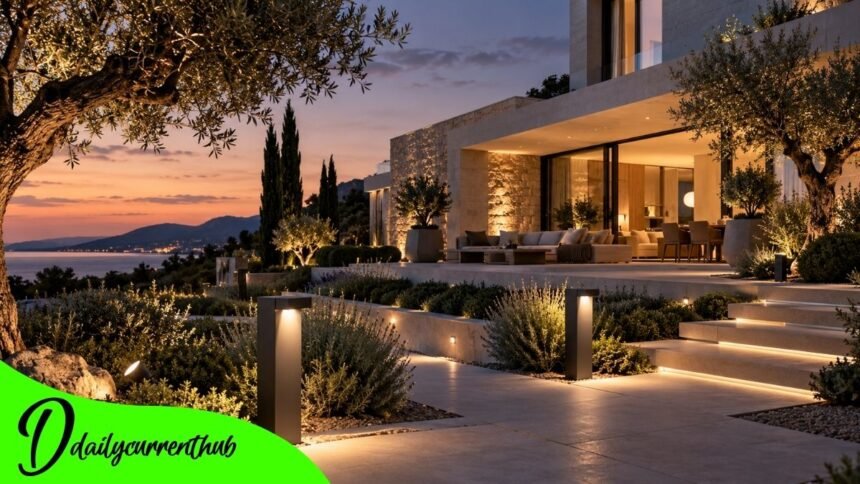
Cristher is known for architectural lighting, outdoor design, and helping develop the Spanish lighting industry. Founded in 1981 as a family business, the company later joined a larger organization that eventually became Novolux Lighting, a manufacturer and supplier of indoor and outdoor lighting solutions.
Today, the brand specializes in residential and architectural exterior lighting. Its collections include bollards, wall-mounted fixtures, recessed lights, spotlights, and other products designed for buildings, gardens, pathways, and landscaped environments.
The company’s history reflects changes in lighting technology, architectural expectations, and the industry’s commercial organization. What began as an independent family enterprise is now a specialist product range within an international lighting business.
This article explores Cristher’s verified history, its relationship with Novolux Lighting, key product collections, design characteristics, sustainability commitments, and ongoing relevance to modern architectural projects.
What Is Cristher?
Cristher is a specialist outdoor lighting brand in Novolux Lighting’s portfolio. Its products are designed for residential exteriors, architectural projects, and outdoor environments that require both practical illumination and visual design.
Unlike a general household lighting range, Cristher places considerable emphasis on fixtures that become part of a building or landscape. A recessed light may be integrated into paving, while a bollard can establish the illuminated boundaries of a walkway. Directional spotlights can highlight planting, walls, or particular architectural features.
Novolux describes the range as a high-end collection with considerable variety, modularity, and customization options. These characteristics matter especially to architects and lighting designers working under different installation conditions.
The brand’s significance also comes from its history. Cristher is not simply a recent product label; its origins predate the current Novolux corporate identity by several decades.
Early History and Background of Cristher
Cristher began in 1981 as a family lighting business. Its establishment marks the starting point of the corporate history Novolux Lighting documents.
The company grew as the lighting industry gradually moved beyond traditional lamps toward increasingly specialized architectural products.
Outdoor lighting requires attention to conditions that indoor decorative fixtures do not always encounter. Rain, dust, changing temperatures, and physical contact can influence material selection and construction methods.
Cristher’s modern product portfolio demonstrates how specialized exterior lighting incorporates these considerations into design.
Novolux’s corporate history documents the company’s origins, though available official materials do not detail individual founding family members. The documented corporate milestones offer a more reliable way to understand its development than an unsupported personal narrative.
Cristher’s Relationship with Novolux Lighting
Cristher’s relationship with Novolux developed through several key corporate changes.
In 1990, another family lighting company, Dopo, was established. According to the Novolux company timeline, investment fund N+1 acquired Cristher and Dopo in 2005.
The following year, the businesses were combined to create Grupo Gestión Integral Novolux Internacional, S.L.
This merger brought together lighting businesses with different product focuses. Later, it expanded with additional brands, specialized departments, and international distribution.
In 2019, the organization redesigned its corporate identity, grouping its brands under the Novolux name and adopting Novolux Lighting S.L.
Today, the portfolio includes Cristher, Dopo, Exo, Indeluz, and Canaled.
The company positions Cristher toward architectural outdoor lighting, while Dopo concentrates on residential outdoor applications. This distinction helps explain why the two names continue to appear separately within the same organization.
Architectural and Outdoor Lighting Products
The Cristher range covers several exterior lighting categories, each designed to meet specific installation requirements.
Bollards and columns are among its recognizable product types. These upright fixtures can illuminate walkways, gardens, entrances, and other pedestrian areas.
Wall-mounted luminaires provide another approach, adding illumination to building exteriors without requiring freestanding installations.
Recessed products allow lighting equipment to be integrated into floors, walls, and ceilings. They are commonly specified where a low-profile appearance is desirable.
The brand also offers directional spotlights, which can be used to draw attention to individual objects or architectural details.
Underwater products extend the range into installations that require specially engineered equipment for aquatic environments.
Together, these categories demonstrate the variety of lighting methods available to designers. Rather than depending on one type of fixture throughout a project, different luminaires can be selected for different locations and functions.
Design, Materials, and Technical Features
Architectural lighting involves more than appearance. A fixture must also suit its physical surroundings and the electrical requirements of the installation.
Cristher’s published product specifications include information about materials, power, color temperature, ingress protection, installation methods, and beam distribution.
For example, the Turret bollard has been described by Novolux as an aluminum exterior fixture available in 500 mm and 750 mm heights. The published product information identifies IP65 protection and options with 3000K and 4000K color temperatures.
The Disc spotlight provides a different form of flexibility. Novolux lists mounting options for walls, floors, and ceilings, plus adjustable positioning and several beam-angle options.
Such details help architects and installers distinguish between products that may look similar but serve different purposes.
An IP rating describes protection against solid objects and water ingress. It should be evaluated for each specific product rather than assumed to apply equally across an entire brand.
Applications in Residential and Commercial Projects
Outdoor lighting serves both functional and decorative purposes.
In residential environments, appropriately placed fixtures can improve visibility around entrances, pathways, terraces, and landscaped areas. They can also highlight building materials and architectural forms after sunset.
For commercial properties, design requirements may differ. External circulation routes, hospitality environments, and larger landscaped spaces can require coordinated lighting across multiple areas.
The Cristher catalog includes product types suitable for these settings, though each fixture’s suitability depends on its specifications and the project requirements.
A carefully planned lighting arrangement considers brightness, beam direction, glare, installation position, and the visual relationship between surrounding surfaces.
Using several complementary fixture types may provide greater design flexibility than relying on a single lighting source.
Customization and Product Development
One characteristic Novolux emphasizes in its description of Cristher is the ability to customize products for specific projects.
The company describes the range as modular, with made-to-order options intended to address different architectural requirements.
Customization can matter when a lighting project has unusual dimensions, visual expectations, or technical constraints.
However, that doesn’t mean every fixture can be modified in every possible way. Available configurations depend on the individual product and the manufacturing options offered.
Novolux also operates specialist design and research activities, combining internal development with external design collaborators.
This organizational structure provides a broader technical setting for the Cristher product range and its continuing evolution.
Sustainability and Local Production
Sustainability has become an important consideration in lighting manufacturing, particularly regarding product life, energy use, materials, and transportation.
Novolux states that Cristher supports local production and works with suppliers and manufacturing operations near its production facilities.
The company also identifies reducing the carbon footprint of production processes as an ongoing objective.
These statements describe the manufacturer’s published approach. They should not be interpreted as independent proof of a particular emissions reduction or environmental certification for every Cristher product.
For purchasers evaluating environmental performance, the relevant evidence includes product-specific energy requirements, repairability, expected lifetime, materials, and any applicable certified environmental information.
These distinctions matter because meaningful sustainability assessment depends on measurable characteristics, not marketing language alone.
Cristher in the 2026 Lighting Catalog
Novolux’s 2026 catalog marks 45 years since Cristher was established in 1981.
The catalog places the brand within the group’s continuing development of exterior lighting products.
Its collections include wall lights, recessed luminaires, wall washers, spotlights, bollards, urban lighting, and underwater solutions.
Named product families include Turret, Disc, Gibson, Malva, Dain, and Nova.
These families demonstrate the breadth of applications the brand covers, from modest garden installations to more technically demanding architectural lighting.
The 2026 catalog also emphasizes efficient lighting solutions, technical development, and the needs of contemporary projects.
Its historical introduction makes the relationship between the original family business and the present Novolux organization especially clear.
Public Curiosity and Common Misconceptions About Cristher
The name Cristher can be confusing because it is also used as a given name.
A search for the term may return individual professionals, personal profiles, product distributors, or general articles discussing name meanings.
These results do not necessarily refer to the same subject.
For example, Cristher Estrada-Perez appears in publicly documented education and community advocacy activities in Connecticut. That individual should not be confused with the Spanish lighting brand.
Likewise, claims that Cristher has one definitive ancient linguistic meaning require credible linguistic evidence. Similarities to other names do not establish an etymology.
For readers researching the lighting business, the clearest identifying details are its founding year, product specialization, association with Novolux, and official catalog.
Separating unrelated search results is essential to presenting accurate information.
Legacy and Future of Cristher
Cristher’s documented legacy is closely connected to the development of Novolux Lighting.
Its establishment in 1981, subsequent acquisition, merger with Dopo, and continuation as a specialist brand form a clear sequence of corporate development.
The fact that its name remains within the company’s product portfolio demonstrates continuity between the original business and its current commercial identity.
Future developments will depend on the group’s product decisions, technical research, market requirements, and the changing expectations of lighting designers.
Energy efficiency, customization, and architectural integration already appear in Novolux’s published materials, but individual future launches should not be assumed before they are announced.
Cristher’s history offers a useful example of how a specialist family business can join a wider international organization while retaining a recognizable product identity.
Conclusion
Cristher has a documented history extending back to 1981, when it began as a family lighting business in Spain. Through acquisition, corporate integration, and the growth of Novolux Lighting, it developed into a specialist range serving residential and architectural outdoor lighting requirements.
Its present catalog includes bollards, recessed fixtures, spotlights, wall-mounted lighting, and other equipment intended for different exterior settings. The manufacturer describes the range in terms of product diversity, technical specifications, modularity, and customization.
The brand also emphasizes separating verified corporate history from unrelated information tied to a shared name.
For readers researching Cristher, the most reliable understanding comes from its official business history, published product specifications, and established relationship with Novolux Lighting.
(FAQs)
1. What is Cristher?
Cristher is a Spanish-origin lighting brand specializing in residential and architectural outdoor luminaires. It forms part of Novolux Lighting.
2. When was Cristher founded?
Cristher was founded in 1981 as a family lighting business, according to the official Novolux corporate timeline.
3. Is Cristher owned by Novolux Lighting?
Cristher is part of Novolux Lighting’s brand portfolio and is marketed as its specialist range for architectural outdoor lighting.
4. What products does Cristher offer?
Its portfolio includes bollards, columns, recessed lights, wall-mounted fixtures, spotlights, underwater lighting, and related products.
5. Where is Cristher based?
Cristher originated in Spain. Its parent organization, Novolux Lighting, is headquartered and operates in the Barcelona area.
6. Is Cristher suitable for outdoor use?
Yes. The brand specializes in exterior lighting, although installation conditions and protection ratings must be checked for each model.
7. What is the difference between Cristher and Dopo?
Both belong to Novolux Lighting. Cristher focuses on higher-end residential and architectural exterior lighting, while Dopo is positioned toward general residential outdoor lighting solutions.
8. Does Cristher also refer to a person?
Yes. Cristher is a personal name, but people with that name aren’t automatically connected to the lighting company or to one another.