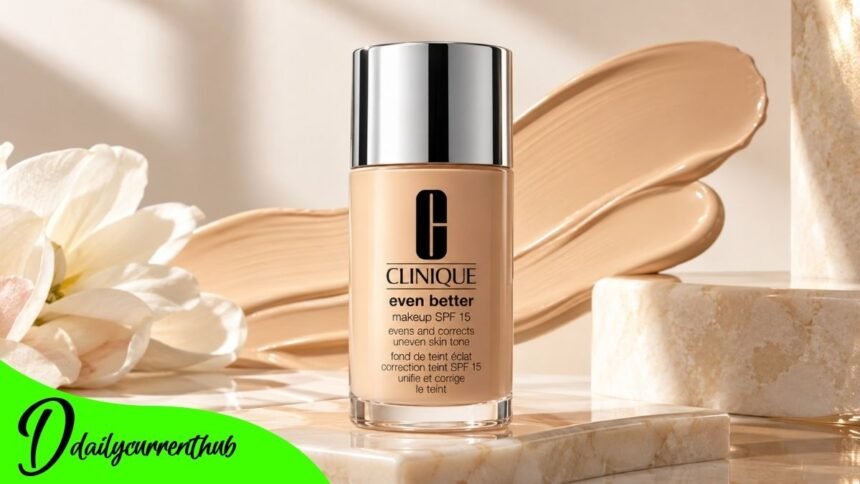
Clinique Even Better Makeup SPF 15 is a liquid foundation that delivers natural-looking coverage while addressing uneven skin tone and dark spots. Created by the established skincare and cosmetics brand Clinique, the product combines traditional foundation benefits with ingredients associated with skin-brightening care.
Unlike foundations designed for dramatic coverage, this formula focuses on balanced coverage, comfortable application, and a natural finish. Clinique describes it as a dermatologist-developed product containing vitamin C, with buildable medium coverage and a long-wearing formula.
Its SPF 15 rating adds sun protection, though it shouldn’t replace a dedicated sunscreen. Understanding that distinction is particularly useful for people concerned about pigmentation and everyday UV exposure.
This article examines the foundation’s ingredients, coverage, shade selection, skincare claims, application methods, and suitability for different skin types, using published product information and dermatological guidance.
What Is Clinique Even Better Makeup SPF 15?
Clinique Even Better Makeup SPF 15 is a dermatologist-developed foundation intended to improve the appearance of the complexion through makeup coverage while offering additional skincare benefits. It belongs to Clinique’s Even Better collection, which focuses on issues such as uneven pigmentation and visible discoloration.
The product combines foundation pigments with a lightweight, creamy base. Its medium coverage is designed to make skin-tone irregularities less noticeable without the look typically associated with heavier, full-coverage makeup.
Clinique also promotes the foundation’s vitamin C ingredients as part of its approach to improving the appearance of dark spots over time. This separates its positioning from conventional foundations that make no claims beyond immediate cosmetic coverage.
Its appeal lies in that combination: a natural-looking finish, an established skincare brand, and an ingredient-led formula designed for regular use.
The Background and Purpose of the Foundation
A Foundation Designed Around Complexion Concerns
The Even Better range reflects Clinique’s approach to combining makeup with skincare-focused formulation. Rather than presenting foundation solely as a way to conceal visible differences in skin tone, the brand positions this product as a cosmetic option for people concerned about uneven-looking complexions.
Its two principal functions are different. Makeup pigments provide immediate coverage, while the vitamin C formulation is intended to support visible improvement over continued use.
This distinction matters because foundation can temporarily disguise a dark spot without changing the underlying pigmentation. Clinique’s longer-term claims concern the appearance of bare skin after consistent application, not simply how the complexion looks immediately after makeup is applied.
The product therefore sits between everyday foundation and skincare-infused cosmetics, though it remains makeup rather than a prescribed treatment for pigmentation disorders.
Coverage, Texture, and Natural Finish
How Medium Coverage Changes the Appearance of Skin
One of the foundation’s defining characteristics is its buildable medium coverage. This means users can begin with a light application and add more product where additional coverage is needed.
Medium coverage can help reduce the visible contrast between uneven areas, including mild redness and dark spots. However, it isn’t as opaque as a concealer, and pronounced pigmentation may remain visible.
Clinique describes the texture as lightweight and creamy, with a finish that resembles naturally even-looking skin. The product is also formulated to provide flexibility during wear, rather than creating an inflexible coating.
For everyday makeup, that balance may appeal to users who want a polished appearance without the heavier look of full-coverage foundation.
The final result still depends on preparation, application amount, surrounding skincare products, and skin condition.
Vitamin C and Skincare Ingredients
Why Vitamin C Is Included
Vitamin C is central to the foundation’s skincare positioning. Clinique identifies it as a key ingredient associated with a brighter-looking complexion.
The published US ingredient list includes magnesium ascorbyl phosphate and tetrahexyldecyl ascorbate, both vitamin C forms used in cosmetic formulations.
The formula also lists glycerin, silicones, botanical extracts, and other ingredients serving different formulation functions. Glycerin is commonly used as a humectant, while silicones can improve spreadability and create a smoother cosmetic finish.
However, identifying an ingredient does not establish its concentration or guarantee a particular clinical result. The finished formula, ingredient stability, application frequency, and skin response all influence performance.
Clinique also advises checking the packaging because ingredient lists may change or differ between markets.
Dark Spots and Uneven Skin Tone
What the Published Research Actually Supports
Clinique states that the foundation visibly reduces dark spots after 12 weeks of daily use. Its US product information identifies clinical testing involving 22 women over 12 weeks.
This provides a more specific basis for the brand’s statement than an unsupported promise of instant skin transformation. Nevertheless, the published summary is limited. A study with 22 participants does not mean everyone will experience the same improvement.
There is also a difference between visibly improving pigmentation and treating the underlying cause of a diagnosed pigmentation condition.
Sun exposure, inflammation, hormones, and other factors can influence uneven pigmentation. A cosmetic foundation cannot be assumed to address all those causes.
For consumers, the practical interpretation is straightforward: this foundation offers immediate cosmetic coverage and carries a manufacturer-supported longer-term appearance claim. Individual results remain variable.
Understanding SPF 15 Protection
Can Foundation Replace Sunscreen?
The foundation contains SPF 15, adding sun protection to an otherwise cosmetic product. Clinique markets this feature as helping protect against future visible discoloration.
However, SPF 15 foundation should not be treated as a complete substitute for daily sunscreen.
The American Academy of Dermatology recommends choosing a broad-spectrum, water-resistant sunscreen with SPF 30 or higher. It also advises reapplication approximately every two hours while outdoors, and after swimming or sweating.
Another practical consideration is how much to apply. People often use relatively small amounts of foundation to achieve their preferred look, which may not provide the labeled level of sun protection.
A suitable routine is to apply a dedicated broad-spectrum SPF 30+ sunscreen in the recommended amount, then apply foundation once the sunscreen has settled.
This is especially relevant when trying to prevent pigmentation from becoming more noticeable.
Long-Wearing Formula and Daily Performance
Understanding the 24-Hour Wear Claim
Clinique advertises up to 24 hours of color-true wear, alongside resistance to caking, streaking, and settling. The brand also describes the formula as sweat- and humidity-resistant.
These are manufacturer performance claims, not guarantees that every application will remain unchanged for 24 hours.
Real-world wear can be influenced by sebum production, facial movement, environmental humidity, skincare layering, and how much foundation is applied.
A long-wearing formula may help during long workdays or events, especially when frequent touch-ups are inconvenient. However, you should still remove makeup thoroughly at the end of the day.
Don’t confuse advertised humidity resistance with a water-resistance claim for sunscreen protection.
Skin Type Compatibility
Which Skin Types Are Best Suited?
Clinique specifically identifies dry, combination, and combination oily skin as suitable for this foundation. The formula’s advertised hydrating properties and natural finish support its intended compatibility with these skin types.
People with dry areas may benefit from moisturizing before application, while those with oilier areas may prefer lighter skincare underneath or a small amount of setting powder.
The foundation is fragrance-free and dermatologist-tested, ophthalmologist-tested, and allergy-tested. These characteristics may be relevant to consumers who prefer makeup without added fragrance.
Nevertheless, fragrance-free doesn’t mean no ingredient can irritate. Anyone with a known cosmetic allergy should inspect the ingredient list and consider patch-testing a new product.
For very oily or very dry skin, the manufacturer’s recommendations should be considered alongside individual preferences and how the product behaves during wear.
Shade Range and Color Matching
Finding the Right Foundation Shade
Shade selection strongly influences whether medium-coverage foundation looks natural. A suitable match should work with both complexion depth and undertone.
Clinique’s US website lists 50 shades, while its UK website lists 39. Availability therefore depends on the market.
Listed shades include CN 10 Alabaster, CN 28 Ivory, CN 40 Cream Chamois, WN 46 Golden Neutral, WN 100 Deep Honey, and CN 127 Truffle.
Clinique offers a virtual shade-finding tool and recommends professional shade matching at its beauty counters.
When choosing a foundation, compare the color along the jawline in natural daylight to see whether it blends with both the face and neck. It is also worth allowing the product to settle before judging the match.
The foundation is marketed with color-true pigments intended to minimize visible color changes during wear.
How to Apply Clinique Even Better Makeup SPF 15
Preparing the Skin for Application
Good foundation application begins with suitable skincare preparation. Clean skin, an appropriate moisturizer, and a dedicated sunscreen can help create a comfortable base.
After skincare has settled, apply a small amount of foundation to the center of the face and blend outward. This follows Clinique’s published application directions.
A clean makeup sponge, foundation brush, or fingertips may be used according to personal preference. Layer additional product over areas needing more coverage, rather than applying a thick layer across the entire face at once.
For a natural finish, blend evenly around the nose, jawline, and hairline. Allowing each thin layer to settle helps assess whether more foundation is needed.
If you prefer setting powder, apply it selectively rather than covering the entire face. The goal is to retain the product’s intended natural appearance.
Finally, remove makeup thoroughly using an appropriate cleanser or makeup remover. Clinique specifically recommends removing the foundation with one of its makeup removers.
Benefits and Limitations
A Balanced Assessment of the Formula
Based on published product information, the foundation’s main strengths are its buildable medium coverage, natural finish, vitamin C formula, fragrance-free status, and extensive shade selection.
This combination may appeal to someone seeking everyday makeup that addresses uneven skin tone without a fully opaque finish.
However, several limitations deserve equal attention.
SPF 15 falls below the SPF 30 minimum dermatologists recommend for a dedicated sunscreen. The vitamin C-related pigmentation claims should be interpreted in light of the relatively small clinical study cited by Clinique. The advertised 24-hour wear also does not predict identical results for every skin type.
Finally, shoppers seeking very full coverage or a distinctly matte finish may prefer another foundation.
For these reasons, the product is best evaluated as a skincare-infused, natural-finish foundation rather than a replacement for sunscreen or targeted medical skincare.
Conclusion
Clinique Even Better Makeup SPF 15 combines conventional foundation coverage with a skincare-oriented formulation. Its medium coverage, natural finish, vitamin C ingredients, and broad shade selection give it a clear place among complexion products intended for everyday wear.
The foundation’s primary immediate benefit is cosmetic: it helps create a more even-looking complexion. Clinique also reports visible improvement in dark spots after continued use, supported by a limited clinical testing summary.
Its SPF 15 adds another consideration, but consumers should still use a dedicated broad-spectrum sunscreen with SPF 30 or higher for everyday sun protection.
Ultimately, this product suits people who prioritize comfortable, natural-looking medium coverage and want a foundation with vitamin C. Choosing the right shade, applying it carefully, and keeping expectations realistic are key to getting the most from its published benefits.
(FAQs)
1. What is Clinique Even Better Makeup SPF 15 used for?
It is a liquid foundation that provides medium coverage, evens out your complexion, and helps reduce the appearance of dark spots over time.
2. Is Clinique Even Better Makeup SPF 15 suitable for oily skin?
Clinique recommends it for dry, combination, and combination oily skin. People with very oily skin may prefer different finishes and wear.
3. Does the foundation provide full coverage?
No. Clinique describes it as offering buildable medium coverage with a natural finish.
4. Does it contain vitamin C?
Yes. The formula includes vitamin C ingredients, including derivatives listed in Clinique’s published ingredient information.
5. Can it help reduce dark spots?
Clinique reports visible improvement after 12 weeks of daily use, based on clinical testing involving 22 women. Results may vary.
6. Is SPF 15 enough for daily sun protection?
It is below the SPF 30 minimum recommended by the American Academy of Dermatology. A dedicated broad-spectrum SPF 30+ sunscreen is recommended.
7. Is the foundation fragrance-free?
Yes. Clinique identifies this foundation as 100% fragrance-free. Consumers with specific sensitivities should still review the full ingredient list.
8. How many shades are available?
Clinique lists 50 shades on its US website and 39 on its UK website. The exact selection depends on the region and retailer.