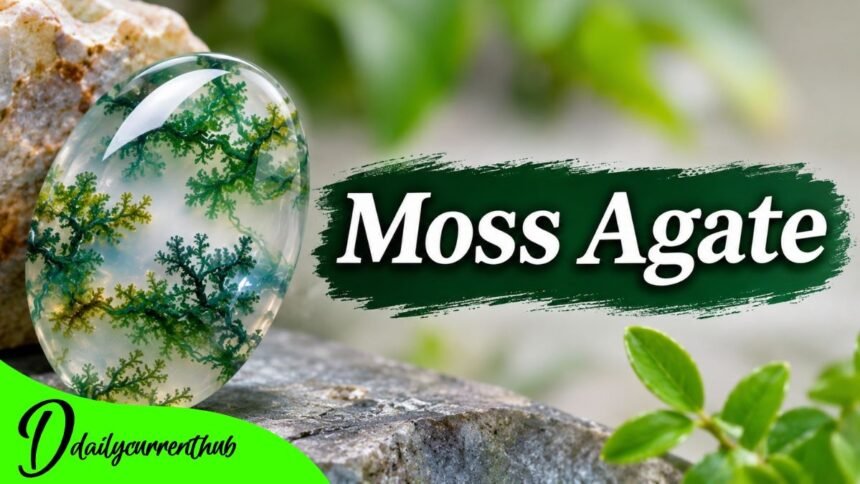
Moss Agate is a distinctive gemstone celebrated for its intricate green, brown, and black markings, which resemble miniature forests, moss, or delicate branches suspended inside a stone. Unlike gemstones valued mainly for uniform color or exceptional transparency, Moss Agate draws attention for its naturally occurring mineral inclusions. Each specimen can display a different arrangement, giving the material a remarkable range of appearances.
Despite its name, Moss Agate contains no actual moss or preserved vegetation. It belongs to the chalcedony family, a fine-grained form of silica associated with quartz. Its botanical-looking patterns arise from mineral substances trapped within the stone.
Collectors, jewelry designers, and mineral enthusiasts appreciate Moss Agate for its natural beauty and geological character.
This article examines what Moss Agate is, how it forms, where it occurs, what makes it distinctive, and how to identify, purchase, and care for it responsibly.
What Is Moss Agate?
Moss Agate is an ornamental variety of chalcedony distinguished by mineral inclusions that create natural patterns resembling moss, plants, trees, or miniature landscapes.
Chalcedony consists of extremely fine intergrowths of silica minerals. In Moss Agate, this fine-grained host material provides a contrasting background that makes darker or greener inclusions stand out.
The term agate usually refers to chalcedony with recognizable banding. Moss Agate, however, often lacks the concentric bands associated with conventional agates. Its widely accepted gemstone name reflects its visual character rather than a strict requirement for banding.
The stone’s unusual appearance explains its appeal in jewelry and lapidary work. Instead of removing every visible inclusion, a cutter may deliberately preserve and highlight the markings.
Consequently, patterns that might be considered imperfections in other gemstones become Moss Agate’s most recognizable feature.
The Hidden Interior of Moss Agate
Moss Agate’s appeal often becomes apparent when the stone is cut and polished.
An unworked specimen may have an uneven exterior that reveals relatively little about the patterns inside. Cutting exposes the relationship between the chalcedony and its mineral inclusions, while polishing makes many details easier to see.
Some stones contain delicate, widely separated strands. Others feature dense clusters of green material that resemble vegetation. Branching black formations can look like tree silhouettes against a pale background.
Transparency also changes the viewing experience. In translucent specimens, inclusions may appear suspended at different depths, producing a layered effect.
These characteristics are geological, not botanical. The marks are not tiny plants, preserved forests, or evidence of ancient organic growth.
They are mineral features whose shapes happen to resemble natural landscapes.
Geological Origins and Formation of Moss Agate
Moss Agate develops through geological processes involving silica-rich fluids and mineral deposition.
Silica can accumulate in openings within rocks, including cavities, fractures, and other available spaces. Under suitable conditions, dissolved silica is deposited as fine-grained chalcedony.
Mineral inclusions may become enclosed within the developing material or occur along openings and surfaces associated with the stone’s formation.
The exact sequence depends on the geological environment and the minerals involved. Consequently, not every Moss Agate specimen forms through an identical process.
Its patterns offer clues about the interaction between silica and other minerals.
Branching structures, for example, can form when mineral-rich solutions deposit material along small pathways. These structures are known as dendrites because their shapes resemble branching trees.
Understanding this process changes how the gemstone is appreciated. Its unusual markings are records of mineral formation and deposition rather than illustrations created by living organisms.
Moss Agate’s Relationship with Quartz and Chalcedony
Moss Agate belongs to the broader quartz mineral family.
Quartz is composed of silicon dioxide, represented by the chemical formula SiO₂. Chalcedony is a fine-grained silica material associated with quartz, and several familiar ornamental stones belong to this group.
These include carnelian, onyx, and different forms of agate.
Moss Agate is distinguished by the character of its inclusions.
Traditional banded agate attracts attention through repeated layers of contrasting colors. Moss Agate is recognized primarily through irregular, moss-like patterns.
Dendritic agate is closely related, although the term often describes material dominated by branching brown or black inclusions.
These names can overlap in commercial use. Sellers don’t always apply gemstone terminology consistently, so the underlying mineral identity matters more than a decorative trade name.
The Role of Mineral Inclusions
The inclusions inside Moss Agate are central to its appearance.
Green patterns are commonly associated with chlorite-group minerals or amphiboles, including hornblende. These minerals can create fine strands, cloudy patches, or dense moss-like formations.
Iron-bearing substances may produce reddish or brownish patterns, while manganese oxides can generate darker markings.
The exact composition cannot always be established by color alone.
Two visually similar stones may contain different inclusion minerals, and laboratory testing may be necessary to identify particular substances confidently.
This distinction matters because descriptions such as “green moss” are visual comparisons rather than precise mineralogical identifications.
The inclusions also explain Moss Agate’s wide variation. Their arrangement, concentration, and color can differ substantially across specimens.
For gem cutters, this variation presents both an opportunity and a challenge: the most attractive polishing orientation may depend on how the inclusions sit within the rough stone.
Natural Colors, Patterns, and Varieties
Although Moss Agate is strongly associated with green, its appearance is not limited to a single color.
Many specimens have clear, milky-white, or greyish backgrounds decorated with green markings. Others contain contrasting brown, reddish, or black features.
Some patterns resemble fern leaves or fine branches. Others produce clouds, patches, or flowing shapes.
Inclusions may be concentrated in one section of a gemstone or distributed across its entire surface.
A particularly attractive specimen may combine several features: translucency, clear pattern separation, pleasing color contrast, and a polished finish that reveals the internal structure.
No universal rule requires every stone to display a particular shade of green or a particular arrangement of markings.
That variability is part of Moss Agate’s identity as a natural gemstone.
Where Is Moss Agate Found?
Moss Agate has been documented in several parts of the world.
Mineralogical locality records include occurrences in India, notably in Gujarat and Maharashtra. The broader category of moss-patterned agates is also associated with the United States.
Montana Moss Agate is a familiar American example, particularly associated with the Yellowstone River Basin. It commonly shows darker dendritic markings and may look different from green-inclusion Moss Agate.
These regional distinctions demonstrate why provenance can be useful when describing a gemstone.
However, a specimen’s country of origin should not be assumed from its color or pattern.
A seller’s geographical description becomes more reliable when supported by documented sourcing information.
Natural appearances can overlap across regions, making visual identification of a precise mining locality uncertain without additional evidence.
Cultural Meaning and Symbolism
Moss Agate has become associated with nature-themed symbolism, particularly growth, renewal, stability, and balance.
Its visual resemblance to vegetation helps explain these associations. Green mineral patterns naturally invite comparisons with gardens, forests, and living landscapes.
In contemporary crystal traditions, Moss Agate is sometimes described as a stone of personal growth or emotional balance.
These interpretations belong to cultural and spiritual practices rather than established mineralogical science.
No reliable clinical evidence shows that carrying or wearing Moss Agate treats medical conditions, improves circulation, or independently produces psychological or financial benefits.
Its documented value lies in its physical properties, decorative potential, and significance to collectors.
People may still appreciate the gemstone as a personal symbol of nature or renewal without treating symbolic beliefs as scientific facts.
Moss Agate in Jewelry and Decorative Design
Moss Agate is used in rings, pendants, earrings, bracelets, beads, and carved decorative objects.
Cabochon cutting is particularly suitable for this gemstone. A cabochon has a smooth, polished surface, often with a rounded top, that can make internal patterns easier to appreciate.
Other examples include polished freeform shapes and ornamental carvings.
Its hardness of approximately 6.5–7 on the Mohs scale provides reasonable resistance to ordinary scratching, although hardness should not be confused with resistance to breaking.
A sharp impact may still chip or fracture a gemstone.
For frequently worn rings, protective settings can reduce exposure to accidental knocks. Pendants and earrings generally encounter less direct surface contact during everyday use.
The best design depends on the stone’s dimensions, visible inclusions, and intended purpose.
The Importance of Origin and Gemstone Identification
Identifying Moss Agate involves more than recognizing green markings.
A buyer should consider the underlying chalcedony, the distribution of inclusions, and any signs of artificial treatment.
Natural stones can vary widely. Some display subtle patterns, while others have unusually intense color contrasts.
A highly decorative appearance does not automatically prove that a stone has been dyed or artificially produced. Equally, an attractive photograph is not sufficient evidence of natural origin.
Gemological testing may help determine whether a specimen is chalcedony, while microscopic observations can help evaluate inclusions and possible treatments.
For valuable purchases, sellers should clearly disclose known enhancements and avoid unsupported claims about origin or rarity.
Responsible purchasing also means asking about traceability when the material’s source matters.
A convincing gemstone description should distinguish between what has been documented and what has merely been assumed.
Public Curiosity and Common Misconceptions About Moss Agate
Several misconceptions surround Moss Agate, largely because of its unusual appearance and name.
The most obvious is the belief that it contains living or fossilized moss. The patterns are mineral inclusions and do not constitute preserved plants.
Another misconception is that every Moss Agate must be green. Although green markings are characteristic of many examples, brown, reddish, and black inclusions also occur.
The name can also create confusion about banding. Many Moss Agate specimens do not show the regular bands associated with classic agate.
Some commercial descriptions further exaggerate the gemstone’s properties by promising physical healing, guaranteed prosperity, or specific emotional outcomes.
Such claims should not be confused with established evidence.
Understanding these distinctions helps consumers appreciate Moss Agate without relying on inaccurate geological or medical claims.
How to Choose Quality Moss Agate
Selecting Moss Agate largely comes down to the balance between natural patterns and artistry.
Pattern visibility is a useful starting point. Distinct inclusions that contrast clearly with the surrounding chalcedony can create an especially appealing appearance.
Transparency may increase the sense of depth, although more opaque stones can also have attractive designs.
Buyers should inspect the polished surface for scratches, chips, unwanted cracks, and uneven finishing.
Cut orientation is another consideration. A well-positioned cabochon can display the stone’s most distinctive markings without unnecessarily obscuring them.
Size alone does not determine quality. A smaller stone with a striking pattern may be more appealing than a larger specimen with poorly defined inclusions.
Moss Agate does not have a universally applied grading system comparable to the established grading framework used for diamonds.
Descriptions such as premium or collector quality therefore need supporting details rather than relying on marketing language.
Cleaning and Long-Term Care
Moss Agate is relatively durable for a decorative gemstone, but sensible handling helps preserve its appearance.
Warm water, mild soap, and a soft cloth or brush are practical choices for routine cleaning. After washing, rinse the gemstone carefully and dry it with a clean, soft cloth.
Harsh chemicals and abrasive cleaning products should be avoided.
If the stone has known treatments, fractures, or a delicate mounting, additional care may be required. Seek professional advice before using ultrasonic or steam-cleaning equipment.
Jewelry storage also matters.
Keeping Moss Agate separate from harder gemstones can reduce accidental surface scratching. A fabric-lined compartment or soft pouch provides convenient protection.
Although the material is reasonably resistant to ordinary wear, it should not be exposed unnecessarily to strong impacts.
These simple measures help maintain the polished surface and the visibility of its natural patterns.
Legacy and Future of Moss Agate
Moss Agate occupies an interesting place between mineral collecting, decorative craftsmanship, and personal symbolism.
Its beauty does not depend on exceptional transparency or the brilliant sparkle associated with traditionally faceted gemstones.
Instead, its character emerges from mineral inclusions that record aspects of the stone’s geological history.
This makes each specimen an opportunity to observe natural variations in silica and associated minerals.
Gem cutters can emphasize different features through their choice of shape, orientation, and polishing technique, transforming the same material into contrasting decorative designs.
The gemstone’s continuing relevance also highlights the importance of clear trade descriptions, responsible sourcing, and accurate mineral identification.
For collectors and jewelry enthusiasts, Moss Agate offers something straightforward but distinctive: natural patterns that reward close observation.
Conclusion
Moss Agate is a captivating example of how geological processes can produce forms that resemble familiar landscapes. Its delicate branching structures and moss-like inclusions create the appearance of miniature natural scenes within chalcedony.
As a member of the quartz family, it combines recognizable physical properties with considerable visual variation. The mineral inclusions responsible for its appearance distinguish it from many conventional agates and explain its appeal to collectors, lapidary artists, and jewelry designers.
Understanding Moss Agate also requires separating scientific evidence from popular misconceptions. Its markings are mineral structures, not fossilized plants, and its symbolic associations should not be mistaken for proven therapeutic effects.
Whether displayed as a mineral specimen, fashioned into jewelry, or appreciated as a decorative object, Moss Agate demonstrates that distinctive beauty can emerge from the interaction of ordinary geological materials.
Its lasting appeal lies in that combination of natural complexity, individual variation, and craftsmanship.
(FAQs)
1. What is Moss Agate made of?
Moss Agate consists primarily of chalcedony, a fine-grained silica material associated with quartz. Its chemical composition is mainly silicon dioxide (SiO₂), with additional mineral inclusions that create its patterns.
2. Does Moss Agate contain real moss?
No. Moss Agate does not contain actual moss or preserved plants. The moss-like formations are natural mineral inclusions.
3. What gives Moss Agate its green color?
Green markings commonly arise from inclusions of chlorite-group minerals or amphiboles such as hornblende.
4. Is Moss Agate a type of quartz?
Yes. Moss Agate belongs to the chalcedony group within the quartz mineral family.
5. How hard is Moss Agate?
Moss Agate generally measures approximately 6.5–7 on the Mohs hardness scale, making it reasonably resistant to scratching but not immune to chipping or breakage.
6. Where can Moss Agate be found?
Documented occurrences include locations in India and other countries. Related moss-patterned agates, including Montana Moss Agate, are also found in the United States.
7. Does Moss Agate have scientifically proven healing powers?
No reliable clinical evidence establishes that Moss Agate can treat illnesses or produce specific physical healing effects. Its associations with growth and balance are symbolic or spiritual beliefs.
8. How should Moss Agate jewelry be cleaned?
Use mild soap, warm water, and a soft cloth or brush. Avoid abrasive materials, harsh chemicals, and unnecessary impacts. Consult a jeweler when the stone has treatments or a delicate setting.