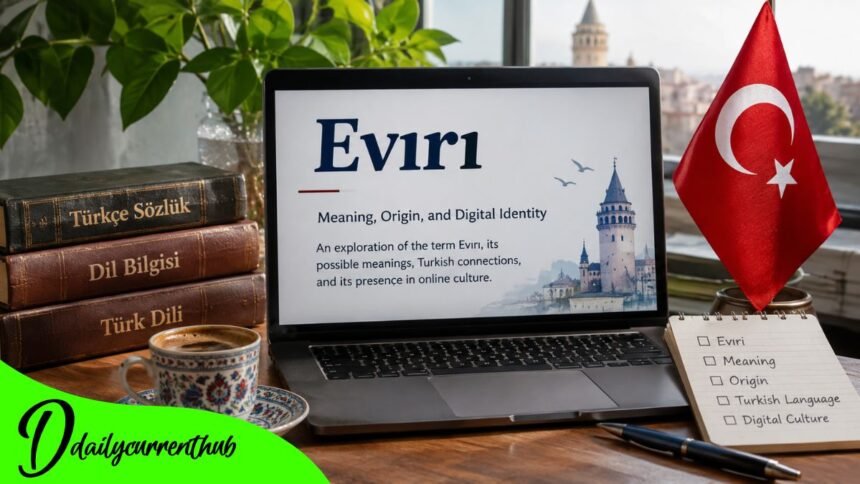
Evırı is an unusual expression that has attracted attention across online articles and search results. Its distinctive spelling, particularly the Turkish dotless letter ı, makes it look like a word with a specific linguistic or cultural background. Yet understanding its meaning is more complicated than its appearance suggests.
Some websites associate Evırı with unity, transformation, and belonging. Others connect it to translation, creative branding, or alternative spellings of familiar words. These explanations are not equally supported by reliable linguistic evidence.
Unlike a documented public figure with an established biography, Evırı has not been reliably identified as a particular person with a publicly confirmed career, family, or personal history.
This article examines what can reasonably be established about Evırı, the genuine Turkish vocabulary it resembles, and the reasons an unfamiliar expression can become a subject of online curiosity. It also separates verifiable information from interpretations that require further evidence.
What Is Evırı?
Evırı is best understood as an ambiguous expression appearing in online discussions about language, meaning, and unusual terminology.
Its spelling raises questions because it resembles genuine Turkish vocabulary but does not clearly correspond to a verified standard dictionary entry.
Some online explanations present Evırı as a symbolic concept, while others treat it as a spelling variation or an invented expression. Such interpretations should be understood as claims made by individual publishers rather than established linguistic definitions.
There is also no reliable basis for assigning Evırı a specific personal biography. A search term appearing on multiple websites does not establish that it represents a real individual.
The most useful approach is therefore to examine the expression itself: its spelling, similarities to established words, possible contexts, and the reliability of information published about it.
This distinction allows readers to understand Evırı without confusing online popularity with documented historical or cultural significance.
Understanding the Linguistic Background of Evırı
The Distinctive Spelling of Evırı
One of Evırı’s most recognizable features is its use of the letter ı, commonly known in English as the dotless i.
This is not simply a decorative variation of the ordinary English letter i. In Turkish, dotted and dotless forms represent different letters.
The Turkish alphabet contains 29 letters, including both i and ı. Their distinction matters in spelling, pronunciation, and word recognition.
Consequently, replacing the letters in Evırı with ordinary English characters does not necessarily preserve the intended form.
Its appearance suggests a possible connection to Turkish orthography, but spelling alone cannot establish its Origin.
A newly created username, product name, or online expression can incorporate characters from another language without adopting that language’s established vocabulary.
Recognizing this difference is essential when researching unfamiliar terms.
Evırı and Genuine Turkish Vocabulary
Evırı resembles several existing Turkish expressions, but visual similarity does not prove that they share a meaning.
One relevant example is çeviri, the established Turkish word for translation. It is used to discuss converting written or spoken content from one language into another.
Another relevant expression is evrilmek, a Turkish verb describing a natural transition from one form into another.
These words have recognizable linguistic functions. By comparison, evırı lacks a similarly established definition in the evidence reviewed.
That does not mean every use of the expression is meaningless. A particular writer or organization may use an unfamiliar spelling with a clearly intended meaning.
However, that private or contextual interpretation should not be presented as a universally recognized Turkish definition.
Evırı and Its Possible Meaning in Online Communication
Why Evırı Is Sometimes Connected to Translation
The connection between Evırı and translation largely comes from its resemblance to çeviri.
Someone unfamiliar with Turkish characters might confuse the two spellings or encounter them while searching for translation-related information.
However, they are not interchangeable in standard Turkish.
The word çeviri has an established meaning, while Evırı has no verified equivalent.
For anyone discussing language translation professionally, using the recognized Turkish term avoids unnecessary confusion.
This distinction matters most in educational writing, translated documents, and digital publishing, where a small spelling difference can affect an explanation’s accuracy.
Is Evırı Related to the English Word Every?
Some online explanations compare Evırı with the English word “every.”
The resemblance is clear, but it does not confirm a linguistic relationship.
In English, every is a determiner that refers to all members of a group individually.
Evırı is not a recognized standard English spelling of that word.
If someone encounters Evırı in a sentence that clearly requires the word every, a spelling variation may be one possible explanation.
Nevertheless, the surrounding sentence must support that interpretation.
A resemblance between two words is a starting point for investigation, not sufficient proof of their shared meaning or historical development.
Evırı in Modern Digital Culture
How Unfamiliar Expressions Become Searchable Topics
Search engines have made unusual expressions easier to discover and discuss.
When an unfamiliar keyword appears in online content, readers may investigate it to understand its meaning. Publishers may then create explanatory articles addressing those searches.
Evırı shows how a term can develop an online presence even when its exact definition remains uncertain.
Articles discussing the expression do not necessarily establish where it originated or how widely people use it in everyday communication.
A meaningful distinction exists between appearing in search results and having a documented place in a language.
Search visibility can demonstrate that content about an expression exists. It cannot, on its own, confirm a traditional meaning, cultural history, or recognized linguistic status.
The Role of Digital Identity and Creative Naming
Unusual spellings are also common in digital naming.
Businesses, creative projects, and individual account holders sometimes adopt distinctive words to differentiate themselves from existing names.
A term such as Evırı could function as a creative identifier in a particular context, but any actual brand, account, or commercial connection would need independent confirmation.
If the expression appears as a username, readers should investigate the specific account rather than assume that information published about the keyword refers to the account holder.
This is especially relevant to biographical writing.
A username does not automatically reveal someone’s legal name, nationality, marriage, family relationships, or professional background.
Respecting that distinction protects both factual accuracy and individual privacy.
Common Misconceptions About Evırı
Does Evırı Represent Unity or Togetherness?
Some online articles describe Evırı as a concept associated with unity, belonging, harmony, or shared experience.
These descriptions may sound culturally meaningful, but their historical and linguistic foundations require scrutiny.
A recognized cultural expression should ideally be supported by reliable dictionaries, documented historical usage, published linguistic research, or evidence from the communities using it.
Without that support, describing Evırı as an established traditional concept would go beyond the available evidence.
The values of unity and hospitality certainly exist across many cultures, including Turkish society.
That broader cultural reality, however, does not demonstrate that Evırı is a recognized name for those values.
The safest distinction is between an interpretation that someone has proposed and a definition that has been independently verified.
Why Repeated Claims Are Not Always Reliable
Information can appear convincing when several websites repeat similar explanations.
Yet repetition alone does not establish accuracy.
An article may reproduce a definition from another website without examining whether the original explanation came from a credible dictionary or linguistic study.
Subsequent articles can then repeat the same information, creating an impression of widespread agreement.
For an unusual expression such as Evırı, identifying the original evidence matters more than counting how many articles make the claim.
This principle applies beyond language research. It matters just as much when examining biographies, historical events, business information, and public figures.
Trustworthy writing should distinguish an independently documented fact from an unsupported assertion that has circulated online.
Why Evırı Should Not Be Treated as an Unverified Biography
The Importance of Confirming Personal Identity
An uncommon keyword can sometimes resemble a person’s name, nickname, or social media identity.
Nevertheless, a responsible biography requires more than a searchable phrase.
A writer should establish the subject’s identity through credible public records, authentic interviews, official profiles, or other reliable material.
Personal details such as age, birthplace, education, employment, spouse, and children require their own verification.
In the case of Evırı, the reviewed evidence does not identify a specific person whose background can responsibly be documented.
It would therefore be misleading to invent a marriage, professional achievements, family history, or relationship with a public figure.
When identity is uncertain, examining the keyword’s documented usage is more informative than presenting assumptions as biography.
Privacy and the Limits of Public Curiosity
Privacy is an essential consideration when researching unfamiliar names.
A person may use a pseudonym or online identifier without disclosing their private circumstances.
Public curiosity does not create reliable evidence, nor does it justify revealing or guessing intimate personal details.
If Evırı is used by a private account holder, their identity and relationships should not be inferred from the spelling alone.
This principle protects individuals against mistaken identification while helping publishers maintain credibility.
Good biographical research begins with verification, not with constructing a personal narrative around a keyword.
How to Interpret Evırı Correctly
Look at the Context Before Assigning a Meaning
The most reliable way to understand Evırı is to examine where it appears.
In a discussion about multilingual documents, a writer may be referring to translation-related terminology.
In a conversation about names or branding, the expression may be functioning as a distinctive identifier.
If it appears in a sentence that otherwise uses English, the surrounding grammar may reveal whether a spelling variation is involved.
These are possibilities to investigate, not predetermined definitions.
Readers should also preserve the exact spelling when searching because Turkish dotted and dotless letters are not identical.
Comparing the source with reliable language references can help determine whether the term has been confused with another word.
A Practical Method for Checking Unfamiliar Words
Effective language research starts with identifying the exact written form.
Next, readers can consult established dictionaries and language institutions instead of relying entirely on secondary online articles.
For Turkish vocabulary, the Turkish Language Association is an important reference.
If a claimed meaning is cultural or historical, additional evidence from recognized scholarly research may be necessary.
If the expression belongs to a brand or online creator, an authentic statement from its owner provides a stronger basis for understanding the intended name.
When these checks cannot establish a meaning, the most accurate conclusion is that the interpretation remains uncertain.
This method is more useful than assigning an attractive definition that lacks supporting evidence.
The Future of Evırı in Online Language
Language changes as people develop new ways to communicate.
Words can emerge through creative writing, popular culture, technology, regional usage, and repeated communication within particular communities.
However, not every unfamiliar expression becomes an established word.
For Evırı, its future significance depends on whether identifiable communities, publishers, or creators adopt it with a consistent meaning.
Reliable evidence of such usage would provide a stronger foundation for defining the expression.
Until then, Evırı remains an example of the challenges involved in interpreting unusual online terminology.
Its case illustrates why modern language research must consider both the flexibility of digital communication and the importance of established evidence.
Conclusion
Evırı is a distinctive online expression whose exact meaning and Origin have not been conclusively established through reliable linguistic evidence.
Its Turkish-style spelling creates understandable comparisons with words such as çeviri and evrilmek, but those similarities do not prove that Evırı has the same meaning.
Online descriptions connecting it to unity, transformation, or cultural traditions should be treated carefully unless supported by credible sources.
The available evidence also does not establish Evırı as a particular private individual or provide grounds for a personal biography.
What makes the expression worth examining is the larger question it raises about language in the digital age.
Search visibility, repeated articles, and unusual spellings can create curiosity, but they cannot replace genuine documentation.
For readers and publishers alike, the most responsible approach is to investigate context, preserve accurate spelling, and distinguish facts from interpretations.
That approach offers a clearer understanding of Evırı without inventing a history.
(FAQs)
1. What does Evırı mean?
Evırı does not have a single verified, universally accepted meaning. Its interpretation depends on the context in which the expression appears.
2. Is Evırı a genuine Turkish word?
The spelling resembles Turkish vocabulary, but the exact form has not been verified as an established standard Turkish dictionary word in the sources reviewed.
3. Is Evırı the same as çeviri?
No. Çeviri is the established Turkish word for translation. Evırı has a different spelling and no confirmed equivalent definition.
4. Is Evırı a person’s name?
No specific individual has been reliably identified from the keyword alone. It should not be treated as a documented personal biography without further evidence.
5. Does Evırı mean unity or harmony?
Some websites associate it with these ideas, but the claims lack sufficiently established linguistic or historical support.
6. Why does Evırı contain the letter ı?
The character ı is part of the Turkish alphabet. Its presence suggests a Turkish spelling influence but does not conclusively establish the expression’s Origin.
7. Can Evırı be used as a brand or username?
It could be adopted as a distinctive name, subject to relevant naming and trademark considerations. A specific owner or organization would need to be verified independently.
8. What is the best way to understand Evırı?
Examine its original context, compare similar words, consult authoritative linguistic resources, and avoid treating unsupported online definitions as facts.