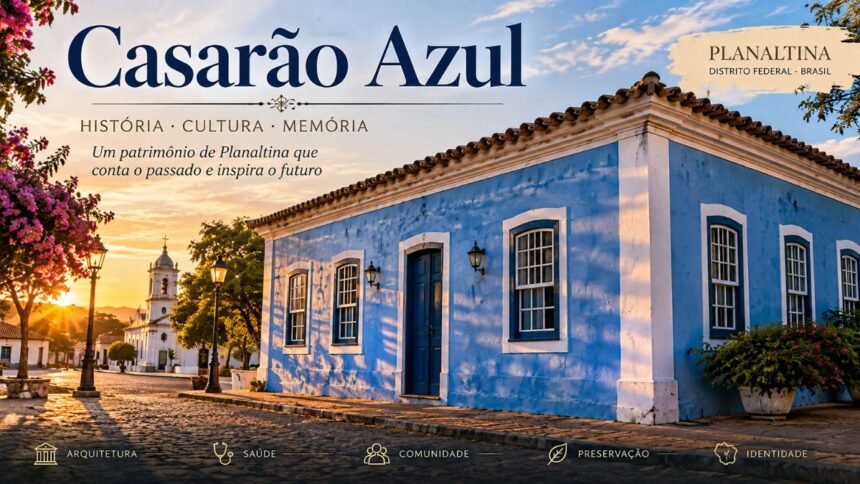
Casarãophysician’s e of Memory. The historic buildings associated with Planaltina’s central area, in Brazil’s Federal District. Far more than a house distinguished by its blue façade, it forms part of a streetscape that preserves evidence of Planaltina’s development before Brasília became the national capital. That difference matters: the surviving evidence suggests the house developed through different construction phases rather than appearing in its present form at one precise moment.
Its historical importance is also linked to physician and politician Hosanah de Campos Guimarães. This Planaltina native became a prominent doctor, mayor of Planaltina, vice-governor, and governor of Goiás. Research on Planaltina identifies Casarão Azul as a former residence and medical consulting space associated with him.
This article examines what can actually be established about Casarão Azul, separating documentary evidence from local tradition while exploring its architecture, medical history, and place in Planaltina’s cultural memory.
What Is Casarão Azul?
Casarão Azul is a historic house within Planaltina’s traditional urban area. Academic studies regularly include it among the buildings that help explain Planaltina’s identity as an older settlement, alongside landmarks such as the Historic and Artistic Museum of Planaltina and the São Sebastião Church. The Legislative Chamber of the Federal District has also referred to the blue mansion when discussing Planaltina’s important historic architecture.
Its importance comes from Planaltina’s overlapping stories. It represents an architectural transition between older Central Brazilian building practices and newer materials. It is connected with an influential local family. It is associated with medical care in a period when physicians were scarce in the region. Its changing physical condition has also become part of a wider debate about how Planaltina protects buildings that carry community memory.
The Historical Setting of Casarão Azul
Understanding Casarão Azul requires looking beyond the house itself. Planaltina existed long before Brasília’s inauguration in 1960 and was later incorporated into the Planaltina of the new Federal District.
Its older streets therefore preserve a different historical layer from Brasília’s internationally known modernist architecture. Rather than monumental government complexes, Planaltina includes houses, churches, squares, and traditional buildings tied to everyday community life.
Official descriptions of Planaltina have highlighted Casarão Azul alongside other traditional structures as evidence of this older heritage. In 2011, the Planaltina Chamber of the Federal District specifically referenced the building when describing the city’s historical architecture.
This setting gives Casarão Azul significance beyond aesthetic appearance. It helps document the urban world that existed in the region before construction of the planned capital transformed central Brazil.
Early History and Construction of Planaltina’s Azul
The dating of Casarão Azul illustrates why historical research must distinguish documentary evidence from repeated local claims.
An architectural study by Pedro Paulo Palazzo and Rubiana Cardoso Campos Lemos identifies 1926 as the attested date for construction of the façade. Their examination suggests that different parts of the property may have emerged in stages. They specifically analyzed the main house, façade, veranda, and southern annex to determine their likely chronological relationship.
A separate academic source dates Casarão Azul to 1921 and states that it served as a residence, lodging, and hospital.
These sources should not simply be combined into a false certainty. The responsible conclusion is that Casarão Azul belongs to the early decades of Brasília’s twentieth century, while the architectural evidence gives particularly strong support for 1926 for its façade.
Architecture and Building Techniques
Casarão Azul is valuable to architectural historians because its construction captures a period of technological transition.
Research indicates that the building combines a brick façade with adobe walls elsewhere in the structure. This combination matters because fired brick was becoming more common, while earth-building techniques remained widespread in the Central Plateau.
Its layout also reflects a mixture of urban and rural residential traditions. Researchers observed characteristics common to houses in Central Brazil, including circulation protected by broad roof overhangs and traditional wooden architectural elements.
The famous blue appearance is itself more complicated than the name suggests. Architectural investigation found evidence of earlier layers of lilac and green paint beneath later finishes, showing that the building’s visual identity changed over time.
Casarão Azul is therefore not a perfectly frozen historical object. Like many long-lived houses, it carries physical evidence of adaptation.
Casarão Azul and Dr. Hosanah Campos Guimarães
One of the strongest human connections in the building’s documented history is Hosanah de Campos Guimarães.
Goiás state government records say Guimarães was born in Planaltina on 31 October 1905, studied medicine in Rio de Janeiro, and graduated in 1929 before returning to Planaltina. His career later extended into politics: he served as mayor of Planaltina, vice-governor and governor of Goiás.
Research from the University of Brasília describes Casarão Azul as a former residence and medical consulting space of Dr. Hosannah Guimarães.
That association gives the building a historical role extending beyond domestic architecture. It connects a physical place with the development of professional medicine and local political leadership in Planaltina during the twentieth century.
From Residence to Medical Space
Local history reported by Correio Braziliense also identifies Casarão Azul as the residence of the physician remembered locally as Dr. Osana and reports oral accounts that the property was used as a hospital for a period. The newspaper carefully noted that much of the mansion’s story survives through oral testimony because written documentation is limited.
That distinction is crucial.
The building’s association with Hosanah Guimarães as a physician is well supported. Claims about its precise functional role at particular moments require greater caution because different sources use terms such as medical office, clinic, and hospital.
Rather than choosing the most dramatic description, the surviving evidence supports a broader conclusion: Casarão Azul was connected to the building’s medical practice in Planaltina, making it part of the community’s healthcare history as well as its architectural history.
Family and Political Connections
The Guimarães family occupied an important place in Planaltina’s regional history.
Official Goiás records identify Hosanah as the son of Salviano Monteiro Guimarães and Olívia Campos Guimarães. After earning his medical degree, he returned to his home region and combined medicine with public life.
His political significance extended beyond local government. The state biography says he supported the transfer of Brazil’s capital to the Central Plateau and hosted members of the Poli Coelho Commission on his farm in 1948 and 1949. The commission contributed to studies concerning the territory of the future Federal District.
Casarão Azul should not be portrayed as the headquarters of all those activities unless evidence specifically establishes that connection. Its importance is more precise: the house is associated with a person whose medical and political career intersects a transformative period in the region’s history.
Casarão Azul in Planaltina’s Cultural Landscape
The surrounding buildings shape Casarão Azul’s spatial meaning.
Research on Planaltina’s traditional sector places it within a broader network of historically significant streets, squares, residences, and civic structures. A 2023 academic study describes the house along Rua Salvador Coelho and identifies it as a visually prominent historic building in the traditional area.
Another heritage study includes Casarão Azul among the properties that residents consider part of Planaltina’s historical and cultural identity.
This means the mansion is valuable not simply because a notable person once lived there. HeritaPlanaltina’slectively. Streets, façades, public spaces, and neighboring buildings help residents understand how a town developed over generations.
Preservation and Community Engagement
Casarão Azul has also become part of Planaltina’s preservation debate.
In 2009, Correio Braziliense reported that a residents’ group was campaigning to protect historic structures in the city. The article described the façade of Casarão Azul as architecturally notable but poorly preserved at that time and reported discussions about restoration.
Later academic research continued to link the mansion to preservation efforts.
These sources come from different years, so they should not be read as a description of the building’s exact condition today. What they demonstrate clearly is a continuing community concern with maintaining the historic environment.
Preservation in such cases relies on restoring paint. Adobe, wood, brick, foundations, and later modifications all require informed conservation decisions.
Public Curiosity and Historical Misconceptions About Casarão Azul
The name “Casarão Azul” creates an SEO challenge because it is not unique. Brazil has hotels, restaurants, holiday properties, and other buildings carrying the same or a similar name.
That makes geographic identification essential.
The historically documented Casarão Azul discussed here is a Planaltina, Distrito Federal property connected with the traditional sector and Hosanah Campos Guimarães.
Another potential misconception concerns its age. Repeating a single construction year without qualification would ignore conflicting academic references. Stronger architectural research dates the existing façade to 1926, while other research on Planaltina’s mansion is more general.
Responsible heritage writing should respect such distinctions rather than turn uncertain history into a neat but unsupported story.
The Power of Local Memory
Casarão Azul illustrates how community history survives through several kinds of evidence.
The building itself offers evidence: materials and construction joints reveal physical changes. Academic studies and heritage inventories also provide evidence. Government records document people such as Hosanah Guimarães. Newspaper accounts of conservation campaigns. Oral testimony fills gaps that official archives do not always cover.
Each type of evidence has different strengths.
Oral history can capture memories never recorded in government documents, but it must be treated as testimony rather than unquestioned fact. Architectural analysis can reveal building phases, but it may not explain every activity that occurred inside a property.
Casarão Azul becomes especially valuable when these sources are read together.
Legacy and Future
The legacy of Casarão Azul lies in its ability to connect several histories that might otherwise be considered separately.
Architecturally, it documents the coexistence of adobe and brick construction during a period of change. Socially, it is connected with a prominent Planaltina family. Medically, it is associated with the practice of one of the region’s pioneering physicians. Politically, that physician later occupied major public offices in Goiás. Culturally, the mansion remains part of discussions about preserving Planaltina’s traditional center.
Its future significance depends as much on careful documentation as on physical conservation. Every restoration, archival discovery, and oral-history project can clarify parts of the story that remain uncertain.
Casarão Azul matters precisely because its history is layered rather than simple.
Conclusion
Casarão Azul is best understood not as an isolated blue house but as a surviving witness to Planaltina’s twentieth-century transformation.
The most reliable evidence links its present architectural development to the 1920s, including a documented 1926 façade, while scholarly sources also support an earlier 1921 date. Its adobe and brick construction records changing building practices, and its association with physician and politician Hosanah Campos Guimarães links the property to Planaltina’s medical and civic history.
Just as important is the community effort surrounding the building. Preservation advocates, historians, and researchers have treated Casarão Azul as part of a larger historic landscape whose value rests in collective memory.
The most compelling story here does not require speculation. The documented history is already substantial: Casarão Azul represents architecture, healthcare, family history, and the preservation of a Planaltina that existed before Brasília reshaped the Centro-Sul region.
FAQs
1. What is Casarão Azul?
Casarão Azul is a historic building in the traditional sector of Planaltina, Distrito Federal, Brazil. It appears in academic research concerning Planaltina’s architectural and cultural heritage.
2. Where is Casarão Azul located?
Historical and academic sources place it in Planaltina’s traditional urban area, with research identifying it along Avenida/Rua Salvador Coelho.
3. When was Casarão Azul built?
The precise dating requires qualification. Architectural research documents its façade in 1926, while another academic source dates the property to 1921.
4. Who lived in Casarão APlanaltina? A Planaltina associate links the building with physician and politician Hosanah Campos Guimarães, describing it as a former residence and medical consulting space connected with him.
5. Who was Hosanah Campos Guimarães?
He was a Planaltina-born physician who later served as mayor of Planaltina, vice-governor, and governor of Goiás. He graduated in medicine in Rio de Janeiro in 1929.
6. Was Casarão Azul Planaltina’s hospital?
Some historical and academic accounts report hospital or medical use. The most firmly supported point is that the property was connected to Hosanah Guimarães’s medical practice; descriptions of its exact institutional status vary by source.
7. Why is Casarão Azul historically important?
Its significance comes from its historic architecture, its combination of adobe and brick construction, its connection to Hosanah Guimarães, and its role in Planaltina’s cultural memory.
8. Is Casarão Azul part of preservation efforts?
Yes. Published reporting and academic research document community concern and preservation initiatives involving Casarão Azul and other historic buildings in Planaltina.