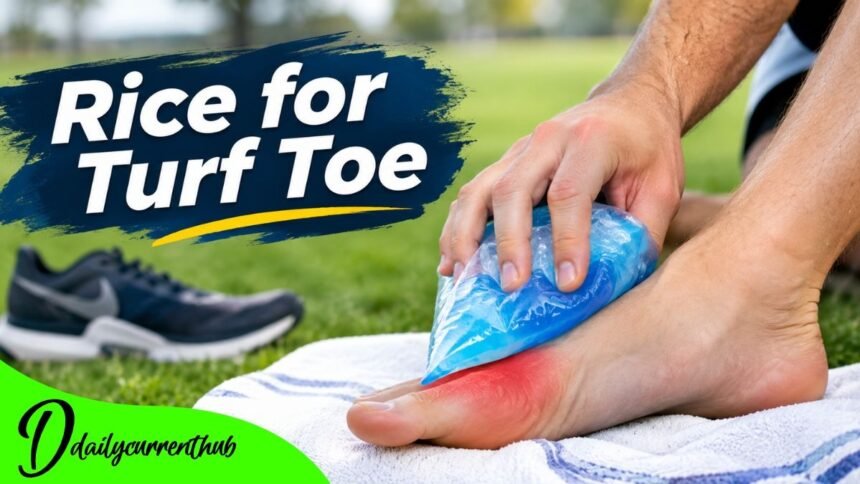
Turf toe may sound like a minor sports injury, but damage to the joint at the base of the big toe can make walking, running, and even standing uncomfortable. The injury is especially common among athletes who stop suddenly, accelerate quickly, or push forcefully off their toes. Without appropriate care, a significant sprain can cause prolonged discomfort and interfere with physical performance.
RICE for Turf Toe is a commonly recommended first-aid approach that uses four straightforward measures: rest, ice, compression, and elevation. These steps help manage Pain and swelling during the early stages of injury.
However, the RICE method is not a complete treatment for every case. More serious injuries may require immobilization, rehabilitation, or specialist assessment.
This article explains how turf toe develops, how to apply RICE safely, what recovery may involve, and when professional medical attention becomes necessary.
What Is Rice for Turf Toe?
RICE for Turf Toe describes using the RICE first-aid method to manage a sprain affecting the big toe’s main joint.
The term “turf toe” refers to an injury involving the soft tissues supporting the first metatarsophalangeal joint. These structures include ligaments, the joint capsule, and the plantar plate beneath the joint.
The injury commonly occurs when the front of the foot remains planted while the heel rises and the big toe bends upward beyond its normal range.
This movement places excessive stress on the tissues that stabilize the joint.
RICE is intended to reduce discomfort and swelling while the injured area is protected from further strain. It is especially useful during the early management of mild injuries.
For moderate or severe turf toe, the same initial measures may be appropriate, but they should be paired with medical evaluation and a treatment plan based on the extent of the damage.
Understanding Turf Toe and Its Causes
How Turf Toe Develops
The big toe plays a major role in balance, walking, running, and pushing the body forward.
During normal movement, the metatarsophalangeal joint bends to help transfer weight through the forefoot. When the toe is forced too far upward, the supporting tissues can stretch or tear.
Turf toe is common in football, soccer, basketball, wrestling, and other activities that involve sudden changes in direction.
Artificial playing surfaces and flexible athletic shoes may contribute to the risk in certain situations, although turf toe can also happen on natural grass and during everyday activities.
Recognizing the Symptoms
Symptoms depend on the injury’s severity.
Common signs include Pain at the base of the big toe, swelling around the joint, tenderness when touching the area, and difficulty bending the toe.
Bruising may develop after a more substantial injury. Some people notice Pain when attempting to push off the affected foot.
Severe injuries can make normal walking difficult.
These symptoms are not exclusive to turf toe. Fractures, sesamoid injuries, gout, and other joint problems can cause similar discomfort, so an accurate diagnosis matters.
How the RICE Method Works for Turf Toe
Rest: Protecting the Injured Joint
Rest is the first component of the RICE method.
Continuing to run, jump, or push through Pain can place additional stress on injured ligaments and other soft tissues.
During the initial stage, avoid activities that repeatedly bend the big toe upward or increase discomfort.
For mild injuries, temporarily reducing activity may be sufficient. More serious cases sometimes require crutches, a walking boot, or other protective support recommended by a clinician.
Rest does not necessarily mean remaining completely inactive for an extended period.
As symptoms improve, appropriate movement and gradual activity help reduce stiffness and restore normal function.
The goal is to protect the healing structures without unnecessarily prolonging immobility.
Ice: Managing Pain and Swelling
Ice is commonly used to ease discomfort after a turf toe injury.
Cold therapy temporarily reduces Pain and may help manage swelling around the affected joint.
You can generally apply a cold pack for 15–20 minutes at a time, with sessions spaced several hours apart during the first two or three days.
Always place a towel or other protective material between the ice pack and the skin.
Direct contact with ice can cause cold-related skin injury.
Stop the application if the skin becomes unusually painful, numb, or discolored.
People with impaired circulation, reduced skin sensation, or certain medical conditions should seek professional advice before using cold therapy.
Ice provides temporary symptom relief; it does not repair a torn ligament on its own.
Compression: Supporting Swollen Tissues
Compression involves applying gentle pressure around the injured area to help control swelling.
A suitable elastic bandage or supportive dressing may be recommended.
The wrap should provide light, even compression without causing additional Pain.
Excessively tight wrapping can interfere with normal circulation.
If the toes become numb, cold, unusually pale, or more painful, loosen or remove the bandage.
Compression should not force the injured big toe into an uncomfortable position.
Because forefoot anatomy is relatively complex, professional guidance may help you decide whether a wrap or a specific taping technique is appropriate.
Elevation: Reducing Fluid Accumulation
Elevation is the fourth component of RICE.
Raising the injured foot above heart level while resting can help reduce swelling by assisting fluid drainage.
A practical approach is to lie down and support the leg with pillows.
Elevation can be particularly useful during the first 24–48 hours, when swelling may be more noticeable.
Keep the foot comfortably supported rather than hanging unsupported or forced into an awkward position.
Elevation complements the other RICE measures but cannot replace appropriate protection of an injured joint.
How to Apply RICE Safely at Home
The following steps provide a practical starting point for a suspected mild turf toe injury.
- Stop the activity: Avoid running, jumping, or movements that reproduce the Pain.
- Protect the foot: Reduce weight-bearing if walking is painful, and consider supportive, stiff-soled footwear.
- Apply cold therapy: Use a wrapped ice pack for up to 20 minutes at a time.
- Use gentle compression: Apply a suitable support without restricting circulation.
- Elevate the foot: Rest with the injured foot supported above heart level when practical.
- Monitor symptoms: Watch for increasing Pain, bruising, swelling, instability, or difficulty walking.
- Seek appropriate assessment: Get medical advice if symptoms are significant, worsening, or not improving.
These measures can help manage early symptoms, but people should not assume every painful big toe injury is a minor sprain.
Understanding the Three Grades of Turf Toe
Grade 1: Mild Sprain
A Grade 1 injury involves stretching of the supporting tissues without a major tear.
Symptoms generally include localized tenderness, mild swelling, and discomfort during certain movements.
Common treatments include RICE, activity modification, and supportive footwear.
Many athletes recover relatively quickly, but they should resume activity only when symptoms and function allow.
Grade 2: Partial Tissue Tear
Grade 2 turf toe involves a partial tear of the plantar structures supporting the joint.
Pain, swelling, and bruising are usually more pronounced.
Moving the toe and bearing weight may become difficult.
Treatment may include RICE, protective taping, stiff-soled footwear, and temporary immobilization.
A healthcare professional may recommend a walking boot to protect the joint.
Recovery commonly takes several weeks, depending on the injury.
Grade 3: Severe Tissue Damage
Grade 3 turf toe involves a complete tear of key supporting tissues.
The affected joint may become unstable, and walking or bending the toe can be extremely painful.
These injuries require medical assessment.
Treatment often involves longer immobilization and structured rehabilitation.
Some patients with severe instability, associated fractures, or substantial soft-tissue damage may require surgery.
RICE alone is not sufficient to manage a serious Grade 3 injury.
Additional Treatments Beyond RICE
Supportive Footwear and Taping
Stiff-soled shoes can help reduce excessive bending of the big toe during walking.
A clinician may recommend a rigid forefoot insert, sometimes called a turf toe plate or a Morton’s extension.
These devices limit movement that could aggravate injured tissues.
Specialized taping may provide additional support.
However, incorrect taping can restrict circulation or place the toe in an unsuitable position. It should be performed according to professional guidance.
Pain Management and Medication
Pain relief may be useful during recovery.
Depending on the patient’s medical history, a healthcare professional or pharmacist may recommend an appropriate over-the-counter medicine.
Nonsteroidal anti-inflammatory drugs, including ibuprofen, may help relieve Pain and swelling, but they are not suitable for everyone.
Certain medical conditions, medications, and pregnancy-related considerations can affect their safety.
Medication should be used according to professional advice and product instructions.
Physical Therapy and Rehabilitation
Rehabilitation becomes important when the initial Pain and swelling begin to settle.
A physiotherapist may introduce exercises designed to improve the toe’s range of motion, strengthen the surrounding muscles, and restore balance.
Treatment progresses according to symptoms and tissue healing.
Aggressive stretching too early can aggravate an injured joint.
For this reason, rehabilitation should match the injury grade rather than follow a fixed schedule.
Recovery Time and Returning to Sports
Recovery from turf toe varies considerably.
A mild Grade 1 sprain may allow a return to sport within several days if normal movement and weight-bearing are comfortable.
Grade 2 injuries can require approximately two to four weeks away from demanding athletic activity, although some take longer.
Grade 3 injuries often take much longer, especially when complete tears, instability, or surgery are involved.
These periods are general observations, not guaranteed recovery timelines.
Returning to activity should depend on functional improvement.
Before resuming demanding exercise, the injured person should be able to walk comfortably, move the toe adequately, and perform sport-specific movements without significant Pain or instability.
A healthcare professional may recommend continuing protective footwear or taping during the return-to-play period.
Rushing back before adequate healing may increase the risk of persistent symptoms.
Common Mistakes When Treating Turf Toe
Several avoidable errors can complicate early recovery.
Continuing painful activity: Repeatedly forcing the toe into extension may aggravate damaged tissues.
Applying ice directly to skin: Unprotected cold packs can injure the skin.
Using excessive compression: Tight bandages may reduce circulation rather than provide helpful support.
Returning to sports too quickly: Reduced swelling does not automatically mean the joint has regained full strength and stability.
Ignoring severe symptoms: Significant bruising, joint instability, or inability to bear weight can indicate an injury requiring medical assessment.
Remaining immobilized unnecessarily: Prolonged restriction without clinical guidance may contribute to stiffness.
Proper recovery requires balancing early protection with the gradual restoration of normal movement.
When Should You Seek Medical Attention?
Medical assessment is important when big toe pain follows a significant injury or interferes with normal movement.
Seek prompt medical attention if the toe appears deformed, the Pain is severe, there is marked swelling or bruising, or walking is difficult.
Numbness, changes in circulation, an open wound, or an inability to bear weight also warrant urgent evaluation.
A clinician may examine the joint’s stability and range of motion.
X-rays can help identify fractures, sesamoid abnormalities, or other bone-related problems.
MRI may be considered when a substantial ligament or plantar plate injury is suspected.
Persistent Pain should not be ignored, even when the original injury seemed mild.
Preventing Future Turf Toe Injuries
Prevention focuses on reducing excessive stress on the big toe.
Appropriate athletic footwear can provide better forefoot support during activities involving acceleration, jumping, and sudden turns.
Athletes with a previous turf toe injury may benefit from rigid inserts or protective taping when recommended by a clinician.
Maintaining foot strength, ankle mobility, balance, and appropriate training loads may support overall lower-limb function.
However, no single exercise or footwear modification guarantees protection against turf toe.
Anyone recovering from a previous severe sprain should follow individualized guidance before returning to demanding sports.
Conclusion
RICE for Turf Toe remains a widely recommended approach to early symptom management following a sprain of the big toe joint.
Rest protects the affected tissues from unnecessary strain, ice provides temporary pain relief, compression helps manage swelling, and elevation supports fluid drainage.
Together, these measures offer a practical starting point for managing many mild sports injuries.
However, turf toe is not always minor. A partial or complete tear of the joint’s supporting structures may require protective equipment, medical assessment, physiotherapy, or occasionally surgery.
The most effective recovery strategy depends on recognizing injury severity, protecting the joint appropriately, and gradually returning to movement.
By combining sensible first aid with appropriate professional guidance, people with turf toe can give their injured joint the best opportunity to recover safely and regain useful function.
(FAQs)
1. What does RICE stand for in turf toe treatment?
RICE stands for Rest, Ice, Compression, and Elevation. These four measures are commonly recommended to manage early Pain and swelling after a turf toe injury.
2. Is RICE effective for turf toe?
RICE can help manage symptoms, particularly in mild injuries. However, it does not directly repair severely torn ligaments and cannot replace medical treatment when significant tissue damage is present.
3. How long should I ice turf toe?
Cold packs are commonly applied for 15–20 minutes per session during the early period after injury. Protect the skin with a towel and allow breaks between applications.
4. Should I walk with turf toe?
Walking may be possible with a mild injury, but painful weight-bearing should be limited. Moderate or severe injuries may require a walking boot, crutches, or other support recommended by a clinician.
5. Can turf toe heal without surgery?
Yes. Most turf toe injuries can be treated without surgery. Severe tears, persistent instability, or certain associated injuries may require surgical evaluation.
6. How long does turf toe take to heal?
Mild injuries may improve within days, moderate injuries often require weeks, and severe injuries can take months to recover fully. The timeline depends on the degree of tissue damage and treatment.
7. Should I tape my big toe when recovering from turf toe?
Supportive taping can limit excessive joint movement, but the correct technique depends on the injury. A healthcare professional can advise whether taping is appropriate and show you how to apply it safely.
8. When should I see a doctor for turf toe?
Seek medical assessment for severe Pain, substantial swelling or bruising, deformity, instability, difficulty bearing weight, or symptoms that persist or worsen despite initial care.