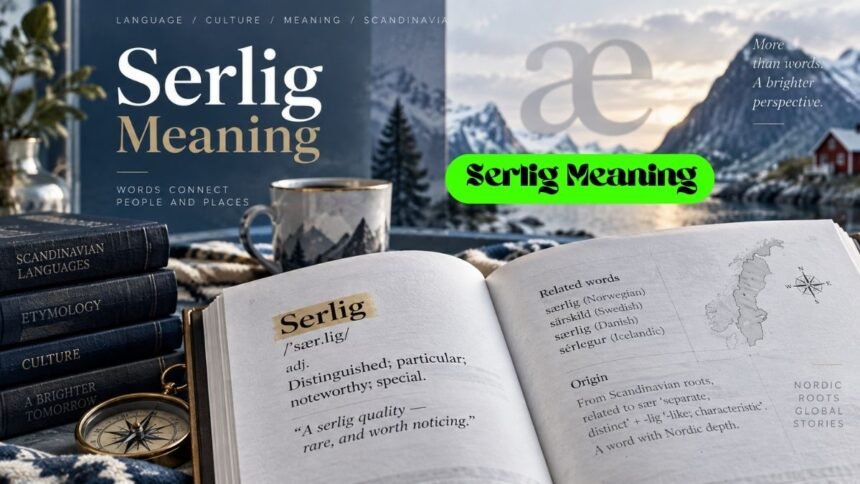
The word serlig has become increasingly visible across online articles, search results, branding discussions and informational websites, yet its meaning is far less settled than many pages suggest. Some describe serlig as a philosophy of authenticity. Others link it to digital communication, individuality, or simplicity. The strongest linguistic evidence, however, points in a clearer direction: serlig is closely associated online with the Scandinavian word “særlig.”
In standard Norwegian, særlig can mean “special,” “particular,” “especially” or something outside the ordinary. Denmark’s official dictionary records closely related meanings, including something distinctive, special or relevant in a particular context. Both Norwegian and Danish sources trace the word back to Old Norse.
That distinction matters because serlig itself should not be presented as a mysterious new philosophy with a universally accepted definition. This article examines what we can establish about the term, how its online use differs from the documented Scandinavian word, and why readers encounter so many conflicting explanations.
What Does Serlig Mean?
The safest definition of serlig depends on context. When the term is being used as an alternative spelling or keyboard-friendly rendering of særlig, it generally points toward the concepts of being special, particular, distinctive or especially significant.
Norway’s Bokmålsordboka defines særlig as something outside the ordinary and gives equivalents such as “special” and “particular.” Det Norske Akademis ordbok likewise records meanings relating to something distinctive or special and also documents its adverbial use in the sense of “especially.”
The Danish evidence is similar. Den Danske Ordbog defines særlig as something that differs from what is usual and lists “speciel” as a synonym. It can also emphasize something that deserves particular attention.
Problems begin when websites move beyond this documented linguistic meaning and present serlig as though it has one official modern philosophical definition. Current online articles attach ideas such as authenticity, individuality, quiet uniqueness and meaningful communication to the term, but those interpretations are not standardized dictionary definitions.
The Linguistic Origin of Serlig
The established Scandinavian word behind much of the discussion is særlig.
Norwegian lexical authorities trace særlig to Old Norse sérligr. Denmark’s dictionary records the same Old Norse origin. This means the underlying linguistic concept is much older than the recent wave of English-language web articles discussing “serlig.”
In Norwegian, the word functions both adjectivally and adverbially. It can describe something unusual or special, or it can emphasize a statement in much the same way English uses “especially” or “particularly.”
This historical evidence matters because it prevents a modern SEO trend from being confused with the word’s actual history.
Serlig may look like a newly invented internet expression, but the closely related Scandinavian form has documented linguistic roots stretching back far beyond modern websites, social platforms or branding culture.
Serlig and the Scandinavian Word Særlig
The difference between serlig and særlig may appear small, but it matters when accuracy is the goal.
The official Norwegian spelling recorded by Bokmålsordboka is særlig, while the Nynorsk equivalent is særleg.
Danish also uses særlig.
By comparison, the spelling serlig is frequently used on English-language websites as an easier or adapted rendering. Several contemporary articles explicitly connect serlig with særlig and explain the missing “æ” as part of the term’s simplified online spelling. That explanation is plausible and widespread online, although it should not be mistaken for an official declaration that “serlig” is itself the standard Scandinavian spelling.
For editorial purposes, the distinction is straightforward: use særlig when referring specifically to the standard Norwegian or Danish word. Use serlig when discussing the searchable internet term itself.
Why Serlig Appears Without the Letter Æ
English-language keyboards and publishing systems don’t always make Scandinavian characters easy to type. As a result, words containing characters such as æ may sometimes appear in altered forms when written by people outside Scandinavia.
Online explanations of serlig commonly claim that it developed as a simplified spelling of særlig.
However, that explanation should be expressed carefully. A simplified internet spelling does not automatically become a formally recognized English word.
Search engines can generate significant visibility around unusual spellings because users encounter them repeatedly, search for explanations and then produce additional content answering those searches. This can create the appearance of a completely new concept even when much of the discussion began with an older linguistic form.
The rise of serlig online illustrates why source quality matters. A large number of web pages repeating an interpretation does not carry the same evidentiary weight as established dictionaries documenting a word’s spelling, history and use.
How Serlig Is Being Used Online
Serlig now appears in several different online contexts.
Some websites describe it simply as a variation related to the Scandinavian særlig. Others broaden the term considerably, presenting serlig as an idea associated with authenticity, individuality, thoughtful communication, calmness or being quietly distinctive.
Still other sites attach the word to digital strategy, information organization or branding. One current article, for example, defines serlig in terms of information retrieval and knowledge management—a meaning quite different from articles treating it as emotional authenticity.
That inconsistency is revealing.
If a term supposedly means authenticity on one site, knowledge organization on another and Scandinavian “special” on a third, readers should not assume all three definitions have equal linguistic authority.
The most defensible approach is to separate the documented language meaning from newer creative internet interpretations.
Serlig as an Idea of Being “Special”
The modern idea most closely aligned with the documented linguistic evidence is something special, particular, or distinctive.
This connection does not require inventing a new philosophy.
Norwegian dictionaries explicitly define særlig using meanings equivalent to special and distinctive, while Danish sources describe something differing from the ordinary.
That may help explain why modern writers have expanded serlig into discussions about uniqueness and individuality. The leap from “special” to “quietly unique” is understandable as creative interpretation.
Yet interpretation and definition are different things.
Writers can certainly use serlig artistically to suggest understated uniqueness. Still, they should disclose that this is a modern usage rather than claiming that centuries of Scandinavian language prove an entire contemporary lifestyle philosophy.
Serlig in Branding and Digital Content
From a branding perspective, Serlig has qualities that make it an attractive name.
It is short, visually distinctive and unfamiliar to many English-speaking readers. That naturally creates curiosity.
The word is already being used by unrelated websites, including a pet-focused publication called Serlig. This demonstrates another reason readers should depend on context rather than assuming every appearance refers to one universal concept.
A company, publication or creator can use Serlig as a brand without that commercial use changing its linguistic history.
This distinction is common across the internet. Existing words, foreign-language words and adapted spellings often become brand identities. Once that happens, search results can mix dictionary definitions, company pages, lifestyle commentary, and SEO articles.
Readers therefore need to ask a simple question: Is Serlig being used here as a word, a brand name or a newly coined concept?
The answer can completely change the meaning.
Why Different Websites Define Serlig Differently
No single authoritative modern definition of serlig exists across the English-language web.
One article describes the term as quietly meaningful and authentic. Another presents it primarily as a spelling related to Scandinavian særlig. Other sites connect it with digital identity, intentional communication or information systems.
This is a textbook example of why repeating search-result claims without checking primary linguistic sources can create confusion.
Established dictionaries provide relatively consistent evidence about særlig.
The modern web provides inconsistent claims about serlig.
That does not make creative modern uses invalid. Language constantly evolves, and new meanings can emerge. But a responsible article should distinguish between a historically documented definition and a new interpretation that has not achieved broad lexical recognition.
For readers searching “serlig meaning,” that distinction is arguably the most useful answer.
Common Misconceptions About Serlig
One misconception is that serlig is a newly established English dictionary word with a single definition. Available linguistic evidence does not support that claim.
Another is that serlig definitely represents a formal digital philosophy. Current websites use the term in too many different ways for that claim to be reliable.
A third mistake is describing serlig as the standard Norwegian or Danish spelling. The dictionaries reviewed for this article record særlig, not serlig, as the relevant standard form.
Finally, do not automatically treat the term as the name of one product or company. Serlig appears across unrelated contexts, including branded websites.
The safest rule is therefore contextual: determine where the term appears before deciding what it means.
How to Use Serlig Accurately
If you are writing formal English and want to express the idea conveyed by Scandinavian særlig, established English alternatives such as special, particular, distinctive, especially or particularly will usually be clearer.
If you are specifically discussing Scandinavian language, preserve the correct spelling særlig whenever possible.
If you use serlig as a creative term, brand name or stylistic expression, give readers enough context to understand what you mean.
That approach avoids presenting an emerging or adapted spelling as though its definition has already been universally settled.
Accuracy matters especially for publishers because search-driven terms can accumulate misinformation rapidly when one website copies another. Checking authoritative linguistic references before making historical or definitional claims produces a far stronger article than simply repeating whatever meaning currently dominates blog results.
The Future of Serlig
Whether serlig eventually develops into a widely recognized independent English term remains uncertain.
Language can change dramatically when words cross borders, become brands or spread through online communities. Some adapted words eventually acquire independent meanings. Others remain niche spellings or temporary search trends.
At present, the strongest verifiable foundation remains the relationship with Scandinavian særlig, whose meaning and Old Norse ancestry are clearly documented.
Modern interpretations of serlig may continue to develop around individuality, authenticity or digital culture, but those meanings should be presented as evolving usage rather than settled linguistic fact.
For readers today, the most useful understanding is simple: serlig is an ambiguous online term whose clearest linguistic connection is to “særlig,” the Scandinavian word for something special, particular, or especially significant.
Conclusion
Serlig appears mysterious largely because online sources use it in different ways. The reliable linguistic evidence provides a clearer starting point. Norwegian and Danish dictionaries document særlig, a word rooted in Old Norse and associated with meanings such as special, particular, distinctive and especially.
The spelling serlig has subsequently appeared across English-language websites, branding and modern explanatory articles. Some writers have expanded it into ideas about authenticity, quiet individuality or thoughtful communication, but those newer interpretations do not yet constitute one authoritative definition.
Understanding that difference removes much of the confusion. Rather than presenting serlig as an invented philosophy or making unsupported historical claims, responsible coverage should distinguish established Scandinavian language evidence from evolving internet usage.
That makes the term easier to understand—and keeps the explanation grounded in facts rather than repetition.
FAQs,Dailycurrenthub.co.uk
1. What does serlig mean?
Serlig is commonly associated online with the Scandinavian word særlig, which can mean special, particular or especially. Modern websites also use serlig more broadly, but those interpretations are not standardized.
2. Is serlig an English word?
Serlig is not a common, standard English dictionary word in the linguistic sources reviewed for this article.
3. Is serlig a Norwegian word?
The standard Norwegian form is særlig, according to Bokmålsordboka and other Norwegian dictionaries.
4. What does særlig mean in Norwegian?
It can describe something special, particular or outside the ordinary and can also be used adverbially in the sense of “especially.”
5. Is særlig also used in Danish?
Yes. Den Danske Ordbog records særlig with meanings such as special or something different from what is usual.
6. Where does særlig come from?
Both Norwegian and Danish dictionary sources trace it to the Old Norse word sérligr.
7. Why do websites give different meanings for serlig?
Because the modern spelling has been interpreted creatively in different online contexts. Some connect it to the Scandinavian language, while others use it for ideas such as authenticity, individuality, or digital organization.
8. Can serlig be used as a brand name?
Yes. The term already appears as a name for unrelated online projects, so its meaning as a brand depends on the organization using it.