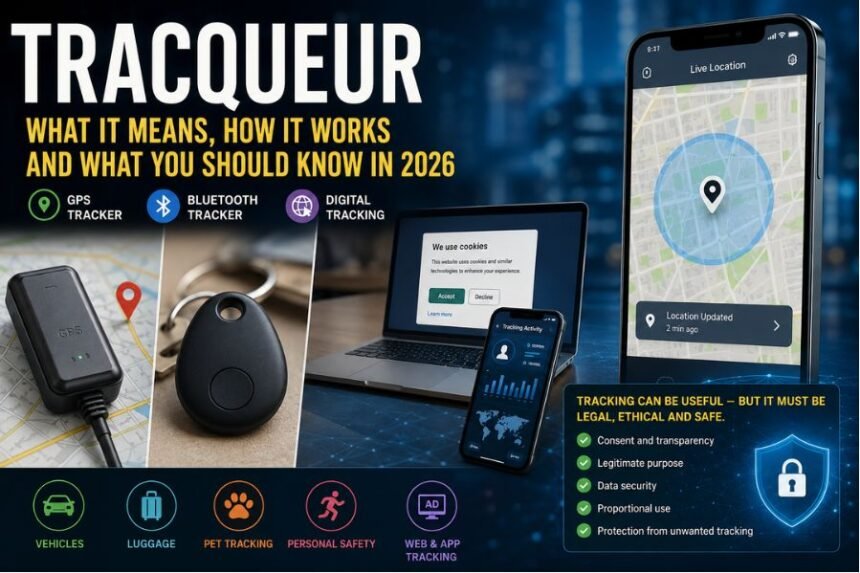
A tiny device attached to a suitcase can reveal where it was last seen. A vehicle system can record routes and working hours. A website can recognize a browser through cookies, pixels, or fingerprinting. All three activities may be casually described online via the keyword trackery, yet they do not rely on the same technology—or even the same legal rules.
That distinction matters more in 2026. Location tags have become useful for recovering misplaced belongings, yet they raise concerns about unwanted tracking. Digital tracking has also become a major privacy issue across websites and connected devices. In August 2026, the Internet Engineering Task Force’s Detecting Unwanted Location tracqueur working group published an updated threat-model draft examining how lightweight location tags can be misused for stalking and abuse.
There is another problem hidden in the search term itself: “tracqueur” is not the standard French term for a GPS tracker. Authoritative French references use traceur for a tracking or geolocation device, while traqueur carries a different dictionary history, primarily associated with tracking or the driving game in hunting.
BLUF: Tracqueur is best treated as an informal, alternative, or search-driven spelling associated with tracking. In technology, the standard French term is generally “traceur,” which includes a GPS geolocation device. A modern tracker may use GPS, Bluetooth, cellular networks, software identifiers, cookies, or combinations of these technologies.
The First Tracqueur Mystery Is Actually Linguistic
Searching for “tracqueur” can yield explanations that immediately translate the term as “tracker.” That gives users a general idea, but it overlooks an important linguistic distinction.
Larousse defines traceur as, among other things, a small satellite geolocation device fitted to a person, vehicle, or object and connected to a digital interface that enables tracking of movements. Larousse explicitly lists “tracker” as a synonym in this technological meaning.
The Académie française also recognizes traceur as an established French word derived from tracer, although its dictionary entry covers several meanings beyond electronic tracking.
Traqueur, meanwhile, comes from traquer. CNRTL records its historical use for a hunter or person involved in driving game, as well as extended meanings involving searching or pursuit.
This does not mean every use of tracqueur is meaningless. Search language evolves differently from dictionary language. It simply means that publishers, buyers, and researchers should identify the specific type of tracking being discussed rather than treating “Tracqueur” as a formal, universal product category.
What a Modern Tracqueur Can Actually Be
Under the broad tracking interpretation, a tracqueur could describe several very different systems.
GPS location tracqueur
A GPS receiver determines position from radio signals transmitted by satellites. GPS.gov explains the basic concept through trilateration: position is calculated using measured distances from known satellite positions, with extremely precise timing required for real-world GPS operation.
A GPS tracking product can then combine this positioning data with another communication method—often cellular connectivity—to transmit location data to an app or server.
Common applications include vehicles, valuable equipment, fleet operations, and other assets.
Bluetooth item tracqueur
Small Bluetooth tracking tags work differently. They do not necessarily behave like self-contained GPS receivers continuously transmitting their own coordinates.
Many modern tags participate in crowdsourced finding networks. Nearby compatible devices can detect a tag and contribute information that helps its owner locate the missing item. The IETF describes modern lightweight location-tracking tags as components of crowdsourced networks where other users’ devices may report that a tag has been observed and where it was seen.
These systems are especially useful for keys, bags and luggage.
Web and application traceurs
Tracking is not limited to physical location.
France’s data-protection authority, the CNIL, uses the term “traceurs” for technologies including HTTP cookies, device fingerprinting, invisible pixels or web bugs, software-generated identifiers, and other mechanisms capable of storing or retrieving information from a user’s device.
That makes the broad concept behind a tracker much larger than a GPS map.
A tracker may answer “Where is my bag?”
A digital tracer may answer “What did this browser do?”
Those are fundamentally different questions.
The important buying lesson is simple: the word on the product page matters less than the underlying radio, network, sensor and software architecture.
Privacy Is Where Tracking Stops Being Just a Convenience Feature
The same characteristics that make tracqueur useful can create risks when tracking occurs without a person’s knowledge.
Apple says AirTag, Find My accessories and compatible Bluetooth location-tracking devices include unwanted-tracking protections and should not be used to track people without consent. Apple also states that it worked with Google on an industry specification that enables unwanted-tracking alerts across iOS and Android on compatible devices.
The issue remains technically active rather than solved once and for all. The IETF’s Detecting Unwanted Location tracqueur (DULT) working group is developing standards-related work to detect small location-tracking accessories, identify them, and address malicious use. Its August 6, 2026 threat-model draft specifically discusses stalking and abuse as possible misuses of crowdsourced tracking tags.
The safest way to judge any tracker is not to ask whether tracking is possible, but whether the person deploying it has a legitimate purpose, appropriate authority or consent, adequate security, and a proportionate reason for collecting the data.
That principle applies to both hardware and software.
France Draws Clear Lines Around Vehicle and Online Tracking
French privacy regulation provides useful examples of why context matters.
The CNIL says employee-vehicle geolocation may be used for certain legitimate purposes, including documenting transport services and protecting employees, goods or vehicles, such as facilitating vehicle recovery after theft. At the same time, such systems are subject to rules intended to protect employee privacy.
Online tracking has its own framework.
Under the rules described by the CNIL, many cookies and other tracqueur require users to be informed and to provide consent before information is stored on or accessed from their device. Exceptions apply to certain technologies that are strictly necessary for communications or for a service expressly requested by the user.
Consent must also represent a genuine choice. The CNIL says withdrawing consent should be as simple as giving it, while merely continuing to browse does not constitute valid consent for non-essential tracqueur.
In January 2026, the CNIL also published recommendations on cross-device consent, addressing situations in which tracking preferences associated with an account may apply across connected phones, computers, tablets, or televisions.
That development shows just how far the idea of a “tracker” has moved beyond a blinking GPS box attached to a vehicle.
Before Choosing a Tracker, Ask These Seven Questions
A product should be evaluated according to its actual function rather than the marketing terminology surrounding it.
- What needs to be tracked? A car, suitcase, pet, equipment, or digital activity?
- Which technology performs the tracking? GPS, Bluetooth, cellular connectivity, Wi-Fi, sensors, or software?
- Does it provide live location or only last-seen information?
- Does it require a subscription or a separate mobile data service?
- How is collected information secured and retained?
- Does the person or organization using it have a legitimate right to track the target?
- Does the system include protections against unauthorized or unwanted tracking?
These questions prevent a common mistake: buying a tracker because its headline promises “real-time tracking” without understanding what network or infrastructure makes that feature possible.
Why “Tracqueur” Is Better Understood as a Search Intent Than a Product
The most accurate answer to the keyword is also the most useful one: Tracqueur is not one universal technology.
It is a search expression sitting at the intersection of GPS tracking, Bluetooth finding networks, connected vehicles, digital analytics, and privacy. The standardized French vocabulary matters, but understanding the technology behind the term matters more.
By 2026, the key question has shifted from whether objects and devices can be tracked—they clearly can—to how tracking is performed, who controls the information, whether the monitored party knows about it, and what safeguards prevent a useful tool from becoming an invisible surveillance mechanism.
That is the real story behind tracqueur—Cross-platform Bluetooth tracker protections.
FAQs
What is a tracqueur?
A tracqueur is generally an informal or alternative spelling associated with a tracker or tracking system. It can refer contextually to GPS devices, Bluetooth finding tags, asset-monitoring systems, or digital tracking technologies. In standard French technology terminology, traceur is the more established term for a tracking device.
Is tracqueur the correct French spelling for a GPS tracker?
Tracqueur is not the standard dictionary spelling for the technological device. Larousse recognizes traceur as a small satellite-geolocation device that can be fitted to a person, vehicle, or object and used with a digital interface to follow movement.
Does every traceur contain GPS?
No. A tracker does not automatically contain GPS. Location and activity systems can rely on GPS, Bluetooth, cellular communications, connected-device networks or software identifiers. Bluetooth item tags, for example, can use nearby devices and crowdsourced finding networks instead of functioning as conventional standalone GPS tracqueur.
Can websites usetracqueur without consent?
Some tracqueur require prior consent while specific exemptions exist. The CNIL states that many advertising and similar tracqueur require consent. In contrast, technologies strictly necessary to provide an expressly requested service or to facilitate electronic communications may qualify for exemptions under applicable French rules.
Can a Bluetooth tracker secretly follow a person?
Bluetooth location tags can be misused for unwanted tracking, which is why detection safeguards exist. Apple supports alerts for compatible unwanted tracqueur, while the IETF’s DULT work is addressing technical approaches and threat models for detecting and responding to unwanted location-tracking accessories.
What is the biggest risk associated with tracking technology?
The central risk is unauthorized or disproportionate monitoring. A tracker designed to recover a lost object can become intrusive when used to follow another person without permission. At the same time, digital traceurs can create privacy concerns when browsing behavior or identifiers are collected without appropriate transparency or consent.
Editorial Disclaimer
“Tracqueur” does not appear to represent a single standardized technology category, product, or company based on the authoritative linguistic and technical sources reviewed for this article. Its meaning should therefore be interpreted from context. Product capabilities, privacy requirements, and tracking laws can vary by technology, jurisdiction, and use case; readers should verify the current official guidance before deploying tracking systems that involve other people.