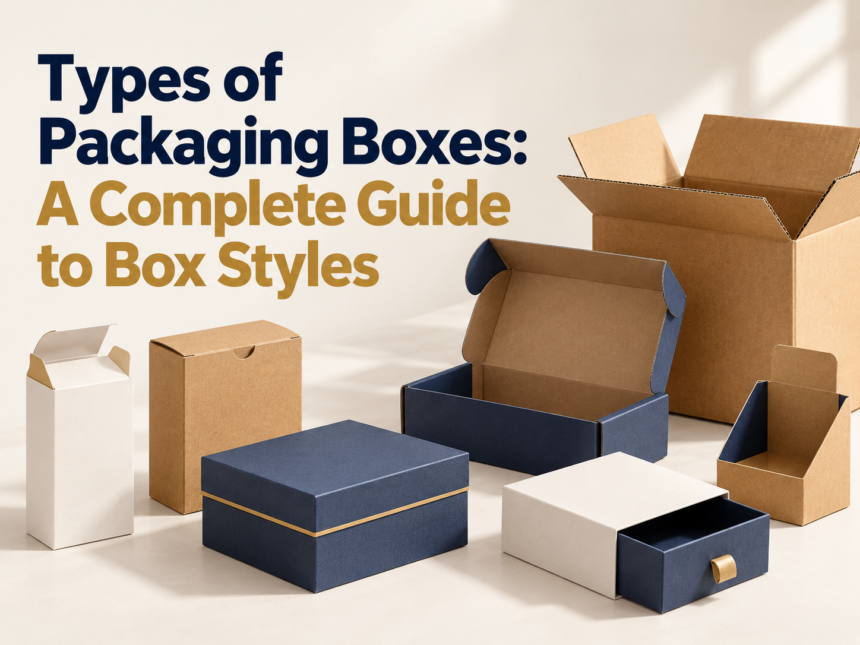
Walk into any store and look around. Almost every product you see sit inside some kind of box, and that box was chosen on purpose. Different product need different structure, different strength and different shelf presence. Knowing which box style do what is the difference between packaging that work and packaging that cost you money in damage and returns.
Here is a breakdown of main box families and where each one actually belong.
Folding Cartons
Folding cartons are the thin paperboard boxes you find on retail shelve everywhere. Cereal, toothpaste, cosmetics, medicine, all of it. They ship flat, assemble by hand or machine, and print beautifully because the board surface is smooth.
Common folding carton style include:
- Straight tuck end (STE) — both flap tuck in same direction, cleanest front face
- Reverse tuck end (RTE) — flap tuck opposite direction, cheaper to die cut
- Seal end — glued top and bottom, used for food and anything needing tamper evidence
- Snap lock bottom — auto locking base, good for heavier item
- Gable box — carry handle built into the top, popular for takeout and gift
- Sleeve box — outer band that slide over an inner tray
Typical board run from 12pt up to 28pt. Lighter stock for small light product, heavier stock when the box need to hold shape under weight.
Corrugated Boxes
Corrugated is the fluted board you see on shipping carton. It is made of liner sheet with a wavy flute in between, which is what give it the crush resistance.
Flute types matter more then people realize:
- B flute — thin, good print surface, used for retail ready shipper
- C flute — the standard shipping flute, good all round protection
- E flute — very thin, bridges the gap between folding carton and corrugated
- F flute — thinnest, used for small premium shipper
- Double and triple wall — for heavy industrial load
Regular slotted container (RSC) is the most produced box style on earth. Flaps meet in the middle, tape it shut, done.
Mailer Boxes
Mailer boxes exploded in popularity with ecommerce. The roll end tuck front style need no tape, protect well in courier network, and give brands that unboxing moment people film for social media.
Where a plain RSC say “shipping”, a printed mailer say “brand”. Thats why subscription companies almost all use them.
Rigid Boxes
Rigid boxes are the premium tier. Think phone box, luxury watch box, high end cosmetic set. They are built from thick greyboard, usually 36pt or 48pt, then wrapped with printed paper. They dont fold flat, which make them more expensive to ship empty, but the perceived value is much higher.
Common rigid style:
- Lid and base (two piece)
- Magnetic closure
- Drawer or slide out
- Book style with hinge
- Shoulder neck box
Specialty And Niche Styles
- Pillow box — curved, no glue, often for small accessory
- Pyramid box — novelty gift shape
- Window box — die cut opening with clear patch
- Hexagon and custom die cut — shelf standout
- Partition and insert boxes — divided interior for bottle, jars or multi piece kit
Box Sizes And Choosing The Right One
Picking size is where most mistake happen. Too big and your product rattle around and the void fill cost add up. Too small and the box bulge, seams split, graphic distort.
Few things to keep in mind:
- Box dimension are always written as Length x Width x Depth, measured on the inside
- Add 1/8″ to 1/4″ clearance around product so it slide in without forcing
- For corrugated, remember the board thickness itself eat into outside dimension
- Standard mailer size that run often are 6″ x 4″ x 2″, 8″ x 6″ x 2″, 10″ x 8″ x 3″ and 12″ x 9″ x 4″
- Shirt and apparel box commonly sit around 10″ x 8″ x 2″ and 14″ x 10″ x 3″
- Small retail carton for cosmetic or supplement often fall between 2″ x 2″ x 3″ and 4″ x 3″ x 5″
If you are not sure how to take the measurement properly, this guide to measure lxwxh of box walk through it step by step with the inside versus outside distinction explained.
Material Quick Reference
| Box type | Usual stock |
|---|---|
| Folding carton | SBS, kraft, 12pt to 28pt |
| Mailer | E flute or B flute corrugated |
| Shipper | C flute, double wall |
| Rigid | 36pt / 48pt greyboard, wrapped |
A Note On Minimums
Minimum order quantity vary a lot by style. Digital printing has brought folding carton minimums down to around 100 unit at many suppliers, including suppliers listed on zeepackaging.com, while rigid box and specialty die cut usually sit higher because of tooling and hand assembly involved.
Final Thought
There is no single best box. A candle need different protection then a tshirt, and a subscription box have a different job then a warehouse shipper. Start with the product weight, fragility and where it will be seen, then work backward to the style. Get that part right and everything else, print, finish, insert, follow naturally.