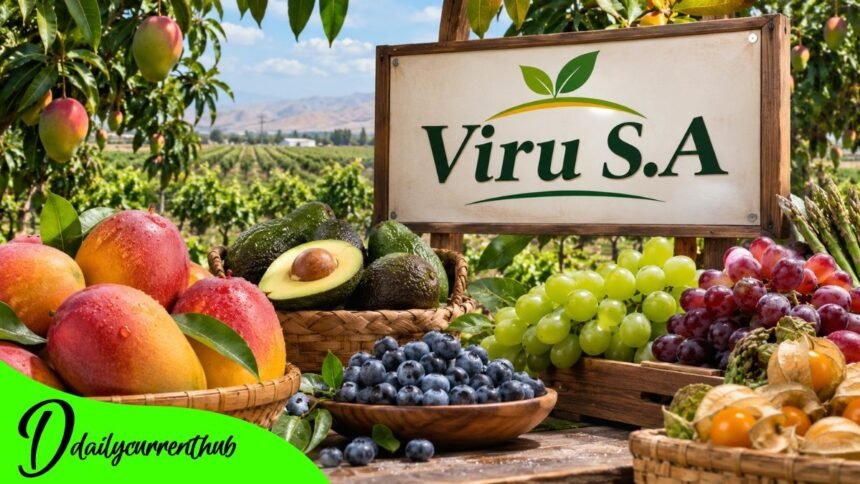
Viru S.A. is a prominent name in Peru’s agro-industrial sector, known for producing, processing, and exporting fruits and vegetables to international markets. With roots dating back to 1994, the business has developed from an agricultural operation in northern Peru into part of a major international food group.
Its growth reflects Peru’s growing importance in global agricultural trade. Through farming, industrial processing, product development, and international distribution, Viru has established business relationships across multiple continents.
The company is particularly associated with asparagus, artichokes, peppers, mangoes, avocados, and other agricultural products. Its operations cover fresh, frozen, and preserved food categories.
This article explores Viru S.A.’s background, business model, international activities, workforce, environmental initiatives, and corporate development. It also examines how agricultural production and modern food processing have contributed to the company’s position in international markets.
What Is Viru S.A.?
Viru S.A. is associated with one of Peru’s established agro-industrial businesses, whose operations combine commercial farming with industrial food preparation for domestic and international customers.
The company developed its operations in northern Peru, particularly around Virú in the La Libertad region, where agriculture has long played an important economic role. At the same time, irrigation infrastructure and processing investments have supported the development of export-oriented farming.
Unlike businesses that concentrate exclusively on growing crops, Viru has built capabilities that extend into food preservation, freezing, packaging, and distribution.
Grupo Viru operates across several food categories, supplying agricultural products to businesses and consumers in international markets.
Its significance lies not simply in agricultural output but in the value added through processing, product development, employment, and connections between Peruvian farms and global food supply chains.
Early History and Background of Viru S.A.
From Agricultural Beginnings to Industrial Expansion
Viru began operations in 1994 with approximately 150 hectares of agricultural land, according to company information published by Great Place to Work Peru.
The early business developed in northern Peru, where agricultural investment created opportunities to supply products beyond local markets.
Over time, Viru expanded its cultivated area and processing capacity. This development allowed the company to handle larger quantities of produce while offering food products in different commercial formats.
Peruvian export directories indicate that its export activities began in 2002.
The progression from cultivation to large-scale food processing illustrates an important development in Peru’s agricultural economy. Export businesses increasingly needed more than farmland: they required industrial facilities, coordinated logistics, and the ability to meet international buyers’ quality requirements.
Viru’s expansion followed this broader shift toward higher-value agricultural exports.
Agricultural Operations and Business Model
How Vertical Integration Supports Production
One defining feature of Grupo Viru is its vertically integrated operating model.
Vertical integration means connecting different stages of production within an organized business structure. In agriculture, this may include crop cultivation, harvesting, processing, packaging, and distribution.
Grupo Viru states that its production facilities are located close to its agricultural fields. This arrangement allows the business to coordinate the movement of produce between farming and industrial operations.
Efficient handling is especially important for perishable agricultural products.
Fresh vegetables and fruits require suitable storage, transportation, and processing conditions to preserve their commercial quality.
A coordinated system reduces unnecessary handling, supports product traceability, and improves production planning.
The model also enables Viru to supply the same agricultural sector through different product categories, including fresh food, frozen produce, and preserved products.
Products and Food Processing at Viru S.A.
Fresh, Frozen, and Preserved Food Products
Grupo Viru organizes its principal business activities into three major categories.
Fresh products: The company supplies agricultural products such as avocados, asparagus, and blueberries. Fresh produce requires careful post-harvest handling and appropriate distribution systems.
Frozen products: The group’s frozen portfolio includes fruits and vegetables. It uses individual quick freezing (IQF), which freezes individual pieces of food rather than forming them into a single frozen mass.
Preserved products: The business produces preserved vegetables, fruits, sauces, and prepared food products. Its established portfolio includes asparagus, artichokes, and peppers.
These different categories serve distinct commercial needs.
Fresh products appeal to markets that prioritize produce sold in its original form. Frozen foods offer convenient storage and preparation options, while preserved foods provide alternative packaging and shelf-life characteristics.
The portfolio’s breadth also allows the business to serve retail, foodservice, and business-to-business customers.
International Expansion and Global Presence
From Peru to International Food Markets
International exports have become central to Viru’s development.
Grupo Viru reports distribution to more than 50 countries across five continents, demonstrating the geographic reach of its operations.
The business has developed a European presence through companies associated with Spain, France, and Italy.
A key development occurred in 2023 when Viru acquired Superior Foods International, a United States-based company that markets frozen food products.
This acquisition expanded the group’s international commercial network and strengthened its connections with the North American food sector.
Such international operations give an agricultural producer access to customer relationships and distribution expertise beyond its original country of operation.
For Viru, geographical expansion has accompanied the development of a diversified food portfolio rather than replacing the company’s agricultural roots in Peru.
Workforce and Corporate Culture
Employment and Professional Development
Agriculture and food processing are labor-intensive industries requiring employees across numerous professional areas.
Viru’s activities involve agricultural workers, processing personnel, technical specialists, administrative teams, and commercial employees.
The wider Grupo Viru currently reports more than 19,000 collaborators, although workforce figures can vary by reporting period and organizational scope.
Employee development has also been part of the company’s publicly described workplace initiatives.
Great Place to Work Peru ranked Viru first among Peruvian workplaces with more than 1,000 employees in its 2025 ranking.
This recognition reflects its standing in that specific workplace assessment, although an award alone cannot capture every aspect of working conditions.
The company has also described professional development programs designed to help employees improve their skills and access opportunities across its international operations.
Community Engagement and Social Initiatives
Education, Childcare, and Employee Support
Viru’s publicly documented social initiatives include programs focused on education and employee families.
One example is Escuela CEBA Viru, which helps participating workers complete primary or secondary education through schedules adapted to their employment responsibilities.
The initiative recognizes that adult education can be difficult to pursue alongside work and family obligations.
Another program, Mi Pequeño Viru, provides childcare support for eligible employees with young children.
According to information published by Great Place to Work Peru, the facility offers services including nutrition, educational activities, and child care.
These initiatives show specific ways the company has invested in employee support.
Their broader social effectiveness would require additional independent evaluation, but the programs themselves are publicly documented examples of community and workforce engagement.
Sustainability and Environmental Responsibility
Agricultural Resource Management
Environmental management is a significant consideration for companies operating large agricultural and food-processing facilities.
Water availability, agricultural waste, energy consumption, and efficient resource use can all influence long-term production.
Grupo Viru identifies sustainability as central to its corporate strategy and states that its activities support 16 of the United Nations’ 17 Sustainable Development Goals.
The company has reported initiatives involving organic waste processing and renewable energy.
For example, its publicly described composting operation uses organic residues from agricultural and industrial activities to produce compost for agricultural applications.
Viru has also reported implementing photovoltaic solar energy technology at a packing facility.
These are concrete examples of environmental measures the business reported.
However, sustainability initiatives should not be mistaken for independent verification of the company’s overall environmental performance.
A comprehensive assessment would also consider resource consumption, emissions, regulatory compliance, and measurable outcomes over time.
Quality Standards and Innovation
Meeting International Food Industry Requirements
Exporting food to international markets requires attention to quality, hygiene, traceability, and regulatory requirements.
Viru is listed in Peruvian export directories for food safety and agricultural certifications, including standards related to food processing and agricultural practices.
Such certifications can support commercial relationships with buyers who require documented production controls.
The group also emphasizes innovation through product development and processing technology.
Its IQF freezing operations are an example of technology used to offer agricultural produce in a form suitable for modern food distribution.
Innovation in agro-industry does not always mean creating entirely new products. It can also involve improving packaging, production efficiency, processing techniques, and the consistency of existing products.
These capabilities are especially relevant when serving markets with different purchasing preferences and food specifications.
Corporate Identity and Public Information
Understanding the Viru Name and Corporate Structure
The name Viru S.A. appears in established Peruvian business directories and historical company records.
However, the legal history deserves careful treatment.
A resolution issued by Peru’s National Water Authority in April 2025 records corporate name changes and a reorganization involving Virú S.A., Virú Group Perú S.A., and an entity previously named Agrícola Bicentenaria S.A.
The document explains that the former Virú S.A., identified by RUC 20373860736, changed its name to Virú Group Perú S.A. Another company, previously Agrícola Bicentenaria S.A., adopted the Virú S.A. name (RUC 20610799869).
This distinction matters because older business listings may refer to the historical company rather than the newer legal entity.
For a general company profile, Grupo Viru is therefore the most useful reference for the group’s current operating scale and international business activities.
Future Outlook and Industry Significance
Opportunities and Long-Term Business Priorities
Viru’s established operations place it within several important areas of international food trade: fresh produce, frozen foods, preserved vegetables, and prepared food products.
Its existing distribution network and processing infrastructure provide a foundation for continued commercial activity.
The future performance of agricultural exporters depends on factors including customer demand, crop yields, production costs, water availability, and access to overseas markets.
Food safety requirements and environmental expectations also remain significant considerations for businesses supplying international customers.
Viru’s publicly documented investments in processing capabilities, international distribution, and workforce programs show how the business has approached these challenges historically.
Nevertheless, specific future revenue, export volumes, acquisitions, or expansion plans should not be presented as certain without confirmed company disclosures.
The company’s long-term significance will ultimately be determined by its ability to maintain reliable agricultural production and commercial relationships while managing the practical demands of a multinational food business.
Conclusion
Viru S.A. represents an important chapter in the development of Peru’s export-oriented agricultural industry.
Beginning with agricultural operations in 1994, the business evolved through investments in cultivated land, food processing, and access to international markets. Today, Grupo Viru operates across fresh, frozen, and preserved food categories, reaching customers in numerous countries.
Its story reflects more than the movement of agricultural goods from Peru to overseas destinations.
The company has developed processing infrastructure, expanded internationally, and introduced documented initiatives in employee education, childcare, and environmental management.
The distinction between historical company records and the group’s current corporate structure also highlights the importance of accurate reporting.
Viru’s continuing relevance lies in its combination of agricultural production, food manufacturing, international distribution, and the economic opportunities associated with Peru’s agro-industrial sector.
(FAQs)
1. What is Viru S.A.?
Viru S.A. is a Peruvian agro-industrial company name associated with the production, processing, and export of agricultural food products through the wider Grupo Viru business.
2. When was Viru S.A. established?
According to its published company history, the business began agricultural operations in 1994.
3. Where is Viru S.A. located?
The company’s historical operating base is in Virú, within Peru’s La Libertad region. Grupo Viru also operates and conducts commercial activities outside Peru.
4. What products does Viru S.A. produce?
Its wider business portfolio includes asparagus, artichokes, peppers, mangoes, avocados, blueberries, and other fresh, frozen, and preserved food products.
5. Does Viru S.A. export internationally?
Yes. Grupo Viru reports distributing products to more than 50 countries across five continents.
6. How many employees does Viru S.A. have?
Grupo Viru reports more than 19,000 collaborators across the group. Figures for individual legal companies may differ.
7. What sustainability initiatives has Viru introduced?
Publicly reported initiatives include organic compost production, solar energy systems, and environmental programs aligned with the group’s stated sustainability strategy.
8. Why is Viru S.A. important to Peru’s agricultural industry?
The business contributes to agricultural production, food processing, employment, and international distribution, helping connect Peruvian agricultural products with overseas markets.