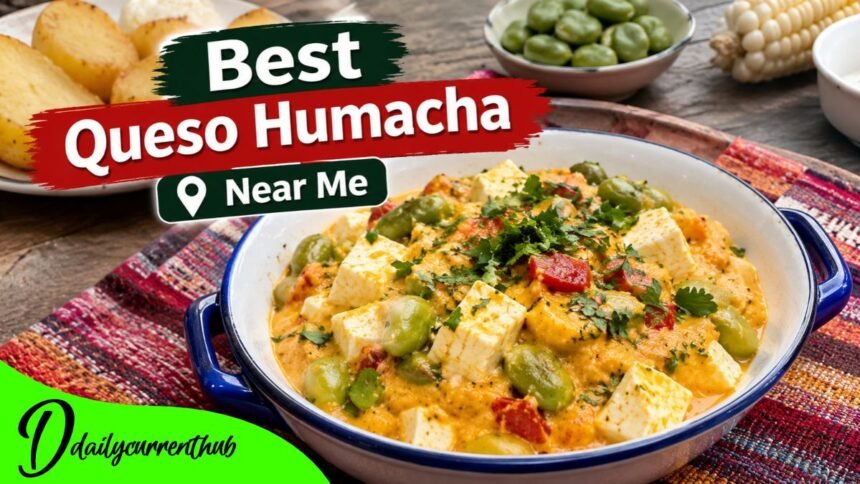
Searching for the best queso humacha near me can lead you to one of Bolivia’s distinctive traditional dishes. With its combination of fresh cheese, yellow chili, tender broad beans, potatoes, and Andean corn, queso humacha offers a comforting taste of Bolivian home cooking.
Closely associated with La Paz and the culinary traditions of the Bolivian Andes, this dish is especially significant during Semana Santa, or Holy Week. Its rich, savory sauce and satisfying vegetables make it a memorable choice for people interested in authentic South American cuisine.
Finding traditional queso humacha outside Bolivia can require careful searching. Not every Latin American restaurant serves regional Bolivian specialties, and menus can change according to seasonal ingredients and local demand.
This guide explores what makes queso humacha special, how it is traditionally prepared, what to look for when choosing a restaurant, and how to spot an authentic version near you.
What Is Queso Humacha?
Queso humacha is a traditional Bolivian dish made with fresh cheese and a savory sauce seasoned with ají amarillo, a yellow chili used in Andean cooking. Broad beans, potatoes, and corn contribute texture and make the dish substantial enough to serve as a main meal.
Unlike many cheese-based dishes that depend on a smooth, uniform sauce, queso humacha often retains visible pieces of cheese and vegetables. The cheese softens in the warm liquid while the potatoes and corn provide a satisfying contrast.
Its character comes from the combination of ingredients rather than elaborate presentation. A well-prepared serving lets the flavor of the cheese, the warmth of the chili, and the fragrance of the herbs remain recognizable.
For anyone searching for the best queso humacha near me, understanding this traditional composition is the first step towards distinguishing the authentic dish from unrelated cheese-based meals.
The Origins and Cultural Background of Queso Humacha
A Traditional Dish Associated With La Paz
Queso humacha belongs to Bolivia’s regional food heritage, particularly in La Paz. The city’s municipal tourism authority identifies it as a traditional preparation associated with the country’s Holy Week customs.
Historical accounts link the dish’s development to the colonial period, when European dairy ingredients entered Andean cooking. Over time, cheese and milk were combined with familiar regional foods such as potatoes, corn, beans, and chili.
The result reflects the meeting of different culinary traditions. Andean agricultural ingredients remain central to the finished meal, while the dairy component contributes its characteristic richness.
Its Connection With Semana Santa
During Semana Santa, Bolivian families traditionally prepare a selection of meat-free or meat-restricted dishes. Queso humacha is among the foods associated with these celebrations.
The dish is particularly suitable for this occasion because traditional versions rely on cheese and vegetables rather than meat as their main ingredients.
Municipal food events in La Paz have also featured queso humacha among the regional specialties offered during Holy Week.
Although closely tied to this religious season, the dish can be enjoyed year-round wherever it is prepared.
Traditional Ingredients and How Queso Humacha Is Prepared
Fresh Cheese, Yellow Chili, and Andean Vegetables
Queso humacha is built on queso criollo, a fresh cheese used in Bolivian cooking. Regional recipes combine it with milk, onions, ají amarillo, and tender broad beans.
Potatoes and choclo, the large-kernel corn associated with Andean cuisine, are prepared separately or incorporated into the finished dish.
Another distinctive ingredient is huacataya, an aromatic herb that contributes a recognizable herbal character. Some traditional recipes also include garlic, parsley, quirquiña, or boiled egg.
The precise quantities and preparation methods vary. This variation does not necessarily indicate a departure from tradition; regional and household recipes balance the same familiar ingredients in different ways.
The Traditional Cooking Method
Preparation generally begins by cooking onions with ají amarillo to make a seasoned base known as an ahogado. Then add the broad beans and cook until tender.
Milk, cheese, and sometimes vegetable stock are incorporated to create a moist, rich mixture. The cheese is heated carefully so that it softens without completely losing its texture.
Meanwhile, potatoes and corn are cooked until tender. Arrange them in a bowl or deep plate and cover with the cheese-and-bean mixture.
Fresh herbs provide the finishing touch. Depending on the recipe, a portion may also include a boiled egg.
The resulting meal combines several textures: tender vegetables, soft cheese, and a warm, lightly spicy sauce.
What Makes the Best Queso Humacha?
Ingredient Quality and Authentic Flavor
When comparing restaurants, ingredient quality matters more than elaborate decoration. Good queso humacha should feature cheese that complements the sauce without overwhelming the vegetables.
Ají amarillo should add flavor and color. The desired intensity varies between cooks, so the best level of heat is partly a matter of personal preference.
Broad beans should be properly cooked, while potatoes and corn should remain tender without becoming excessively soft.
Huacatay can make a noticeable difference to the overall flavor. A restaurant that uses this traditional herb may produce a more recognizably Andean result than one relying entirely on unfamiliar substitutes.
Balanced Texture and Traditional Presentation
Authentic queso humacha is not simply melted cheese poured over potatoes. The seasoned base, vegetables, cheese, and herbs work together to create the complete dish.
A good serving should contain enough liquid to coat the ingredients without completely masking their individual textures.
Presentation may differ between households and restaurants. Some versions are particularly saucy, while others are thicker. Appearance alone doesn’t determine which preparation is superior.
The most useful assessment considers flavor, cooking technique, ingredient balance, and how closely the preparation follows recognized Bolivian recipes.
How to Find the Best Queso Humacha Near Me
Search Beyond General Latin American Restaurants
The best starting point is to search specifically for Bolivian restaurants rather than assuming every South American or Latin American establishment makes queso humacha.
Restaurant directories, mapping services, and local food platforms can help identify businesses specializing in Bolivian cuisine.
Useful searches include “queso humacha near me,” “Bolivian restaurant near me,” “queso umacha,” and “traditional La Paz food.”
Alternative spellings matter because restaurants may use different names for the same traditional preparation.
After finding a suitable restaurant, check its current menu or contact the establishment directly. A business serving Bolivian food does not automatically offer queso humacha.
Examine Menus and Customer Photographs
Menu descriptions can reveal whether a restaurant offers a preparation resembling traditional queso humacha.
Look for references to fresh cheese, broad beans, potatoes, corn, ají amarillo, and huacataya.
Customer photographs can provide useful visual evidence, particularly when the dish’s name appears alongside a dated review. However, photographs alone cannot establish that an item is still available.
Reviews can help assess service and general food quality, but they should not replace confirmation from the restaurant.
For this article, no specific restaurant can be reliably ranked as the best without a defined search area, a confirmed current menu, and comparable evidence.
Recognizing Authentic Bolivian Restaurants
Understanding Regional Specialties
Bolivian cuisine contains substantial regional variety. A restaurant specializing in traditional La Paz cooking may be a useful place to investigate when searching for queso humacha.
Other recognizable Bolivian foods include salteñas, chairo, plato paceño, and different preparations featuring Andean potatoes and corn.
Their presence on a menu can indicate an interest in Bolivian culinary traditions, although it does not guarantee that queso humacha is served.
Asking the Right Questions
Before traveling, ask whether queso humacha will be available on your intended date. It is also worth confirming whether the dish contains huacatay, fresh cheese, and ají amarillo.
Customers with dietary requirements should request a complete ingredient list and ask about the stock used in the sauce.
A knowledgeable restaurant should be able to explain its preparation and identify any substitutions.
This approach is more dependable than choosing an establishment solely because it has a high overall rating.
Traditional Flavors and Serving Style
Queso humacha brings together mild dairy richness, the savory warmth of chili, and the natural flavors of vegetables.
Fresh cheese provides body, while potatoes absorb some of the seasoned sauce. Broad beans add substance, and corn introduces a different texture.
The herbal element contributes another layer, particularly when huacatay is used.
Traditional preparations are generally served warm, making them particularly appealing as a comforting main course.
The exact taste will depend on the cheese, chili preparation, herb selection, and cooking method. This explains why two restaurants can serve recognizable versions of queso humacha while producing noticeably different results.
Vegetarian and Dietary Considerations
Queso humacha is traditionally recognized as a meat-free dish, making it relevant to diners who prefer vegetarian meals.
However, a restaurant’s preparation should still be checked. Some recipes use vegetable stock, while other kitchens may make substitutions.
The dish also contains dairy products, so it is unsuitable for people who must avoid milk unless a specially adapted recipe is prepared.
Some versions include egg. Customers with allergies should verify both the ingredients and the possibility of cross-contact during preparation.
Vegetarian diners who avoid animal-derived rennet should also ask about the cheese used.
Traditional queso humacha is not vegan, and not every cheese-based preparation meets every vegetarian or religious dietary standard.
Ordering Queso Humacha for Takeaway or Delivery
Finding queso humacha through delivery services depends on which restaurants operate in the customer’s delivery area and what’s on their current menus.
When the dish is available, packaging matters because it combines a moist sauce with cooked vegetables and cheese.
A suitable takeaway container should prevent leakage and allow the food to be transported without excessive movement.
Customers may prefer to request separate packaging for certain components when a restaurant offers that option.
For longer journeys, prompt delivery and proper temperature control matter. Hot food should be handled safely and should not be left at room temperature for extended periods.
Checking the restaurant’s preparation time and delivery arrangements can help protect the meal’s quality.
The Cultural Importance of Traditional Bolivian Cooking
The continued preparation of queso humacha demonstrates how familiar ingredients can preserve regional culinary identity.
Potatoes, corn, and broad beans have deep connections with Andean agriculture. Their combination with cheese and chili reflects the historical development of Bolivian food traditions.
Family cooking, regional restaurants, and public food festivals all help these recipes remain part of contemporary life.
The dish’s association with Semana Santa gives it particular cultural meaning beyond its ingredients.
For diners outside Bolivia, experiencing a carefully prepared queso humacha offers an introduction to the traditions of La Paz and the wider Andean region.
The value of an authentic meal, then, isn’t limited to taste. It also lies in understanding the ingredients, methods, and cultural setting from which the preparation developed.
Conclusion
Finding the best queso humacha near me begins with knowing what makes this Bolivian specialty distinctive. Fresh cheese, ají amarillo, broad beans, potatoes, corn, and aromatic herbs combine to produce a satisfying dish rooted in Andean culinary traditions.
Its association with La Paz and Semana Santa gives queso humacha historical and cultural importance, while its comforting flavors make it enjoyable beyond traditional celebrations.
The most reliable way to discover a good serving is to search for Bolivian restaurants, examine menus carefully, and confirm availability directly. Ingredient quality, careful preparation, and respect for recognized regional recipes matter more than unsupported claims about which restaurant is the best.
Whether enjoyed in a traditional Bolivian dining room, at a cultural food event, or prepared at home, queso humacha offers an appealing introduction to the richness of Bolivia’s culinary heritage.
(FAQs)
1. What is queso humacha?
Queso humacha is a traditional Bolivian cheese-based dish made with fresh cheese, ají amarillo, broad beans, potatoes, corn, and aromatic herbs.
2. Where does queso humacha originate?
It comes from Bolivia and is particularly associated with the traditional cuisine of La Paz and the Andean region.
3. How can I find the best queso humacha near me?
Search for Bolivian restaurants using local restaurant directories and mapping services. Check current menus and confirm availability directly before visiting.
4. Is queso humacha spicy?
It contains ají amarillo, which contributes chili flavor and can provide heat. Spiciness depends on the preparation.
5. Is queso humacha vegetarian?
Traditional versions are meat-free, but customers should verify the stock, cheese ingredients, and preparation methods before assuming a particular serving meets their dietary requirements.
6. What type of cheese is used in queso humacha?
Traditional recipes commonly use queso criollo, a fresh cheese associated with Bolivian cuisine.
7. Is queso humacha served only during Semana Santa?
No. Although it is strongly associated with Holy Week traditions in Bolivia, you can also prepare and enjoy the dish at other times of the year.
8. Can I prepare queso humacha at home?
Yes. Traditional recipes describe preparing a seasoned onion-and-chili base, adding broad beans, milk, and cheese, then serving the mixture with cooked potatoes and corn.