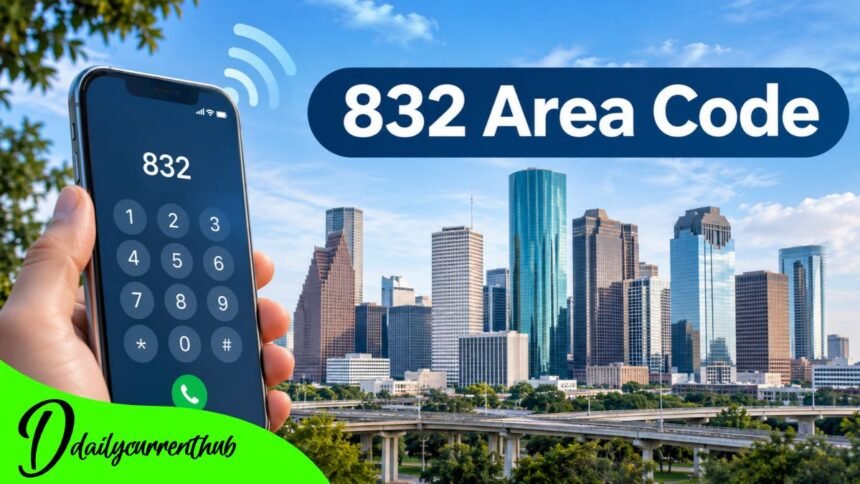
The 832 area code serves Houston, Texas, and numerous surrounding communities. Introduced on January 16, 1999, it became part of the Houston region’s expanding telephone numbering system, helping accommodate demand for additional phone numbers.
Today, the 832 area code is used within a region that also includes area codes 713, 281, 346, and 621. These numbers serve the same general geographic territory through an area code overlay, allowing multiple area codes to operate in one region without requiring existing customers to change their telephone numbers.
Whether you have received an unfamiliar call beginning with 832, are considering a Houston business phone number, or want to understand the region’s telephone system, knowing the facts can be useful.
This guide explains the 832 area code’s geographic coverage, history, dialing requirements, time zone, and practical tips for identifying and handling calls.
What Is the 832 Area Code?
The 832 area code is a three-digit geographic telephone code assigned to the greater Houston metropolitan region of Texas. It forms part of the North American Numbering Plan, which organizes telephone numbers across the United States, Canada, and several other participating territories and countries.
In a standard American telephone number, the area code appears before the seven-digit local number. It identifies the numbering region associated with the telephone number, not the precise address of the person or business using it.
Area code 832 was introduced to increase the supply of telephone numbers available in Houston. Its introduction was particularly significant because it accompanied a restructuring of how the existing 713 and 281 area codes operated.
Rather than assigning 832 to an entirely separate geographic district, telecommunications administrators made it available across the territory already associated with the existing codes.
That arrangement remains central to understanding why Houston residents and businesses can have different area codes despite operating in the same neighborhood.
Where Is the 832 Area Code Located?
The 832 area code covers Houston and surrounding communities in southeastern Texas. Houston is the region’s largest city and the principal geographic reference for this telephone code.
The broader overlay territory includes communities such as Baytown, League City, Missouri City, Pasadena, Pearland, Sugar Land, and The Woodlands.
These communities are not exclusively assigned to 832. Because Houston uses overlapping area codes, telephone numbers in the same community may begin with 281, 346, 621, 713, or 832.
According to the Public Utility Commission of Texas, the wider Houston numbering region extends into several counties, including Harris, Fort Bend, Brazoria, Chambers, Galveston, Liberty, Montgomery, San Jacinto, Waller, and Austin.
This geographic arrangement explains why identifying a particular city solely from the first three digits of a Houston-area telephone number can be misleading.
A person in Sugar Land and a business in central Houston can both use 832 numbers, while their nearby neighbors may use completely different area codes.
History and Introduction of Area Code 832
Houston’s telephone numbering history began long before 832 was introduced.
Area code 713 was established in 1947 as one of Texas’s original area codes under the North American Numbering Plan. As regional telephone demand developed, numbering administrators introduced additional codes to serve Houston and the surrounding territory.
Area code 281 entered service in 1996, initially separating much of Houston’s suburban region from the territory associated with 713.
The next major change occurred on January 16, 1999.
According to the North American Numbering Plan Administrator’s planning documentation, the geographic boundary separating 713 and 281 was eliminated, and the new 832 area code was introduced across their combined territory.
This change established an overlay arrangement rather than creating another permanent geographic division.
It also brought mandatory ten-digit local dialing to the affected region.
Houston’s numbering system expanded again in 2014 with area code 346. Another addition followed on January 23, 2025, when area code 621 became available for new telephone numbers within the existing overlay region.
These developments show how the numbering system has been adjusted over time without requiring every existing telephone customer to adopt a new area code.
How the Houston Area Code Overlay System Works
An area code overlay allows two or more area codes to cover the same geographic territory.
In Houston, the overlay system now includes five area codes: 281, 346, 621, 713, and 832.
The main benefit of this arrangement is that additional telephone numbers can be introduced while existing numbers remain unchanged.
For example, a longtime Houston resident can retain a 713 telephone number while a nearby business receives a new number beginning with 832 or 621.
Both numbers can operate within the same general geographic region.
The introduction of 621 in January 2025 clearly illustrates this process. Texas regulators confirmed that existing telephone numbers would remain unchanged and that new customers could receive numbers with the additional code.
An overlay also means that an area code is no longer a reliable way to distinguish central Houston from its surrounding suburbs.
The complete number, carrier information, and associated service records are more relevant when trying to understand an individual telephone number’s assignment.
Calling and Dialing Rules for the 832 Area Code
The Houston area uses ten-digit dialing for local telephone calls within its overlay region.
This means callers should enter the three-digit area code followed by the seven-digit telephone number, even when both parties are located nearby.
The basic format is:
832-XXX-XXXX
When making a call from outside the United States using international dialing, the country code for the North American Numbering Plan is +1.
A telephone number can therefore be written internationally as:
+1 832 XXX XXXX
The Public Utility Commission of Texas states that customers in the Houston overlay region continue using ten digits for local calls and 1 followed by ten digits for long-distance calls.
Emergency and designated service numbers are handled differently.
People can continue using 911 for emergencies and 988 for the Suicide & Crisis Lifeline. Other three-digit service codes, such as 211, 311, 411, 511, 611, 711, and 811, remain available where the relevant services operate.
These established dialing arrangements were not changed by the introduction of area code 621.
What Time Zone Does the 832 Area Code Follow?
The geographic region associated with the 832 area code follows Central Time, the standard time zone for Houston.
Central Time changes seasonally because Texas observes daylight saving time.
Time PeriodTime ZoneUTC Offset
Standard Time Central Standard Time (CST) UTC−6
Daylight Saving Time Central Daylight Time (CDT) UTC−5
Central Standard Time generally applies during the colder months, while Central Daylight Time applies during the daylight saving period.
For businesses communicating with Houston customers, this distinction is important when scheduling calls, appointments, customer support, and virtual meetings.
Someone calling an 832 number from another state or country should check Houston’s current local time rather than assuming it matches their own.
The time zone identifies the geographic region associated with the area code. It does not prove that a mobile phone user is physically in Houston when receiving a call.
Is the 832 Area Code Toll-Free?
No. 832 is a geographic area code, not a toll-free area code.
Toll-free numbers in the North American Numbering Plan use designated codes such as 800, 888, 877, 866, 855, 844, and 833.
An 832 number does not fall into that category.
However, that doesn’t automatically mean every call to an 832 number carries an additional charge.
The cost depends on the caller’s telephone service, calling plan, and whether the call is classified as local, long-distance, or international.
Some telephone plans include domestic calling allowances, while other services may charge differently.
When Texas introduced the 621 overlay, regulators said the additional area code would not change existing calling rates or determine which calls qualified as local calls.
Customers should consult their service provider for specific pricing information.
Can an 832 Phone Number Reveal a Caller’s Exact Location?
An 832 telephone number indicates an association with the greater Houston numbering region, but it does not establish someone’s current physical location.
This distinction matters because modern telephone services are no longer limited to traditional landline connections.
People may keep their telephone numbers after changing providers, while mobile phones let customers use their numbers when traveling outside their original service region.
Internet-based calling services can also separate the number displayed to a recipient from the user’s physical location.
Consequently, a person with an 832 number might be working elsewhere in Texas, traveling across the United States, or communicating from another country.
The first three digits can help identify the number’s geographic numbering assignment, but they should not be treated as evidence of a caller’s present whereabouts.
They also cannot establish a caller’s name, occupation, or identity on their own.
Unknown Calls, Caller ID Spoofing, and Phone Scams
Receiving an unexpected call from the 832 area code does not automatically mean the call is suspicious.
Houston-area telephone numbers are legitimately used by individuals, companies, organizations, and service providers.
Nevertheless, consumers should understand that caller ID information can be manipulated.
The Federal Trade Commission warns that scammers can use a technique called caller ID spoofing, which allows a call to display a telephone number different from the actual originating number.
This can make an unfamiliar call appear to come from a familiar location or trusted organization.
One form of this practice involves presenting a number that resembles the recipient’s local area code, making the call look geographically familiar.
As a result, seeing 832 on a phone screen does not guarantee the caller is in Houston or legitimately controls the displayed number.
Consumers should be cautious when an unexpected caller requests bank details, account passwords, verification codes, or other sensitive personal information.
If someone claims to represent a bank, government office, or company, it is safer to end the conversation and contact the organization through independently verified contact information.
Suspicious calls can also be reported through the Federal Communications Commission’s consumer complaint system or the Federal Trade Commission.
The appropriate response depends on the caller’s behavior, not simply the area code appearing on the screen.
The 832 Area Code for Houston Businesses
Telephone numbers remain an important part of business communication, particularly for organizations serving customers in a defined geographic market.
An 832 number identifies a business telephone line with the greater Houston numbering region, although it does not independently verify the company’s physical headquarters.
A local business might use such a number for customer inquiries, appointment scheduling, sales communication, or support services.
Because 832 shares its territory with several other Houston area codes, no company in the region must use the same three-digit prefix.
Businesses should also remember that acquiring a telephone number with a Houston area code does not automatically establish a physical office, professional license, or verified commercial presence in Texas.
Customers evaluating an unfamiliar company should consider its independently verifiable contact details and business records rather than relying only on its telephone number.
For existing companies, consistency is important. Telephone numbers should be accurately displayed on websites, directories, invoices, and customer communications.
The Future of Houston’s Telephone Numbering System
The introduction of area code 621 in January 2025 represents the latest confirmed expansion covered in this guide.
Its implementation added another source of telephone numbers to the existing Houston overlay territory.
The Public Utility Commission of Texas confirmed that the change would not require existing customers to replace their telephone numbers or alter their established calling arrangements.
Numbering administrators monitor the availability and use of telephone numbers when evaluating whether additional capacity will be needed.
Future changes depend on numbering demand, available resources, telecommunications planning, and applicable regulatory decisions.
For existing 832 customers, the important point is that the current overlay arrangement allows different Houston area codes to continue operating together.
There is no basis for assuming that introducing another area code automatically makes established 832 numbers invalid.
Conclusion
The 832 area code is an established part of Houston’s telecommunications infrastructure. Since its introduction on January 16, 1999, it has served the greater Houston metropolitan region alongside other area codes.
Its development reflects changes in telephone numbering administration, particularly the move from geographically separated codes to an overlapping numbering system. Today, 832 shares its territory with 281, 713, 346, and 621, allowing multiple telephone prefixes to serve the same communities.
Understanding this system helps residents, businesses, and callers identify the geographic association of telephone numbers without making incorrect assumptions about their owners.
The most useful facts are straightforward: 832 is associated with Houston, follows Central Time, requires ten-digit local dialing, and is not a toll-free code.
For anyone receiving an unfamiliar call, the area code provides geographic context, not proof of identity. Verifying unexpected callers remains the most reliable approach.
(FAQs)
1. Where is the 832 area code located?
The 832 area code serves Houston, Texas, and surrounding communities within the greater Houston metropolitan region.
2. What state uses the 832 area code?
Area code 832 is assigned to Texas, United States, primarily serving the Houston metropolitan area.
3. When was the 832 area code introduced?
The 832 area code entered service on January 16, 1999, as an overlay serving the territory associated with area codes 713 and 281.
4. What cities use the 832 area code?
The geographic overlay region includes Houston and communities such as Pasadena, Pearland, Baytown, Sugar Land, League City, Missouri City, and The Woodlands.
5. Is the 832 area code a scam number?
No. Area code 832 is a legitimate geographic telephone code. However, scammers can manipulate caller ID, so evaluate unknown callers individually.
6. What time zone is area code 832 in?
The Houston region follows Central Time, using Central Standard Time (UTC−6) and Central Daylight Time (UTC−5), depending on the season.
7. Is area code 832 toll-free?
No. Area code 832 is a geographic code. Whether a call costs extra depends on the telephone provider, calling plan, and the Type of call.
8. What other area codes serve the same area as 832?
Area codes 281, 346, 621, and 713 share the greater Houston overlay region with 832. The most recent addition, 621, began service on January 23, 2025.