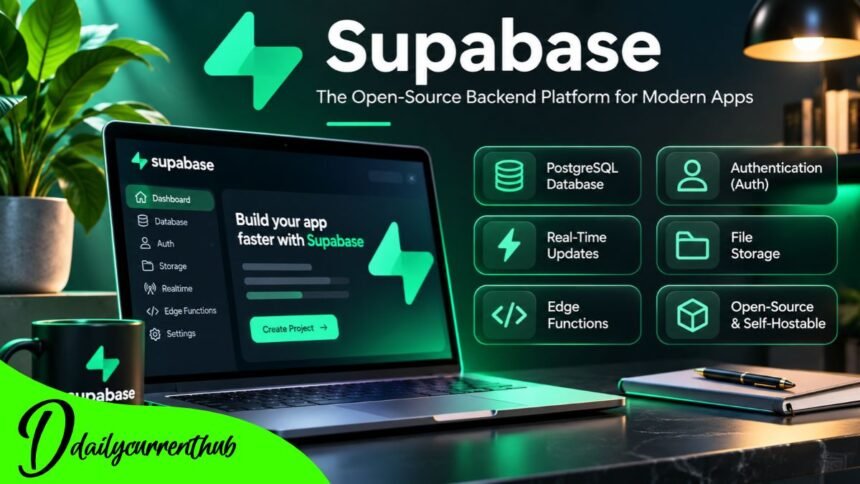
Building a modern application requires more than an attractive interface. Behind every successful digital product is a backend that manages data, authenticates users, stores files, and connects different services. Supabase addresses many of these requirements through an integrated development platform built around PostgreSQL.
Launched in 2020, Supabase emerged as an open-source alternative to Firebase. Its approach differs from traditional proprietary backend platforms because it uses PostgreSQL, a widely used open-source relational database management system.
Developers can use Supabase to build web applications, mobile applications, software-as-a-service platforms, and products that require live data updates. Rather than configuring several independent backend services, they can access a collection of connected tools through one platform.
This article explores what Supabase is, how its technology works, its development history, pricing, security features, advantages, limitations, and role in modern software development.
What Is Supabase?
Supabase is a PostgreSQL-based development platform that provides essential backend services for building applications. Its primary components include a managed database, user authentication, file storage, realtime communication, and server-side functions.
The platform is designed to reduce the amount of infrastructure developers need to configure themselves.
For example, a developer creating an online learning application might need user accounts, course records, uploaded documents, and a system for tracking student progress. Supabase provides services that can support each of these requirements within a connected environment.
Its PostgreSQL foundation is especially significant. PostgreSQL supports relational tables, structured queries, transactions, indexing, and data integrity constraints. Developers retain access to these established database capabilities while benefiting from Supabase’s additional services.
Supabase is not a complete replacement for every backend system. Applications may still require custom business logic, external integrations, and careful infrastructure planning.
History and Background of Supabase
Supabase began development in January 2020, with Paul Copplestone and Ant Wilson playing central roles in establishing the company.
The project entered a software development market where teams increasingly expected cloud services to handle routine infrastructure tasks. Firebase had already demonstrated the appeal of integrated backend tools, but developers also wanted an approach based on PostgreSQL and open-source software.
Supabase pursued that opportunity by combining established technologies rather than creating an entirely new database system.
Its architecture brings together PostgreSQL and supporting services for database APIs, authentication, storage, and realtime communication.
The company has continued developing its platform through community participation, product releases, and commercial investment.
An important distinction is that Supabase’s open-source foundations and its managed commercial service are related but not identical. The managed service provides operational features and infrastructure that developers would otherwise need to maintain.
How Supabase Works Behind the Scenes
Supabase’s architecture centers on PostgreSQL.
When a developer creates a Supabase project, the platform provisions a database and provides access to connected backend services.
The database can store application records, including user profiles, product information, messages, and transactions. Supabase can automatically expose suitable database objects through a REST API using PostgREST.
Client applications interact with those APIs, while PostgreSQL permissions and Row Level Security (RLS) policies help control access.
Supabase also provides client libraries that simplify common operations such as reading database records, authenticating users, and uploading files.
This architecture allows frontend developers to work directly with selected backend services without building a custom API endpoint for every database operation.
However, applications with specialized requirements may still benefit from dedicated backend services, database functions, or Edge Functions.
PostgreSQL Database and Automatic APIs
The PostgreSQL database is one of Supabase’s defining features.
Unlike systems built primarily around document databases, PostgreSQL provides a relational model where developers can establish connections between tables using keys and constraints.
Consider an e-commerce application containing customers, orders, and products. Relational tables let the application organize these records consistently and retrieve connected information with SQL queries.
Supabase supports database management through a visual Table Editor and a SQL Editor.
Its automatically generated REST API can reduce repetitive development work. When developers create supported database tables and configure the necessary permissions, those tables can be accessed through the API.
Because the underlying database is PostgreSQL, developers can also use familiar SQL tools and supported extensions.
This foundation gives applications flexibility when they rely on complex relationships, reporting queries, and structured business data.
Supabase Authentication and User Management
User authentication is essential for applications containing personal accounts or restricted information.
Supabase Auth provides tools for implementing account registration, sign-in, and session management.
Supported authentication methods include email and password, magic links, one-time passwords, social login through supported providers, and single sign-on options.
For example, a membership website can use Supabase Auth to register members and manage their authentication sessions.
The authentication service works alongside PostgreSQL security policies to control which information authenticated users can access.
This distinction matters because verifying a user’s identity does not automatically authorize access to every database record.
Developers must set appropriate access rules, protect privileged credentials, and configure authentication settings to meet their application’s requirements.
Realtime Features and Live Application Updates
Modern applications increasingly require information to appear without users manually refreshing a page.
Supabase Realtime provides capabilities built around WebSocket communication.
Its features include Broadcast, Presence, and Postgres Changes.
Broadcast allows applications to send messages to connected clients. Presence lets applications track shared connection state, such as which participants are active in a collaborative workspace.
Postgres Changes allows clients to subscribe to configured database changes.
These capabilities can support chat interfaces, collaborative tools, live dashboards, and activity indicators.
Realtime functionality still requires thoughtful implementation. Developers must consider authorization, connection limits, message volume, and whether every database change genuinely needs to be transmitted to connected users.
File Storage and Edge Functions
Many applications need to store content beyond ordinary database records.
Supabase Storage supports managing files through storage buckets. Developers can use it for images, documents, and other application files.
Storage access can be configured through public or private buckets, with security policies controlling access where appropriate.
A private document repository, for example, can use authentication and access rules to restrict which users can retrieve uploaded files.
Supabase also offers Edge Functions, which let developers run server-side TypeScript code.
These functions can communicate with external services, process requests, and handle operations that should not expose sensitive credentials to a user’s browser.
For a subscription-based application, server-side functions may help process payment-provider webhooks or other integrations.
Together, Storage and Edge Functions extend Supabase beyond basic database management.
Security and Data Privacy in Supabase
Security is one of the most important responsibilities in application development.
Supabase provides mechanisms that support secure development, including PostgreSQL permissions, authentication systems, and Row Level Security.
Row Level Security allows developers to define policies that restrict access to individual database rows.
For example, an application can set a policy that lets users read only their own profile records without accessing other users’ private information.
Proper configuration is essential. A database exposed through an API can create serious risks if permissions are too broad or security policies are missing.
Developers should also protect secret keys, review authentication configurations, maintain backups, and test authorization rules before deploying to production.
Supabase provides documentation and operational tools to support these tasks, but using the platform does not automatically make an application secure or legally compliant.
Artificial Intelligence and Vector Search
Supabase also supports AI-driven development workflows.
Its PostgreSQL ecosystem includes the pgvector extension, which lets you store and query vector embeddings within the database.
Embeddings represent information numerically and are commonly used for similarity searches.
For example, a developer building a document-search system can store embeddings associated with documents and compare them against a user’s search query.
This capability can support semantic search, recommendation systems, and retrieval components used in AI applications.
Supabase does not automatically provide every part of an AI system. Developers still need suitable models, data-processing workflows, and application logic.
Its practical advantage is combining conventional relational records with vector search in a PostgreSQL environment.
Supabase vs Firebase: Understanding the Differences
Supabase and Firebase both help developers avoid building every backend component from scratch, but their technical foundations differ.
Firebase is part of Google’s application development ecosystem and includes products such as Cloud Firestore, authentication, and Cloud Functions.
Supabase centers its development experience on PostgreSQL and SQL-based data management.
This difference influences data modeling, queries, and application architecture.
Developers comfortable with relational databases may appreciate Supabase’s SQL capabilities. Firebase can appeal to teams whose requirements align with its document-oriented database services and broader Google ecosystem.
Neither platform is universally superior.
The appropriate choice depends on factors such as application architecture, existing development experience, scalability requirements, hosting preferences, and long-term operational costs.
Supabase Pricing and Available Plans
Supabase offers several pricing tiers designed for different development requirements.
Its Free plan provides an entry point for experimentation, learning, and smaller projects.
The Pro plan starts at $25 per month and includes larger resource allowances and additional operational features.
The Team plan starts at $599 per month and is designed for organizations requiring additional collaboration, security, and administrative capabilities.
Enterprise pricing is customized according to business requirements.
These figures represent published starting prices, not guaranteed total project costs. Actual charges can depend on database resources, storage, bandwidth, compute, and other usage.
Developers should examine current limits and billing policies before selecting a production plan.
Advantages and Limitations of Supabase
One of Supabase’s clearest advantages is its integrated approach.
Developers can manage database records, authentication, storage, and selected realtime functionality within a connected platform.
PostgreSQL support also offers access to established database tools and relational data capabilities.
Another advantage is the availability of open-source components and self-hosting options, which can provide greater deployment flexibility.
However, these benefits come with responsibilities.
A developer still needs to understand SQL, database relationships, security policies, and performance considerations.
Resource usage can affect hosting costs, while applications with complex requirements may need custom services beyond Supabase’s built-in functionality.
Self-hosting introduces additional operational work, including infrastructure security, maintenance, monitoring, and backups. It also doesn’t provide the same experience or capabilities as the managed service.
Supabase is therefore best understood as a platform that simplifies important backend tasks rather than eliminating backend engineering.
How to Get Started with Supabase
Developers generally begin by creating a Supabase account and setting up a project.
Once the database is provisioned, they can use the dashboard to create tables and define relationships.
Next, they connect an application through a supported client library or API.
For applications containing user accounts, developers can configure Supabase Auth and establish Row Level Security policies.
Storage buckets, realtime subscriptions, and Edge Functions can be added as needed.
Supabase also provides a command-line interface for local development and related workflows.
A sensible development approach is to begin with a small feature, test database access and authorization, and gradually add services as the application becomes more complex.
Before launching, developers should review security, performance, backups, resource limits, and production configuration.
The Future of Supabase in Modern Development
Supabase operates within a development environment increasingly shaped by cloud infrastructure, open-source software, and AI-assisted application building.
Its PostgreSQL foundation places it within a mature database ecosystem, while its integrated services address common backend development requirements.
The platform’s support for vector search also makes it relevant to developers building applications that combine traditional records with AI-related functionality.
Continued development of its tools and infrastructure may influence how teams approach application architecture, although no particular future market outcome can be guaranteed.
Supabase’s long-term relevance will depend on practical factors, including reliability, security, developer experience, costs, and its ability to meet evolving application requirements.
Conclusion
Supabase has established itself as a PostgreSQL-based backend development platform that combines essential application services in a single environment.
Its database, authentication, file storage, realtime communication, and Edge Functions give developers tools to build a wide range of digital products.
The platform’s relationship with open-source technologies matters because it lets developers work with established systems rather than relying entirely on proprietary database architecture.
At the same time, using Supabase successfully requires sound technical decisions. Security policies must be configured correctly, application performance must be monitored, and hosting expenses must be evaluated regularly.
For developers who want an integrated backend built around PostgreSQL, Supabase represents a practical option. Its greatest value isn’t removing the need for engineering expertise, but making common backend capabilities easier to assemble, manage, and extend.
(FAQs)
1. What is Supabase used for?
Supabase is used to build and manage application backends, including databases, authentication systems, file storage, realtime features, and server-side functions.
2. Is Supabase free to use?
Yes. Supabase provides a Free plan with resource and usage limits. Paid plans offer more capacity and additional features.
3. Who founded Supabase?
Supabase was co-founded by Paul Copplestone and Ant Wilson. Development began in 2020.
4. Is Supabase better than Firebase?
Neither is universally better. Supabase uses PostgreSQL as its database foundation, while Firebase offers products based on different database and infrastructure technologies. The choice depends on application requirements.
5. Which database does Supabase use?
Supabase uses PostgreSQL, an open-source relational database management system.
6. Can Supabase be used for AI applications?
Yes. Supabase supports vector storage and similarity search using PostgreSQL extensions such as pgvector, which can be useful in AI applications.
7. Is Supabase secure for production applications?
Supabase provides authentication, database permissions, and Row Level Security. Production security also depends on correct configuration, access controls, and application-level safeguards.
8. Can developers self-host Supabase?
Yes. Supabase provides self-hosting documentation and tools, but self-hosted deployments require infrastructure management and don’t offer full feature parity with the managed platform.