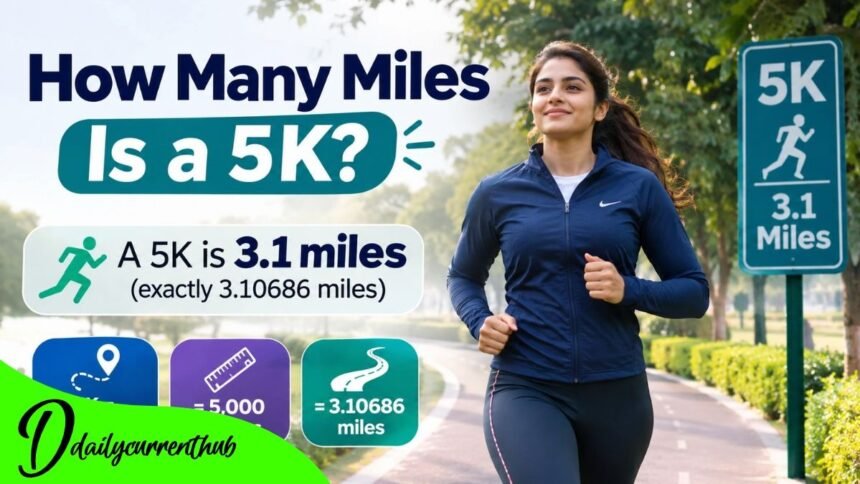
How many miles is a 5K? A 5K is approximately 3.1 miles, equivalent to exactly 5 kilometers or 5,000 meters. The more precise conversion is 3.10686 miles. Whether you are signing up for your first running event, measuring a walking route, or working toward a fitness goal, knowing this distance makes planning much easier.
The 5K is a widely used distance in recreational running, community races, charity events, and competitive athletics. It offers a clear target without the extensive preparation required for a half marathon or marathon.
For beginners, completing a 5K can represent a meaningful personal achievement. Experienced runners may use the same distance to test their pace, endurance, and racing performance.
This article explains the exact conversion, how 5K compares with other race distances, typical completion-time calculations, treadmill measurements, and practical preparation methods.
How Many Miles Is a 5K Exactly?
A 5K measures 5 kilometers. Converting that distance into miles gives approximately 3.106856 miles, usually rounded to 3.1 miles for everyday use.
The calculation relies on the international mile, which equals exactly 1.609344 kilometers. This conversion is recognized by the United States National Institute of Standards and Technology (NIST).
The mathematical formula is:
5 kilometers ÷ 1.609344 = 3.106856 miles
Rounding the result to one decimal place gives the familiar 3.1-mile distance.
The distinction matters when measuring a course precisely. An exact 3.1-mile route is approximately 11 meters shorter than 5,000 meters. For casual exercise, that difference is small. For accurately measured races, however, the full 5-kilometer distance is the correct reference.
Why Is It Called a 5K?
The letter K represents kilometers, a metric unit of distance. One kilometer contains exactly 1,000 meters, so five kilometers equal 5,000 meters.
Race organizers use the term 5K because it is shorter and easier to recognize than writing out five kilometers.
This naming pattern also applies to other running events, including 10K races covering 10 kilometers and 15K races covering 15 kilometers.
The name identifies distance, not speed or difficulty. A person walking five kilometers and another person running the same route cover the same distance, even though their finishing times differ.
Understanding the 5K Distance
How Does a 5K Compare With Other Running Distances?
Understanding how a 5K compares with other distances can help participants choose realistic fitness goals.
Race distance (kilometers) Approximate miles
1K 1 0.62
3K 3 1.86
5K 5 3.11
10K 10 6.21
Half marathon 21.0975 13.11
Marathon 42.195 26.22
A 10K covers exactly twice the distance of a 5K. A half marathon covers a little more than four times the distance, while a full marathon is approximately 8.44 times longer.
These comparisons show why the 5K can be a practical starting point for distance running. Participants can develop experience over a defined course before considering longer events.
Is a 5K the Same as a 5,000-Meter Race?
In terms of distance, yes. Both cover exactly 5,000 meters.
In athletics terminology, however, the events are distinguished by where they take place.
World Athletics identifies the 5,000-meter race as a track event, typically requiring 12.5 laps around a standard 400-meter track. A 5km road race takes place on a measured road course.
Road conditions, turns, elevation changes, and weather can affect how the race feels. The official distance remains the same.
How Long Does It Take to Complete a 5K?
The time required to finish depends primarily on pace, although terrain, conditions, experience, and fitness can also influence performance.
No single finishing time defines a successful 5K. Competitive athletes may prioritize speed, while recreational participants may focus on finishing comfortably.
Estimated 5K Completion Times by Pace
The following table calculates finishing times based on maintaining a constant pace throughout the full five kilometers.
Pace per kilometer5K completion time
4 minutes 20 minutes
5 minutes 25 minutes
6 minutes 30 minutes
7 minutes 35 minutes
8 minutes 40 minutes
9 minutes 45 minutes
10 minutes 50 minutes
12 minutes 60 minutes
These are mathematical examples, not guaranteed performance times or population averages.
A runner maintaining a six-minute-per-kilometer pace finishes in 30 minutes. Someone maintaining a ten-minute-per-kilometer pace finishes in 50 minutes.
Small pace adjustments can make a noticeable difference over the full distance.
How to Calculate Your 5K Finishing Time
One simple approach is to multiply the number of kilometers by your average pace per kilometer.
Finishing time = Distance × Average pace
For example, someone maintaining eight minutes per kilometer would calculate:
5 × 8 minutes = 40 minutes.
Runners who track pace in minutes per mile can use approximately 3.106856 miles instead.
Consistent pacing offers a useful way to estimate finishing time, although actual results can vary when people slow down, stop, or encounter changes in terrain.
Running and Walking a 5K
Can Beginners Complete a 5K?
Yes. A 5K can be a suitable goal for beginners, particularly when preparation matches their current fitness and physical capabilities.
Completing the distance does not require continuous running. Participants may walk, jog, or alternate between the two.
A beginner might start with short, manageable walking sessions and gradually add running intervals. This approach allows training to progress without requiring an immediate attempt at the full distance.
A structured beginner program can also help participants understand when to exercise, recover, and increase activity.
Is Walking a 5K Still an Achievement?
Walking five kilometers requires covering the same distance as running five kilometers.
For many people, walking is a practical form of physical activity that can be incorporated into regular routines.
The time needed will depend on individual walking speed, breaks, and route conditions. At a constant pace of 10 minutes per kilometer, the full walk takes 50 minutes. At 12 minutes per kilometer, it takes one hour.
Walking can be especially useful for people building a consistent activity habit. The goal does not need to be speed; completing an appropriate distance regularly can be valuable in itself.
Participants entering an organized race should check whether the event welcomes walkers and whether a course time limit applies.
How to Prepare for Your First 5K
Build Distance Gradually
A beginner-friendly approach starts with a manageable amount of activity and gradually increases the workload.
Rather than immediately attempting five kilometers at a running pace, participants can begin with walking and short jogging intervals.
For example, a training session might alternate a brief jog with a longer walking recovery. As fitness improves, the jogging portions can become longer.
The appropriate progression differs between individuals. Someone who already walks regularly may need a different starting point than someone returning to exercise after a long break.
Structured programs such as the NHS Couch to 5K plan provide an established introduction to gradual running training.
Balance Training With Recovery
Improvement depends on more than completing increasingly difficult workouts.
Recovery gives the body time to adapt between sessions. Beginners should avoid assuming every training day must be faster or longer than the last.
Rest days, comfortable training intensity, and attention to persistent discomfort are important parts of a sensible approach.
People with medical conditions, significant mobility limitations, or concerns about exercise safety may benefit from discussing an appropriate starting level with a healthcare professional.
Prepare for Race Day
Before participating in a 5K, reviewing the event information can prevent avoidable problems.
Participants should understand where the event starts, how the course is marked, whether water is available, and what rules apply.
Comfortable footwear appropriate for walking or running can also make the experience more manageable.
On the day itself, beginning at a sustainable pace is generally more useful than starting aggressively and becoming exhausted early.
Finishing comfortably is a reasonable first objective. Personal speed targets can develop with further training and experience.
Measuring a 5K on a Treadmill or Track
How Far Is a 5K on a Treadmill?
A 5K on a treadmill is the same nominal distance as a 5K outdoors: five kilometers or approximately 3.1 miles.
If the treadmill displays kilometers, the distance target is simply 5.00.
If it displays miles, the more precise target is approximately 3.107 miles. A display that rounds to one decimal place will typically show 3.1 miles.
Treadmill distance readings depend on the machine’s measurement and calibration. Displaying the correct number does not independently verify its real-world accuracy.
How Many Track Laps Make a 5K?
On a standard 400-meter athletics track, a 5K covers 12.5 laps.
Each full lap equals 400 meters when measured along the designated measurement line.
Twelve laps cover 4,800 meters. Another 200 meters completes the full 5,000-meter distance.
This straightforward calculation makes a standard track useful for runners who want to practice maintaining a consistent pace over measured intervals.
Common 5K Mistakes and Practical Tips
Confusing Three Miles With a Full 5K
Three miles and five kilometers are not identical.
Three miles equal approximately 4.828 kilometers, leaving about 172 meters to reach the full 5K distance.
When planning a precisely measured course, using kilometers avoids unnecessary rounding errors.
Starting Faster Than You Can Sustain
New runners sometimes begin too quickly because they feel energetic at the start.
An excessively fast opening section can make the remaining distance harder to complete at the intended pace.
Practicing a comfortable, sustainable rhythm during training helps participants understand the effort required to cover the entire route.
Comparing Yourself With Other Participants
A 5K includes people with different objectives, experience levels, and physical capabilities.
Someone aiming for a personal record and someone completing their first recreational walk may approach the event very differently.
A useful measure of progress is how a person’s own performance, comfort, or consistency changes over time.
Conclusion
Knowing how many miles are in a 5K provides a useful foundation for planning running events, walking routes, and fitness activities. The distance is exactly five kilometers or 5,000 meters, equivalent to approximately 3.106856 miles.
Although people commonly describe a 5K as 3.1 miles, the precise measurement becomes helpful when calculating pace, marking a course, or using a fitness tracker.
A 5K offers flexibility because participants can approach it based on their experience and goals. Some run competitively, others jog at a steady rhythm, and many complete the distance by walking.
For beginners, gradual preparation, sustainable pacing, and appropriate recovery provide a sensible foundation. Experienced runners can use the same distance to track performance changes.
Ultimately, the 5K is more than a measurement on a race registration page. It is a clearly defined distance that people can use to set realistic, measurable goals and track their progress over time.
(FAQs)
1. How many miles is a 5K exactly?
A 5K equals approximately 3.106856 miles. It is commonly rounded to 3.1 miles.
2. Is a 5K exactly three miles?
No. Three miles equals about 4.828 kilometers, making it about 172 meters shorter than a full 5K.
3. How many steps are in a 5K?
The number depends on individual step length. For example, an average step length of 0.75 meters requires about 6,667 steps to cover 5,000 meters.
4. How long does it take to walk a 5K?
At a steady pace of 10 minutes per kilometer, a 5K walk takes 50 minutes. Individual walking times vary.
5. Can you complete a 5K without running?
Yes. You can walk or alternate between walking and jogging to cover the full distance. Organized events may have their own participation rules.
6. How many laps is a 5K on a running track?
A 5K requires 12.5 laps of a standard 400-meter running track.
7. Is a 5K or 10K longer?
A 10K is longer. It covers 10 kilometers, exactly twice the distance of a 5K.
8. What treadmill distance should I use for a 5K?
Set your treadmill distance goal to 5.00 kilometers or approximately 3.107 miles, depending on the display settings.