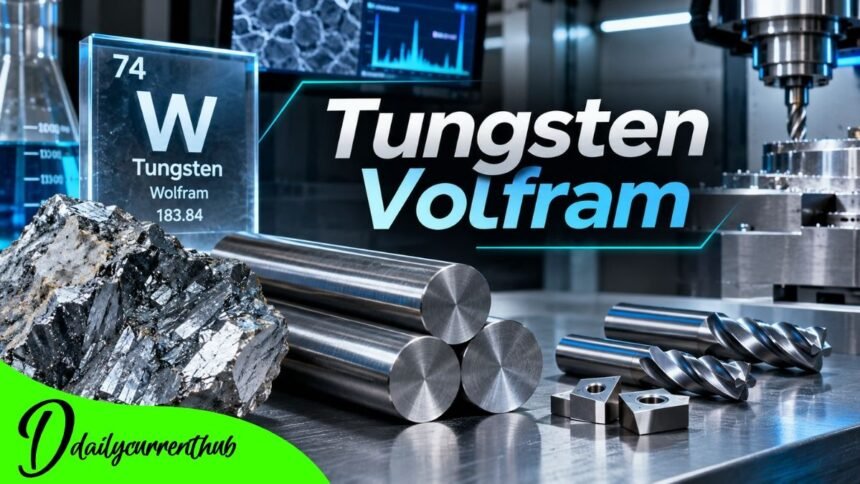
Tungsten Volfram is a remarkable metallic element whose unusual physical properties have made it essential to modern engineering, manufacturing, and industrial technology. Known for its exceptionally high melting point, considerable density, and ability to perform under extreme temperatures, tungsten is used in applications ranging from precision cutting tools to electrical equipment.
The element has two historically established names: tungsten and wolfram. Both refer to the same chemical substance, represented by the symbol W and atomic number 74 on the periodic table. The spelling “wolfram” is also used in several European languages.
Although tungsten gained widespread recognition through its use in traditional incandescent light bulbs, its industrial significance extends far beyond lighting. Tungsten carbide, heat-resistant components, specialized alloys, and manufacturing tools demonstrate the metal’s continuing value.
This article explores Tungsten Volfram through verified scientific facts, including its discovery, chemical characteristics, mineral origins, industrial uses, recycling, and position in the global supply chain.
What Is Tungsten Volfram?
Tungsten Volfram is a naturally occurring transition metal. It is element 74 on the periodic table and shares Group 6 with chromium and molybdenum.
Its scientific importance comes from a combination of properties that few other materials possess in the same form. Tungsten has an extremely high melting point, substantial density, and useful mechanical characteristics at elevated temperatures.
The distinction between pure tungsten and tungsten-containing materials is especially significant. Pure tungsten is used in some electrical and high-temperature applications, while tungsten carbide and tungsten alloys are selected for different combinations of hardness, toughness, and wear resistance.
This versatility explains why tungsten is valuable across multiple industries. It is not a universal replacement for other metals; rather, engineers select it when particular physical requirements justify its use.
History and Discovery of Tungsten Volfram
The identification of tungsten developed through European mineralogical research during the eighteenth century.
In 1781, Swedish chemist Carl Wilhelm Scheele investigated a mineral later associated with the name scheelite. His experiments identified an acidic oxide containing a previously unrecognized metallic element, although he did not isolate the metal itself.
The decisive breakthrough occurred in 1783, when Spanish chemists Juan José and Fausto Elhuyar successfully isolated metallic tungsten from a substance derived from wolframite.
The element’s two names reflect this history.
“Tungsten” originates from Swedish words meaning “heavy stone.” “Wolfram” comes from an older name associated with tungsten-bearing minerals. The element’s chemical symbol, W, preserves that historical connection.
These different naming traditions have sometimes created confusion, but tungsten and wolfram are not separate elements.
Chemical and Physical Properties
Tungsten’s physical characteristics underpin its industrial reputation.
Its density of approximately 19.3 grams per cubic centimeter makes it much denser than common engineering materials such as aluminum and steel. This allows compact tungsten components to provide substantial mass without occupying much space.
Tungsten also conducts electricity and heat, although its suitability for a particular application depends on more than conductivity alone.
At room temperature, its mechanical behavior depends on purity, microstructure, and manufacturing treatment. Some forms are relatively brittle, while properly processed tungsten can be shaped into fine wires and other components.
Chemically, tungsten forms compounds in several oxidation states, with the +6 state especially important. Tungsten oxides and tungstates play a major role in chemical processing and materials research.
Its atomic structure and bonding help explain tungsten’s unusual thermal and mechanical properties.
Why Tungsten Has Such a High Melting Point
Tungsten has the highest melting point of any pure metal.
The Royal Society of Chemistry lists its melting point at approximately 3,414°C, although some scientific references report values close to 3,422°C.
This exceptional characteristic results from the strong metallic bonding within its crystal structure.
For engineers, the practical significance is clear: tungsten can remain solid at temperatures that would melt many commonly used metals.
However, melting resistance does not mean complete resistance to damage. Tungsten can oxidize at elevated temperatures in air, and its mechanical performance changes with temperature and operating conditions.
Consequently, high-temperature tungsten components may require vacuum environments, inert atmospheres, protective systems, or carefully controlled operating conditions.
The difference between high melting temperature and unrestricted heat resistance is essential when evaluating tungsten for industrial use.
Natural Sources and Extraction of Tungsten
Tungsten does not typically occur in nature as large deposits of pure metallic material.
Commercial production begins with tungsten-bearing minerals, particularly wolframite and scheelite.
Wolframite is associated with iron and manganese tungstates, while scheelite has the chemical formula CaWO₄.
Mining operations extract ore containing these minerals. The material is then processed to separate and concentrate the valuable tungsten-bearing components.
Industrial refining can involve chemical treatment to produce intermediate compounds such as ammonium paratungstate and tungsten oxides.
Tungsten metal powder is commonly produced by reducing suitable tungsten oxides, often using hydrogen.
The powder can subsequently undergo consolidation and manufacturing processes to form industrial products.
Extraction technology depends on ore characteristics, plant design, and the intended final material. These operations require careful control of chemical processing, energy consumption, waste, and product purity.
Tungsten Carbide and Industrial Alloys
One of the most important distinctions in tungsten technology concerns tungsten carbide.
Tungsten carbide is a compound of tungsten and carbon, commonly represented by the chemical formula WC.
It is exceptionally hard and wear-resistant, making it suitable for equipment that must cut, drill, or shape difficult materials.
Many commercial cutting tools use cemented carbide rather than pure tungsten carbide alone. These materials contain hard carbide particles combined with a metallic binder, commonly cobalt.
The binder helps provide the toughness needed for practical tools.
Tungsten also contributes to certain specialized steels and high-temperature alloys.
The choice between tungsten metal, carbide, and alloys depends on the intended application. A material optimized for cutting may not suit electrical contacts, and a heat-resistant component may need different properties than a wear-resistant drill bit.
Major Applications in Modern Technology
Tungsten’s usefulness can be seen across several established technologies.
Manufacturing and machining: Tungsten carbide is widely used in cutting inserts, drills, and wear-resistant tools. Its hardness helps maintain cutting performance during demanding operations.
Mining and construction: Tungsten carbide components are used in drilling equipment and machinery operating against abrasive rock and other hard materials.
Welding: Tungsten electrodes play an important role in tungsten inert gas welding, also called TIG welding. Their high melting point helps create a stable welding arc.
Electrical equipment: Tungsten has been used in electrical contacts, specialized wires, electrodes, and components that encounter high temperatures.
Lighting: Traditional incandescent bulbs relied on tungsten filaments heated until they emitted visible light. Although LED lighting has displaced many incandescent applications, tungsten remains historically significant to electrical lighting.
High-temperature equipment: Tungsten and suitable tungsten alloys are used in furnace parts, heating elements, and specialized components that require controlled performance at elevated temperatures.
Its combination of density and thermal characteristics also supports selected radiation-shielding and precision engineering applications.
Global Production and Economic Importance
Tungsten is more than a useful industrial material. It is also economically and strategically important because of its role in manufacturing supply chains.
According to the U.S. Geological Survey’s 2026 Mineral Commodity Summaries, world tungsten mine production was estimated at approximately 85,000 metric tons of tungsten content in 2025.
China remained the dominant producer, accounting for a large majority of estimated global mine output.
Other producing countries include Vietnam, Kazakhstan, Russia, and several nations in Europe, Africa, and South America.
The geographic concentration of production creates potential supply-chain vulnerabilities. Industries that rely on tungsten may face difficulties when trade restrictions, processing bottlenecks, or changes in market conditions affect availability.
China introduced export controls on selected tungsten items in February 2025, highlighting the relationship between critical minerals and international trade policy.
These developments help explain the growing attention given to alternative supply sources, domestic processing, and recovery from industrial scrap.
Recycling and Environmental Considerations
Recycling is an important part of the tungsten supply chain.
Used tungsten carbide tools, manufacturing residues, and other tungsten-containing scrap can serve as secondary raw materials.
Industrial recycling may recover tungsten through chemical processing or other specialized methods, depending on the material’s composition.
Recovery reduces dependence on newly mined resources and can help retain valuable material within industrial supply systems.
However, recycling is not automatically impact-free. Collection, sorting, transportation, chemical treatment, and energy requirements all influence its environmental performance.
The wider environmental footprint of tungsten production also depends on mining methods, ore quality, electricity sources, waste management, and processing efficiency.
Responsible production therefore involves evaluating the full material lifecycle rather than considering metal extraction alone.
Health and Workplace Safety
Tungsten’s industrial usefulness should not be confused with an absence of occupational hazards.
Exposure risks differ substantially between solid finished components, metallic powders, processing chemicals, and airborne dust generated during manufacturing.
Cemented tungsten carbide may contain cobalt or nickel binders, creating additional workplace health considerations.
The U.S. National Institute for Occupational Safety and Health identifies specific exposure concerns associated with cemented tungsten carbide mixtures containing these metals.
Activities such as grinding, machining, and powder handling can require dust control, ventilation, exposure monitoring, and appropriate protective measures.
Safety assessments must consider the exact material composition and working conditions. General claims that all tungsten products are harmless—or that all tungsten-containing materials are equally hazardous—would be inaccurate.
Common Misconceptions About Tungsten Volfram
Several misunderstandings surround this element.
The first is that tungsten and wolfram are different metals. They are simply different names for the same element.
Another misconception is that tungsten carbide and pure tungsten have identical properties. They do not. Tungsten carbide is a chemical compound, while cemented carbide is an engineered composite material.
A third misunderstanding concerns temperature resistance. Tungsten’s exceptionally high melting point does not prevent oxidation or mechanical failure under unsuitable conditions.
Finally, density and hardness are not interchangeable properties. A material can be extremely dense without having the same hardness or wear resistance as tungsten carbide.
Understanding these distinctions makes technical descriptions and purchasing decisions more accurate.
The Future of Tungsten Technology
Tungsten’s future relevance is closely connected to advanced manufacturing, specialized engineering, and resilient material supply chains.
Research continues into tungsten-based materials, improved processing techniques, and components capable of performing in demanding environments.
Tungsten is also investigated for plasma-facing applications in nuclear fusion research because of its high melting point and other material characteristics. Significant engineering challenges remain, including managing thermal stresses and plasma interactions.
Meanwhile, diversification of mineral production and recycling offers practical ways to address supply concentration.
Tungsten’s future importance will depend not only on its remarkable physical properties but also on whether industries can produce, process, recover, and use it efficiently.
Conclusion
Tungsten Volfram stands among the most scientifically interesting and commercially valuable metallic elements. Its exceptional melting point, high density, and versatility have supported developments in manufacturing, electrical technology, welding, and precision engineering.
The historical names tungsten, wolfram, and volfram describe the same element, while the symbol W preserves its mineralogical origins.
Understanding tungsten also requires distinguishing the pure metal from tungsten carbide and other engineered materials. Their individual characteristics explain why different industries use tungsten in different ways.
Modern supply-chain challenges have increased attention on this metal’s economic importance, particularly as manufacturers seek reliable raw materials and more efficient recycling systems.
From eighteenth-century mineral research to contemporary industrial applications, tungsten’s history illustrates how one chemical element can influence multiple technologies. Its continued importance rests on proven material performance, responsible production, and ongoing engineering advances.
(FAQs)
1. What is Tungsten Volfram?
Tungsten Volfram refers to the chemical element tungsten, also known as wolfram. Its chemical symbol is W, and its atomic number is 74.
2. Are tungsten and wolfram the same metal?
Yes. Both names identify the same chemical element. Wolfram is the historical name responsible for the symbol W.
3. What is the melting point of tungsten?
Tungsten melts at approximately 3,414°C according to the Royal Society of Chemistry, making it the pure metal with the highest melting point.
4. Who discovered tungsten?
Carl Wilhelm Scheele identified a tungsten oxide in 1781. Juan José and Fausto Elhuyar successfully isolated the metal in 1783.
5. What is tungsten commonly used for?
Major uses include tungsten carbide cutting tools, welding electrodes, specialized alloys, heating elements, and certain electrical components.
6. Is tungsten stronger than steel?
There is no universal answer because strength can mean different things. Tungsten, steel, and tungsten carbide have different mechanical characteristics, and their suitability depends on the application.
7. Where is tungsten mainly produced?
China is the world’s leading tungsten producer. Other producing countries include Vietnam, Kazakhstan, Russia, and several additional nations.
8. Can tungsten be recycled?
Yes. Tungsten can be recovered from industrial scrap, including used carbide tools and manufacturing residues, through established recycling processes.