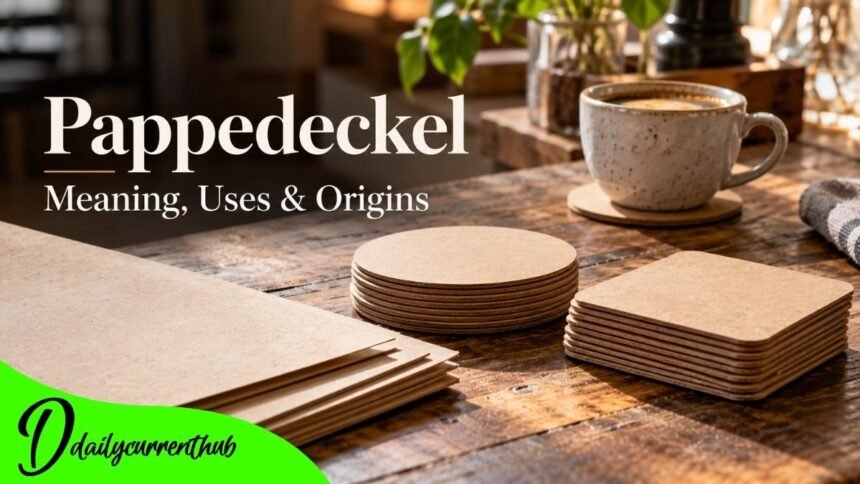
Some words reveal more about everyday culture than their simple appearance suggests. Pappedeckel is one of them. Associated with cardboard, paperboard, and familiar household objects, the expression has connections to regional German speech, traditional manufacturing, packaging, and even the history of drink coasters.
At first glance, its meaning may appear straightforward. The German word Pappe refers to cardboard, while Deckel generally means a lid or cover. Yet translating the entire expression as “cardboard lid” does not capture every situation in which related German words are used.
Standard dictionaries recognize Pappdeckel and Pappendeckel as words referring to a piece of cardboard. The spelling Pappedeckel also appears in documented regional vocabulary, particularly Alemannic German.
These distinctions help explain why the term can refer to cardboard in one conversation and carry a different meaning in another.
This article explores its linguistic background, historical connections, everyday applications, regional variations, and relationship with recyclable paper-based materials.
What Is Pappedeckel?
Pappedeckel is a documented regional German expression associated primarily with cardboard or paperboard. Its closest standard German equivalents are Pappdeckel and Pappendeckel.
According to Duden, both standard forms refer to a piece of cardboard, potentially rectangular. This definition is broader than a literal cardboard lid.
For example, a cardboard backing used in a craft project might be described with a related expression. Where an actual container cover is being discussed, “cardboard lid” could be an appropriate translation. The intended object determines which English wording is most accurate.
Regional linguistic variation also matters. The Alemannic vocabulary reference Alemannische Seiten records Pappedeckel alongside Pabbedeggel as an expression for Karton, meaning cardboard.
That regional evidence establishes that Pappedeckel is not merely an invented internet expression. However, it does not make the spelling interchangeable with standard German in every setting.
The German Origins and Regional Background
Understanding the Components of the Word
The vocabulary behind Pappedeckel becomes clearer when its individual parts are examined.
Pappe describes a firm paper-based material. Duden associates it with relatively stiff cardboard made from paper layers.
Deckel primarily means a cover or lid, though German also uses it for other covering structures, including parts of a bookbinding.
Together, the elements explain why English speakers may initially associate the compound with a cardboard lid.
The challenge is that a compound’s established meaning is not necessarily the sum of its parts. For Pappdeckel, dictionaries record the broader meaning of a piece of cardboard.
This distinction matters in translation, where an overly literal interpretation can change the object being described.
Regional German and Alemannic Variations
German includes numerous regional forms that differ from the standardized language taught in textbooks.
Pappedeckel is documented in Alemannic vocabulary, particularly in southwestern Germany. Regional references also list forms such as Pabbedeggel and Babbedeckel.
These variations illustrate how pronunciation, spelling, and customary meaning can differ between communities.
An especially interesting regional meaning concerns the driver’s license. Alemannic language references record related expressions for this document in certain locations.
Duden separately recognizes a colloquial use of Pappe meaning driver’s license.
A sentence describing somebody losing their Pappedeckel might therefore refer to a driving license rather than discarded cardboard, depending on the dialect and context.
Regional language makes the word more interesting, but it also requires careful interpretation.
Pappedeckel in Everyday Life
Cardboard in Packaging and Household Use
Cardboard is an ordinary material with a surprisingly wide range of applications.
Its stiffness makes it useful for packaging, protective backing, box components, display materials, and lightweight structures.
Depending on the object, a piece of cardboard may separate products, support a printed sheet, or protect a surface from damage.
These practical functions help explain why cardboard-related expressions remain useful in everyday speech.
However, Pappedeckel is not the technical name for every cardboard product. German has more specific vocabulary for different objects, including Pappkarton for a cardboard box and Bierdeckel for a beer coaster.
Using the more precise term is especially helpful in commercial instructions and product descriptions.
Creative and Educational Applications
Stiff cardboard is also familiar in schools, art rooms and household craft projects.
You can cut, fold, paint, or combine its surface with other materials. The exact result depends on the board’s thickness, fiber composition, and coating.
A cardboard sheet might become the base of a model building, an exhibition display or a protective mount for artwork.
In these settings, a reference to Pappedeckel may describe the material rather than a finished manufactured product.
This is another reason the English expression “piece of cardboard” often communicates the intended meaning more clearly than “cardboard lid.”
Pappedeckel and Traditional Drink Coasters
How the Bierdeckel Became Familiar
One particularly recognizable cardboard product is the German Bierdeckel.
A Bierdeckel is a coaster traditionally placed beneath a drinking glass. Its main practical functions include absorbing moisture and protecting the table underneath.
The history of the cardboard coaster is closely connected with developments in paper manufacturing.
The University of Würzburg’s historical Bierdeckel database records that Friedrich Horn’s cardboard factory and printing business in Buckau, near Magdeburg, began cutting and printing cardboard drink coasters in 1880.
Another important milestone followed in 1892, when Robert Sputh registered an invention involving molded wood-fiber coasters.
The material’s absorbency made it well suited to supporting drink vessels.
These innovations helped establish the familiar paperboard coaster as a practical manufactured object.
Why a Bierdeckel Is Not Always a Pappedeckel
Although the two expressions can overlap, they are not identical.
Bierdeckel identifies an object’s function: it is a coaster used with a drink.
Pappdeckel and Pappendeckel have a broader material-related meaning.
A cardboard coaster can reasonably belong to both categories, but a cardboard sheet used in bookbinding would not ordinarily be described as a Bierdeckel.
Similarly, a coaster made from another material is still a coaster even if it isn’t made from cardboard.
Recognizing this difference prevents a common translation error.
How Cardboard Coasters Are Manufactured
From Wood Fibers to Paperboard
Modern cardboard coaster production shows how a relatively simple material can require specialized industrial processes.
The German manufacturer KATZ, which has produced beverage coasters for more than a century, documents its production methods in detail.
The process begins with wood-derived fibers, which are prepared and mixed with water.
The fiber mixture is processed into wood-pulp board using papermaking equipment that forms a continuous sheet.
The process centers on water removal, controlled thickness, and suitable surface properties.
KATZ identifies board thickness, grammage, moisture content, whiteness and surface roughness as important manufacturing parameters.
These characteristics influence how the material performs during printing, cutting and use.
Printing, Cutting and Finishing
Once the paperboard sheets are prepared, they can be printed with decorative artwork, branding or information.
KATZ describes using offset printing to apply designs to board sheets before further processing.
Industrial cutting equipment then produces the required coaster shapes.
Round and square designs are familiar examples, but other shapes are possible.
The University of Würzburg’s historical database records common measurements of approximately 107 millimeters in diameter for round beer coasters and 93 × 93 millimeters for square ones.
Those dimensions describe established coaster formats, not every cardboard product or custom coaster.
Manufacturing therefore involves decisions about fiber quality, absorbency, dimensions, and the final article’s intended use.
Common Materials and Practical Applications
Paperboard, Cardboard and Other Materials
The terminology surrounding paper-based materials can become confusing because everyday language does not always distinguish them precisely.
Paperboard generally describes relatively stiff paper-based sheet material. Cardboard is a broader everyday expression that may refer to several kinds of substantial paper products.
Some boards are made from multiple layers, while others are formed by processes that turn fiber into a relatively thick sheet.
Wood-pulp board used for beverage coasters is valued for its absorbent properties.
Packaging boards may instead be selected primarily for stiffness, foldability, or their ability to protect products.
These differences matter because a material designed to absorb moisture may not suit a package that must resist water.
Choosing the Right Cardboard Product
The intended application should determine the material.
A coaster needs a surface that can hold a drink and manage moisture.
A packaging component may require bending strength, accurate dimensions, and compatibility with printing or folding machinery.
A craft project may prioritize ease of cutting and appearance.
Food-contact packaging adds considerations because you can’t determine suitability for direct contact with food simply by knowing a material is made from paper.
This practical distinction is essential when selecting cardboard products for commercial or domestic purposes.
Cultural Connections and Community Uses
Printed Coasters as Advertising Materials
The humble cardboard coaster has an interesting history as an advertising surface.
Breweries and other businesses have used printed coasters to display branding, illustrations, and promotional messages.
The University of Würzburg’s Bierdeckel database records their use for commercial advertising and announcements connected with local events, including village festivals.
A coaster therefore has a dual purpose: it performs a practical function while presenting printed information to the person using it.
This link between everyday utility and visual communication is why historical coaster designs offer an interesting record of commercial culture.
Collecting and Preserving Historical Designs
Beer coasters have also attracted collectors interested in printing, advertising, breweries, and regional heritage.
Historical examples can document business names, graphic styles, local events and changes in printing methods.
Collections consequently preserve more than individual objects. They can provide evidence of the commercial and visual environments in which those objects circulated.
The University of Würzburg’s Bierdeckel collection illustrates the historical research value of material that might otherwise be considered disposable.
A modest cardboard object can become a meaningful historical source when its design, date, and provenance are recorded.
Environmental Considerations and Recycling
Why Material Composition Matters
Cardboard is made from paper fibers, but its environmental properties cannot be judged from the material name alone.
Production consumes resources, including raw materials, water and energy. Printing, surface treatments and transport can also affect a product’s overall environmental footprint.
A paper-based object should not automatically be described as environmentally harmless, biodegradable or recyclable in every disposal system.
The material’s composition matters.
Uncoated paperboard behaves differently from products containing plastic layers, special coatings, or substantial contamination.
KATZ states that its wood-pulp board can be recycled and describes returning manufacturing offcuts to its production process.
That is a documented example of material recovery within a particular manufacturing system, not a universal guarantee for every cardboard product.
Responsible Disposal and Reuse
Germany’s consumer advice organization Verbraucherzentrale recommends placing suitable paper and cardboard packaging in the paper recycling stream.
It also identifies restrictions involving contaminated paper and certain coated or impregnated materials.
For cardboard products, responsible disposal therefore starts with checking what the item is made of and how it has been used.
Clean, recyclable paperboard may be suitable for paper collection, while heavily contaminated or composite materials may require a different disposal route.
Local waste-management instructions should take priority because collection systems and accepted materials vary.
Avoiding unnecessary waste and reusing suitable materials can also reduce demand for replacement items.
Public Curiosity and Common Misconceptions About Pappedeckel
The word’s unfamiliar spelling has encouraged several simplified explanations that do not always reflect dictionary or regional evidence.
One misconception is that Pappedeckel must refer exclusively to a cardboard lid. The documented meanings are broader and include cardboard itself.
Another is that the expression means a beer coaster. Although cardboard coasters connect naturally with the term, Bierdeckel is the more precise German name for that object.
A third misunderstanding concerns spelling. Pappedeckel is documented in Alemannic vocabulary, while Duden records Pappdeckel and Pappendeckel as standard forms.
It would therefore be inaccurate to dismiss every instance of Pappedeckel as meaningless, just as it would be inaccurate to present it as the only accepted standard spelling.
It also assumes that all cardboard products can be recycled or composted without restrictions.
Material composition, treatment, and local disposal rules prevent such a sweeping conclusion.
The central lesson is that context matters twice: first when interpreting the word, and again when evaluating the physical material.
The Future of Cardboard-Based Products
Cardboard’s modern relevance extends beyond traditional packaging and printed coasters.
Manufacturers continue to develop paperboard products for various technical and commercial applications.
KATZ, for example, identifies uses of its wood-pulp board in beverage coasters, displays, absorbent products and sound-insulation materials.
Such applications demonstrate that similar fiber-based materials can serve substantially different purposes depending on their design and processing.
Future product development will continue to raise questions about performance, resource consumption, printability, material recovery, and suitability for particular uses.
None of these developments changes the underlying linguistic point: Pappedeckel is a regional expression with a wider meaning than any single modern product category.
Its continuing interest comes from the relationship between a familiar material, regional language and the many objects made from paper fibers.
Conclusion
Pappedeckel offers an illuminating example of how ordinary vocabulary can connect language, manufacturing and cultural history.
Documented in regional Alemannic German, the expression relates primarily to cardboard and is closely associated with the standard German forms Pappdeckel and Pappendeckel.
Its meaning isn’t limited to a cardboard lid or a beer coaster. Depending on regional usage and context, it can describe cardboard itself and, in some dialects, even a driver’s license.
The history of printed drink coasters adds another dimension, linking wood-fiber manufacturing to advertising, hospitality, and historical collecting.
Environmental considerations also deserve attention because paper-based products differ in their composition and recycling requirements.
Ultimately, the most accurate way to understand Pappedeckel is to consider both the language and the object being described. That approach explains the term without reducing its varied meanings to one misleading translation.
(FAQs)
1. What does Pappedeckel mean in English?
It is a regional German expression associated with cardboard or paperboard. Depending on the context, suitable English translations include “cardboard,” “piece of cardboard,” or “cardboard cover.”
2. Is Pappedeckel a genuine German word?
Yes. An Alemannic regional vocabulary source documents Pappedeckel. Standard German dictionaries separately recognize the closely related forms Pappdeckel and Pappendeckel.
3. What is the difference between Pappedeckel and Pappdeckel?
Pappedeckel is documented in regional usage, while Pappdeckel is an established standard German spelling. Both are connected with cardboard.
4. Does Pappedeckel mean a beer coaster?
Not exclusively. A cardboard coaster is one related example, but the more specific standard German word for a beer coaster is Bierdeckel.
5. Can Pappedeckel refer to a driver’s license?
Yes, in certain regional German dialects. Alemannic vocabulary sources document this alternative meaning, and Duden records a similar colloquial meaning for Pappe.
6. How are traditional cardboard beer coasters made?
Manufacturing commonly involves preparing paper fibers, forming absorbent board, printing designs, and cutting the material into the required shapes.
7. Is every Pappedeckel recyclable?
Not necessarily. Recyclability depends on the product’s materials, coatings, contamination, and the local waste-collection system’s rules.
8. Why is Pappedeckel culturally interesting?
The expression preserves regional German vocabulary, while related cardboard objects such as printed beer coasters connect to traditional manufacturing, advertising, and historical collections.