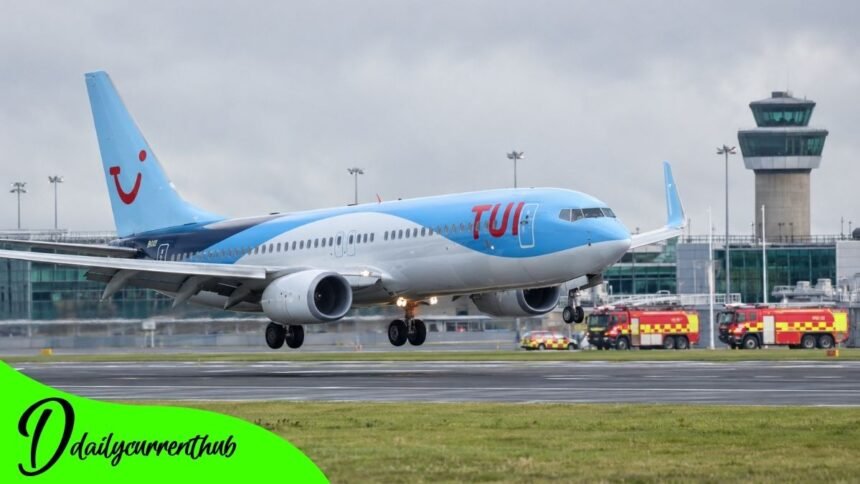
On September 28, 2025, a TUI Airways passenger flight scheduled to travel from Cardiff, Wales, to Paphos, Cyprus, experienced an unexpected disruption shortly after takeoff. The incident, widely discussed as the TUI Flight BY6754 Emergency Landing, attracted considerable attention after the Aircraft declared an emergency and diverted to Birmingham Airport.
The Boeing 737-800 was carrying holidaymakers when a bird strike prompted the crew to reconsider the planned journey. Flight-tracking information showed the Aircraft circling over South Wales before heading towards the West Midlands, where emergency services prepared for its arrival.
Although initial reports suggested an engine failure, TUI Airways later clarified that the diversion followed a bird strike and was precautionary.
The Aircraft landed safely, and passengers and crew disembarked. The incident illustrates how aviation emergency procedures, airport coordination, and operational decisions work together when a routine flight encounters an unexpected hazard.
This article examines the confirmed timeline, aircraft details, official explanations, passenger arrangements, and wider aviation safety lessons surrounding the incident.
What Happened on TUI Flight BY6754?
TUI Flight BY6754 was operating a scheduled passenger service from Cardiff Airport to Paphos, a popular holiday destination in Cyprus.
On Sunday, September 28, 2025, the Boeing 737-800 departed Cardiff in the late afternoon. Shortly after departure, the Aircraft encountered a bird strike, leading the crew to interrupt its normal climb and reassess the flight.
Instead of continuing towards the Mediterranean, the pilots remained over South Wales before diverting towards Birmingham Airport.
Aviation tracking reports recorded the Aircraft transmitting emergency transponder code 7700, which identifies an aircraft experiencing an emergency.
Emergency services at Birmingham prepared for its arrival. The Aircraft subsequently landed safely at approximately 5:30 p.m.
The event was significant because it combined an unexpected wildlife hazard, a diversion from an international route, an emergency declaration, and coordinated airport procedures.
Importantly, TUI later distinguished the bird strike from the engine failure described in some initial news reports.
Departure from Cardiff Airport
A Scheduled Flight to Cyprus
Flight BY6754 was scheduled to connect Cardiff Airport with Paphos International Airport.
Paphos is an established holiday destination from the United Kingdom, making this route part of TUI Airways’ wider leisure travel network.
The Aircraft involved was identified as a Boeing 737-800, registration G-TAWY.
News reports placed the departure at approximately 4:28 p.m. British Summer Time, although published schedules gave an earlier departure time.
The flight was expected to continue towards Cyprus before the reported bird strike altered its journey.
The First Signs of Trouble
Following takeoff, the Aircraft stopped its normal climb and began circling in the South Wales area.
Flight-tracking coverage described holding patterns west of Cardiff and around Swansea Bay.
At this stage, the pilots had to respond to an unexpected event during a particularly demanding phase of flight.
Takeoff and initial climb require close monitoring of aircraft performance, engine indications, navigation, and surrounding traffic.
When an abnormal event occurs, flight crews use established procedures to assess whether continuing the journey remains appropriate.
The decision to interrupt BY6754’s planned route reflected the need to prioritize safety.
The Bird Strike and Emergency Declaration
Why Bird Strikes Matter in Aviation
A bird strike occurs when a bird collides with an aircraft during flight or on the ground.
Such collisions can affect different parts of an aircraft, including the fuselage, wings, windscreen, and engines.
The potential consequences depend on several factors, including the size and number of birds, impact location, aircraft speed, and resulting damage.
A bird strike does not automatically mean an aircraft has suffered engine failure.
However, aviation guidance recognizes that impacts involving engine intakes can create serious operational concerns.
The European Union Aviation Safety Agency’s bird-strike guidance discusses the importance of assessing aircraft condition and returning for inspection when necessary.
For BY6754, TUI confirmed a bird strike after takeoff and described the subsequent diversion as precautionary.
What Does Squawk 7700 Mean?
During the incident, aviation tracking reports indicated that BY6754 transmitted transponder code 7700.
Under UK aviation rules, code 7700 identifies an aircraft in an emergency.
The signal helps alert air traffic services to the need for special attention and coordination.
Its use does not establish a specific mechanical failure or reveal an incident’s severity on its own.
In the case of BY6754, the emergency declaration was followed by a controlled diversion and successful landing.
Why the Aircraft Diverted to Birmingham
Choosing an Appropriate Alternative Airport
After remaining over South Wales, the Aircraft headed towards Birmingham.
The diversion allowed the flight to land at a suitable airport rather than continue the much longer international journey.
In aviation, selecting a diversion airport involves operational considerations such as runway availability, weather, air traffic, aircraft performance, and emergency support.
Public accounts of BY6754 confirm Birmingham as the chosen diversion destination, but they do not establish every factor behind the crew’s selection.
Aviation tracking coverage shows the Aircraft climbed to about 12,000 feet during the diversion.
It later entered holding patterns near Birmingham before making its final approach.
Why Aircraft Sometimes Circle Before Landing
Holding patterns can appear alarming to people following an aircraft online, but they serve several operational purposes.
They may give flight crews time to complete checklists, coordinate with air traffic control, evaluate aircraft performance, or prepare for an approach.
Aircraft weight can also affect landing planning, particularly when a flight departs with fuel intended for a much longer journey.
Several news reports described BY6754 circling before its landing.
However, the precise operational reason for each holding pattern should not be assumed without detailed flight records or a crew explanation.
TUI Flight BY6754 Emergency Landing Timeline
Contemporary aviation reporting documented the following sequence on September 28, 2025.
Approximate Time (BST)Reported Event
4:28 p.m. Aircraft departs Cardiff Airport
Shortly after departure Bird strike occurs
During initial climb Aircraft interrupts climb and circles over South Wales
During diversion Emergency code 7700 is reported
5:10 p.m. Aircraft reported holding near Birmingham
5:12 p.m. Birmingham Airport begins temporary suspension of operations
5:26 p.m. Aircraft approaches Birmingham’s runway 33
5:29–5:30 p.m. Aircraft lands safely
Around 5:40 p.m. Aircraft taxis towards its parking position
These times are drawn from airport statements and contemporary flight-tracking reports. Minor variations appear between published accounts.
Birmingham Airport’s Emergency Response
Preparing the Airport for Arrival
Birmingham Airport temporarily suspended operations at approximately 5:12 p.m. to accommodate the incoming TUI aircraft.
The suspension lasted around 30 minutes, according to the airport’s statement reported by British news outlets.
Airport fire services were positioned to meet the Aircraft on arrival.
This preparation is a standard part of aviation emergency management.
Having emergency vehicles available lets responders act immediately if an aircraft has trouble while landing or after stopping.
A Successful Landing on Runway 33
Flight-tracking service AIRLIVE reported that BY6754 touched down safely on Birmingham’s runway 33 at approximately 5:29 p.m.
Emergency vehicles attended the Aircraft, which subsequently taxied towards the apron.
Birmingham Airport confirmed that its fire service met the Aircraft in accordance with normal procedures.
The successful landing was followed by the safe disembarkation of passengers and crew.
The outcome illustrates the practical value of preparation and communication between flight crews, air traffic controllers, and airport emergency teams.
What Passengers Experienced
Uncertainty During the Diversion
For passengers, an emergency diversion can be unsettling even when the Aircraft remains under control.
Contemporary reporting included accounts of travelers becoming concerned when they realized that the flight was no longer heading towards Cyprus.
One passenger, Dave Preece, described uncertainty and shock among those on board in comments reported by the BBC and subsequently carried by other publications.
He also described an announcement referring to engine failure.
That account helps explain why some early news coverage used stronger mechanical-failure language than TUI’s later statement.
Passenger testimony is valuable for understanding the human experience, but it should be distinguished from an independently established technical finding.
Safety After Arrival
Reports confirmed that passengers and crew were able to leave the Aircraft safely after it reached Birmingham.
The diversion significantly disrupted their travel plans, but the Aircraft did not continue the original journey with those passengers that evening.
The distinction between an operational emergency and its eventual outcome matters: an emergency declaration reflects a need for precaution and priority handling, not necessarily a disastrous result.
TUI Airways’ Official Explanation
Bird Strike Rather Than Confirmed Engine Failure
One key detail is the difference between early reports and TUI’s explanation.
Initial aviation incident coverage described a possible failure of the Aircraft’s left engine.
Some newspapers also reported engine failure when the story first emerged.
TUI Airways subsequently stated that there had been no engine failure and confirmed a bird strike after takeoff.
The airline characterized the diversion as a routine precautionary procedure.
That clarification is essential to accurate reporting.
A bird strike can produce indications that require careful investigation. Still, the available public record should not be treated as proof of a complete engine failure when the operator specifically disputed that description.
Airport Statements
Cardiff Airport confirmed that flight TOM6754, traveling from Cardiff to Paphos, had diverted to Birmingham and landed safely.
Birmingham Airport separately confirmed the temporary suspension of operations, the attendance of its fire service, and the Aircraft’s safe arrival.
Together, these statements establish the core operational facts without requiring assumptions about unreported cockpit decisions.
What Aviation Safety Procedures Tell Us
The Importance of Precautionary Decisions
Aviation safety depends on identifying abnormal situations early and responding before they worsen.
Guidance published by the European Union Aviation Safety Agency recommends appropriate checks and landing decisions following significant bird-strike events.
It also discusses the importance of inspecting the Aircraft after such an occurrence.
These principles provide context for BY6754’s diversion, although they do not establish which individual checklist items its pilots completed.
Communication and Coordinated Support
The event involved several parts of the aviation system.
The flight crew managed the Aircraft and made operational decisions. Air traffic services supported the diversion, while Birmingham Airport prepared the airfield for an emergency arrival.
The emergency transponder code helped communicate the Aircraft’s status within the air traffic system.
This coordination is fundamental to commercial aviation safety.
Passenger Arrangements After Landing
The unexpected arrival in Birmingham meant passengers could not complete their planned journey to Cyprus on the original flight.
Travel industry publication Travel Gossip reported on September 29, 2025, that TUI arranged overnight hotel accommodation and that passengers departed for Cyprus the following morning.
Cyprus-based reporting also described alternative travel arrangements.
These reports indicate that the operator addressed the immediate disruption by arranging onward travel.
The incident nevertheless demonstrates how a precautionary diversion can affect accommodation, airport operations, onward connections, and holiday schedules.
The full individual experiences of every passenger cannot be established from the published accounts.
Public Curiosity and Misconceptions
Was the Aircraft in Immediate Danger?
An emergency declaration confirms that the crew considered the circumstances serious enough to require emergency handling.
It does not, by itself, prove that a crash was imminent.
In BY6754’s case, the Aircraft diverted, completed its approach, and landed safely.
The publicly established outcome does not support exaggerated claims of a near-disaster.
Did the Aircraft Suffer Engine Failure?
Some early aviation reports used that description, but TUI specifically denied engine failure.
The more accurate summary is that the Aircraft experienced a bird strike and made a precautionary diversion.
Detailed conclusions about the engine’s internal condition would require appropriate maintenance or investigative evidence.
Why the Incident Still Matters
The event attracted attention because it disrupted an international passenger service and required a visible emergency response.
It also demonstrates the need for caution when interpreting breaking aviation news.
Initial descriptions can change as operators, airport authorities, and investigators provide additional information.
Accurate reporting depends on distinguishing confirmed events from preliminary interpretations.
Conclusion
The TUI Flight BY6754 Emergency Landing on September 28, 2025, began as a routine journey from Cardiff to Paphos and became an unexpected diversion following a bird strike shortly after takeoff.
The Boeing 737-800, registration G-TAWY, deviated from its planned route, circled over South Wales, and flew to Birmingham Airport, where emergency services prepared for its arrival.
The Aircraft landed safely at approximately 5:30 p.m., and passengers and crew disembarked.
Although initial accounts raised concerns about engine failure, TUI subsequently clarified that the incident involved a bird strike and described the diversion as precautionary.
The event highlights the importance of trained flight crews, effective communication, appropriate airport readiness, and timely operational decisions.
Above all, it reminds us that an aviation emergency declaration is part of a structured safety response. In this case, those procedures ended with the Aircraft and its occupants safely on the ground.
(FAQs)
1. When did the TUI Flight BY6754 emergency landing happen?
The incident occurred on Sunday, September 28, 2025, after the Aircraft departed Cardiff Airport.
2. Where was TUI Flight BY6754 originally going?
The flight was traveling from Cardiff Airport in Wales to Paphos International Airport in Cyprus.
3. What caused the emergency diversion?
TUI Airways confirmed that a bird strike occurred shortly after takeoff and that the diversion was precautionary.
4. Did TUI Flight BY6754 experience engine failure?
Some initial reports described engine failure, but TUI Airways publicly denied that an engine failure had occurred.
5. Which Aircraft was involved?
The Aircraft was a TUI Airways Boeing 737-800 registered G-TAWY.
6. Where did the Aircraft make its emergency landing?
It landed safely at Birmingham Airport in England, using runway 33.
7. Were passengers and crew safe?
Yes. Contemporary reports confirmed that passengers and crew disembarked safely after the Aircraft landed.
8. What happened to passengers after the emergency landing?
Travel industry reporting stated that TUI arranged overnight hotel accommodation and onward travel to Cyprus the following morning.