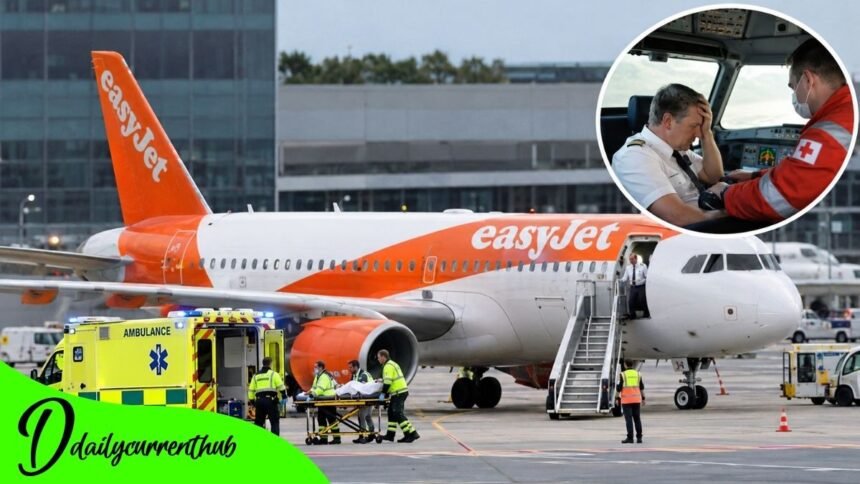
On August 15, 2025, an easyJet flight traveling from Istanbul, Turkey, to Manchester, United Kingdom, experienced an emergency while crossing European airspace. Flight U22152, operated by an Airbus A320, was forced to divert to Cologne Bonn Airport in Germany after a medical problem affected a member of the cockpit crew.
The incident attracted attention because the aircraft transmitted the international emergency code 7700 while cruising at approximately 36,000 feet. Aviation reports later identified the first officer’s sudden illness as the reason for the diversion.
With 185 people on board, the aircraft landed safely in Germany, where the affected crew member received medical attention. A replacement pilot was subsequently arranged so the journey could continue.
The EasyJet U22152 emergency in Germany offers a useful example of how aviation safety procedures, cockpit responsibilities, and emergency coordination work when an unexpected medical event interrupts an international passenger flight.
What Happened to EasyJet Flight U22152?
EasyJet flight U22152 was operating an international passenger service between Istanbul and Manchester when an unexpected medical situation developed in the cockpit.
According to an incident account published by The Aviation Herald and reproduced by AeroInside, the aircraft was approximately 150 nautical miles east-southeast of Cologne when the first officer became unable to continue performing flying duties.
The first officer was reportedly experiencing severe stomach pain. The captain consequently decided to divert the aircraft to Cologne Bonn Airport.
Flight-tracking coverage recorded an emergency declaration while the Airbus A320 was traveling at its normal cruising Altitude.
The aircraft subsequently descended and changed course toward Cologne, where it landed without a reported landing problem.
Rather than a mechanical breakdown, the central event was the sudden illness of a flight crew member whose duties were essential to the aircraft’s normal operation.
Flight Route and Background
The flight began in Istanbul and was scheduled to end in Manchester, a major international airport serving northwestern England.
The Airbus A320 involved in the incident carried the registration G-EZRX. Aviation incident records identify it as an A320-200, a widely used narrow-body commercial passenger aircraft.
Before the emergency, the aircraft had reached approximately 36,000 feet, described in aviation terminology as flight level 360.
At this Altitude, passenger aircraft generally operate during the cruise phase, when they follow routes coordinated with air traffic control.
The planned journey would have taken the flight across European airspace toward the United Kingdom.
However, the sudden medical problem changed the operational priorities. Completing the planned route was no longer the immediate objective; securing medical help and bringing the aircraft safely to an appropriate airport took precedence.
The Medical Emergency in the Cockpit
The most important detail surrounding the emergency concerns the first officer’s health.
The Aviation Herald’s reporting described the first officer as incapacitated after experiencing severe abdominal pain. Food poisoning was suspected, but that suspicion should not be confused with a confirmed medical diagnosis.
EasyJet’s public response, quoted by German news outlet t-online, confirmed that a crew member urgently required medical assistance.
The airline did not publicly establish the person’s exact medical condition in that statement.
In aviation, pilot incapacitation refers to a situation in which a pilot cannot perform the duties required for safe flight operations. It does not necessarily mean that the individual has lost consciousness.
A crew member can become incapacitated through illness or another medical condition that prevents them from safely performing cockpit responsibilities.
For U22152, the reported severe pain was enough to require a change in the flight plan.
Why the Aircraft Diverted to Germany
Cologne Bonn Airport became the diversion destination after the medical problem developed over Germany.
The aircraft was already within a geographical area where it could reach a suitable German airport without continuing all the way to Manchester.
Choosing an alternate airport during an emergency requires consideration of practical factors such as airport suitability, flight conditions, air traffic control coordination, and the urgency of the situation.
The U22152 captain’s exact internal assessment has not been publicly detailed in the available incident accounts.
What is documented is the decision to divert to Cologne and the successful completion of that diversion.
This distinction matters because an emergency landing is not necessarily evidence that an aircraft was suffering a technical fault.
In this case, the reported reason for changing the destination was medical urgency.
Understanding Emergency Code 7700
One of the most widely discussed aspects of the EasyJet U22152 Emergency Germany incident was the activation of emergency transponder code 7700.
This internationally recognized code informs air traffic control that an aircraft is experiencing an emergency.
Air traffic controllers can use that information to identify the situation and coordinate appropriate assistance or priority handling.
The code does not specify the exact nature of the emergency.
It can apply to medical emergencies, aircraft systems problems, or other circumstances requiring urgent attention.
AIRLIVE’s aviation coverage recorded the easyJet aircraft transmitting squawk 7700 while cruising over Germany.
The emergency signal therefore indicated the crew was dealing with a serious operational situation, but it did not identify the cause.
Later information about the first officer’s illness provided the necessary context.
The Safe Landing at Cologne Bonn Airport
The diversion concluded successfully when the Airbus A320 landed at Cologne Bonn Airport.
The Aviation Herald reported that the aircraft landed on runway 32R approximately 27 minutes after the diversion decision described in its account.
German reporting also documented the aircraft’s descent toward Cologne and its arrival shortly before 6 p.m. local time.
The safe landing was the most important immediate Outcome for those on board.
The reviewed incident accounts reported no crash, emergency evacuation, or passenger injury associated with the landing.
The event illustrates the practical purpose of emergency procedures: to give flight crews an organized way to respond to unexpected circumstances before they develop into greater dangers.
Medical Assistance and Replacement Crew
Once the aircraft reached Cologne, attention turned to the affected first officer.
The aviation incident report states that the crew member was taken to a hospital. EasyJet also confirmed to German media that medical assistance was provided promptly.
The company then faced a separate operational challenge.
Although the aircraft landed safely, the scheduled journey to Manchester could not resume with a first officer unable to perform flying duties.
A replacement pilot was therefore arranged.
This was necessary to restore the flight’s normal operating capability.
Commercial passenger flights depend on appropriately qualified and medically fit cockpit crew members. A diversion prompted by pilot illness can therefore create delays even when the aircraft itself remains capable of flying.
Passenger Disruption and Arrival in Manchester
For passengers on board, the emergency led to an unexpected stop and a substantial delay.
The Aviation Herald account stated that passengers remained aboard while arrangements were made for a replacement pilot.
German reporting based on Flightradar24 records indicated the aircraft spent nearly seven hours on the ground in Cologne before departing for the United Kingdom in the early hours of August 16.
The aircraft eventually reached Manchester safely.
Published accounts differ in how they describe the overall arrival delay. The Aviation Herald’s account cites about five hours, while the timeline reported by t-online indicates a longer interruption.
The distinction between time spent on the ground and delay against the original scheduled arrival is important when interpreting those figures.
The available reporting does not establish precisely what assistance every passenger received during the wait.
Nevertheless, the interruption demonstrates how a medical event involving one crew member can affect an entire scheduled passenger service.
EasyJet’s Response to the Emergency
EasyJet publicly acknowledged the medical diversion through comments provided to German media.
A company spokesperson confirmed that a crew member had needed urgent medical attention and that the journey subsequently continued to its intended destination.
The airline also emphasized the importance it places on the safety and wellbeing of passengers and crew.
Its response established two essential facts: the diversion was linked to a medical issue, and the affected crew member received assistance after landing.
The statements did not establish a definitive diagnosis or provide a detailed account of the first officer’s later recovery.
That is an important boundary between publicly documented operational information and private medical matters.
No one needs to invent further medical details to understand why the aircraft diverted.
Medical Emergency Versus Technical Failure
Early reporting on U22152 suggested the aircraft’s descent might have been linked to a pressurization problem.
AIRLIVE initially mentioned a possible pressurization issue before updating its coverage to identify a crew medical emergency.
Subsequent incident reporting and easyJet’s confirmation support the medical explanation.
A rapid descent on a flight-tracking map does not, by itself, prove that cabin pressurization failed.
Aircraft may descend for several operational reasons, including diversion planning and emergency management.
Similarly, squawking 7700 does not establish engine failure, structural damage, or another mechanical defect.
The reviewed reports provide no verified basis to describe the U22152 incident as a confirmed technical failure.
Separating early possibilities from established findings is essential when reporting aviation emergencies accurately.
Passenger Rights Following the Diversion
An unexpected diversion raises questions about passenger assistance and compensation.
For qualifying flights, UK261 passenger rights can require an airline to provide care during a significant delay. Depending on the circumstances, this may include refreshments, communication facilities, and accommodation when necessary.
EasyJet’s published disruption guidance also explains how it helps passengers reach their destinations after diversions.
Financial compensation is a separate question.
Under UK passenger-rights rules, qualifying delays can create compensation rights. Still, an airline may avoid fixed compensation where it establishes extraordinary circumstances that could not have been avoided through reasonable measures.
Whether an individual crew medical emergency satisfies that legal test depends on the specific facts and applicable law.
The public reports reviewed here do not establish that all U22152 passengers received compensation or that their claims were uniformly rejected.
Passengers seeking reimbursement or compensation should therefore rely on their booking details, the actual arrival delay, relevant expense records, and the airline’s explanation rather than assuming an automatic result.
Aviation Safety Lessons From the Incident
The U22152 emergency demonstrates why commercial aviation relies on multiple layers of operational protection.
A two-pilot flight crew provides an important level of redundancy when one pilot can no longer continue.
Emergency transponder procedures allow pilots to signal urgent situations, while air traffic control can help coordinate an alternate route and landing.
Suitable diversion airports provide opportunities for medical intervention without requiring an aircraft to complete its original journey.
Replacement crew arrangements then help restore normal operations once an immediate emergency has been resolved.
These measures do not eliminate unexpected medical events, but they provide structured ways of managing them.
The successful diversion to Cologne is a practical example of those protections working together during a real-world flight.
Conclusion
The EasyJet U22152 Emergency Germany incident on August 15, 2025, was a significant operational disruption caused by a reported medical emergency involving the first officer.
The Airbus A320, registered G-EZRX, was traveling from Istanbul to Manchester when the first officer became unable to continue normal flying duties. The captain diverted the aircraft to Cologne Bonn Airport, where it landed safely.
The affected crew member received medical attention, and a replacement pilot was arranged before the aircraft continued to Manchester.
Although the event caused a lengthy interruption for those traveling, the documented Outcome was a successful diversion rather than an aviation accident.
The incident also highlights the importance of careful reporting. Initial suggestions about a technical problem should not be presented as confirmed facts when later evidence identifies a medical cause.
Ultimately, U22152 shows how established safety procedures, professional flight crew decisions, and airport coordination can help manage an emergency while keeping passenger and crew safety at the center of the response.
(FAQs)
1. What happened during the EasyJet U22152 emergency in Germany?
On August 15, 2025, easyJet flight U22152 diverted to Cologne Bonn Airport after the first officer became incapacitated by a medical problem during the journey from Istanbul to Manchester.
2. Why did easyJet flight U22152 make an emergency landing?
The diversion was caused by a crew medical emergency. Aviation reporting identified severe stomach pain affecting the first officer as the immediate problem.
3. Where did EasyJet U22152 land in Germany?
The aircraft landed safely at Cologne Bonn Airport in Germany, where medical assistance was arranged for the affected crew member.
4. What aircraft was operating EasyJet U22152?
The flight was operated by an Airbus A320-200 registered G-EZRX.
5. How many people were on board EasyJet U22152?
According to the aviation incident report, 185 people were on board. That figure refers to people aboard the aircraft, not necessarily 185 passengers alone.
6. Was the emergency caused by aircraft pressurization failure?
Early coverage suggested a pressurization issue, but later reports identified a medical emergency. A pressurization failure has not been established as the cause.
7. Did EasyJet U22152 eventually reach Manchester?
Yes. After landing in Cologne and arranging a replacement pilot, the aircraft continued to Manchester, arriving substantially later than planned.
8. Were passengers entitled to compensation after the diversion?
Passenger rights depend on the applicable regulations, the cause of the delay, and the airline’s response. Compensation was not automatically established for every passenger simply because the flight diverted.