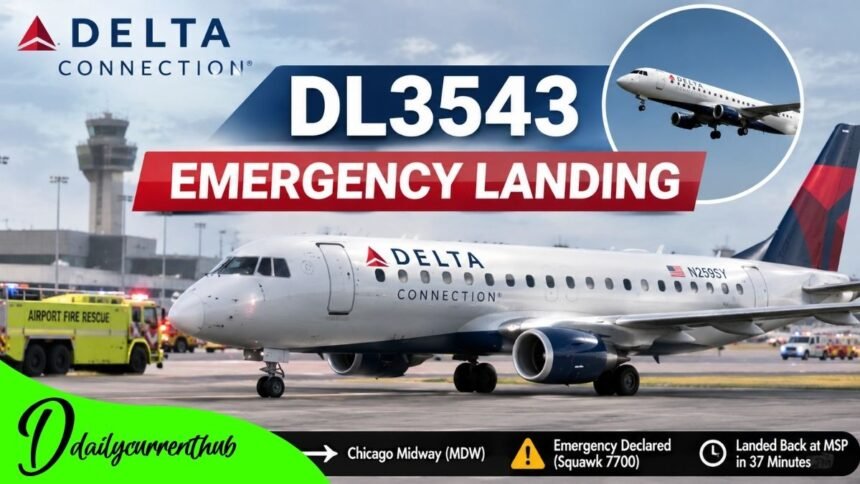
The Delta Connection DL3543 Emergency Landing on July 7, 2025, attracted attention after a regional passenger aircraft turned back toward Minneapolis–Saint Paul International Airport shortly after departure. The flight was scheduled to fly to Chicago Midway International Airport, but it returned to its departure airport after the crew declared an emergency.
According to contemporary aviation reporting, the Embraer regional jet stopped climbing at approximately 21,000 feet, reversed course, and transmitted emergency transponder code 7700. The aircraft subsequently landed on Runway 12R in Minneapolis about 37 minutes after departure.
Although the sequence of events is documented, the precise reason behind the emergency declaration has not been reliably established in the public reporting reviewed.
Understanding the incident requires separating the recorded flight movements from the technical explanations that appeared online afterward.
This article examines the Delta Connection DL3543 emergency landing, including its timeline, aircraft details, safety procedures, operating airline, and the limits of available evidence.
What Happened During the Delta Connection DL3543 Emergency Landing?
Delta Connection flight DL3543 departed Minneapolis on July 7, 2025, for a scheduled regional service to Chicago Midway.
The aircraft was an Embraer regional jet with registration N259SY, operated by SkyWest Airlines for Delta Connection.
During the initial phase of the journey, the aircraft climbed to approximately 21,000 feet. Instead of continuing toward Chicago, it stopped climbing and turned back toward Minneapolis roughly ten minutes after takeoff.
The crew declared an emergency, and transponder code 7700 was reported.
Aviation news outlet AIRLIVE documented the developing situation on the day of the event. Its subsequent updates reported that DL3543 landed on Minneapolis Runway 12R approximately 37 minutes after departure and later reached stand C12.
These details establish an emergency return rather than a crash. They do not, however, establish which technical or operational condition led the crew to turn back.
Complete Timeline of Delta Connection Flight DL3543
Departure From Minneapolis
On July 7, 2025, DL3543 departed Minneapolis–Saint Paul International Airport, serving the Minneapolis–St—metropolitan area.
Its planned destination was Chicago Midway International Airport, one of Chicago’s principal commercial airports.
The scheduled journey was a relatively short domestic flight, with Minneapolis as the departure point and the airport where the aircraft ultimately returned.
The Aircraft Stops Climbing
According to AIRLIVE, the Embraer aircraft stopped climbing at approximately 21,000 feet.
This altitude is a significant part of the reported flight sequence. It identifies when the aircraft’s ascent ended before the return toward Minneapolis.
However, an interrupted climb alone cannot establish a mechanical fault. Aircraft may level off or change their planned flight profile for several reasons, and identifying the actual cause requires additional evidence.
The Crew Turns Back
Approximately ten minutes after departure, DL3543 reversed course.
Rather than continuing toward Chicago, the pilots directed the aircraft back toward Minneapolis.
A return to the departure airport can be an appropriate response when flight crews determine that continuing the planned journey is less desirable than landing and addressing a concern on the ground.
The available account documents the turnback but does not reveal the crew’s complete decision-making process.
Emergency Declaration
The aircraft was reported to have used transponder code 7700, the internationally recognized emergency code.
This provided an important indication of the flight’s emergency status.
The code itself does not identify the underlying problem. It therefore does not indicate a particular aircraft-system failure.
Landing at Minneapolis
AIRLIVE subsequently reported that DL3543 landed on Runway 12R at Minneapolis approximately 37 minutes after departure.
A further update placed the aircraft at stand C12.
The documented outcome was a completed return to the airport, not a crash or an off-airport forced landing.
Why Did Delta Connection DL3543 Return to Minneapolis?
What the Available Evidence Establishes
The central unanswered question is why the emergency was declared.
Contemporary reporting establishes three key developments: the aircraft stopped climbing, returned toward Minneapolis, and used emergency code 7700.
It does not identify a specific technical problem.
That distinction matters because an emergency declaration describes the urgency of a situation without necessarily revealing its cause.
Possible Causes Versus Confirmed Facts
Aircraft may return to an airport following a mechanical indication, a cabin-related concern, a medical emergency, or another operational issue.
These are general examples of situations that can affect commercial aviation. They are not established explanations for DL3543.
Some later online articles have attributed the incident to pressurization problems, electrical issues, or other technical faults.
Without supporting airline statements, maintenance findings, or authoritative investigation records, those explanations should not be presented as confirmed.
The accurate conclusion remains that the reason for the Delta Connection DL3543 emergency declaration has not been reliably established in the sources reviewed.
Understanding Emergency Code 7700
What Does Squawk 7700 Mean?
Aircraft transponders transmit information that helps air traffic control identify and monitor aircraft.
Code 7700 is the emergency transponder code recognized under Federal Aviation Administration procedures.
When transmitted, it can generate special emergency indications within air traffic control surveillance systems.
The purpose is to make controllers aware that an aircraft may require urgent assistance.
Does Code 7700 Mean an Aircraft Is Crashing?
No.
An emergency declaration does not automatically mean that an aircraft is experiencing an uncontrollable situation.
FAA guidance distinguishes between distress and urgency conditions.
A distress condition involves serious or immediate danger, while an urgency condition involves a safety concern that requires timely attention.
A crew can request emergency assistance before a situation becomes more serious.
For DL3543, the reported use of code 7700 establishes the emergency declaration but does not reveal the severity or technical nature of the underlying condition.
Aircraft and Operating Airline Details
The Embraer E175LR Aircraft
The aircraft identified in the incident report carried registration N259SY.
Aircraft databases, including Flightradar24 and Planespotters, identify N259SY as an Embraer E175LR operated by SkyWest Airlines in Delta Connection service.
The Embraer E175 belongs to a family of twin-engine regional passenger jets widely used for short- and medium-distance airline services.
Its role in regional aviation makes it suitable for routes connecting major airline hubs with other domestic airports.
Nevertheless, the aircraft model alone does not prove the cause of this particular emergency.
How Delta Connection Operates
Delta Connection is a regional airline brand associated with Delta Air Lines.
Delta works with regional operating partners, including SkyWest Airlines, Endeavor Air, and Republic Airways.
These airlines operate regional services under the Delta network, although the actual operating airline may differ from the Delta brand displayed on a passenger’s booking.
For N259SY, aircraft records identify SkyWest Airlines as the operator.
This distinction helps prevent confusion when evaluating reports about which company operated DL3543.
Air Traffic Control and Emergency Procedures
How Controllers Respond to an Emergency
Air traffic controllers play an essential role when an aircraft declares an emergency.
FAA procedures direct controllers to obtain relevant information, assess the situation, and provide appropriate assistance.
Depending on the circumstances, this may involve coordinating flight paths, managing nearby traffic, and helping the aircraft reach a suitable airport.
Emergency handling is designed to support pilots while preserving safe separation between aircraft.
These are established aviation procedures, although the precise controller instructions issued to DL3543 have not been established by the material reviewed.
Why Returning to the Departure Airport Can Be Appropriate
An aircraft that has recently departed may return to its original airport when that option provides a suitable route to landing.
The decision depends on operational factors such as aircraft condition, airport suitability, weather, available runways, and the crew’s assessment.
In DL3543’s case, the aircraft returned to Minneapolis instead of completing the planned trip to Chicago.
The recorded landing demonstrates that the aircraft reached a runway at its departure airport. It does not establish the technical assessment behind that decision.
Landing and Immediate Aftermath
Arrival on Runway 12R
The most significant confirmed outcome was the aircraft’s return to Minneapolis.
AIRLIVE reported that DL3543 landed on Runway 12R about 37 minutes after takeoff.
A subsequent report placed the aircraft at stand C12.
These details establish that the aircraft completed its approach and returned to an airport stand.
The contemporary account did not provide a comprehensive passenger report, detailed medical information, or maintenance findings.
Consequently, it would be inappropriate to invent passenger statements, describe an evacuation, or claim that a particular inspection occurred.
What Happened to Aircraft N259SY Afterward?
Aircraft tracking records identify N259SY in subsequent Delta Connection operations.
That later service history indicates that the aircraft was not permanently withdrawn following the July 2025 event.
However, later flight activity does not establish what technicians found after the emergency, whether particular components were repaired or when maintenance clearance was granted.
Those questions require specific maintenance or operator records.
Unconfirmed Claims and Public Misconceptions
Was There a Pressurization Failure?
Some retrospective online accounts have suggested a pressurization issue.
The contemporary AIRLIVE report does not identify such a failure.
Without stronger evidence, a pressurization malfunction must remain an unverified claim rather than the established cause.
Was There an Electrical or Engine Problem?
Other articles have suggested different technical explanations.
The reporting reviewed does not establish an electrical failure or engine malfunction as the cause of the emergency.
Conflicting descriptions should not be combined into a supposedly definitive technical narrative.
Why Accurate Reporting Matters
Aviation incidents often generate public interest because flight diversions and emergency codes can appear alarming.
However, flight-tracking data generally reveals aircraft movement, altitude, timing, and certain transmitted information. It does not automatically explain what occurred inside an aircraft’s systems.
Responsible reporting distinguishes observations from explanations.
For DL3543, the route, reported climb altitude, emergency declaration, and return are supported by contemporary reporting. The precise cause remains a separate question.
Aviation Safety and Long-Term Significance
Emergency Declarations Are Part of Aviation Safety
Commercial aviation safety depends partly on crews identifying unusual conditions and requesting assistance when appropriate.
FAA guidance encourages pilots to seek help promptly when safety becomes uncertain.
Declaring an emergency can provide access to additional air traffic control assistance before a problem escalates.
The DL3543 incident illustrates the practical purpose of these procedures without proving what specific condition triggered their use.
What the Incident Demonstrates
The documented flight sequence shows an aircraft discontinuing its intended journey, returning to the departure airport and completing a landing after an emergency declaration.
It is reasonable to describe this as an emergency return that ended with a reported safe landing.
It would not be reasonable to treat that outcome as proof that every system was operating normally throughout the flight.
Nor does the event establish that a serious mechanical failure occurred.
Both conclusions would go beyond the available evidence.
Could Further Information Change the Account?
Yes.
An authoritative airline statement, relevant maintenance documentation, or an official aviation investigation could provide additional details about the circumstances.
Such evidence might clarify whether the emergency involved an aircraft system, an operational concern, or another factor.
Until then, the publicly documented sequence remains more reliable than unsupported explanations.
Conclusion
The Delta Connection DL3543 Emergency Landing on July 7, 2025, was a reported emergency return involving a regional aircraft traveling from Minneapolis to Chicago Midway.
The Embraer E175LR, registered N259SY and operated by SkyWest Airlines, stopped climbing at approximately 21,000 feet and turned back roughly ten minutes after departure.
The crew reportedly transmitted emergency code 7700, and the aircraft returned to Minneapolis, landing on Runway 12R approximately 37 minutes after takeoff.
Its subsequent arrival at stand C12 completed the documented operational sequence.
The incident offers a useful example of how aviation emergency procedures can support an aircraft returning to an airport. At the same time, the available evidence does not identify the technical cause of the emergency.
The most accurate account therefore preserves both essential conclusions: the aircraft returned and landed, while the precise reason behind the emergency declaration remains unconfirmed.
(FAQs)
1. What happened during the Delta Connection DL3543 emergency landing?
Flight DL3543 turned back toward Minneapolis on July 7, 2025, after stopping its climb at approximately 21,000 feet. The crew declared an emergency, and the aircraft subsequently landed at Minneapolis.
2. When did the Delta Connection DL3543 emergency landing occur?
The reported incident occurred on July 7, 2025, during a scheduled flight from Minneapolis to Chicago Midway International Airport.
3. Why did Delta Connection DL3543 make an emergency landing?
The exact cause has not been established in the reliable public reporting reviewed. The aircraft’s turnback and emergency declaration are documented, but the underlying issue has not been confirmed.
4. Where did DL3543 land?
The aircraft returned to Minneapolis–Saint Paul International Airport and landed on Runway 12R.
5. What aircraft was involved in the incident?
The aircraft was an Embraer E175LR registered N259SY, operated by SkyWest Airlines under the Delta Connection brand.
6. What does squawk 7700 mean?
Squawk 7700 is an emergency transponder code used to alert air traffic control to an aircraft emergency. It does not identify the particular technical or operational problem.
7. Did Delta Connection DL3543 crash?
No crash was reported in the contemporary account. AIRLIVE reported that the aircraft returned to Minneapolis, landed on Runway 12R, and subsequently reached stand C12.
8. How long was DL3543 in the air before landing?
According to AIRLIVE, the aircraft landed approximately 37 minutes after departure.