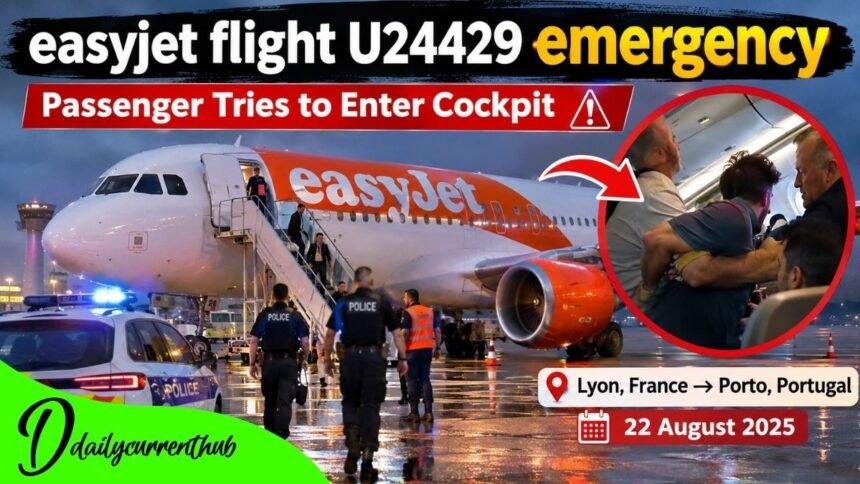
On August 22, 2025, an easyJet flight traveling from Lyon, France, to Porto, Portugal, experienced a serious onboard security incident shortly after takeoff. A passenger attempted to enter the aircraft’s cockpit, prompting an emergency response and an unexpected return to Lyon Saint-Exupéry Airport.
The incident involved easyJet flight U24429, also identified as EJU4429. An Airbus A320 carrying out the service returned safely to its departure airport, where French police took control.
The incident attracted attention because it involved an attempted entry into the flight deck, one of the most security-sensitive areas of a commercial aircraft.
This article examines the easyJet flight U24429 emergency, including the confirmed timeline, the passenger’s reported behavior, the crew’s response, and the measures that brought the situation under control.
It also explains what emergency code 7700 means and separates the documented events from assumptions about the passenger’s intentions.
What Happened on easyJet Flight U24429?
The easyJet flight U24429 emergency began during what was intended to be a routine European passenger service.
After departing Lyon on Friday evening, the aircraft encountered a security issue when a passenger attempted to access the cockpit.
According to reporting published by AFP on August 23, 2025, easyJet and French police confirmed that the passenger’s behavior caused the aircraft to return to Lyon shortly after takeoff.
Other passengers intervened and restrained the individual until the aircraft landed.
The response involved both aviation personnel and French law enforcement. Police met the aircraft following its return, and the passenger was removed.
The airline subsequently confirmed that the flight continued to Porto.
Although the incident was serious, its outcome showed that the immediate security problem could be contained without preventing the aircraft from landing safely.
A Detailed Timeline of the easyJet Flight U24429 Emergency
Departure from Lyon Saint-Exupéry Airport
On the evening of August 22, 2025, flight U24429 departed Lyon Saint-Exupéry Airport for Porto.
Aviation news outlet AIRLIVE reported that the Airbus A320 took off at approximately 18:34 local time, using runway 35L. The flight was reportedly about an hour behind its original schedule.
The aircraft involved carried the registration OE-IJL.
The planned route connected Lyon, a major city in southeastern France, with Porto in northern Portugal.
The events that followed occurred early in the journey, before the aircraft could continue toward its intended destination.
The Passenger’s Attempt to Enter the Cockpit
The central event was an attempted unauthorized entry into the cockpit.
AFP reported that a 26-year-old Portuguese passenger tried to force his way into the flight deck shortly after takeoff.
The cockpit is a restricted operational area that contains the controls and systems pilots use to operate the aircraft.
Uncontrolled access to this area raises immediate aviation security concerns, regardless of the individual’s eventual explanation or medical condition.
Reporting established that the passenger attempted to enter the cockpit. It did not establish that he successfully entered or gained control of any aircraft systems.
The available confirmed accounts therefore support describing the event as an attempted cockpit intrusion, not a successful cockpit breach.
The Emergency Declaration at 20,000 Feet
AIRLIVE reported that the aircraft interrupted its climb at approximately 20,000 feet and transmitted emergency transponder code 7700.
This information came from aviation tracking coverage, not the airline’s publicly reported statement.
The emergency declaration signaled that the flight required special attention from air traffic control.
At this point, the crew’s operational priority was to manage the aircraft safely while the security situation was being contained.
The available reports do not provide a complete transcript of cockpit communications or detailed information about every instruction issued by air traffic controllers.
What is established is that the flight reversed course and returned toward Lyon.
The Aircraft’s Safe Return to Lyon
Following the incident, the Airbus A320 returned to its departure airport.
AIRLIVE reported that the aircraft landed on runway 35R approximately 45 minutes after takeoff and subsequently parked at a remote stand.
French authorities had been alerted to the situation.
The safe landing ended the immediate in-flight emergency, although police and medical response continued after the aircraft landed.
Why Did easyJet Flight U24429 Return to Lyon?
A Security Incident Rather Than a Confirmed Technical Failure
The return was due to passenger behavior.
easyJet’s statement, as reported by AFP, attributed the return to an incident involving a passenger onboard.
The principal reports reviewed identified no confirmed engine failure, structural problem, or other aircraft malfunction as the cause.
That distinction matters because an emergency declaration does not automatically mean an aircraft has experienced a technical defect.
Airlines can return to their departure airport for multiple reasons, including security threats, serious medical situations, or operational safety concerns.
In the U24429 case, the documented trigger was the attempted access to the cockpit.
Why Returning to the Departure Airport Made Sense
Lyon was the airport from which the aircraft had recently departed.
Returning there allowed the flight to land at an airport where it could be met by the relevant French authorities.
The subsequent police intervention confirms that an organized ground response followed the aircraft’s return.
However, the exact factors the pilots considered when selecting Lyon over other possible airports have not been publicly detailed.
The decision should therefore be understood through its confirmed outcome rather than assumptions about conversations or procedures inside the cockpit.
Understanding Squawk 7700 and Its Importance
What Does Emergency Code 7700 Mean?
Aircraft use transponders to transmit identifying information and other signals that assist air traffic control.
Under European aviation rules published by the European Union Aviation Safety Agency (EASA), code 7700 indicates a general emergency.
It does not specify the precise cause of the emergency.
For example, the same code can be associated with different categories of urgent onboard situations.
Selecting this code helps alert the aviation surveillance system to an aircraft requiring emergency attention.
In the easyJet flight U24429 emergency, AIRLIVE reported that the crew selected 7700 while responding to the passenger incident.
Does Squawk 7700 Mean a Hijacking?
No. Squawk 7700 is a general emergency code.
European aviation rules separately identify code 7500 for unlawful interference.
The attempted cockpit entry understandably raised security concerns, but the emergency code itself does not establish the passenger’s motives.
Neither the publicly reported airline statement nor the available police account confirmed that the incident was an organized hijacking attempt.
Treating those possibilities as facts would misrepresent the evidence.
How Passengers and Crew Responded
The Role of Fellow Passengers
One of the most significant elements of the incident was the intervention by other passengers.
French police told AFP that fellow travelers subdued the individual and restrained him until the aircraft returned to Lyon.
Their intervention helped bring the immediate confrontation under control.
The precise number of passengers who assisted, their identities, and the individual actions they took were not established in the principal official accounts.
Consequently, descriptions of specific passengers performing heroic acts should not be presented as verified unless supported by reliable direct evidence.
The Crew’s Responsibility During the Incident
Cabin and flight deck crews have different responsibilities during an onboard emergency.
Cabin crew manage safety within the passenger cabin, while pilots must continue operating the aircraft and coordinating with air traffic control.
The safe return of U24429 confirms that the aircraft remained under operational control throughout the diversion.
Available public reporting does not document the precise division of tasks among crew members.
What can be stated is that the onboard disturbance was contained, the aircraft returned safely, and the passenger was handed over to authorities.
French Police Intervention and Medical Assessment
What Happened After the Landing?
French police were waiting for the aircraft after it returned to Lyon.
The passenger was removed from the flight and taken into custody.
Authorities identified him as a 26-year-old Portuguese national.
According to police information reported by AFP, medical examinations indicated that he had experienced airsickness and delirium.
He was subsequently hospitalized in France.
Police also said he had not previously been known to their services.
These details were reported in the immediate aftermath of the incident and should not be expanded into unsupported claims about his medical history.
Why the Medical Findings Matter
The medical findings provided important context for the behavior that disrupted the flight.
Reports of delirium and airsickness were attributed to examinations described by French police.
They should not be used to infer a specific long-term psychiatric diagnosis or establish motives that authorities did not confirm.
The distinction between an individual’s reported medical condition and criminal intent is particularly important in aviation incidents.
A potentially dangerous action requires an appropriate safety response even when medical issues may have contributed to the behavior.
In this case, authorities addressed both the immediate security problem and the passenger’s subsequent medical needs.
What Happened to Flight U24429 After the Emergency?
The return to Lyon did not permanently end the scheduled journey.
After police removed the passenger, easyJet confirmed that the flight continued to Porto later that evening.
French news reporting established that the aircraft eventually reached its intended destination.
Historical flight-tracking records also associate the August 22 service with the aircraft registration OE-IJL.
The incident caused a substantial interruption to the journey, although published accounts differ in how much operational detail they provide.
No serious injuries were identified in the principal reports reviewed.
This outcome is central to understanding the event: the aircraft landed safely, the disruptive passenger was removed, and the service eventually continued.
Public Curiosity and Misconceptions About the Incident
Did the Passenger Take Control of the Aircraft?
No verified evidence shows the passenger took control of the aircraft.
Reports consistently describe an attempt to access the cockpit, not a successful takeover.
This distinction matters because the word “cockpit” can be exaggerated when a story circulates online.
Was This an Aircraft Accident?
The incident was an onboard security emergency, not a reported crash.
The aircraft returned safely to Lyon and later completed the journey to Porto.
Aviation emergencies are not the same as accidents. Many result in controlled landings and the resolution of the underlying problem.
Was the Emergency Caused by Mechanical Trouble?
The confirmed explanation was a passenger-related security incident.
Although the aircraft declared an emergency, the principal reporting did not identify a mechanical problem as its cause.
These distinctions help readers understand the event without unnecessary sensationalism.
Aviation Safety Lessons from easyJet Flight U24429
Maintaining Flight Deck Security
The incident reinforces why access to commercial aircraft cockpits is strictly controlled.
An attempted intrusion can create an immediate safety concern, even when the person involved does not ultimately gain access.
The U24429 incident illustrates the importance of treating unauthorized attempts to enter the flight deck seriously.
Coordination Between Air and Ground Teams
The aircraft’s safe return and the presence of French police demonstrate that managing an onboard disturbance can require action both in the air and after landing.
Pilots must continue flying safely, onboard personnel must manage the cabin situation, and airport authorities may need to prepare for intervention.
These responsibilities are distinct but connected.
Accurate Reporting Protects Public Understanding
The case also illustrates the need to distinguish verified facts from assumptions.
The passenger’s attempted cockpit entry, the aircraft’s return, the police response, and the continuation to Porto were publicly confirmed.
Aviation tracking coverage reported the altitude and emergency transponder selection.
Details about individual intentions, private medical history, and the exact cockpit communications should not be invented to make the story more dramatic.
Conclusion
The easyJet flight U24429 emergency on August 22, 2025 was a serious onboard security incident involving an attempted unauthorized entry into the cockpit.
The Airbus A320 was traveling from Lyon to Porto when the disturbance occurred. Fellow passengers restrained the individual, the crew returned the aircraft safely to Lyon, and French police intervened after landing.
The passenger was subsequently hospitalized following medical examinations that, according to police reports, indicated airsickness and delirium.
The flight later continued to Porto, bringing the interrupted journey to a safe conclusion.
The incident demonstrates that an aviation emergency does not necessarily involve a technical failure or an accident. It can arise from an unexpected passenger-related situation that requires an urgent, coordinated response.
Most importantly, the documented events provide a clear account without exaggerated claims of a hijacking, a cockpit takeover, or an aircraft malfunction.
(FAQs)
1. What happened during the easyJet flight U24429 emergency?
On August 22, 2025, a passenger attempted to enter the cockpit of an easyJet flight traveling from Lyon to Porto. The aircraft returned to Lyon, where police removed the individual.
2. Why did easyJet flight U24429 make an emergency landing?
The aircraft returned because of a security incident in which a passenger attempted to gain unauthorized access to the cockpit.
3. Did easyJet flight U24429 land safely?
Yes. The Airbus A320 returned safely to Lyon Saint-Exupéry Airport. The flight later continued to Porto.
4. What aircraft was involved in the emergency?
According to aviation tracking reports, the aircraft was an Airbus A320-214, registration OE-IJL.
5. What does squawk 7700 mean?
Squawk 7700 is an internationally recognized transponder code for a general emergency. Aviation reporting indicated that the U24429 crew used it during the incident.
6. Was the incident an attempted hijacking?
A passenger attempted to enter the cockpit, but the available confirmed reports did not establish an organized hijacking attempt or a successful takeover of the aircraft.
7. What happened to the passenger responsible?
French police removed the 26-year-old Portuguese passenger after the flight landed. Authorities reported that he was later hospitalized following medical examinations.
8. Did the flight eventually reach Porto?
Yes. easyJet confirmed that the service continued to Porto after the passenger had been removed at Lyon.