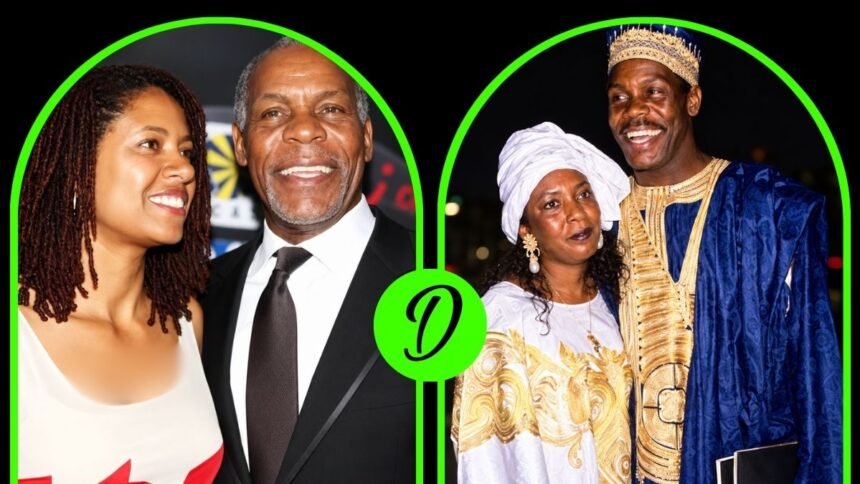
Danny Glover is internationally recognized for his performances in The Color Purple, the Lethal Weapon films, and numerous other productions. Alongside his acting career, he has earned attention for his involvement in civil rights, humanitarian causes, and community activism. Yet one important person in his early personal and professional journey was Asake Bomani, his first wife.
Bomani is more than a former celebrity spouse. She has a documented history in the arts as a San Francisco gallery owner, exhibition curator, and co-editor of publications exploring Black artists and their connections with Paris. Her cultural work gained recognition through the American Book Awards.
The couple met in college, married in 1975, and raised their daughter, Mandisa Glover. Their marriage ended in 2000.
Understanding Bomani’s story requires looking beyond her relationship with a famous actor. Her contributions to artistic representation, publishing, and family life offer a fuller picture of a woman whose work deserves recognition in its own right.
This article explores Asake Bomani’s background, relationship with Danny Glover, artistic career, family life, and documented achievements, while separating fact from unverified claims.
Profile Summary
| Detail | Information |
|---|---|
| Full Name | Asake Bomani |
| Reported Birth Name | Sandra Henderson |
| Reported Date of Birth | July 1, 1945 |
| Reported Birthplace | Wilmington, Delaware, United States |
| Nationality | American |
| Profession | Arts professional, former gallery owner, editor; also described as a jazz singer |
| Education | Attended San Francisco State College |
| Former Husband | Danny Glover |
| Marriage | 1975–2000 |
| Children | One daughter, Mandisa Glover |
| Notable Publication | The Paris Connections: African American Artists in Paris |
| Literary Recognition | 1993 American Book Awards, with Belvie Rooks |
| Historical Residence | San Francisco, California |
| Known Community Interests | Black art, cultural exhibitions, and artistic representation |
| Current Residence | Not independently established |
| Social Media | No authenticated public account established |
Who Is Asake Bomani?
Asake Bomani is an American arts professional best known publicly as actor Danny Glover’s first wife. Their relationship began before Glover became an internationally recognized Hollywood performer, placing Bomani within an important period of his early development.
She also built a professional identity within San Francisco’s artistic community. Historical records identify her with Bomani Gallery, while Smithsonian collections document her editorial and curatorial contributions to exhibitions in Paris that examined African American, African, and Caribbean artists.
Her work with Belvie Rooks on Paris Connections received recognition in the 1993 American Book Awards.
Bomani’s biography connects several different stories: African American cultural history, independent gallery work, publishing, marriage, and parenthood. Although much public attention has centered on Danny Glover, her professional record shows she was actively involved in the arts rather than existing solely as her husband’s celebrity.
The Life, Work, and Relationships of Asake Bomani
The Private Life of Asake Bomani
Asake Bomani has generally maintained a less prominent public profile than Danny Glover, particularly in the years following their divorce. Much of the surviving documentation of her life comes from historical interviews, family photographs, gallery records, and exhibition publications.
Her public presence was nevertheless substantial at particular moments. During Glover’s rise in Hollywood, Bomani attended film-related events and appeared in professional photographs alongside him. These appearances provide a documented record of their relationship during the years when his acting career was expanding.
It would be inaccurate to describe her as someone who was never publicly visible. Her work as a gallery owner and exhibition editor also involved participation in cultural activities intended for audiences.
A distinction should therefore be made between having a limited contemporary celebrity profile and living entirely outside public life. Bomani has experienced both professional visibility and relative privacy at different stages of her life.
Early Life and Background of Asake Bomani
Entertainment biographical sources describe Bomani as having been born Sandra Henderson on July 1, 1945, in Wilmington, Delaware. However, those details are less firmly documented than her adult life in California.
Her college years provide a clearer historical starting point. She attended San Francisco State College, now San Francisco State University, where she met Danny Glover in the 1960s.
Glover studied economics and participated in student activism, while Bomani was involved in English studies.
They met during a significant period in San Francisco’s educational and political history. The university became closely associated with student activism and demands for greater academic representation.
The surrounding historical environment matters because Glover later became an outspoken social activist, while Bomani built a career centered on art and cultural expression.
Although their professional paths eventually diverged, both became involved in public work that engaged with African American identity and cultural representation.
Marriage and Partnership with Danny Glover
Asake Bomani and Danny Glover’s relationship began long before Hollywood fame shaped Glover’s public identity.
In an interview published by The Independent, Glover recalled feeling too shy to approach Bomani at first. He repeatedly waited outside her English class, briefly greeted her, and eventually found the confidence to ask her out.
The couple married in 1975.
Early in their marriage, Glover transitioned from community development work to professional acting. According to Glover’s later recollections, Bomani supported his decision to pursue a career in performance.
The marriage continued as his career expanded into major films during the 1980s and 1990s.
Photographic archives document the couple attending public events, including Hollywood premieres. Their appearances demonstrate that Bomani was part of Glover’s public family life during an important stage of his career.
The couple separated after more than two decades together. Glover filed for divorce in 1999, and the couple ended their marriage in 2000.
Asake Bomani’s Role Behind the Scenes
One of the clearest examples of Bomani’s influence is Glover’s early decision to become an actor.
In his interview with The Independent, Glover acknowledged that Bomani encouraged him to pursue acting professionally.
This matters because he changed careers before he achieved the recognition associated with his later film roles.
A partner’s support can shape a person’s professional development, but Bomani’s contribution should be described within the limits of the historical evidence. Glover’s acknowledgment shows she encouraged him; it does not show she managed his career or directed his individual acting decisions.
Their relationship also unfolded as Bomani developed her own cultural interests.
Rather than presenting her exclusively as a supportive spouse, a more complete account recognizes two people pursuing different professional paths while sharing family responsibilities.
Her documented gallery and publishing activities show that she had independent ambitions and accomplishments beyond her marriage.
Art Gallery, Publications, and Literary Recognition
Bomani’s involvement in the visual arts is among the most substantial and independently documented parts of her biography.
The San Francisco Public Library’s historical reference records identify her as the owner of Bomani Gallery, formerly located at 251 Post Street in San Francisco.
Photographs from December 1990 also document Bomani and Glover at her gallery.
Her association with Paris Connections provides additional evidence of her professional work.
In 1992, Bomani Gallery and Jernigan Wicker Fine Arts presented related exhibitions examining Black artists with connections to Paris.
Smithsonian Libraries and Archives records identify Bomani and Belvie Rooks as editors of The Paris Connections: African American Artists in Paris. Raymond Saunders is credited with curatorial responsibility for that publication.
A related volume, Paris Connections: African and Caribbean Artists in Paris, credits Bomani and Rooks as editors and Bomani and Cheryle Wicker as curators.
These are distinct cataloged publications, both dating to 1992.
The exhibitions explored relationships between visual art, geography, identity, and the experiences of artists whose work crossed national boundaries.
In 1993, Bomani and Rooks were named among the recipients of the American Book Awards for their work associated with Paris Connections.
This recognition is especially significant because it establishes Bomani’s achievements independently of her former husband’s career.
Family Life: Raising the Next Generation
Asake Bomani and Danny Glover welcomed their daughter, Mandisa Glover, on January 5, 1976.
Mandisa grew up in San Francisco, where the family lived in the Haight-Ashbury neighborhood. This neighborhood was also closely connected to Danny Glover’s own upbringing.
As his acting career developed, the family occasionally attended public entertainment events together—archival photographs document Glover, Bomani, and Mandisa’s appearances in the early 1990s.
Mandisa later developed her own professional interests. A 2024 People magazine profile described her work in the food industry as a chef and business owner, along with earlier experiences in film production.
These details demonstrate that the next generation developed a professional identity distinct from Hollywood acting.
Public reporting confirms that Bomani and Glover shared responsibility for raising Mandisa during their marriage. However, their private parenting arrangements should not be reconstructed from assumptions about their personalities or celebrity status.
Their daughter’s life remains an important part of the family’s documented history.
Philanthropy and Community Engagement
Danny Glover’s public record includes extensive involvement in civil rights, labor advocacy, humanitarian campaigns, and social justice causes.
His activism has been discussed in major newspaper interviews and public appearances across several decades.
Bomani’s own documented community engagement is more clearly associated with cultural work.
Through her gallery and the Paris Connections exhibitions, she helped present the work of Black artists to public audiences.
Exhibitions of this kind can contribute to cultural education by making artistic histories accessible through displays, publications, and institutional records.
Her professional activities therefore have significance beyond commercial gallery operations.
However, Glover’s philanthropic commitments should not automatically be attributed to Bomani. The available evidence does not establish that she personally operated a specific charitable foundation, donation program, or ongoing humanitarian campaign.
Her verifiable contribution to community life is best understood through her involvement in cultural presentation and the documentation of artistic achievement.
The Power of Privacy: Influence Without Publicity
Celebrity relationships often draw attention long after a marriage ends.
In Bomani’s case, public interest continues largely because of her historical connection with Danny Glover. Yet a biography focused exclusively on that relationship would overlook her independent work in the arts.
Her limited contemporary media presence also highlights the distinction between public recognition and documented accomplishment.
A person does not need frequent interviews or social media appearances for earlier professional contributions to remain meaningful.
Bomani’s editorial credits continue to appear in institutional collections decades after the original exhibitions.
Those records make her professional role accessible even when recent personal interviews are scarce.
At the same time, limited publicity cannot establish her personal reasons for maintaining privacy. Attributing her media presence to humility, deliberate secrecy, family priorities, or any other unconfirmed motivation would be speculative.
The more defensible conclusion is that her documented achievements remain relevant regardless of how frequently she appears in public discussion today.
Public Curiosity and Misconceptions About Asake Bomani
Several recurring misconceptions complicate online discussions of Bomani’s life.
One concerns her professional identity. Some celebrity profiles describe her principally as Danny Glover’s former wife, overlooking her independently documented gallery and editorial work.
Another involves her publication history.
The title Paris Connection: African American Paris is sometimes repeated in online biographies, occasionally with a 1991 publication date.
Institutional library catalogs instead identify the documented 1992 exhibition publications as Paris Connections, with distinct subtitles and editorial credits.
It is also misleading to describe the recognized publication simply as a solo-authored novel. The available records identify Bomani as a co-editor of exhibition-related art publications.
Other claims concern her current wealth, Residence, relationships, or social media accounts. Such details should not be treated as established without reliable supporting evidence.
A responsible biography distinguishes what archival records demonstrate from information that circulates without meaningful verification.
Legacy and Future
Asake Bomani’s historical significance rests on more than her former marriage.
Her association with Bomani Gallery places her within San Francisco’s cultural landscape during the late twentieth century. Her editorial and curatorial work connects her to exhibitions exploring Black visual artists and their relationship with Paris.
Her recognition through the American Book Awards provides another lasting component of that record.
She also remains part of Danny Glover’s personal history as his first wife, the mother of his daughter, and a person he credited with encouraging his early acting ambitions.
These aspects of her life are interconnected, but each deserves appropriate attention.
Her future personal plans cannot be reliably predicted from the information publicly documented.
What can be established is the continuing availability of her professional work through library collections and historical exhibition records. Those records preserve contributions that might otherwise be overshadowed by the celebrity relationship through which many readers first discover her name.
Conclusion
Asake Bomani’s life shows why the biography of someone connected to Hollywood should extend beyond celebrity relationships. Her marriage to Danny Glover remains an important chapter, beginning before his rise to international fame and continuing through much of his early success.
Yet Bomani also developed an identifiable professional history in San Francisco’s arts community.
Her gallery ownership, involvement in the Paris Connections exhibitions, and recognition through the 1993 American Book Awards establish meaningful achievements in cultural publishing and artistic representation.
Her family history also includes her daughter, Mandisa Glover, whose independent professional development has been documented in later reporting.
Although many details of Bomani’s present-day personal life remain private, her historical record provides a foundation for understanding her contributions.
Ultimately, Asake Bomani deserves recognition not only as Danny Glover’s first wife but also as an arts professional whose work helped document and present important aspects of Black cultural history.
Read this too:Arlene Silver: The Inspiring Life, Career, and Marriage to Dick Van Dyke
(FAQs)
1. Who is Asake Bomani?
Asake Bomani is an American arts professional, former gallery owner, and editor best known publicly as Danny Glover’s first wife. She contributed to art exhibitions and publications documenting Black artists.
2. When did Asake Bomani marry Danny Glover?
Asake Bomani married Danny Glover in 1975, after they met in college at San Francisco State College.
3. Why did Asake Bomani and Danny Glover divorce?
Danny Glover filed for divorce in 1999, citing irreconcilable differences. Their marriage ended in 2000. Further private details should not be assumed.
4. Does Asake Bomani have children?
Yes. She and Danny Glover have one daughter, Mandisa Glover, born January 5, 1976.
5. What is Asake Bomani famous for?
She is best known for her former marriage to Danny Glover, her San Francisco art gallery, and her editorial contributions to the Paris Connections exhibition publications.
6. Did Asake Bomani win an American Book Award?
Yes. Asake Bomani and Belvie Rooks were listed among the 1993 American Book Awards recipients for Paris Connections: African American Artists in Paris.
7. What is Asake Bomani’s professional background?
Her documented professional background includes gallery ownership, art exhibition work, and publication editing. Entertainment biographies have also described her as a jazz singer.
8. Where is Asake Bomani now?
Her current Residence and personal activities have not been independently established through reliable recent reporting. Her historical work remains documented in institutional art and library collections.