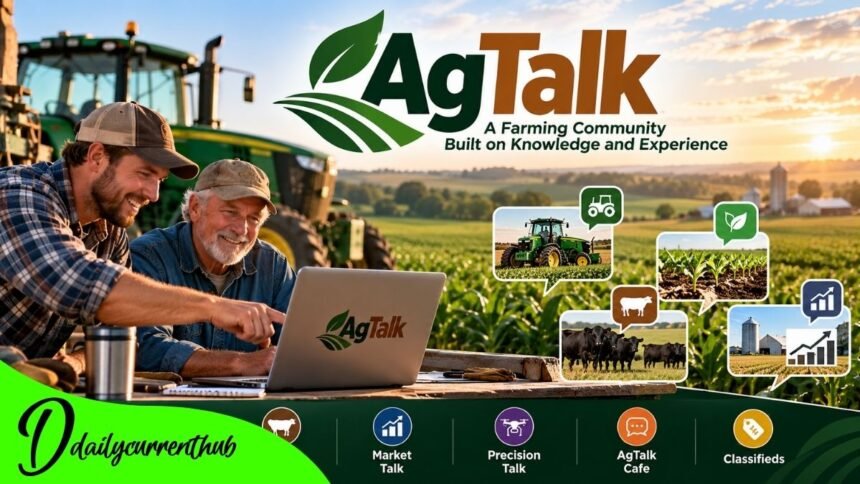
AgTalk has become a long-standing online meeting place for farmers to exchange practical knowledge, discuss agricultural challenges, and learn from others’ experiences. Unlike social media platforms built around entertainment and personal visibility, this agricultural discussion forum concentrates on the everyday realities of farming.
From repairing expensive machinery to managing crop production, understanding livestock practices, and discussing changing grain markets, its members participate in conversations closely connected to agricultural work.
The community dates back to 2000, when farmers sought a simpler alternative to commercial agricultural discussion websites. Over time, it developed into an extensive collection of conversations covering traditional farming practices and modern agricultural technology.
Its continued activity in 2026 demonstrates that traditional discussion forums can remain relevant even as digital communication changes.
This article explores AgTalk’s history, its major discussion sections, its community standards, and practical ways farmers can use it to exchange information and make better-informed decisions.
What Is AgTalk?
AgTalk is an online agricultural discussion community where farmers, equipment users, livestock producers, and others connected with farming exchange information through topic-based forums.
The platform operates through discussion threads. A participant starts a conversation by asking a question, sharing an experience, or introducing a subject. Other registered users can respond, adding advice, observations, or alternative perspectives.
This format lets a single practical question develop into a detailed discussion drawing on experiences from multiple farms.
For example, conversations about a tractor problem may involve maintenance techniques, possible causes, replacement components, and operating conditions. Crop-related discussions may examine planting methods, environmental conditions, or agricultural equipment.
AgTalk’s distinguishing characteristic is its emphasis on participation rather than conventional publishing. Most of its material comes directly from community members.
This creates opportunities for practical learning, though individual contributions should be evaluated carefully rather than treated as verified professional instruction.
Origins and Early Development of AgTalk
AgTalk’s history dates to June 2000, when internet discussion boards were becoming increasingly useful tools for exchanging specialized knowledge.
According to a January 2010 Farm Progress article by David Hest, Ohio farmer David Orr and several others helped develop the community after experiencing difficulties with existing commercial agricultural forums.
At the time, slow internet connections made websites containing heavy graphics and advertising inconvenient for many rural users.
The founders favored a simpler discussion environment that prioritized communication over elaborate presentation.
This approach reflected the early internet’s technological constraints. A platform didn’t need sophisticated visual features to be useful if participants consistently contributed valuable information.
The same Farm Progress report described AgTalk as a community supported by voluntary contributions and moderation efforts.
Its early history shows farmers developing digital infrastructure to meet their own communication needs.
The Agricultural Community Behind AgTalk
AgTalk’s value is closely tied to the knowledge its members contribute.
Agriculture involves problems that vary significantly by location, weather, soil conditions, machinery, and production methods. A technique that works on one farm may produce different results elsewhere.
Discussion forums allow these differences to become part of the conversation.
One participant might describe a specific equipment failure, while another explains how they handled a similar issue. Other contributors can then share additional experiences or point out circumstances that change the recommended approach.
This exchange doesn’t guarantee a correct answer, but it can help users identify possibilities they hadn’t considered.
The community also preserves older discussions. Those archives may help when farmers encounter problems with machinery models or agricultural technologies that remain in service years after their introduction.
Revisiting past conversations is one of a traditional forum’s practical strengths.
Machinery Talk: Practical Equipment Knowledge
Machinery Talk is a major section of AgTalk. Its official description focuses on equipment operation, repairs, and practical suggestions.
This subject matters because agricultural machinery often represents a substantial business investment.
Tractors, combines, planters, sprayers, and harvesting equipment require maintenance and careful operation. Equipment breakdowns can also interrupt work during periods when timing matters.
On Machinery Talk, users discuss mechanical problems, compare equipment performance, and share repair observations.
The platform also includes a separate section called Where Can I Find?????, intended for people searching for salvage yards, replacement parts, and equipment.
These discussions can help readers understand how other operators approach similar problems.
However, always check mechanical advice against manufacturer instructions and applicable safety requirements, especially when repairs involve hydraulics, electrical systems, or moving components.
Crop Talk and Agricultural Production
Crop Talk provides a dedicated space for discussing crops and cultivation practices.
Crop production requires decisions involving seed selection, planting conditions, nutrient management, weed control, irrigation, and harvesting.
The suitability of these decisions depends heavily on local circumstances.
Within agricultural forums, growers can compare their experiences with similar crops, equipment, and environmental challenges.
Such discussions may help participants develop questions for agronomists or identify information worth investigating through agricultural research and extension services.
One important limitation is that personal experience does not necessarily establish a reliable scientific conclusion.
A practice one contributor reports as successful may not apply to different soil types, climates, or production systems.
For that reason, AgTalk is most useful when its discussions complement credible agronomic research rather than replace it.
Stock Talk: Connecting Livestock Producers
Livestock production has its own technical and management challenges, which are addressed through the Stock Talk discussion section.
The forum is designated for livestock-related conversations.
Discussions may cover feeding practices, grazing management, animal housing, production equipment, and general livestock operations.
Exchanging experience can be particularly helpful when producers compare management approaches or discuss equipment used in daily animal care.
Nevertheless, animal health problems require careful treatment.
Advice from an online discussion cannot establish a veterinary diagnosis or determine the correct treatment for an individual animal.
Producers should consult qualified veterinary professionals for illnesses, medications, or serious welfare concerns.
Precision Agriculture and Modern Farm Technology
Agricultural technology has changed considerably since AgTalk was established.
Modern farming increasingly uses satellite positioning, digital guidance systems, field mapping, electronic monitoring, and automated equipment.
AgTalk covers several of these topics in dedicated sections.
Precision Talk focuses on precision-agriculture equipment and how it operates. Users discuss technology that guides machinery, collects field information, and manages agricultural tasks.
Drone Talk covers aerial, satellite, and unmanned technologies used in production agriculture.
The community also maintains Computer Talk, which addresses computer hardware, software, and related technical questions.
These categories show the range of technologies now used in agricultural operations.
For farmers considering new equipment, these discussions provide practical context on how certain systems perform in real operating environments.
Technical compatibility, software licensing, warranty conditions, and data security should still be confirmed through official documentation.
Market Talk and Agricultural Business Decisions
Agricultural marketing is another major subject within the community.
Market Talk is dedicated to discussions about agricultural markets and related decisions.
Farm businesses operate in environments affected by commodity prices, production costs, transportation expenses, and changing supply and demand.
Participants may share opinions about market developments, pricing conditions, and their interpretations of agricultural trends.
The discussion format allows different viewpoints to appear together, which can be valuable when market conditions are uncertain.
However, market commentary from forum participants is not equivalent to verified financial analysis.
Prices, forecasts, and trading opinions can change rapidly. Farmers should compare community discussions with current market reports, official data, and qualified professional advice before making significant commercial decisions.
AgTalk offers a place to explore perspectives, not a guarantee of profitable outcomes.
AgTalk Cafe and the Human Side of Farming
Not every conversation on AgTalk concerns farm equipment or agricultural production.
The community includes AgTalk Cafe, a polite place to meet and talk, and Kitchen Table, which focuses on family, home, and everyday life.
These sections recognize that farming communities have social connections extending beyond technical work.
Agricultural occupations can involve long hours, seasonal pressures, and geographically dispersed populations.
Online communities let participants stay connected with people who understand aspects of rural life.
Historically, these relationships have extended beyond online conversations.
The 2010 Farm Progress report described gatherings where AgTalk members met in person. It also documented a 2009 fundraising effort in which community members raised approximately $25,000 to help a member’s family facing substantial medical expenses.
That reported example illustrates how an online agricultural network can support real-world community action.
It should not, however, be interpreted as evidence of a permanent charitable organization or continuing fundraising program.
Privacy, Moderation, and Community Standards
The ability to share information publicly also creates responsibilities.
AgTalk maintains a published posting policy that emphasizes respectful participation and prohibits several forms of disruptive or inappropriate behavior.
The policy addresses harassment, spam, abusive content, copyright violations, and inappropriate commercial promotion.
It also explains that moderation does not mean every message is reviewed before publication.
This distinction matters because users remain responsible for evaluating information they encounter.
The forum allows people to participate under usernames, but public discussion posts should not be confused with private communication.
Participants should avoid publishing confidential business records, sensitive financial details, private addresses, or other information that could expose them to unnecessary risk.
The official FAQ also explains that posting requires registration, while reading does not require an account.
The registration requirement was introduced in response to spam problems experienced in 2006.
Together, these practices show how the community has attempted to balance open discussion with reasonable participation controls.
AgTalk Classifieds and Agricultural Equipment Listings
AgTalk also provides a separate classified listings area.
Its listings include agricultural machinery, replacement components, precision-farming equipment, and related products.
This gives equipment buyers and sellers another way to connect with people involved in agriculture.
Unlike the discussion forums, classifieds are intended specifically for commercial listings.
Visitors can examine item descriptions, advertised prices, and seller information.
However, listings should not be mistaken for independent verification of an item’s condition or a seller’s reliability.
Before purchasing expensive equipment, buyers should establish ownership, inspect the machinery where practical, confirm important specifications, and agree on secure transaction arrangements.
For high-value purchases, professional inspections and documented agreements can provide important protection.
How to Use AgTalk Effectively
New visitors can begin by browsing the main forum categories and reading existing discussions.
The official FAQ says you can read without registering, but to participate, you must create an account.
After registering, members can select an appropriate category and start a discussion or respond to an existing thread.
A useful question normally contains enough detail for other participants to understand the problem.
For machinery discussions, this may mean including the equipment model, operating symptoms, maintenance history, and relevant error messages.
For crop questions, details such as crop type, location, growing conditions, and development stage can help establish context.
Members should also search previous discussions before opening a new thread.
AgTalk’s official FAQ describes search options involving keywords, authors, subjects, and posting dates.
When reviewing answers, readers should compare multiple contributions and consider whether the advice applies to their particular situation.
Following up with the eventual solution can also make a discussion more useful to future visitors.
Public Curiosity and Misconceptions About AgTalk
One misconception is that AgTalk operates as an official agricultural advisory authority.
It does not. It is a community discussion platform where individual contributors express their own opinions and experiences.
Another misconception is that older forum designs are necessarily obsolete.
AgTalk’s continued activity shows that a conventional discussion format can remain useful when the subject matter is specialized, and the community contributes regularly.
Visitors should also distinguish the main discussion boards from classified advertisements.
The two sections serve different purposes and should be approached with different expectations.
Understanding these distinctions helps readers use the platform responsibly.
The Continuing Relevance and Future of AgTalk
As of October 2026, AgTalk continued to display active conversations across several major agricultural categories, including machinery, crops, livestock, markets, and precision technology.
Its continued operation reflects the lasting usefulness of subject-focused online communities.
Agriculture combines practical experience with scientific knowledge, business management, and technological development. Farmers often need information that addresses specific equipment or production circumstances.
Discussion forums can help connect people who have encountered similar challenges.
The platform’s future development cannot be predicted from its existing activity alone.
However, its established archive and range of technical discussion categories give farmers reasons to keep finding its material useful.
AgTalk’s most reliable role remains what it has done throughout its history: enabling people involved in agriculture to exchange experiences, ask questions, and learn from one another.
Conclusion
AgTalk represents more than a collection of agricultural message boards. Its history shows how farmers built an online community to share practical information without relying entirely on commercial publishing platforms.
Since its establishment in 2000, the forum has hosted discussions covering machinery, crop production, livestock management, agricultural markets, and increasingly sophisticated farming technology.
Its social sections also demonstrate that agricultural communities are shaped by personal relationships as well as professional concerns.
The platform’s usefulness comes from its members’ knowledge and participation. At the same time, responsible readers must recognize the limitations of advice supplied by individual contributors.
For farmers, agricultural students, machinery operators, and others interested in practical agriculture, AgTalk offers access to a substantial collection of real-world discussions.
Its lasting contribution is the opportunity it provides for people with shared agricultural interests to communicate, compare experiences, and learn together.
(FAQs)
1. What is AgTalk?
AgTalk is an online agricultural discussion forum where farmers and other participants exchange information about equipment, crops, livestock, markets, and farming technology.
2. Who founded AgTalk?
Ohio farmer David Orr and other forum participants helped establish AgTalk in 2000, according to historical reporting published by Farm Progress.
3. Is AgTalk free to use?
Public discussions can be read without registration. The official FAQ does not describe a subscription requirement for ordinary forum reading and participation.
4. Do I need an account to post on AgTalk?
Yes. AgTalk requires users to register before contributing posts or replies. Visitors can read public discussions without registering.
5. What is Machinery Talk on AgTalk?
Machinery Talk is a discussion category focused on operating, maintaining, repairing, and troubleshooting farm equipment.
6. Can farmers buy or sell equipment through AgTalk?
Yes. AgTalk provides a separate classifieds section containing agricultural equipment and related listings. Buyers should independently verify sellers and products before completing transactions.
7. Is the agricultural advice on AgTalk always reliable?
No. Forum contributions reflect individual experiences and opinions. Important technical, financial, veterinary, and agronomic decisions should be checked against qualified professionals and trustworthy sources.
8. Is AgTalk still active in 2026?
Yes. The forum displayed active discussions during October 2026 across categories including Machinery Talk, Crop Talk, Stock Talk, Precision Talk, and Market Talk.