In northern Sweden, the Municipality of Boden is undergoing a remarkable industrial and social transformation. New investment in low-emission steel production, expanding defensedefense operations, and growing demand for skilled workers are reshaping the area’s economic future.
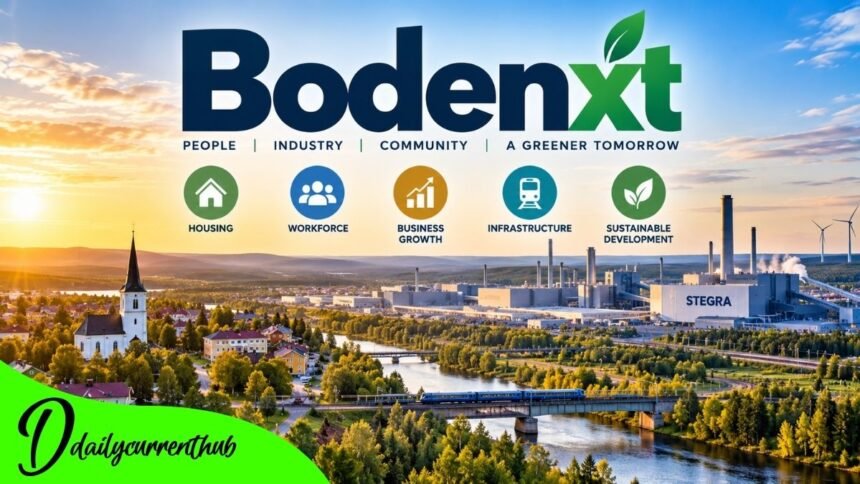
At the centercenter of the municipality’s response is Bodenxt, a development platform designed to coordinate changes affecting businesses, infrastructure, housing, and everyday community life.
Unlike a traditional company or technology product, this initiative operates within municipal development work. It aims to help the community respond to rapid growth while protecting residents’ long-term interests.
The initiative is closely connected with Stegra, the industrial company developing a major green steel production facility at Boden Industrial Park.
Understanding its significance requires looking beyond industrial investment figures. Its real purpose lies in coordinating the different parts of society that must develop together when a region undergoes rapid economic change.
What Is Bodenxt?
Bodenxt is the Municipality of Boden’s platform for coordinating the extensive transformation taking place across the community.
Its responsibilities concern the connections between economic development and the practical requirements of a growing population.
When a large employer establishes operations, the consequences extend far beyond the factory itself. Workers need accommodation, transportation, education, and community services. Businesses require reliable infrastructure, while public authorities must coordinate land use, environmental requirements and long-term planning.
The municipal platform brings these interconnected priorities into a common development framework.
The municipality has described the speed of change as comparable to about 20 years of societal development compressed into a much shorter period.
That comparison illustrates why ordinary administrative processes may need closer coordination during exceptional periods of growth.
The Origins and Early Development of Bodenxt
The initiative’s background can be traced to Boden’s efforts to strengthen its local economy before the current industrial expansion.
In 2017, the municipality introduced a growth program intended to establish a clearer direction for economic development. The programme addressed several sectors, including green electricity-dependent industries, environmental technologies, tourism and digital activities.
The municipal response to the COVID-19 pandemic subsequently demonstrated the value of closer cooperation across administrative boundaries.
Rather than treating departments as entirely separate organizations, local leaders began developing more coordinated working methods.
A major turning point came when the company then known as H2 Green Steel selected Boden for its industrial development. The decision was announced in February 2021.
The scale of the proposed investment created demands involving planning permissions, land, roads, housing and employment.
Bodenxt emerged as a means of coordinating these responsibilities across the municipality and its associated organisations.
The Organization Behind the Initiative
The platform is associated with Boden Municipality, rather than a privately owned business or individual founder.
Municipal reporting describes an organizational structure built around major development themes.
These include living and housing, skills supply, business development and infrastructure. Infrastructure responsibilities encompass both above-ground facilities and underground networks.
Coordinators and working groups connect the relevant departments and municipal companies.
This approach matters because decisions affecting one sector frequently influence another.
For example, approving new housing construction also requires consideration of transportation, electricity, water, sewerage and nearby public services.
A coordinated administrative structure can help officials identify those dependencies earlier.
It does not eliminate legal procedures or planning requirements. Instead, it provides a framework for managing related responsibilities more consistently.
Partnership with Stegra and Industrial Development
One of the most significant relationships connected with the initiative involves Stegra, formerly H2 Green Steel.
The company is developing a large industrial facility intended to produce steel with substantially lower emissions than conventional coal-based steelmaking.
Its proposed production system uses hydrogen-based technology as a key part of the manufacturing process.
The project has helped attract attention to Boden as a location for industrial investment.
However, Stegra and the municipal platform have different responsibilities.
Stegra is the industrial developer. The municipality manages public planning and development responsibilities associated with the wider community.
Their cooperation covers matters such as land, permits, accommodation, workforce needs and infrastructure.
Municipal reporting has described approximately 40 collaborative workstreams between Boden and Stegra.
This relationship demonstrates how large industrial developments depend on cooperation between companies and public institutions.
Housing and Community Development
Housing represents one of Boden’s most pressing development challenges.
In May 2026, the municipality reported that the vacancy rate for rental apartments was close to zero.
This shortage affected both incoming workers and existing residents seeking different accommodation.
The municipality also identified difficulties caused by high construction costs and uncertain financing conditions.
At that time, eleven detailed development plans were being prepared or processed, collectively allowing for approximately 1,300 apartments and 500 detached houses.
These numbers represented planning capacity rather than completed construction.
Housing pressure also illustrates the difference between creating employment opportunities and establishing a sustainable community.
A new worker may need accommodation for an entire family. Existing residents may need smaller homes, affordable rentals, or opportunities to remain close to their workplaces.
On October 22, 2026, the municipality reported another complication: contamination had delayed a planned development of 41 rental homes in Prästholmen.
The example demonstrates why sustainable development requires careful environmental investigation as well as construction planning.
Workforce Skills and the Next Generation
Industrial expansion creates demand for engineers, technicians, construction workers, logistics specialists and employees in supporting services.
The wider community also needs qualified people in education, healthcare, retail and municipal administration.
For Boden, the challenge is therefore not simply attracting industrial workers. It is creating conditions for people to establish lasting lives.
On October 21, 2026, the municipality announced a combined Skills and Relocation Unit, headed by Thomas Knutsson.
The unit brings employment-related skills planning together with support for people considering relocation.
Its responsibilities include helping employers identify recruitment needs and helping newcomers navigate the practical challenges of moving.
The municipality reported that the unit comprised 14 employees, with much of its staffing supported through externally funded projects.
This development illustrates the broader principle behind the transformation: recruiting a skilled professional is only one part of building a sustainable workforce.
Housing, education, employment opportunities for family members and community connections all influence whether newcomers remain.
Business Growth and Essential Infrastructure
Major industrial investment can create opportunities for companies that supply construction, transportation, engineering, maintenance,, and other services.
The municipality’s business development efforts seek to support this broader economic activity.
Infrastructure is especially important because industrial growth requires reliable physical connections.
On June 9, 2026, a new six-kilometer railway serving Boden Industrial Park was officially inaugurated.
The project involved cooperation between public and private organizations, including Polar Structure and the municipality.
Its completion provided the industrial area with a direct connection to the Swedish railway network.
Another milestone followed on October 1, 2026, when the first section of a new road to the industrial park opened.
The municipality reported that the entire road development represented an investment of approximately SEK 500 million, with the remaining sections expected to be completed by the end of 2027.
These projects show how industrial development requires infrastructure that can serve additional businesses and the wider region.
Environmental Responsibility and Community Engagement
Environmental sustainability is central to the municipality’s industrial development ambitions.
Stegra’s planned production methods are intended to reduce the emissions associated with traditional steelmaking. The municipality anticipates a reduction of up to 95 percent compared with conventional blast-furnace production.
That figure is a projected technological outcome, not proof that the entire operation has already achieved that reduction.
The environmental responsibilities surrounding major industrial development extend beyond the production process.
Transport systems, energy consumption, land use, housing construction and water infrastructure all influence the environmental consequences of growth.
Community participation is another important consideration.
In September 2026, Boden Municipality opened public consultation on a proposed comprehensive development plan looking towards 2040.
The process invited residents, businesses, associations and other stakeholders to comment on future land use and development priorities.
Such consultation provides a formal opportunity for public participation in decisions affecting the municipality’s future.
The Influence of Coordination Behind the Scenes
Much of the development platform’s work concerns activities that are less visible than factories, roads or housing projects.
Administrative coordination includes aligning planning processes, connecting organizations and addressing problems that cross departmental boundaries.
This work can have significant consequences even when it does not attract widespread attention.
For example, recruitment plans depend on available accommodation. Housing development depends on suitable land, financing and infrastructure. Infrastructure projects require cooperation between authorities, contractors and investors.
The municipality’s organisational approach recognises that these responsibilities cannot always be managed effectively in isolation.
Its potential value therefore lies in helping different participants understand shared priorities.
However, coordination should not automatically be treated as evidence of success. Outcomes must still be evaluated through completed projects, financial sustainability, environmental performance, and improvements in residents’ daily lives.
Public Misconceptions About Bodenxt
The name can be confusing because it resembles a technology company’s branding.
Some online descriptions present it as a software platform, artificial intelligence application, or commercial digital service.
Those interpretations do not match the municipality’s official description.
The term platform refers to a framework for municipal coordination and development.
It does not identify a downloadable application or consumer subscription product.
It would also be inaccurate to assign the initiative a personal net worth, family history, or marriage record.
Although individual public officials and business leaders have contributed to Boden’s development, the initiative itself is an organisational arrangement.
Clear distinctions between municipal responsibilities, private investment and projected outcomes are essential when evaluating its achievements.
Legacy and Future Development
The long-term importance of Boden’s transformation will depend on more than attracting industrial investment.
The municipality must balance economic growth against accommodation shortages, environmental requirements, infrastructure costs and residents’ quality of life.
Its proposed comprehensive plan looks ahead to 2040, while individual infrastructure and housing projects follow their own development schedules.
Expansion by the Swedish Armed Forces adds another dimension to the local economy, increasing demand for workers, services and community facilities.
The most meaningful measures of success will include whether businesses can operate sustainably, newcomers can establish permanent homes, and existing residents share in the benefits of development.
The challenge is to turn a period of exceptional investment into durable community improvements.
Conclusion
Bodenxt represents an ambitious approach to coordinating economic and social development in northern Sweden.
Its significance does not come from an individual personality, commercial brand, or digital product. It comes from the municipality’s effort to connect major industrial expansion with the practical needs of residents and businesses.
The initiative encompasses housing, recruitment, infrastructure, sustainable industry,, and long-term planning.
Its development has already coincided with major infrastructure milestones, including the inauguration of a new railway and the opening of a road connection to Boden Industrial Park.
At the same time, housing shortages and environmental complications demonstrate that substantial challenges remain.
The ultimate legacy of the initiative will depend on how effectively Boden converts industrial investment into lasting improvements in employment opportunities, community services, environmental performance and everyday living conditions.
Its central lesson is straightforward: sustainable economic transformation requires careful attention to the society surrounding the industry.
(FAQs)
1. What is Bodenxt?
It is the Municipality of Boden’s development platform for coordinating industrial growth, housing, workforce needs, business development, and infrastructure.
2. Where is Bodenxt located?
It is associated with the Municipality of Boden in Norrbotten County, northern Sweden.
3. Who operates Bodenxt?
The Municipality of Boden manages the initiative through its municipal development and coordination structures.
4. Is Bodenxt a private company or software application?
No. The official initiative is a municipal development platform, not a conventional private company or downloadable software product.
5. What is the relationship between Bodenxt and Stegra?
Stegra is developing a major green steel facility in Boden, while the municipality coordinates wider community development requirements associated with industrial expansion.
6. Why is housing such an important issue?
Rapid employment growth has increased demand for accommodation. In May 2026, the municipality reported that rental apartment vacancies were close to zero.
7. What infrastructure projects are connected with Boden’s transformation?
Major developments include the railway inaugurated in June 2026 and the new road to Boden Industrial Park, whose first section opened in October 2026.
8. What is the long-term goal of Bodenxt?
Its purpose is to support coordinated, sustainable development so industrial expansion can contribute to employment, infrastructure and improved conditions for the wider community.