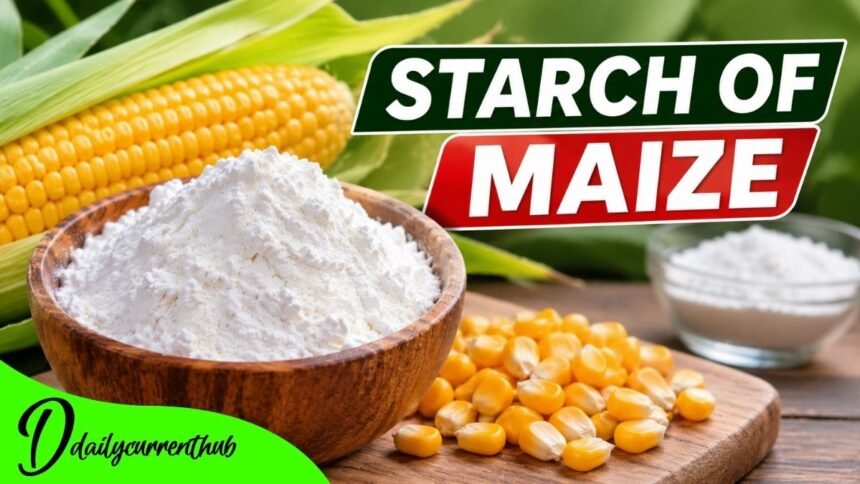
Maize starch, commonly known as cornstarch or cornflour in several countries, is a widely used ingredient in food preparation and industrial manufacturing. Extracted from the starchy part of maize kernels, this fine white powder is valued for its ability to thicken liquids, improve food textures, and serve as a useful raw material in manufacturing.
Although maize starch appears simple, its properties make it remarkably versatile. It plays an important role in preparing soups, sauces, desserts, baked goods, and crispy coatings. Beyond cooking, manufacturers use starch-derived materials in paper production, textiles, adhesives, pharmaceuticals, and other products.
Understanding maize starch involves more than knowing its kitchen uses. Its chemical composition, production process, nutritional characteristics, and behavior during heating help explain why it works so effectively.
This article explores the composition, manufacturing process, practical applications, nutritional profile, and key safety considerations of maize starch, providing a clear, reliable guide for everyday readers.
What Is Starch of Maize?
Starch of maize is a refined carbohydrate obtained primarily from the endosperm of maize kernels. The endosperm is the part of the grain that contains most of its stored starch.
Unlike whole maize flour, which contains other components of the grain, refined maize starch consists almost entirely of starch. The extraction process separates it from much of the protein, fiber, and oil naturally present in corn.
The finished product is generally white, soft, and powdery, with little noticeable flavor.
Its most familiar characteristic is its thickening ability. When heated with sufficient water, maize starch granules absorb moisture and swell, changing the consistency of the surrounding liquid.
This property makes it valuable in many foods, from homemade gravy to commercially prepared desserts.
The ingredient also has applications outside food manufacturing because starch can act as a binder, coating material, or component in other processed products.
How Starch of Maize Is Produced
Extracting Starch From Corn Kernels
Commercial maize starch is commonly manufactured through a process called wet milling.
The process separates corn kernels into their main components, allowing manufacturers to recover starch alongside other useful materials.
Production generally involves several stages.
First, harvested maize is cleaned to remove unwanted materials, including dust and pieces of plant matter.
The kernels are then steeped in water under controlled conditions. Commercial steeping often uses water with a small amount of sulfur dioxide to help separate the kernels.
After steeping, the softened kernels are milled, and the germ, fiber, protein, and starch fractions are progressively separated.
The recovered starch is washed to improve its purity.
Finally, it is dried and prepared for packaging or further industrial processing.
Why Processing Matters
Starch extraction changes the nutritional composition of the original maize grain.
Whole maize contains carbohydrates, protein, fats, fiber, and various micronutrients. Refined maize starch retains mainly the carbohydrate component.
This explains why cornstarch behaves differently from whole maize flour in recipes.
The manufacturing process also recovers several useful corn components rather than producing starch alone.
Chemical Composition and Properties of Maize Starch
Amylose and Amylopectin
Maize starch consists primarily of two glucose-based polymers: amylose and amylopectin.
Amylose is made of mostly linear chains of glucose molecules, whereas amylopectin has a highly branched molecular structure.
These two components influence how starch behaves during heating, cooling, and food processing.
Ordinary maize starch typically contains about 25–28% amylose, although composition varies by maize variety.
Waxy maize starch contains much less amylose and consists predominantly of amylopectin.
Other varieties have been developed with higher amylose concentrations for specialized applications.
How Maize Starch Thickens Liquids
One of maize starch’s most valuable properties is gelatinization.
When starch is mixed with water and heated, its granules absorb moisture and swell. As heating continues, changes in the starch structure thicken the mixture.
What Happens During Cooking?
The extent of thickening depends on several factors, including temperature, water content, starch concentration, and other ingredients.
Sugar, acids, salts, and fats can influence how starch behaves.
Cooling may further change texture as starch molecules begin to reassociate, a process known as retrogradation.
These characteristics explain why starch is useful in both everyday cooking and specialized food manufacturing.
Common Uses of Starch of Maize in Cooking
Thickening Soups, Sauces, and Gravies
Perhaps the best-known use of maize starch is thickening liquid foods.
It provides body and consistency without adding a strong flavor.
Cooks frequently use cornstarch in gravies, vegetable sauces, soups, fruit fillings, and stir-fry sauces.
For smooth results, it’s best to mix the starch with a small amount of cold water before adding it to hot food.
This mixture is called a slurry.
Improving Baking Results
Maize starch is also used in baking to influence texture.
When combined with other suitable ingredients, it can help produce softer biscuits, delicate cakes, and tender baked products.
Because maize starch contains no gluten-forming wheat proteins, it behaves differently from wheat flour.
However, cornstarch alone cannot replace ordinary flour in every baking recipe. Wheat flour contributes structure, whereas maize starch primarily changes texture and consistency.
Creating Crispy Food Coatings
Maize starch is frequently included in coatings for fried foods.
Under appropriate cooking conditions, it can help create a crisp surface.
This makes it useful in vegetable coatings, fried chicken recipes, and various Asian-inspired dishes.
The result depends on the coating mixture, moisture level, cooking temperature, and preparation technique.
Preparing Desserts
Cornstarch is used in custards, puddings, pie fillings, and other thickened desserts.
Its ability to create a smooth texture makes it especially useful when a recipe requires controlled thickening.
Some desserts combine cornstarch with milk, sugar, and flavoring ingredients.
The starch contributes to consistency rather than sweetness.
Nutritional Value of Starch of Maize
Is Maize Starch Healthy?
Maize starch is a source of carbohydrate energy, but it is not a particularly rich source of essential nutrients.
Its main dietary function is usually technological: improving the texture and consistency of prepared foods.
Most recipes use relatively small quantities, so nutritional impact depends on the amount consumed and the overall meal.
Because regular cornstarch is mainly digestible starch, it can raise blood glucose.
People managing blood sugar should consider the carbohydrate content of the complete dish rather than assuming cornstarch is nutritionally insignificant.
Is Starch of Maize Gluten-Free?
Pure maize starch is naturally gluten-free because maize does not contain the gluten proteins associated with wheat, barley, and rye.
However, contamination can occur when foods are processed or packaged alongside gluten-containing ingredients.
People with coeliac disease should choose appropriately labeled gluten-free products and check manufacturer information when necessary.
Industrial Applications of Maize Starch
Pharmaceutical Manufacturing
Starch and starch-derived ingredients are used in pharmaceutical production.
Depending on the formulation, they can function as tablet binders, disintegrants, or other processing aids.
These applications depend on controlled ingredient specifications and manufacturing standards.
Paper and Textile Production
Maize starch has long been used in paper manufacturing.
Starch-based materials can help improve surface properties and support paper-processing operations.
In textile manufacturing, starch may be used for sizing, a process that helps protect yarn during weaving.
Adhesives and Packaging
Starch is also an important starting material for certain adhesives.
Its binding properties make it useful in applications such as paperboard and corrugated packaging.
Modified starches can provide additional performance characteristics for different manufacturing requirements.
Starch-Based Materials
Maize starch can also serve as a renewable feedstock for certain bio-based materials.
These include some formulations used in biodegradable plastics and packaging.
However, environmental performance depends on the complete material formulation and disposal conditions. A product containing maize starch is not automatically home-compostable.
Maize Starch vs Corn Flour: Understanding the Difference
Corn product names vary by country, which can confuse consumers.
In the United States, cornstarch generally means the refined starch extracted from corn kernels.
American corn flour usually refers to finely ground maize containing more components of the grain.
In the United Kingdom, the term cornflour commonly refers to the ingredient Americans call cornstarch.
Maize flour and maize starch therefore should not always be treated as interchangeable.
ProductMain CharacteristicsTypical Uses
Maize Starch Refined white starch powder Thickening and texture
Whole Maize Flour Finely ground maize Baking and cooking
Cornmeal Coarser ground maize Cornbread and polenta
Potato Starch Refined potato starch Thickening and baking
Tapioca Starch Refined cassava starch Thickening and chewy textures
Checking the product description is especially useful when following recipes published in another country.
Proper Storage and Food Safety
How to Store Cornstarch
Maize starch should be stored in a cool, dry location inside a tightly sealed container.
Keeping moisture out is especially important because damp storage can cause clumping and deterioration.
The container should also be protected from insects and contamination.
A clean, dry spoon helps keep unwanted moisture out of the package.
Common Cooking Mistakes
Adding dry cornstarch directly to hot liquid can create lumps.
Preparing a cold-water slurry first usually produces smoother results.
Using excessive starch can make sauces unpleasantly thick, while insufficient heating may prevent proper gelatinization.
Recipes containing cornstarch should also be handled according to the food-safety requirements of their other ingredients.
Environmental Considerations and Future Applications
Maize is an agricultural crop, making its starch a renewable biological raw material.
This has encouraged interest in starch-based alternatives for selected industrial materials.
Researchers and manufacturers have investigated starch blends, biodegradable films, adhesives, and other products.
Nevertheless, renewable origin does not guarantee a lower environmental impact in every application.
Agricultural inputs, processing energy, transportation, material formulation, and end-of-life treatment all influence the environmental performance of starch-based products.
Careful evaluation is therefore necessary when comparing these materials with conventional alternatives.
Conclusion
Maize starch is a versatile, widely used ingredient whose importance extends far beyond the kitchen. Extracted primarily from the endosperm of maize kernels, it provides distinctive thickening, binding, and textural properties that support food preparation and numerous manufacturing processes.
Its usefulness comes largely from the behavior of amylose and amylopectin, the two major starch components. These molecules help explain why cornstarch can transform a thin liquid into a smooth sauce, influence the texture of baked products, or contribute to industrial formulations.
From a nutritional perspective, maize starch is mainly a refined source of carbohydrates rather than a comprehensive source of vitamins, minerals, or protein.
Knowing the difference between maize starch and whole maize flour, understanding its gluten-free characteristics, and using appropriate cooking and storage methods can help consumers make informed decisions.
As both a traditional kitchen ingredient and an industrial raw material, maize starch remains an important example of how agricultural resources can support a diverse range of practical applications.
(FAQs)
1. What is starch of maize made from?
Starch of maize is extracted primarily from the endosperm of corn kernels. It consists mainly of amylose and amylopectin, two carbohydrate polymers.
2. Is starch of maize the same as cornstarch?
Yes. Maize starch and cornstarch refer to the same basic ingredient. In the United Kingdom, it is commonly called cornflour.
3. Is maize starch naturally gluten-free?
Yes. Pure maize starch is naturally gluten-free, although cross-contact during manufacturing may affect individual products.
4. Can maize starch replace wheat flour?
It can replace some of the flour in selected recipes, but it is not a universal substitute because it lacks the gluten-forming proteins and other components of wheat flour.
5. Why is maize starch used in cooking?
Its main purpose is to thicken liquids and improve food texture. It can also help create crisp coatings and tender baked products.
6. Does maize starch contain sugar?
Plain cornstarch contains negligible naturally occurring simple sugars. However, it is rich in starch, a carbohydrate that the body can digest into glucose.
7. What is the difference between regular and modified maize starch?
Regular maize starch retains its native starch structure, while modified maize starch has undergone physical, enzymatic, or chemical processing to change particular functional properties.
8. How should starch of maize be stored?
Keep it in an airtight container away from moisture, excessive heat, contamination, and pests. Follow the manufacturer’s storage guidance and any date printed on the packaging.