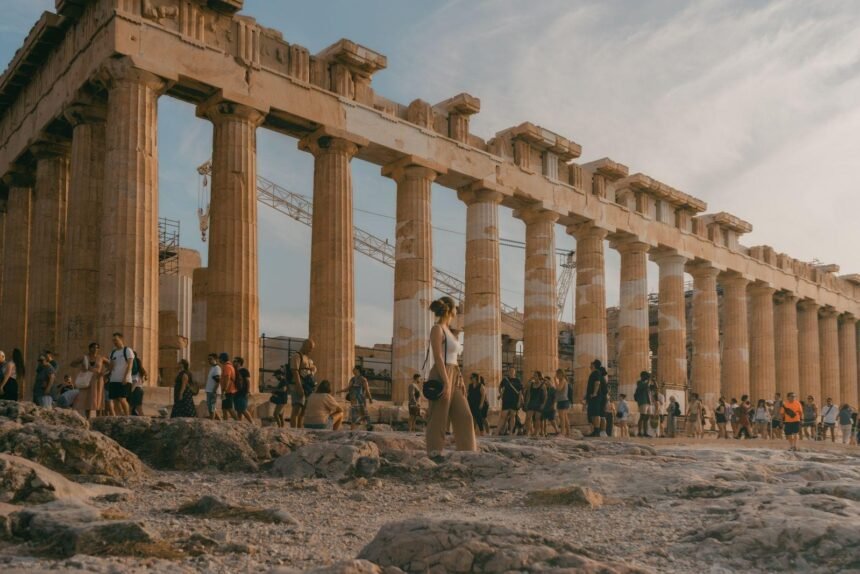
For many families, a trip to Athens is the one that has been talked about for decades. A parent who studied the classics at school, a grandmother who always wanted to see the Parthenon with her own eyes. Then the time finally comes, and a practical question appears that nobody quite wants to ask out loud: can they manage the climb?
The honest answer is that most reasonably mobile older travellers can, with a bit of planning. The Acropolis is a rocky hill, not a mountain, but the way up is uneven, partly stepped and, in places, paved with marble that has been polished smooth by centuries of feet. That last detail matters more than the gradient.
The ground beneath your feet
Ancient marble is slippery, especially when it has rained or when a fine layer of dust has settled on it. Proper walking shoes with a rubber sole make a real difference, and a folding walking stick is no bad idea for anyone whose balance is less than steady. Leave the leather-soled loafers at the hotel.
Timing is the next thing to get right. The site is busiest in the late morning, when cruise groups and tour coaches arrive together, and the steps up to the Propylaia can become a slow-moving crush. Arriving at opening time, or later in the afternoon in the cooler months, means a gentler pace and more space to stop and catch your breath. In summer the heat on the summit can be punishing and there is very little shade, so early is not just pleasant but sensible.
Before booking anything, it helps to read through a thorough guide to an athens acropolis tour so that you can picture the route, the entrances and how long each section usually takes. Knowing in advance where the steeper stretches are makes it much easier to decide where to pause and where to press on. It also helps you judge whether a guided visit, with someone setting a comfortable pace and choosing the resting points, suits your group better than going it alone.
Accessibility, rest and realistic expectations
There is a lift on the north side of the hill intended for visitors with limited mobility, though access arrangements can change and it is not always running, so check the current situation with the site before you travel rather than relying on it. Even with the lift, the summit itself is uneven, and a wheelchair user will need a companion.
Build in rest. There are a few spots on the way up where you can stand aside and take in the view over the city, and nobody minds if you linger. Carry water, a hat and a light layer, because the wind on the summit can be surprisingly cool even on a warm day.
Finally, consider pairing the visit with the Acropolis Museum at the foot of the hill. It is spacious, has plenty of seating and lifts between floors, and its top gallery looks directly up at the Parthenon. For a parent who tires easily, a slow morning on the rock followed by a long lunch and an afternoon among the original sculptures strikes a comfortable balance.
What usually stays with people is not the effort of getting up there. It is the moment of standing on top, with the city spread out below, next to someone who has been waiting a lifetime to see it.