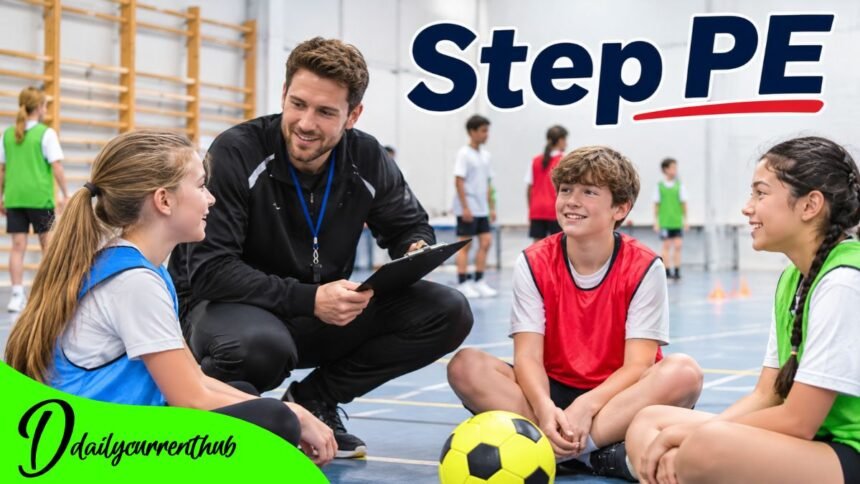
Physical education should allow every student to move, develop skills, build confidence and enjoy taking part. Yet a typical PE class brings together pupils with different fitness levels, sporting experience, physical abilities, and learning needs. An activity that challenges one student may be too difficult or too easy for another.
Step PE, commonly associated with the STEP framework, offers teachers a practical way to respond to these differences. STEP stands for Space, Task, Equipment, and People, representing four aspects of an activity that can be adjusted to make participation more accessible and appropriately challenging.
Rather than expecting every student to complete an identical activity under identical conditions, teachers can modify how an activity works while preserving its educational purpose.
This guide explains Step PE, explores its four components, considers its value in inclusive teaching, and provides practical examples for schools, sports clubs, and other physical activity settings.
What Is Step PE?
Step PE is an approach to adapting physical education activities by adjusting four elements: the space where an activity takes place, the task participants complete, the equipment they use, and the people involved.
The framework gives teachers a straightforward way to consider why someone might struggle during a lesson and what changes could make the activity more suitable.
For example, a pupil who struggles to catch a fast-moving ball might benefit from a larger or softer ball. Another student may need a smaller playing area to reduce the distance they must travel. A more experienced pupil might benefit from a more complex version of the same activity.
These changes do not necessarily require a different lesson plan. They let the teacher preserve a shared learning objective while offering different ways to work towards it.
STEP is particularly relevant to inclusive teaching because participation depends on more than physical ability alone. Confidence, familiarity with activities, communication, and lesson organization can all influence a student’s experience.
Understanding the Four Components of Step PE
1. Space: Adapting the Physical Environment
Space concerns the area available for an activity, including its size, shape, boundaries and arrangement.
A large playing area can provide opportunities for running, passing and tactical movement. However, it may also challenge participants who find covering long distances difficult.
Teachers can adapt the space by reducing the pitch size, changing the distance between targets, or creating smaller activity zones.
In a throwing exercise, beginners might stand closer to the target while more confident participants work from a greater distance. During a team game, smaller playing areas can change how frequently pupils become involved in the action.
Space adaptations must also consider safety. Playing surfaces, obstacles, movement routes and access to equipment can affect how comfortably participants use an area.
The main principle is to create an environment that supports the intended learning, rather than letting the physical setting become an unnecessary barrier.
2. Task: Changing the Activity Requirements
Task refers to what participants are expected to do and the rules or conditions under which they perform it.
Teachers can make an activity more accessible by simplifying instructions, breaking a complex movement into smaller stages, or allowing additional attempts.
Consider a basketball lesson focused on passing. Some pupils may practice stationary chest passes with a partner, while others practice passing while moving. More experienced pupils might complete the exercise under defensive pressure.
All three versions can support the development of passing skills, although the difficulty level differs.
Task adaptations can also affect timing, scoring and decision-making. In some situations, allowing a ball to bounce before being returned may help a learner participate in a racket-based activity.
The objective is not simply to make everything easier. Effective task modification allows students to experience appropriate challenge and develop new skills as their confidence and competence improve.
3. Equipment: Selecting Suitable Sports Materials
Equipment is another important part of Step PE because the design and characteristics of sports materials influence how activities are performed.
Balls differ in size, weight, texture, and speed. Rackets vary in length and striking surface. Targets can be placed at different heights or made larger to support particular learning objectives.
A larger ball may be easier for a beginner to track, while a lighter ball may help participants practice striking or throwing techniques with greater control.
Equipment changes can also support students with mobility, coordination or sensory requirements.
For example, a brightly coloured ball may offer better visual contrast against certain backgrounds. An audible ball may be useful in activities designed for participants with visual impairments.
Equipment should be chosen according to individual needs and the particular activity rather than assumptions about a person’s disability.
Safety, suitability and the manufacturer’s intended use remain essential considerations when modifying sports materials.
4. People: Adjusting Participation and Group Organization
The final component, People, concerns how participants interact and how groups, teams and partnerships are organized.
In some activities, working with a partner provides more opportunities to practice than participating in a large group. Smaller teams may also allow pupils to become more directly involved in the game.
Teachers can organize groups according to specific learning objectives, encourage cooperative exercises, or assign different responsibilities within an activity.
For example, a student developing a new skill may benefit from working with a supportive partner who can provide consistent practice opportunities.
In another situation, mixed-ability teams may encourage cooperation and shared problem-solving.
The People component should not be used to separate students permanently by ability. Grouping decisions should be flexible, respectful, and connected to the intended learning outcome.
Why Step PE Matters in Physical Education
Making Participation More Accessible
A central purpose of Step PE is to reduce unnecessary barriers to participation.
Traditional sports activities often have established rules, equipment and playing conditions. These arrangements may suit competitive sport, but they are not always ideal when the main objective is learning.
By changing particular features of an activity, teachers can create more opportunities for students to practice skills and take part.
Accessibility is not achieved simply by allowing a pupil to be present. Meaningful participation requires an opportunity to engage with the activity and its educational purpose.
STEP provides a structured way to examine whether those opportunities exist.
Supporting Skill Development and Confidence
Developing a physical skill usually requires practice, feedback, and repeated opportunities to attempt a movement.
When an exercise is excessively difficult, students may have limited opportunities to perform the intended skill successfully. When it is too easy, progression may also be restricted.
Step PE allows teachers to adjust the level of challenge.
A student learning to strike a ball might begin with a stationary target, progress to a slowly moving ball, and eventually practice under game conditions.
The overall learning objective remains connected to striking technique, but the demands change as the student’s performance develops.
This approach can support a more positive learning experience, although individual outcomes depend on teaching quality and the appropriateness of the adaptations.
How Teachers Can Apply Step PE in Lessons
Effective use of the STEP framework begins with identifying what pupils are expected to learn.
A teacher planning a football lesson, for example, might focus on passing accuracy, movement into space or cooperation.
Once the objective is clear, the teacher can consider which aspects of the activity could prevent certain students from participating effectively.
The next stage involves selecting suitable adaptations. A reduced playing area might suit one exercise, while different equipment or smaller teams may work better for another.
Teachers should observe how the changes affect participation and performance. An adaptation that works well in one class may be less suitable in another.
Student feedback can be particularly valuable. Asking participants which aspects of an activity help or hinder their learning encourages practical discussion rather than relying entirely on teacher assumptions.
STEP works best as a flexible decision-making tool, not a fixed set of rules that must always be applied in the same way.
Practical Step PE Examples in Different Sports
ActivitySTEP AdaptationIntended Purpose
Football Reduce pitch size or change team numbers Adjust movement demands and involvement.
Basketball Lower the basket or use a lighter ball Support shooting practice.
Cricket Use a larger or softer ball Adjust catching or striking difficulty
Tennis Use slower balls or shorten the court Provide more time to react
Athletics Change distances or target requirements Offer appropriate levels of challenge
Team games Adjust grouping and playing roles Encourage meaningful participation
These are illustrative teaching options, not universal requirements. Their suitability depends on the participants, the learning objectives and the available environment.
Supporting Students with Different Abilities
Inclusive physical education involves recognizing that learners may require different forms of support.
Some students have physical disabilities or mobility requirements. Others may experience sensory differences, coordination difficulties or additional communication needs. Students without disabilities can also vary considerably in confidence and sporting experience.
The STEP framework allows teachers to consider practical changes without assuming that every student with a particular condition needs the same adaptation.
A pupil who uses a wheelchair, for example, may be able to participate in a modified team game when the space, rules and equipment are suitable. The exact changes should be guided by the pupil’s abilities, preferences and the demands of the activity.
Teachers must also avoid reducing participation to observation or administrative roles when a student could take part physically with appropriate adjustments.
Communication with pupils and relevant support staff can help establish suitable activities, particularly when access or safety requirements are involved.
The Teacher’s Role in Inclusive Physical Education
Step PE is a useful framework, but its effectiveness depends on professional judgment.
Teachers need to understand the learning objective, observe how students respond, and decide whether an adaptation is helping.
An activity that appears inclusive on paper may still leave some pupils with few opportunities to participate. For that reason, teachers should focus on actual involvement rather than relying solely on modified rules.
Clear explanations also matter. Students benefit from understanding that different versions of an activity can serve the same educational goal.
Thoughtful lesson organization can prevent adaptations from becoming unnecessarily conspicuous or isolating.
The broader aim is to establish a learning environment where differences in ability are addressed through appropriate teaching rather than treated as reasons for exclusion.
Common Challenges and Practical Solutions
Applying the STEP framework may involve practical constraints.
Limited sports equipment can restrict the range of available adaptations. Teachers may also need to manage large classes, restricted playing areas and different learning objectives within a single lesson.
However, not every adjustment requires additional resources.
Changing the number of players, reducing the distance between targets, or modifying the rules can sometimes be achieved with existing facilities.
Another challenge is finding the correct level of difficulty. A modification that makes an activity accessible should still allow meaningful learning and development.
Teachers can address this by observing performance and gradually changing the activity as skills improve.
It is also essential to recognize that no single adaptation works for everyone. Individual needs, preferences and abilities should guide decisions rather than broad assumptions.
The Future of Inclusive Physical Education
Inclusive physical education remains closely connected to wider discussions about educational access, participation and student wellbeing.
The STEP framework offers a practical way to address these issues in everyday lessons.
Its continuing relevance comes from its flexibility. It does not depend on one particular sport, age group or specialist piece of equipment.
Nevertheless, STEP is not a complete substitute for inclusive curriculum planning, accessible facilities, safeguarding arrangements or appropriate professional support.
It is most useful when combined with effective teaching, individual assessment and a commitment to meaningful participation.
As schools continue to develop inclusive practices, adaptable teaching frameworks can help educators translate broad principles into practical classroom decisions.
Conclusion
Step PE offers a straightforward approach to making physical education more adaptable and inclusive. Through the four components of Space, Task, Equipment and People, teachers can modify activities while maintaining clear learning objectives.
The framework recognizes that pupils do not always learn or participate under identical conditions. Adjusting those conditions can create better opportunities for practice, involvement, and skill development.
Its value lies in practical flexibility. Whether a teacher changes the size of a playing area, selects different equipment, modifies a task or reorganizes a group, the decision should support the learning needs of the participants.
STEP does not guarantee inclusion, nor does it replace professional assessment and thoughtful teaching. Instead, it gives educators a practical structure for identifying barriers and considering useful adaptations.
Used carefully, the STEP framework can help physical education lessons respond better to students’ different abilities, experiences, and needs.
(FAQs)
1. What does Step PE mean?
Step PE refers to using the STEP framework in physical education to adapt activities for different participants.
2. What does STEP stand for in physical education?
STEP stands for Space, Task, Equipment, and People.
3. What is the main purpose of STEP PE?
Its main purpose is to help teachers adapt physical activities so pupils can participate and work towards suitable learning objectives.
4. Is Step PE suitable for primary schools?
Yes. Teachers can use STEP principles to adapt games and movement activities for primary school pupils.
5. Can Step PE support students with disabilities?
Yes. The framework can help teachers consider appropriate adaptations for students with disabilities, guided by individual requirements.
6. Does Step PE require expensive equipment?
No. Some adaptations involve changing rules, playing areas, or group organization without purchasing new equipment.
7. Can Step PE be used in competitive sports?
STEP principles can be applied to training and modified games, although formal competitions may have specific rules and equipment requirements.
8. How can teachers evaluate Step PE adaptations?
Teachers can observe student participation, assess progress towards learning objectives, and gather feedback to determine whether an adaptation is appropriate.