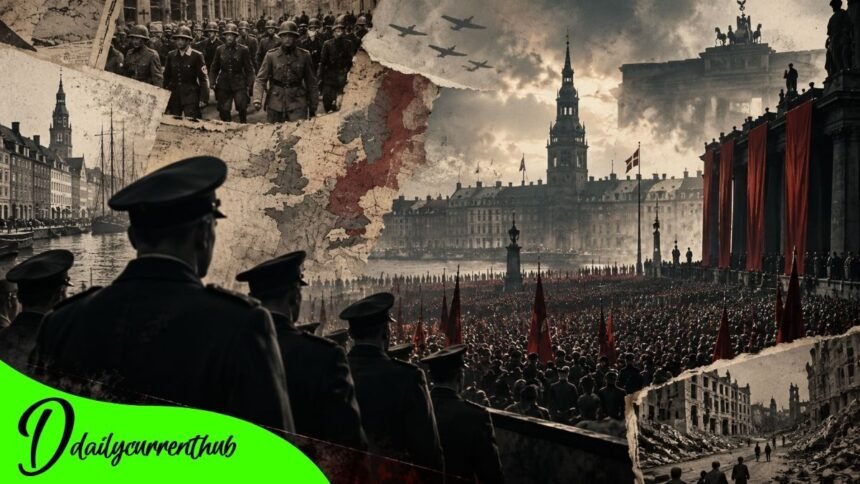
Fascisterne is a Danish term meaning “the fascists,” referring to individuals associated with fascism, a political ideology that profoundly influenced twentieth-century European history. Although the word is Danish, its historical significance reaches far beyond Denmark, particularly to Italy under Benito Mussolini and Germany under Adolf Hitler.
Fascism emerged amid political instability, social tensions, and economic uncertainty after the First World War. Its supporters promoted extreme nationalism, authoritarian leadership, and political systems that placed the interests of the state above individual freedoms.
The history of Fascism also connects to Denmark, where Nazi-inspired political organizations developed during the interwar years. These groups attempted to influence Danish politics but never achieved broad electoral support.
Understanding the term requires examining its linguistic meaning, historical origins, ideological foundations, and political consequences. This article explores these subjects using established historical evidence while distinguishing between fascism, National Socialism, and Denmark’s particular circumstances.
What Is Fascisterne?
Fascisterne is the definite plural Form of the Danish noun fascist. According to Den Danske Ordbog, a fascist is a supporter of fascism. The word therefore translates directly into English as “the fascists.”
This distinction matters because Fascisterne does not identify a particular individual, family, political party, or organization. Its meaning depends on the historical or political context in which it appears.
For example, a Danish text discussing the Italian dictatorship might use the term when referring to Mussolini’s followers. Another historical account might use it more broadly to describe fascist movements elsewhere in Europe.
The Danish word for the ideology itself is fascisme. Fascisterne refers to the people, while fascisme refers to the political ideas and systems associated with them.
Understanding this linguistic difference provides a more accurate foundation for studying European political history.
The Historical Origins of Fascism
Europe After the First World War
The First World War left much of Europe struggling with economic disruption, political instability, and deep social divisions. Millions of people had experienced military conflict, while governments faced difficult questions about national identity, economic recovery, and political authority.
Italy experienced particularly serious tensions during the postwar period. Industrial disputes, political confrontation, and dissatisfaction with existing institutions created an environment in which radical movements gained attention.
Benito Mussolini established the Fasci Italiani di Combattimento in Milan on March 23, 1919. This organization became an important starting point for Italian fascism.
The movement combined aggressive nationalism with hostility toward socialism and parliamentary democracy. Fascist activists also used organized violence as a political instrument.
Understanding these conditions does not justify the movement’s actions. Instead, it explains how political uncertainty and organized intimidation helped an anti-democratic ideology gain influence.
Why Nationalism Became Central
Nationalism was central to fascist political thinking. Its supporters promoted an idealized vision of national unity in which individual interests were expected to serve the nation and its leadership.
However, nationalism alone does not define fascism. The distinctive historical movement combined extreme nationalist beliefs with political repression, authoritarian government, and hostility toward democratic competition.
Fascist organizations presented political disagreement as an obstacle to national strength. Opposition parties, independent organizations, and other sources of political resistance were treated as threats rather than legitimate participants in public life.
This approach laid the ideological foundation for governments that sought to concentrate power while limiting political opponents’ freedom.
Benito Mussolini and the Rise of Italian Fascism
The March on Rome and Political Power
Benito Mussolini remains the central historical figure associated with the emergence of fascism.
In October 1922, the March on Rome demonstrated the fascist movement’s strength and intimidation tactics. Following the political crisis surrounding the march, King Victor Emmanuel III appointed Mussolini prime minister.
Although Mussolini initially entered government through a royal appointment, his movement subsequently dismantled democratic safeguards.
From 1925, the fascists increasingly monopolized political power and established an authoritarian system. Opposition parties were suppressed, political freedoms diminished, and state institutions became instruments of dictatorship.
Mussolini promoted an image of decisive leadership and national revival. Behind that messaging was a system that relied on censorship, coercion, and concentrated authority.
The Structure of Fascist Government
Italian fascism sought to organize public life around a powerful central state.
Political independence was restricted, while government institutions and officially approved organizations gained influence over social and economic activities.
The regime also promoted a corporatist model that organized employers and workers within state-overseen structures.
These arrangements did not eliminate social conflict. Instead, they reduced opportunities for independent political and labor representation.
The dictatorship expanded into imperial warfare, including Italy’s 1935 invasion of Ethiopia. Its political and military ambitions destabilized regions beyond Italy’s borders.
Mussolini’s original regime collapsed in 1943, although he subsequently headed a German-backed fascist republic in northern Italy until 1945.
Political Beliefs and Ideological Foundations
Authoritarianism and the Rejection of Democracy
One of fascism’s central characteristics was rejecting liberal parliamentary democracy.
Fascist movements criticized political pluralism and promoted strong leadership as an alternative to democratic negotiation.
Under this model, the government claimed the authority to define national interests while limiting citizens’ ability to challenge its decisions.
Independent journalism, opposition parties, and organized political dissent faced repression in established fascist dictatorships.
History shows how weakening democratic institutions can concentrate political authority in increasingly unaccountable leadership.
Propaganda and Political Mobilization
Propaganda played an important role in fascist political organization.
Public speeches, newspapers, uniforms, symbols, marches, and carefully arranged demonstrations helped create an image of discipline and national unity.
These methods served practical political purposes. They attracted supporters, established recognizable identities, and communicated the authority party leaders claimed.
Organized public spectacle also helped fascist movements portray themselves as more powerful or representative than their actual political support justified.
Studying propaganda offers insight into how political communication supports authoritarian mobilization.
Fascism and National Socialism
Similarities and Important Differences
Fascism and National Socialism, commonly known as Nazism, shared several important characteristics.
Both rejected liberal parliamentary democracy, promoted authoritarian leadership, opposed political pluralism, and used aggressive nationalist rhetoric.
However, their ideological development differed.
German National Socialism placed an especially central emphasis on racial hierarchy, biological racism, and antisemitism. These beliefs became fundamental to Nazi persecution and the Holocaust.
Italian fascism developed its own political institutions and imperial ambitions, and its policies and ideology changed over time.
Many historians classify Nazism within the broader family of fascist movements while recognizing the distinctive features of Hitler’s ideology and regime.
Maintaining these distinctions helps prevent historical oversimplification.
Fascism in Danish Political History
The Emergence of Extremist Political Movements
Denmark experienced the influence of European fascist and Nazi movements during the interwar period, although its political circumstances differed considerably from those of Italy and Germany.
Democratic institutions remained central to Danish public life, and extremist organizations struggled to win majority support.
Nevertheless, several groups promoted authoritarian or Nazi-inspired political ideas.
The most significant Danish Nazi organization was the Danmarks Nationalsocialistiske Arbejderparti, commonly abbreviated as DNSAP.
Its development demonstrates how authoritarian ideologies crossed national borders while adapting their rhetoric to local political conditions.
The history of Denmark’s far-right movements also reveals an important distinction between political visibility and genuine electoral strength.
The DNSAP and Its Political Leadership
Cay Lembcke and the Party’s Foundation
DNSAP was founded on November 16, 1930, with Cay Lembcke as its original leader.
The organization drew heavily on Adolf Hitler’s German Nazi Party. Its program closely followed that of the German NSDAP, incorporating antisemitism, opposition to parliamentary government, and radical nationalism.
The Danish party also adopted political symbolism and organizational practices inspired by its German counterpart.
This created a contradiction within its political identity. DNSAP claimed to defend Danish nationalism while borrowing extensively from a movement based in Germany.
The contradiction became even more significant after Germany occupied Denmark in 1940.
Frits Clausen and the Party’s Development
Frits Clausen became the party’s leader in 1933.
Under Clausen, DNSAP expanded its organizational activities, including publications, youth organizations, and political campaigns.
The newspaper Fædrelandet became an important part of the party’s propaganda efforts.
Despite these activities, the organization remained politically marginal.
In the 1939 Danish parliamentary election, DNSAP received about 1.8% of the vote and won three seats.
In the 1943 parliamentary election, held during the German occupation, it received about 2.1% of the vote and again won three seats.
These results provide an important historical perspective. Although Danish National Socialism attracted committed supporters, it never became a dominant electoral movement.
Fascist Propaganda and Public Influence
Political Messaging in Danish Society
Danish Nazi organizations used several methods associated with the wider European fascist movement.
Party publications, public gatherings, demonstrations, and organized youth activities attempted to increase political visibility.
These activities also helped supporters build a shared identity.
DNSAP’s membership expanded during the German occupation, but membership growth did not translate into comparable electoral success.
According to Aarhus University’s historical research published through Danmarkshistorien, the party had approximately 5,000 members at the outbreak of the Second World War and around 20,000 by spring 1943.
Yet its electoral support remained limited.
This contrast illustrates why historical analysis must distinguish between party membership, propaganda activity, and broader public acceptance.
Denmark During the German Occupation
Political Conflict and Collaboration
Germany occupied Denmark on April 9, 1940.
The occupation put Danish institutions under extraordinary pressure and forced difficult political choices about cooperation, resistance, and protecting civilians.
The Danish government’s cooperation policy aimed to preserve some domestic control under German occupation. This policy remains a subject of historical debate.
DNSAP sought political power with assistance from the occupying authorities.
Although the party received financial and political support from German interests, it failed to take control of the Danish government.
German authorities ultimately considered the existing Danish administration more useful for maintaining stability and securing supplies.
DNSAP also helped recruit volunteers for German military service, including the Waffen-SS and Frikorps Danmark.
These activities helped the party align itself with the occupying power.
Resistance and the End of the War
Danish resistance activities expanded during the occupation, particularly as the conflict developed.
Sabotage, public opposition, and rising political tensions contributed to the collapse of the Danish government’s policy of cooperation in August 1943.
The end of the occupation in May 1945 brought renewed attention to individuals and organizations that had supported German authorities.
DNSAP disintegrated in 1945.
Party membership alone did not automatically result in criminal prosecution, but some members were prosecuted for specific acts of collaboration.
These distinctions matter when examining wartime responsibility. Historical accountability requires evidence of particular actions rather than assumptions about every individual associated with a political organization.
Public Curiosity and Misconceptions About Fascisterne
Why the Term Is Sometimes Misunderstood
One common misunderstanding is treating Fascisterne as the name of a particular political organization.
The term is broader than that. It is a Danish grammatical form referring to fascists, and who the people are depends on context.
Another mistake is assuming that fascism and Nazism are interchangeable in every historical setting.
Although they share important ideological characteristics, the differences between Italian Fascism, German National Socialism, and Danish Nazi organizations deserve recognition.
It is also inaccurate to assume that every authoritarian political movement belongs to the same historical category.
Scholars classify movements by examining ideology, leadership structures, political practices, historical circumstances, and relations with democratic institutions.
These distinctions make political discussion more accurate and prevent the unnecessary dilution of serious historical terminology.
The Historical Legacy of Fascism
Understanding Its Consequences
The history of fascism remains important because it shows the consequences of authoritarian political power.
European fascist regimes and movements were associated with political repression, militarism, intimidation, persecution, and the erosion of democratic institutions.
Their history also illustrates how political communication can be used to normalize extreme ideological positions.
Denmark’s experience adds another perspective.
The presence of a domestic Nazi movement, combined with its comparatively weak electoral performance, shows that extremist political activity does not necessarily represent the preferences of an entire population.
The historical record also demonstrates why public institutions, documentary evidence, and careful scholarship matter when investigating political movements.
Why Historical Accuracy Matters Today
Contemporary political debates sometimes use the word fascist loosely.
Although the term can apply more broadly, its specific historical meaning should not be overlooked.
Responsible discussion requires distinguishing between documented fascist ideology and ordinary political disagreement.
Historians therefore examine evidence rather than relying solely on labels.
Historical education provides a foundation for recognizing authoritarian practices, understanding political propaganda, and appreciating the role of democratic accountability.
Preserving these distinctions is essential for maintaining an accurate understanding of the twentieth century.
Conclusion
Fascisterne is more than an unfamiliar Danish expression. Its direct meaning, “the fascists,” links the word to a significant, often destructive chapter in European political history.
From Mussolini’s rise in Italy to the development of Nazi-inspired organizations in Denmark, fascist movements challenged democratic institutions and promoted authoritarian systems of government.
The Danish experience is particularly revealing. The DNSAP adopted key elements of German National Socialism, built a committed membership, and sought influence during the German occupation. Nevertheless, its limited electoral support prevented it from achieving broad democratic legitimacy.
Studying these events provides important lessons about political extremism, propaganda, historical responsibility, and the fragility of democratic institutions.
Verified linguistic and historical evidence helps readers separate facts from political exaggeration and appreciate the importance of accurate historical interpretation.
(FAQs)
1. What does Fascisterne mean in English?
Fascisterne is a Danish word meaning “the fascists.” It refers to people who support or belong to fascist movements.
2. Is Fascisterne the name of a person?
No. Fascisterne is a plural noun, not a personal name. It does not identify one particular public figure.
3. Where did fascism originally develop?
Modern political fascism emerged in Italy. Benito Mussolini founded the Fasci Italiani di Combattimento in Milan in March 1919.
4. Who was the most prominent historical fascist leader?
Benito Mussolini founded and led Italian Fascism. He became Italy’s prime minister in 1922 and subsequently established a dictatorship.
5. Did Denmark have a fascist or Nazi movement?
Yes. Denmark had several extremist political organizations, including DNSAP, a Nazi party founded in 1930.
6. Who led Denmark’s DNSAP?
Carl Emil von Schenck-von-Prinz-Eckart founded it and served as its first leader. Frits Clausen assumed leadership in 1933 and became one of the best-known figures associated with Danish National Socialism.
7. Was Danish National Socialism widely supported?
No. DNSAP received about 1.8% of the vote in the 1939 parliamentary election and 2.1% in 1943, winning three seats each time.
8. Why is studying Fascisterne historically important?
The subject helps explain the development of authoritarian movements, the political consequences of fascism, and Denmark’s experience with Nazi-inspired politics during the twentieth century.
SEO Meta Description
Fascisterne means “the fascists” in Danish. Explore fascism’s origins, Mussolini, Denmark’s DNSAP, wartime politics, and its lasting historical legacy.