Wenrath is an unusual name that sparks curiosity because its identity isn’t immediately clear. Some online references treat it as a surname, while others associate it with a geographical location in Germany. A closer look at historical documents, municipal records, and business information reveals a more substantial story.
The strongest documented connection is to Wehnrath, a small locality in Reichshof, North Rhine-Westphalia, Germany. Despite its modest residential population, the area has an established commercial district and links to internationally recognized companies.
The name also appears in an archived German Bundestag publication, showing that the shorter spelling has been used in an official context.
This article explores Wenrath’s verified meaning and geographical identity, its history, population, commercial development, community connections, and why it appears in online searches.
What Is Wenrath?
Wenrath is a spelling documented in connection with Wehnrath, a locality within the German municipality of Reichshof. The distinction between these spellings is central to understanding the subject.
Current local government documents consistently identify the settlement as Wehnrath. However, a 2012 report published by the German Bundestag referred to Reichshof-Wenrath while describing a parliamentary visit to bicycle tire manufacturer Schwalbe.
That historical reference establishes a genuine connection between the spellings, rather than leaving the name dependent on recent internet articles.
Wehnrath is not an independent city. It is part of a larger municipality that includes numerous settlements, each contributing to the region’s residential and economic character.
Its importance is especially visible in business records. While the residential community is relatively small, the surrounding commercial area supports manufacturing, distribution, and other industrial activities.
Geographical Location and Surroundings
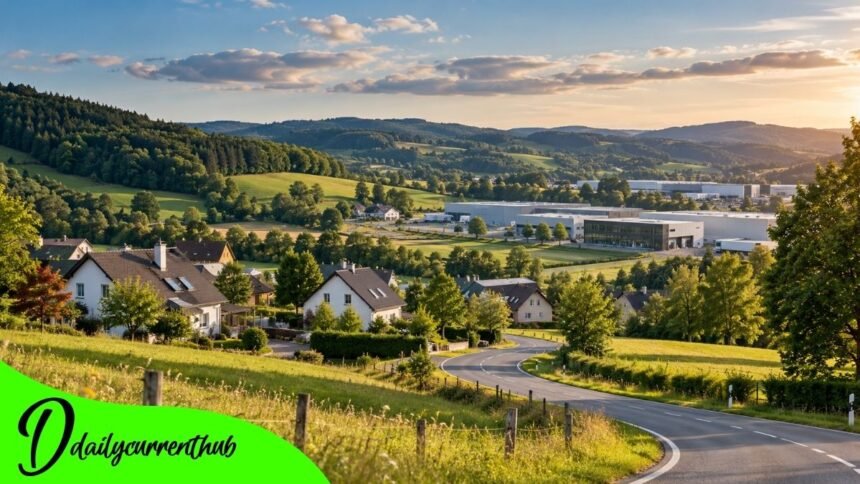
Wehnrath lies in Reichshof, within the Oberbergischer Kreis district of North Rhine-Westphalia. The municipality belongs to the wider Oberbergisches Land region, known for its wooded hills, rural settlements, and industrial traditions.
The surrounding landscape includes forests, meadows, small communities, and established transport routes. These geographical characteristics help explain the coexistence of residential life and commercial development.
The municipality itself covers approximately 114 square kilometers and comprises 106 localities. Wehnrath represents one small part of this wider administrative area.
Its position provides access to regional road connections without placing it inside a major metropolitan center. This combination matters for companies that need commercial facilities while staying connected to other parts of western Germany.
The distinction between the residential settlement and industrial district is also useful. Both are associated with Wehnrath, but they serve different functions and follow different activity patterns.
Early History and Background
Wehnrath’s history extends well beyond its modern business activity. Local historical research commonly dates its earliest known documentary mention to 1357.
The historical name was recorded as Wenegenroede. A reference associated with this period mentions Eckhardt von Wenegenroede in connection with Archbishop Wilhelm von Gennep and a conflict involving the Count of Arnsberg.
This account is cited in historical research on the earliest documented mentions of settlements in the Oberbergisches region.
The medieval form of the name differs considerably from its present spelling. Such differences can occur when regional pronunciations, administrative practices, and written-language conventions change over centuries.
However, the early documentary form does not establish a definitive English translation of the modern name. A precise etymology would require specialist linguistic evidence.
The historical reference shows that the locality has roots reaching back several centuries, long before its modern commercial infrastructure developed.
Wenrath and Wehnrath: Understanding the Names
One of the most interesting aspects of Wenrath is the difference between the spelling people search for and the spelling used in current geographical records.
Wehnrath is the recognized modern locality name. It appears in municipal population records, development documents, and company addresses.
The alternative spelling Wenrath was used in the German Bundestag’s 2012 account of a visit to Schwalbe. The article referred to both Reichshof-Wenrath and the local commercial district.
This establishes that the shorter spelling appeared in an authentic institutional publication. It does not, however, prove that Wenrath was once the formally recognized municipal spelling.
Understanding that distinction prevents researchers from mistaking historical references for separate settlements.
For current geographical research, searching for Reichshof-Wehnrath is generally more useful. For archival research, checking both versions may uncover relevant documents that use different spellings.
Population and Community Development
Wehnrath is a small residential community whose population has remained within a relatively limited range over several decades.
According to Reichshof’s published municipal figures, the locality had 286 residents on December 31, 2024. Earlier figures recorded 295 residents in 2023 and 293 in 2022.
Longer-term records show 219 residents in 1991 and 301 in 2008.
These figures indicate that the locality changed in size without becoming a large urban settlement.
Its small residential size also contrasts with its economic importance. A community can have only a few hundred residents while still containing a commercial district that serves businesses and customers beyond its immediate boundaries.
Population records alone cannot establish residents’ personal circumstances, traditions, or daily routines. Nevertheless, they provide a reliable picture of the settlement’s scale and development.
Business and Economic Significance
The Gewerbegebiet Wehnrath, or Wehnrath commercial area, is among the locality’s most significant modern features.
Reichshof’s municipal records describe several planned development sections within the commercial district. The area accommodates businesses operating across different industrial and commercial sectors.
Its development has been supported through municipal planning, transport infrastructure, and the provision of land for commercial activity.
Official information identifies multiple planning phases, showing that the district grew over an extended period rather than through a single project.
A key feature is the relationship between industrial activity and the wider municipality. Commercial establishments support employment, economic diversity, and the local business environment.
This economic role explains why Wehnrath appears in company publications and industry reporting despite being a relatively small residential settlement.
Its reputation is therefore more closely connected to practical economic activity than to tourism or celebrity culture.
The Schwalbe Connection
One of Wehnrath’s strongest internationally recognizable connections is Ralf Bohle GmbH, the company behind the Schwalbe bicycle tire brand.
Schwalbe’s published company information identifies its headquarters at Otto-Hahn-Straße 1 in Reichshof-Wehnrath.
Company material also records the establishment of its headquarters in the locality in 1995. The business has since developed an international commercial presence.
Schwalbe is best known for bicycle tires, inner tubes, and related products. Its international distribution gives the locality visibility far beyond its immediate geographical surroundings.
This connection helps explain why the place appears in business addresses, trade publications, and historical reporting.
The 2012 Bundestag publication also described a visit to the company, directly linking the spelling Wenrath to a documented business location.
The relationship illustrates how a comparatively small settlement can become connected with an internationally recognized brand through sustained commercial activity.
Infrastructure and Regional Accessibility
Transport infrastructure has been important to the development of the Wehnrath commercial district.
Reichshof’s municipal business information identifies access to the A4 motorway and the B256 federal road as important regional connections.
These routes support movement between the municipality and larger commercial centers. For industrial businesses, road access can affect deliveries, distribution, employee journeys, and customer connections.
The municipality’s planning documents also demonstrate how commercial development and transport considerations are connected.
Industrial growth creates demands that go beyond building construction. Road networks, land use, environmental requirements, and the relationship with residential areas must also be considered.
For visitors or people traveling to a company in the locality, the recognized spelling Reichshof-Wehnrath offers the clearest starting point when checking directions.
Specific public transport connections and service times should be confirmed using current regional information rather than relying on historical descriptions.
Environmental and Community Initiatives
Wehnrath’s business connections also provide examples of publicly documented environmental and community activities.
In December 2023, Schwalbe announced a reforestation project near its headquarters in Reichshof-Wehnrath.
The initiative supported the replanting and maintenance of about one hectare of damaged woodland. The company described its cooperation with Bündnis Zukunftswald and employees’ participation in planting activities.
Schwalbe has also publicized a children’s advisory initiative connected with charitable funding decisions, giving participating children a role in considering community projects.
These activities show how businesses tied to the locality can participate in environmental and social programs.
However, they should not be presented as evidence of every resident’s personal beliefs or charitable activities.
The documented significance lies in the initiatives themselves and their connection to an established company operating in the area.
Public Curiosity and Misconceptions About Wenrath
Unusual names often produce confusing search results, particularly when different spellings appear across historical, geographical, and commercial sources.
Wenrath is a good example.
A search using only the shorter spelling may not immediately reveal the stronger geographical connection. Readers might encounter articles discussing possible surnames, unfamiliar identities, or speculative interpretations.
The available institutional and municipal evidence supports the connection with Wehnrath far more clearly than it supports a biography of one particular individual.
There is no sound basis for assigning a personal age, spouse, children, career, or family history to Wehnrath as though it identifies one established celebrity.
Similarly, a precise linguistic meaning should not be asserted without historical language research.
Distinguishing confirmed facts from unsupported interpretations makes the subject easier to understand and protects readers from misleading information.
Future Outlook and Lasting Significance
Wehnrath’s future is connected to broader developments within Reichshof, including commercial planning, infrastructure, employment, and environmental management.
The municipality maintains planning records for the commercial district, demonstrating that land use and business development remain part of its administrative responsibilities.
Any specific prediction about new factories, population growth, or future investment would require confirmed announcements.
The existing record nevertheless reveals a locality with two distinct characteristics: a relatively small residential population and a developed commercial presence.
Its historical associations, institutional references, and ties to established companies give the place an identity that extends beyond its physical size.
That combination represents Wehnrath’s clearest documented contribution to the wider region.
Conclusion
Wenrath is best understood through its documented connection with Wehnrath, a small locality in Reichshof, Germany. Although the name may initially appear mysterious, public records provide a clear geographical and historical foundation.
The locality’s story includes centuries of recorded history, a modest residential community, and the development of an established commercial district. Its association with Ralf Bohle GmbH and the Schwalbe brand has brought it recognition beyond the surrounding region.
The alternative spelling Wenrath, appearing in a German Bundestag publication, adds an interesting detail to the name’s history.
Rather than constructing an unsupported biography, the evidence reveals something equally worthwhile: the development of a small German locality whose economic connections extend well beyond its borders.
Understanding Wenrath therefore means appreciating the relationship between local history, geography, community life, and modern industry.
(FAQs)
1. What is Wenrath?
Wenrath is a spelling documented in connection with Wehnrath, a locality in the municipality of Reichshof, Germany.
2. Is Wenrath a person or a place?
The strongest verified public evidence connects Wenrath with a geographical location. The keyword alone does not identify a particular public figure.
3. Where is Wenrath located?
The locality officially called Wehnrath is situated in Reichshof, Oberbergischer Kreis, North Rhine-Westphalia, Germany.
4. What is the difference between Wenrath and Wehnrath?
Wehnrath is the spelling used in current municipal records. Wenrath appears in some published references, including a 2012 German Bundestag article.
5. How many people live in Wehnrath?
Municipal records list 286 residents as of December 31, 2024. This is a historical figure, not a confirmed population count for 2026.
6. What is Wenrath famous for?
Wenrath is best known for its established commercial area and the headquarters of Ralf Bohle GmbH, which is connected to the Schwalbe bicycle tire brand.
7. How old is the locality?
Historical research reports an early written mention in 1357 under the name Wenegenroede.
8. Why is Wenrath significant?
Its significance comes from its documented history, its role within Reichshof, and its commercial connections, despite its relatively small residential population.