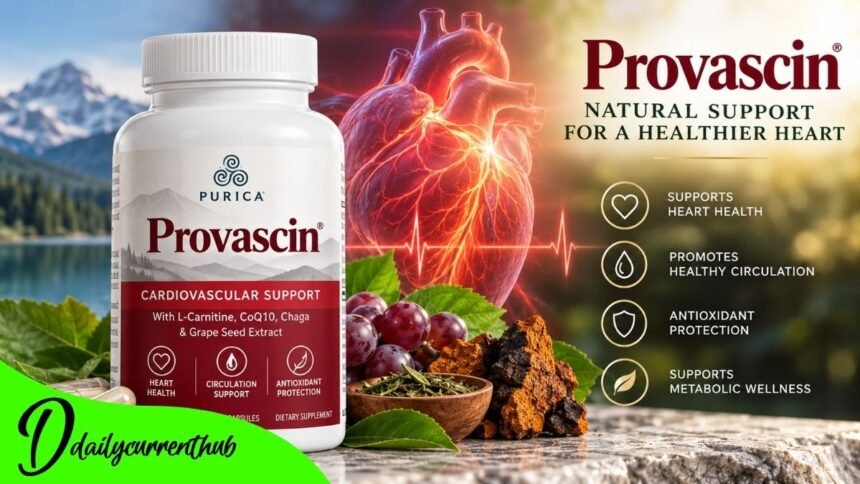
Provascin is a dietary supplement historically marketed for cardiovascular health, blood circulation, and metabolic support. Associated with the Canadian natural-health brand PURICA, the product combined nutritional compounds, botanical extracts, and mushroom-derived ingredients in a formula intended to support several aspects of general wellness.
Interest in Provascin reflects broader consumer demand for nutritional products linked to heart health. Cardiovascular disease remains a major global health concern, driving interest in products containing antioxidants, amino acids, and compounds involved in normal cellular energy production.
However, it’s essential to distinguish a supplement’s intended purpose from its scientifically demonstrated benefits. Although individual Provascin ingredients have been investigated in medical research, those studies do not establish that the complete formula prevents or treats cardiovascular disease.
This article examines Provascin’s documented history, original composition, advertised applications, scientific limitations, safety considerations, and current availability.
What Is Provascin?
Provascin is best documented as a multi-ingredient nutritional supplement marketed under the PURICA brand.
Unlike conventional pharmaceutical treatments containing a defined active drug ingredient, the historical Provascin formula combined several nutritional and botanical substances. Its composition included compounds associated with energy metabolism, antioxidant activity, and cellular function.
The product was promoted to support the cardiovascular system and maintain aspects of metabolic health. Historical retail descriptions also mentioned cholesterol balance, circulation, and muscle tissue maintenance.
These descriptions represent the product’s marketed purposes rather than independently established clinical outcomes.
Provascin should not be confused with prescription medications prescribed to control blood pressure, manage cholesterol, or treat cardiovascular conditions.
Understanding this distinction provides a more accurate foundation for evaluating its proposed benefits and limitations.
The History and Development of Provascin
Provascin’s documented history dates back to the early 2000s.
United States trademark records identify The Nutraceutical Medicine Company Inc. as the company associated with the PROVASCIN name. The trademark application was filed on January 29, 2003, and registration was recorded on March 29, 2016.
The trademark’s listed goods included dietary supplements, specifically anti-catabolic supplements.
Provascin subsequently appeared in Canadian nutritional-product listings under the PURICA brand. Retail records document its availability in capsule form, including 120- and 240-capsule bottles.
The product was positioned within a growing market for supplements intended to support general cardiovascular wellness.
Its historical formula reflected an approach that combined multiple substances rather than focusing on a single nutritional ingredient.
Although trademark and retail records establish the product’s identity and commercial history, they do not demonstrate its Effectiveness for treating medical conditions.
Provascin Ingredients and Their Functions
Historical Canadian retailer listings provide a detailed description of the original PURICA Provascin formula.
The following quantities were listed per capsule.
Ingredient Historical Amount
L-Carnitine 188 mg
Alpha-ketoglutaric acid 125 mg
Organic micronized Chaga 125 mg
Coenzyme Q10 38 mg
Betaine hydrochloride 31 mg
DL-alpha-lipoic acid 13 mg
Grape seed extract 9 mg
Green tea extract 9 mg
These quantities describe the historical retail formulation and should not be assumed to apply to every product currently advertised under the same name.
L-Carnitine and Cellular Energy
L-carnitine plays an established role in transporting long-chain fatty acids into mitochondria, where they can be used for energy production.
The body naturally produces carnitine, and dietary sources include animal-derived foods.
Researchers have studied carnitine supplementation in relation to several health conditions, including cardiovascular disorders and metabolic health.
According to the US National Institutes of Health, findings concerning heart disease have been mixed. Some studies suggest benefits for specific outcomes, while others raise questions about cardiovascular risks associated with long-term supplementation.
Therefore, the presence of L-carnitine in Provascin does not demonstrate that the product reduces cardiovascular disease risk.
Coenzyme Q10 and Antioxidant Activity
Coenzyme Q10, commonly called CoQ10, is naturally present in human cells.
It supports mitochondrial energy production and has antioxidant properties.
CoQ10 has attracted scientific interest because the heart requires substantial energy to function normally.
Nevertheless, the National Center for Complementary and Integrative Health reports that evidence on CoQ10’s Effectiveness in preventing heart disease remains inconclusive.
Available research also suggests that CoQ10 probably does not meaningfully reduce blood pressure.
Its biological importance should not be interpreted as proof of therapeutic Effectiveness when included in a multi-ingredient supplement.
Chaga Mushroom and Plant Extracts
Provascin also contained Chaga mushroom, grape seed extract, and green tea extract.
These ingredients contain naturally occurring compounds that have been investigated for antioxidant and other biological activities.
Green tea extracts have been studied for their effects on cholesterol measurements. Some research has found modest changes in total and LDL cholesterol, but these findings do not directly translate to the Provascin formula.
Antioxidant activity observed in laboratory experiments does not necessarily translate into measurable improvements in cardiovascular outcomes in humans.
A finished supplement’s Effectiveness depends on its formulation, ingredient quantities, bioavailability, and clinical performance.
What Was Provascin Marketed For?
Historical descriptions connected Provascin with several aspects of cardiovascular and metabolic wellness.
Cardiovascular Support
Heart health was the product’s principal marketing focus.
Its combination of nutritional substances was intended to support normal cardiovascular function.
However, no verified clinical evidence supports claims that the complete Provascin formula prevents heart attacks, reverses arterial disease, or treats heart failure.
Blood Circulation
Retail descriptions also associated Provascin with blood vessel function and chronic venous insufficiency.
Chronic venous insufficiency occurs when veins have difficulty returning blood from the legs toward the heart.
Although this condition has established medical treatments, Provascin’s historical marketing does not establish its Effectiveness as a treatment.
Cholesterol and Metabolic Health
Cholesterol management and glucose metabolism were additional themes in older Provascin descriptions.
Some ingredients have been independently investigated in metabolic research.
However, claims concerning a complete product require evidence specific to that formulation.
Provascin should not replace prescribed cholesterol-lowering medicines or diabetes treatment.
What Does Scientific Research Actually Show?
The key distinction in evaluating Provascin is the difference between ingredient-level research and evidence on the finished product.
L-carnitine, CoQ10, and green tea extracts have each been studied independently.
Those investigations involve different participant groups, doses, treatment durations, and research objectives.
Their findings cannot automatically establish the effects of a combination supplement.
A reliable clinical assessment of Provascin would require controlled studies that examine the complete formulation and measure clearly defined outcomes.
These might include changes in cholesterol levels, blood pressure, cardiovascular symptoms, or other validated clinical measures.
The reviewed sources did not provide robust, published clinical trial evidence that the complete historical Provascin formula prevents or treats cardiovascular disease.
Consequently, its original promotional claims should be regarded as marketing descriptions rather than clinically proven medical benefits.
Provascin Side Effects and Safety Considerations
The historical formula contained several biologically active ingredients. This makes safety and medication interactions especially relevant.
The lack of extensive research on the full formulation means its overall long-term safety cannot be established with confidence.
Individual ingredients have documented precautions.
CoQ10 may interact with warfarin and insulin. Green tea extracts have been associated with digestive symptoms and, in uncommon cases, liver injury.
Carnitine supplementation at sufficiently high doses can cause digestive problems. Particular caution is also appropriate for people with kidney disease or seizure disorders.
Historical Provascin retail information recommended consulting a healthcare professional for several circumstances, including diabetes, liver disease, kidney disease, pregnancy, breastfeeding, and the use of blood-pressure medicines or blood thinners.
These precautions should not be overlooked simply because the formula was marketed as natural.
Anyone taking cardiovascular medication should obtain professional advice before combining it with nutritional supplements.
Provascin Dosage and Responsible Use
Older retailer listings included suggested daily capsule quantities for the historical product.
Those instructions should not be treated as current, personalized medical guidance.
A supplement’s suitability depends on its exact formulation, individual health circumstances, medication use, and current product labeling.
Higher capsule quantities also increase exposure to every ingredient in a combination formula.
Because the original product’s current manufacturing and distribution status is uncertain, historical dosage instructions are particularly unsuitable as a basis for self-treatment.
A pharmacist or qualified healthcare professional can help assess the actual ingredients and potential interactions of any product being considered.
Was Provascin FDA Approved?
Provascin is a dietary supplement, not an FDA-approved prescription cardiovascular medicine.
In the United States, dietary supplements are regulated differently from prescription drugs.
The Food and Drug Administration does not approve dietary supplements for safety and Effectiveness before they enter the market.
Manufacturers remain responsible for complying with applicable product safety, manufacturing, and labeling requirements.
Because Provascin was historically marketed in Canada, Canadian natural-health-product regulations are also relevant.
Health Canada identifies licensed natural health products through an eight-digit Natural Product Number, commonly called an NPN.
Consumers should verify the number on any product packaging through the appropriate official database rather than assuming historical retail availability means current regulatory authorization.
Is Provascin Still Available in 2026?
The original PURICA Provascin supplement appears to have disappeared from regular listings at several Canadian retailers.
Vitamart identifies its Provascin product as discontinued and no longer available.
National Nutrition also states that it no longer carries the historical 120-capsule and 240-capsule versions.
These listings establish the product’s unavailability through those particular retailers. They do not independently confirm the manufacturer’s exact discontinuation date or the reasons behind the change.
Consumers encountering Provascin through an unfamiliar seller should verify the product’s authenticity, manufacturer, ingredient label, expiry date, and applicable regulatory information.
An older product photograph or listing is not sufficient evidence of current availability.
Public Misconceptions About Provascin
One recurring misunderstanding is assuming a cardiovascular-support supplement is equivalent to a treatment for heart disease.
Marketing language can contribute to this confusion.
Terms such as antioxidant support, circulation maintenance, and metabolic wellness describe broad intended functions. They do not automatically demonstrate meaningful clinical outcomes.
Another misconception is that combining several researched ingredients guarantees stronger results.
Ingredient interactions can affect absorption, safety, and overall biological activity. A combination must be evaluated rather than assumed to work better than its individual components.
Claims about removing unspecified toxins should also be approached critically.
Meaningful detoxification claims require identification of the substance being removed, a plausible mechanism, and reliable clinical evidence.
The Legacy of Provascin and Cardiovascular Supplements
Provascin illustrates the growing interest in multi-ingredient nutritional formulas designed around specific health concerns.
Historically, it combined metabolic support, antioxidant compounds, and cardiovascular wellness in a single product.
The broader supplement industry continues to explore these areas, but modern evidence-based healthcare requires distinguishing biological plausibility from demonstrated clinical benefit.
Research into nutritional compounds can contribute to medical understanding without proving that every supplement containing those substances is effective.
For people concerned about cardiovascular health, established preventive measures remain central. These include appropriate medical assessment, physical activity, healthy dietary patterns, tobacco avoidance, and evidence-based management of blood pressure, cholesterol, and diabetes.
Conclusion
Provascin was a documented PURICA dietary supplement marketed for cardiovascular and metabolic support. Its historical formula combined L-carnitine, Coenzyme Q10, Chaga mushroom, alpha-ketoglutaric acid, and several botanical compounds.
The product’s commercial history can be traced through trademark records and Canadian retailer listings, which also provide information about its composition and packaging.
However, historical marketing claims must be separated from verified medical evidence.
Although researchers have studied several individual ingredients, reliable clinical proof supporting the complete Provascin formula as a treatment for cardiovascular disease has not been established in the sources reviewed.
Its current retail availability also appears limited, with prominent Canadian sellers identifying the original product as unavailable or discontinued.
Ultimately, Provascin shows why consumers should evaluate supplements based on documented ingredients, trustworthy scientific research, regulatory information, and qualified medical guidance rather than relying solely on promotional claims.
(FAQs)
1. What is Provascin?
Provascin is a historical PURICA dietary supplement containing nutritional and botanical ingredients marketed for cardiovascular and metabolic support.
2. Is Provascin a prescription medication?
No. The documented PURICA Provascin product was marketed as a dietary supplement, not a prescription cardiovascular medicine.
3. What are the main ingredients in Provascin?
Its historical formula included L-carnitine, CoQ10, Chaga mushroom, alpha-ketoglutaric acid, betaine hydrochloride, alpha-lipoic acid, grape seed extract, and green tea extract.
4. Can Provascin lower blood pressure?
Reliable clinical evidence establishing that the complete Provascin formula lowers blood pressure has not been identified. It should not replace prescribed treatment.
5. Does Provascin help manage cholesterol?
The product was marketed for cholesterol support, but evidence demonstrating meaningful cholesterol reduction from the complete formula has not been established.
6. Can Provascin cause side effects?
Its ingredients may cause side effects and interact with medications. CoQ10, green tea extracts, and carnitine each have documented safety considerations.
7. Has Provascin been discontinued?
Vitamart lists the original product as discontinued, while National Nutrition no longer carries it. No manufacturer-confirmed discontinuation date has been established.
8. Is Provascin clinically proven to prevent heart disease?
The reviewed sources do not identify reliable clinical evidence that the complete Provascin formula prevents heart disease or cardiovascular events.