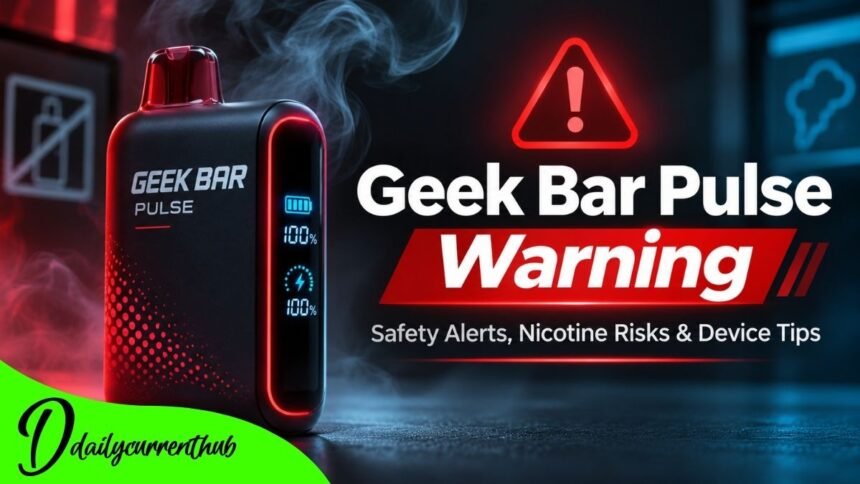
The term Geek Bar Pulse Warning can refer to several different concerns involving the Geek Bar Pulse disposable electronic cigarette. Some people encounter warning indicators on the device’s display. Others want to understand the nicotine warning printed on its packaging or the regulatory action taken against unauthorized Geek Bar products.
Geek Bar Pulse is a rechargeable disposable vaping device featuring a digital screen and different operating modes. Its manufacturer advertises the standard version with a 5% nicotine concentration and estimated puff counts of up to 15,000 in Regular Mode and 7,500 in Pulse Mode. These are advertised performance figures, not guarantees of individual usage or measures of safety.
Understanding these warnings requires separating ordinary battery and liquid-level indicators from potentially dangerous malfunctions and broader public-health concerns.
This article explains Geek Bar Pulse warning meanings, common device indicators, nicotine-related health risks, FDA enforcement notices, and practical precautions supported by public safety guidance.
What Is Geek Bar Pulse Warning?
Geek Bar Pulse Warning is a general search term covering the safety messages, operational indicators, and official notices associated with Geek Bar Pulse vaping devices.
It is not necessarily the name of one specific error message.
A low-battery symbol, for example, concerns the device’s electrical charge. An empty e-liquid indicator suggests that the liquid supply may be depleted. Neither should be confused with the nicotine warning printed on the product.
Regulatory warnings involve a different issue altogether: whether an electronic cigarette has the authorization required to be sold in a particular market.
These distinctions matter because the appropriate response depends on the warning involved. A routine battery notification differs from excessive heating, leaking liquid, or signs of physical damage.
Consumers should identify the exact message, symbol, or physical problem before concluding the device’s condition.
Understanding the Different Types of Geek Bar Pulse Warning
Nicotine Warning on Packaging
The Geek Bar manufacturer’s website displays the statement that its nicotine-containing products contain an addictive chemical.
This warning concerns the substance delivered by the vaping device, not a technical problem with its battery or display.
Nicotine is addictive and can affect the developing brain. Regular exposure may lead to dependence, making it difficult for someone to stop using nicotine products.
A nicotine warning should therefore be understood as a health-related statement, not merely a routine product label.
The Centers for Disease Control and Prevention advises that young people, pregnant women, and adults who have never used tobacco products should not begin using e-cigarettes.
Device Screen Warnings
Geek Bar Pulse models use electronic displays to communicate information about their operating condition.
Depending on the exact device generation, the display may indicate battery charge, estimated remaining e-liquid, and the selected operating mode.
A warning-like display does not always mean a serious malfunction.
For example, a low battery requires a different response from a device that is overheating or physically damaged.
The original Geek Bar Pulse, Pulse X, and newer related models do not necessarily share identical indicators. Exact icon meanings should be confirmed against instructions for the particular model.
Regulatory and FDA Warnings
In the United States, the FDA regulates electronic nicotine delivery systems.
On December 5, 2024, the agency announced warning letters to 115 physical retailers selling unauthorized e-cigarette products. Geek Bar Pulse was among the specifically identified brands and product lines.
The regulatory concern was marketing or selling products without the required FDA authorization.
An FDA warning letter is not the same thing as a device malfunction warning or a nationwide product recall.
Geek Bar Pulse Screen Warning Indicators Explained
Low Battery Warning
A low-battery indicator is one of the most straightforward device notifications.
As the battery charge drops, the screen may show a reduced battery reading or a flashing charge symbol. The exact presentation varies by model.
Rechargeable disposable e-cigarettes combine an internal battery with a finite liquid supply. Recharging the battery does not restore liquid that has already been consumed.
If the battery indicator remains abnormal after charging per the manufacturer’s instructions, the device may have an electrical or display issue.
Users should not attempt to repair a sealed lithium-battery device by opening its casing.
Low E-Liquid Warning
Many Geek Bar Pulse devices indicate remaining e-liquid.
A low or empty indicator suggests the device may be nearing the end of its usable liquid supply.
These readings should be treated as estimates rather than laboratory measurements of the remaining liquid.
When the liquid is depleted, continued operation may result in poor vapor production or an unpleasant burnt taste.
A disposable device is not automatically safe to refill simply because it has a rechargeable battery. The CDC distinguishes rechargeable disposable electronic cigarettes from devices specifically designed for refilling.
Attempting to open a sealed unit can create additional risks involving nicotine liquid and internal battery components.
Flashing Display or Unresponsive Device
A flashing screen may accompany a battery warning, a change in operating state, or a device fault.
However, flashing alone cannot establish the exact cause.
A completely inactive screen might indicate a discharged battery, but physical damage or electronic failure can produce similar symptoms.
Consumers should not assume that repeated flashing is harmless.
If a device remains unresponsive, behaves unpredictably, leaks, or gets unusually hot, continued use is not advisable.
The safest course is to follow the model-specific instructions and avoid modifying the circuitry.
Overheating and Unusual Odors
Excessive heat deserves more serious attention than an ordinary screen notification.
The FDA has documented reports of e-cigarette battery fires and explosions. Although such incidents appear uncommon, they can cause severe injuries.
Warning signs that require immediate discontinuation include excessive heating, swelling, smoke, leaking, or an unusual burning smell.
A damaged or dangerously hot device should not be charged or handled unnecessarily. If it smokes or catches fire, move away and contact emergency services.
These conditions must not be treated as ordinary low-battery problems.
Geek Bar Pulse Battery and Charging Safety
Why Battery Safety Matters
Geek Bar Pulse devices contain rechargeable batteries that supply power to their heating systems.
Like other lithium-battery-powered consumer electronics, they require appropriate storage and charging precautions.
The FDA advises consumers to read manufacturer instructions, avoid charging around flammable materials, and protect vaping devices from extreme temperatures.
Charging on a sofa, bed, or other soft surface can increase risk if overheating occurs.
Devices should be charged on a clean, stable surface where they can be monitored.
Important Charging Precautions
Battery safety involves more than connecting a cable.
Consumers should avoid leaving vaping devices charging unattended or overnight. Charging equipment should meet the manufacturer’s requirements.
A damaged charging port, exposed wiring, or unusual heating during charging requires attention.
Direct sunlight, hot vehicles, and other extreme temperature environments can also create battery hazards.
A disposable vape should never be punctured, crushed, or dismantled to investigate a suspected battery problem.
The absence of a visible warning does not guarantee that a damaged battery is safe.
Nicotine Health Risks Behind the Geek Bar Pulse Warning
Nicotine Addiction and Dependence
One of the most significant concerns associated with Geek Bar Pulse is nicotine exposure.
The original standard model is advertised with a 5% nicotine concentration. This concentration describes the liquid formulation, not the exact quantity absorbed during each inhalation.
Actual nicotine exposure depends on multiple factors, including device characteristics and individual usage behavior.
Nicotine can create dependence, and stopping after regular use may cause withdrawal symptoms such as irritability, cravings, and difficulty concentrating.
The prominent nicotine warning is therefore directly relevant to the product’s health risks.
Exposure to Other Harmful Substances
Nicotine is not the only concern associated with electronic cigarettes.
The CDC explains that e-cigarette aerosol is not harmless water vapor.
It can contain substances such as ultrafine particles, volatile organic compounds, heavy metals, and chemicals with potentially harmful health effects.
Aerosol composition varies between products, so findings about e-cigarettes generally should not be presented as proof that every Geek Bar Pulse contains identical concentrations of particular chemicals.
Long-term health outcomes remain an important area of ongoing research.
Risks for Young People and Pregnant Women
Public-health authorities express particular concern about vaping among young people.
Nicotine exposure during adolescence can affect brain development, including areas involved in attention, learning, mood, and impulse control.
Nicotine is also dangerous during pregnancy because it can interfere with fetal development.
Flavored electronic cigarettes have attracted regulatory attention partly because of their appeal to younger consumers.
No e-cigarette, including Geek Bar Pulse, should be regarded as a harmless recreational product.
FDA Warnings About Geek Bar Pulse
The December 2024 Enforcement Action
The FDA’s December 5, 2024, announcement identified Geek Bar Pulse among unauthorized e-cigarette products sold by retailers receiving warning letters.
The agency stated that the action was conducted in coordination with state partners as part of tobacco law enforcement.
The announcement also referenced findings from the 2024 National Youth Tobacco Survey showing that 5.8% of current youth e-cigarette users reported using Geek Bar-branded products.
This figure refers to Geek Bar as a brand, not specifically to the Pulse model.
Is Geek Bar Pulse FDA Approved?
Geek Bar Pulse does not appear on the FDA’s current list of authorized electronic cigarettes.
In the United States, a new tobacco product generally requires FDA marketing authorization before it may lawfully be marketed.
Importantly, FDA marketing authorization does not declare that an e-cigarette is safe.
The agency explicitly states that authorized tobacco products are not necessarily safe and are not described as FDA-approved.
Geek Bar Pulse’s omission from the authorized list is therefore a significant regulatory fact, separate from questions about individual-device reliability.
Common Misconceptions About Geek Bar Pulse Warnings
A Warning Does Not Always Mean the Same Thing
One common misunderstanding is that all Geek Bar Pulse warnings indicate a defective product.
A depleted battery, empty liquid supply, and overheating battery represent substantially different situations.
Another misconception is that a rechargeable disposable vape can be used indefinitely. Its battery may be rechargeable, but its liquid supply remains finite.
Some consumers also confuse FDA retailer warning letters with consumer safety recalls.
The two regulatory actions serve different purposes and should not be described interchangeably.
Finally, a functioning digital display does not demonstrate that a product is medically safe or authorized for sale.
Geek Bar Pulse Disposal and Environmental Concerns
Disposable electronic cigarettes present environmental challenges because they combine battery components, electronics, and potentially hazardous nicotine residues.
The US Environmental Protection Agency advises against placing e-cigarettes in ordinary household trash or curbside recycling.
Lithium batteries can become damaged during waste handling, increasing fire risks. Residual nicotine liquid can also harm people, animals, and the environment.
In the United States, the recommended disposal route is appropriate household hazardous-waste collection.
Consumers should not attempt to dismantle sealed devices to remove embedded batteries.
Proper disposal helps reduce preventable hazards for waste workers and collection facilities.
Conclusion
Understanding Geek Bar Pulse Warning requires recognizing the difference between ordinary device notifications, nicotine health warnings, and regulatory enforcement information.
Battery indicators and liquid-level displays can help identify the device’s operating condition, but unusual heat, leakage, smoke, or physical damage requires immediate attention.
The nicotine warning addresses addiction and broader health risks associated with electronic cigarette use. Public-health guidance makes clear that vaping is not risk-free, particularly for young people and pregnant women.
Meanwhile, the FDA’s enforcement actions against unauthorized Geek Bar products highlight important regulatory concerns in the United States.
Consumers should rely on official safety guidance, understand the limitations of device displays, and avoid attempts to modify damaged or disposable products.
Ultimately, a screen indicator is only one aspect of product safety. Broader health, battery, legal, and environmental risks matter just as much.
(FAQs)
1. What does Geek Bar Pulse Warning mean?
It can refer to battery or e-liquid indicators, the nicotine warning on packaging, physical device safety concerns, or FDA regulatory notices involving Geek Bar products.
2. Why is my Geek Bar Pulse flashing?
Flashing may indicate a battery issue or another device status. The precise meaning depends on the model and accompanying indicators.
3. What does the low e-liquid warning mean?
It suggests that the device’s estimated liquid supply is running low or has been exhausted. The indicator does not necessarily measure the exact remaining liquid volume.
4. Is Geek Bar Pulse FDA approved?
No. Geek Bar Pulse is not included on the FDA’s current authorized e-cigarette list. The FDA also does not characterize authorized e-cigarettes as safe or FDA-approved.
5. Can a Geek Bar Pulse battery overheat?
Yes. Rechargeable vaping devices have battery-related safety risks. Excessive heating, smoke, swelling, or damage are reasons to stop using it.
6. Is Geek Bar Pulse safe because it has a digital screen?
No. A digital screen provides operating information but does not eliminate nicotine addiction, aerosol exposure, or battery-related risks.
7. Does recharging a Geek Bar Pulse restore its e-liquid?
No. Recharging restores battery power, not depleted e-liquid. Disposable electronic cigarettes are not automatically designed to be refilled.
8. How should an empty Geek Bar Pulse be disposed of?
In the United States, the EPA recommends taking e-cigarettes to an appropriate household hazardous-waste collection facility rather than placing them in regular trash or curbside recycling.