Britain’s railway network relies on much more than passenger trains and stations. Specialist businesses supply machinery, skilled workers, and technical support behind every track renewal, infrastructure improvement, and maintenance operation. Total Rail Solutions, commonly known as TRS, was one of the companies serving this essential part of the railway industry.
Established in 2007, the business developed into a provider of road-rail vehicles, on-track plant hire, operational management, and railway engineering support. Its activities helped contractors undertake work on railway infrastructure across the United Kingdom.
The company underwent significant changes over its history. A 2018 management buyout brought new investment, while an October 2023 acquisition by Readypower Group marked a turning point in its corporate history.
Although the original business no longer operates independently, understanding its development provides valuable insight into the engineering companies supporting Britain’s railways.
This article explores the company’s history, specialist services, ownership changes, acquisition, and current legal position.
Who Was Total Rail Solutions?
Total Rail Solutions was a British business specializing in equipment and operational services for railway engineering projects. Unlike a passenger train operator, it did not primarily transport travelers or manage commercial railway journeys. It focused on supporting contractors responsible for railway construction, maintenance, and infrastructure improvements.
The company became associated with operating and non-operating road-rail plant, subcontracting, and providing skilled labor.
TRS also provided Plant Operations Scheme services, commonly abbreviated as POS. These involve coordinating and controlling specialist equipment used on railway worksites.
Its customers and industry relationships included major railway contractors and work associated with Network Rail infrastructure.
The company’s significance rested on its specialized role within a much larger railway supply chain.
The History and Development of Total Rail Solutions
Early Life and Background of the Company
The company was incorporated on January 31, 2007, as Total Solutions (Southern) Ltd. Its later adoption of the name Total Rail Solutions reflected the identity with which it became widely recognized in the railway sector.
Public corporate records identify Martin Mould and Julie Caldwell as important figures in its early ownership. Rutland Partners named both as founders when it announced its management buyout in November 2018.
The company developed within a railway industry that relies on specialist external suppliers for much of its infrastructure work.
Railway maintenance presents challenges different from those encountered on ordinary construction sites. Equipment must be compatible with railway infrastructure, work is frequently scheduled within limited access periods, and personnel must meet strict competence requirements.
Businesses that provide suitable machines and qualified workers help major contractors carry out these operations.
By 2018, TRS had established itself as a recognized supplier of road-rail plant and related services. Its expansion demonstrated the commercial importance of specialist equipment providers in maintaining and improving Britain’s railway network.
Specialist Railway Equipment and Services
The company’s main operations centered on providing machinery and associated personnel for railway engineering projects.
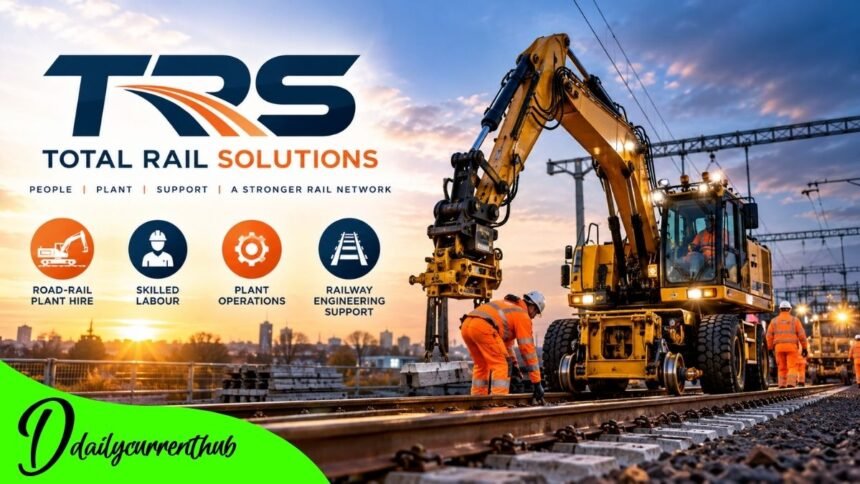
Its historical services included road-rail vehicle hire, on-track plant operations, labor provision, subcontracting, and railway site support.
These activities covered several areas of railway construction and maintenance, including permanent way works, overhead line equipment projects, and civil engineering.
Permanent way refers to railway track infrastructure, including rails, sleepers, ballast, and associated components. Maintaining these assets requires specialized equipment that can operate safely in railway environments.
Overhead line equipment, meanwhile, forms part of the electrical infrastructure supplying power to electrified railway systems. Installation and maintenance can involve elevated access equipment, lifting operations, and carefully coordinated engineering work.
TRS supplied equipment and services relevant to these types of projects.
Its business model therefore extended beyond ordinary machinery rental. Customers could obtain operational support alongside equipment, allowing plant provision and site management requirements to be addressed together.
Road-Rail Vehicles and Their Importance
One defining element of TRS was its association with road-rail vehicles, often called RRVs.
These specialized machines can operate on railway tracks and suitable non-rail surfaces. Depending on their design and attachments, they can excavate, lift, handle materials, or perform other railway engineering tasks.
Their versatility is particularly valuable where conventional machinery cannot easily reach a railway worksite.
For example, an engineering contractor replacing track components may need equipment that can reach the railway through an approved access point and travel along the track to the work location.
Road-rail machines provide an important solution to such operational challenges.
However, their use is governed by engineering acceptance, competence requirements, equipment inspections, and site-specific controls.
TRS operates in this specialized equipment market, providing machinery to contractors that maintain and develop railway assets.
Rutland Partners also highlighted its investment in equipment during the 2018 acquisition announcement, underscoring the importance of the company’s plant fleet to its commercial operations.
Plant Operations and Railway Safety
Railway infrastructure work requires detailed planning, particularly when heavy machinery operates on or near railway tracks.
Plant Operations Scheme services were an important part of the company’s historical offering.
Network Rail’s POS framework sets out requirements for organizations that provide and operate on-track plant. It covers operational arrangements, responsibilities, and compliance processes designed to support safe machinery use.
For contractors, these requirements extend beyond obtaining a suitable machine.
Equipment movements must be planned, competent personnel assigned, operating restrictions understood, and interactions between machines and the railway environment controlled.
The responsibilities associated with railway plant operations help explain why specialist companies offer operational management alongside equipment hire.
In 2018, Rutland Partners specifically identified POS services, including on-track plant planning, delivery, and site management, as an important source of TRS revenue.
This combination distinguished the business from a general plant rental provider. Its role involved supporting machinery management in a tightly regulated working environment.
Workforce and Relationships Within the Rail Industry
Specialist railway equipment is only one element of a successful engineering operation. Trained personnel, technical planning, and contractor coordination are equally important.
Historical descriptions of TRS identify labor provision and subcontracting services alongside its equipment activities.
The company worked with organizations involved in major railway construction and maintenance programs. Rutland Partners stated that TRS had close working relationships with Network Rail and its principal contractors.
A historical recruitment profile also identified contractors such as Balfour Beatty, Siemens, and BAM Nuttall among businesses associated with its work.
These relationships illustrate the structure of Britain’s railway infrastructure industry, where major contractors frequently depend on specialist suppliers for particular equipment and operational capabilities.
For a company like TRS, technical competence and machine availability were commercially important.
Workforce considerations also became significant during the company’s later ownership transition. Readypower’s 2023 acquisition announcement explicitly referred to supporting stability for TRS employees while evaluating the business’s long-term future.
The 2018 Management Buyout
On November 17, 2018, Rutland Partners completed a management buyout of TRS from founders Martin Mould and Julie Caldwell.
The investment represented an important development in the company’s ownership history.
Rutland described TRS as a leading provider of operated and non-operated road-rail plant and related railway services. Its announcement identified Paul Bateman as chief executive and Luke Hersee as operations director.
At the time, Rutland reported that the company had turnover of approximately £30 million. This figure related to the 2018 transaction, not its later financial performance.
Private equity investment can provide companies with financial resources, commercial oversight, and opportunities for operational development.
In TRS’s case, the transaction brought the business under a different ownership structure while retaining an experienced management team.
Rutland remained associated with the company until its sale to Readypower Group in October 2023.
The 2023 Acquisition by Readypower Group
The most significant later event in the company’s history occurred on October 16, 2023, when Readypower Group announced it had acquired 100% of TRS’s share capital.
The buyer was already an established provider of specialist railway equipment and infrastructure services.
Readypower’s announcement explained that TRS had experienced financial difficulties in a challenging market. It identified recent contract cancellations and a declining work pipeline as factors affecting the business as the railway industry approached the end of Control Period 6.
The transaction was presented as a way to provide financial support and greater stability.
Readypower also announced plans to integrate TRS into its wider business.
From an industry perspective, the acquisition brought together businesses operating in closely related areas of railway equipment provision and infrastructure support.
Rutland Partners confirmed its exit from TRS through the sale.
The transaction therefore marked both the conclusion of a private equity investment and the end of TRS’s independent ownership.
Current Company Status in 2026
As of October 2026, Total Rail Solutions no longer operates as an independent railway services business.
Its former LinkedIn company profile states that Readypower Group acquired and fully integrated the business.
The original registered company has a separate legal position.
According to UK Companies House, Total Rail Solutions Limited (company number 06076007) is listed as in liquidation.
Its formal members’ voluntary liquidation began on June 27, 2024, following a June 25, 2024 declaration of solvency.
A members’ voluntary liquidation is a procedure used to wind up a solvent company under the relevant legal requirements. It should not automatically be interpreted as evidence that the company was insolvent when the liquidation began.
This distinction matters because the legal winding-up of the original TRS company is different from the continued operation of its acquiring group.
Readypower continues to describe active rail services, including operated road-rail vehicle hire and POS support.
Readers researching former TRS services should therefore distinguish between the historic company and the operations now provided through Readypower.
Industry Significance and Lasting Legacy
TRS’s history illustrates the role specialist contractors play in Britain’s railway infrastructure system.
Large engineering projects depend on coordinated contributions from principal contractors, equipment providers, operational specialists, and trained workers.
Road-rail machinery is particularly important because railway maintenance often takes place under restricted access conditions and demanding operational rules.
TRS supplied equipment and services for this environment during its years as an independent business.
Its ownership history also reflects changes within the wider rail supply chain. The 2018 management buyout demonstrated investor interest in specialist infrastructure services, while the 2023 acquisition showed how businesses with related capabilities could be brought under a single group.
The company’s name still appears in historical recruitment listings, business directories, and railway industry references.
Readers should be aware that businesses in New Zealand and the Netherlands also use the Total Rail Solutions name. Their presence does not establish a corporate relationship with the former UK company.
TRS’s lasting significance lies in its documented activities, relationships, and contributions to the specialist railway services market, not in the continued operation of its original brand.
Conclusion
Total Rail Solutions was an established participant in Britain’s specialist railway infrastructure sector, supplying road-rail vehicles, equipment, labor, and operational support to engineering contractors.
From 2007, the business built a position in the market for on-track plant and railway construction services. Its work with Network Rail contractors and investment in specialist equipment became key parts of its commercial identity.
The 2018 management buyout marked a new chapter of ownership, while Readypower Group’s acquisition in October 2023 changed the company’s future.
Although the original legal entity subsequently entered members’ voluntary liquidation and no longer operates independently, the broader types of services it provided remain essential to railway engineering.
The company’s story offers a useful example of how specialist suppliers develop, adapt to industry pressures, and become part of larger infrastructure organizations.
(FAQs)
1. What was Total Rail Solutions?
Total Rail Solutions was a British railway infrastructure services company specializing in road-rail plant hire, POS services, skilled labor provision, and railway engineering support.
2. When was Total Rail Solutions established?
The company was incorporated on January 31, 2007, originally under the name Total Solutions (Southern) Ltd.
3. Who founded Total Rail Solutions?
Martin Mould and Julie Caldwell were identified as the company’s founders in Rutland Partners’ November 2018 management buyout announcement.
4. Who acquired Total Rail Solutions?
Readypower Group Limited acquired 100% of the company’s share capital on October 16, 2023.
5. Is Total Rail Solutions still operating in 2026?
The former UK business no longer operates independently. Readypower Group integrated it, while its original registered legal entity is listed as in liquidation.
6. What services did Total Rail Solutions provide?
Its services included road-rail vehicle hire, on-track plant operations, POS support, subcontracting, skilled labor, and equipment for railway construction and maintenance.
7. Where was Total Rail Solutions based?
The business had historical offices in Basingstoke and Thatcham, England. Its former operational address included Greenham Business Park in Thatcham, Berkshire.
8. Why was Total Rail Solutions acquired?
Readypower’s acquisition announcement cited financial pressures, contract cancellations, and a shrinking work pipeline at TRS. The buyer intended to provide stability and integrate the business into its wider railway services operations.