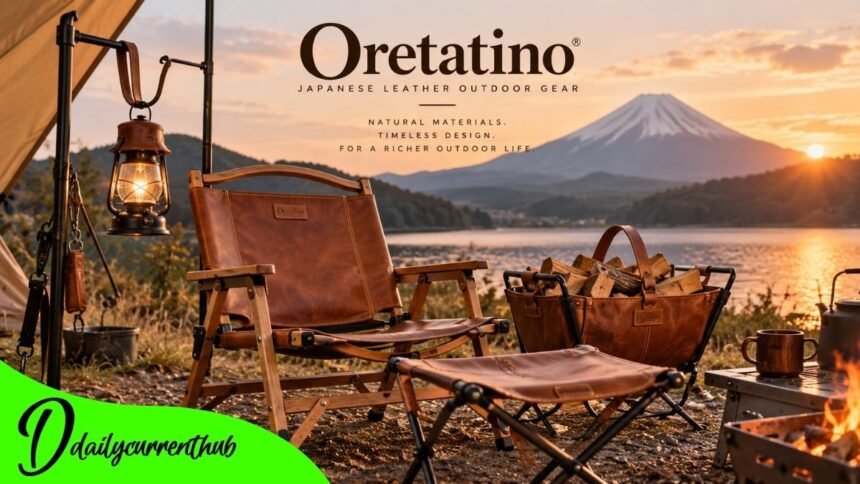
Oretatino is a Japanese outdoor accessories brand that combines traditional leather craftsmanship with a practical approach to using leftover materials. Known for its distinctive camping equipment, the brand transforms surplus genuine leather into functional products designed for outdoor enthusiasts who appreciate durability, simplicity, and individual character.
Rather than concentrating on mass-produced equipment with identical finishes, Oretatino embraces the natural differences found in leather. Its collection includes Kermit Chair leather covers, lantern hooks, firewood carriers, and outdoor stools, each designed around a particular camping need.
The brand’s approach reflects an interesting development in outdoor equipment design: materials that might otherwise be discarded can become useful products through careful selection and skilled manufacturing.
This article explores Oretatino’s background, craftsmanship, product collection, material philosophy, and place within the market for distinctive camping accessories.
What Is Oretatino?
Oretatino is a Japanese camping equipment brand that specializes in products made from leftover genuine leather. Its concept centers on recovering suitable leather left unused during conventional manufacturing and turning it into outdoor accessories with practical value.
The company describes itself as a garage brand, a term in the Japanese outdoor market for smaller, specialized businesses that offer distinctive equipment rather than broad collections of standardized products.
Its identity is closely connected to the natural characteristics of leather. Materials may contain visible grain variations, wrinkles, or surface marks that do not compromise their intended functionality. Rather than treating each mark as a defect, the brand incorporates acceptable variations into its finished designs.
Products are constructed for specific uses, including modifying camping chairs, transporting firewood, and organizing equipment around a campsite.
This combination of material recovery, craftsmanship, and purposeful design forms the foundation of Oretatino’s product identity.
The Origins and Background of Oretatino
The idea behind Oretatino begins with an issue familiar to leather manufacturers: usable material often remains after producing shoes, handbags, and other leather goods.
Natural hides do not have perfectly uniform shapes or surfaces. Manufacturers must cut them to meet product requirements, leaving irregular pieces that may not suit the original design.
Some of these remaining sections retain enough strength and quality for other applications.
Oretatino developed its brand concept around giving such material another practical use. Its official story emphasizes the difference between an imperfection that affects performance and a natural characteristic that simply changes appearance.
This distinction shapes the brand’s identity. Instead of demanding identical-looking material for every product, it works with suitable leather according to what is available.
The approach also influences product appearance because different manufacturing batches may feature slightly different textures.
The result is a product philosophy rooted in resourcefulness and material appreciation, rather than the pursuit of absolute visual uniformity.
The Philosophy Behind the Brand
Oretatino presents leather as a material that develops character through repeated use.
Unlike synthetic materials designed to preserve a consistent appearance, certain genuine leathers can change in color, softness, and surface texture as they age.
This natural aging process is commonly called patina.
For Oretatino, these changes are part of the intended ownership experience. A frequently handled accessory may gradually take on a different appearance from another product of the same design.
Its product philosophy also highlights an appreciation of individuality. Natural marks and grain differences are accepted when they do not undermine the product’s strength.
This does not mean every imperfect piece of leather is suitable. The brand states that areas with damage affecting structural performance are avoided during manufacturing.
The distinction matters because practical camping equipment must withstand handling, movement, and outdoor conditions.
Oretatino’s design concept therefore balances two priorities: preserving natural material characteristics and maintaining useful product strength.
Traditional Japanese Leather Craftsmanship
Craftsmanship plays a central role in Oretatino’s outdoor accessories.
The brand describes a production approach involving experienced leather workers and design influenced by traditional shoemaking expertise.
Leather equipment requires more than attractive cutting patterns. Material thickness, seam placement, and reinforcement type can affect how a finished item performs.
This matters especially for products that carry weight or support a seated person.
The FIREROCK replacement seat, for example, requires careful construction because its leather surface must accommodate body weight while remaining properly fitted to the chair frame.
Oretatino’s descriptions emphasize structural stitching, controlled stretching, and suitable construction techniques.
Other products combine leather and metal to provide the necessary support.
These manufacturing choices illustrate why leather craftsmanship remains relevant to outdoor equipment. The material must be shaped and assembled according to its practical purpose, not simply its appearance.
Oretatino’s Camping Equipment Collection
The Oretatino collection includes several accessories developed for specific outdoor situations. Each product represents a different application of the brand’s leather-focused design philosophy.
INEDIT: Leather Covers for Kermit Chairs
INEDIT is designed as a leather cover for the Kermit Chair, a recognizable folding chair used by camping enthusiasts.
The cover is intended to change the chair’s seating surfaces while preserving the underlying structure.
Its appeal centers on material texture, design compatibility, and the developing appearance of genuine leather.
Because it is a chair accessory rather than a complete chair, buyers must distinguish the cover from the furniture frame itself.
FIREROCK: A Connected Leather Seating Surface
FIREROCK is another leather seating accessory designed for Kermit Chairs.
Its construction connects the seat and backrest sections, creating a continuous leather surface.
Oretatino highlights the specialized cutting and sewing required to manufacture this product.
The design is intended to deliver a more furniture-like appearance while maintaining the practical function of a camping chair.
BIGWAVE: Firewood Transport and Storage
BIGWAVE is a leather-based accessory created for carrying and storing firewood.
Its structure combines a carrier with hooks and straps, allowing users to move firewood and arrange it around their equipment.
The design also supports storage arrangements that help keep firewood away from direct contact with damp ground when used with compatible racks or containers.
This multipurpose construction distinguishes it from an ordinary carrying bag.
BLUE MOON: A Versatile Outdoor Stool
BLUE MOON combines a leather surface with a metal supporting structure.
It is designed for several outdoor uses, including functioning as a stool or footrest. The brand also suggests it’s suitable for certain table-like applications.
Its compact design makes it suitable for campers looking to coordinate furniture accessories.
Oretatino states that BLUE MOON and FIREROCK can be ordered with matching leather materials under specified ordering conditions.
TUSKER and REDSTRIPE: Practical Campsite Accessories
TUSKER is a leather-covered lantern hook built with a metal core and reinforced stitching.
It illustrates the brand’s interest in combining structural materials with traditional leather finishing.
REDSTRIPE is a multipurpose hook accessory intended to help organize camping equipment.
Together, these smaller accessories show that Oretatino’s catalog extends beyond furniture and storage products.
Sustainability and Responsible Material Use
One of Oretatino’s defining characteristics is its use of surplus leather.
The company sources usable leather left over from other manufacturing activities or deemed unsuitable for an original product because of its appearance or dimensions.
By converting selected material into new accessories, the brand gives that leather an additional commercial purpose.
This resembles the principle of upcycling, in which an existing material is repurposed into a useful new product.
However, material recovery should not automatically be treated as proof that a product has no environmental impact.
Leather production involves animal-derived materials and processing, while stitching, packaging, transportation, and other manufacturing activities also consume resources.
Oretatino’s documented contribution is more specific: it uses suitable leftover leather that might otherwise remain unused or be discarded.
That is a meaningful feature of its material strategy without requiring unsupported claims about carbon neutrality or complete environmental sustainability.
Design, Durability, and Everyday Functionality
Oretatino’s appeal lies partly in its effort to combine attractive materials with practical camping functions.
Its products frequently use simple forms, visible stitching, and natural leather surfaces.
A restrained design lets individual materials stand out without relying on excessive decoration.
Yet appearance is only one part of useful outdoor equipment.
A firewood carrier must accommodate repeated lifting, a hook must support appropriate loads, and a chair cover must fit the furniture it was designed for.
Oretatino addresses these requirements through product-specific construction methods.
Leather also introduces practical considerations. It may change with moisture, temperature, sunlight, and repeated handling.
Consequently, durability depends not only on manufacturing quality but also on correct use and maintenance.
The company’s approach is best understood as an effort to produce accessories that are both visually distinctive and suitable for their stated functions.
Product Care and Maintenance
Leather camping accessories require attention because genuine leather responds to environmental conditions.
Oretatino’s product instructions recommend removing excess moisture when an item gets wet and letting it dry naturally in the shade.
Rapid drying near strong heat can cause leather to shrink or develop cracks.
Appropriate conditioning after drying may help maintain flexibility, depending on the leather and product instructions.
Users should also follow any product-specific warnings.
For example, the TUSKER lantern hook is described as having less gripping friction than certain rubber-protected alternatives. It may therefore be less secure when hanging without a load.
Understanding these limitations helps owners use their equipment correctly.
Proper maintenance also supports the visual aging that forms part of Oretatino’s design concept.
Understanding Oretatino’s Business Model
Oretatino’s business model differs from that of a conventional outdoor retailer offering large quantities of standardized equipment.
Its products are built around a particular material supply: surplus genuine leather.
Because available leather can vary, finished products may differ slightly from catalog photographs in texture or natural markings.
Certain products are also manufactured after an order is received rather than being immediately available from existing inventory.
This arrangement makes purchasing conditions particularly important.
Customers should review the stated delivery period, material descriptions, compatibility requirements, and return terms before ordering.
The brand’s Japanese legal disclosure identifies KURO LLC as the selling business and provides formal commercial information.
These details help distinguish the operation from an anonymous product listing and give buyers a clearer understanding of the transaction.
Public Recognition and Common Misconceptions
Oretatino appears in Japanese outdoor-product coverage and specialized discussions about camping equipment.
Its reputation should be evaluated through identifiable products, manufacturing descriptions, and published information rather than unsupported claims about sales rankings or worldwide popularity.
One possible misunderstanding concerns the brand itself.
Oretatino is a commercial outdoor equipment brand, not a publicly documented celebrity or private family member.
Another misconception is that using leftover leather necessarily means accepting weak materials.
The brand distinguishes cosmetic imperfections from damage affecting strength and says it avoids unsuitable sections during production.
Consumers should also understand that two items may show different natural leather markings without necessarily having different functional specifications.
These distinctions better explain the brand’s approach.
The Future of Oretatino
Oretatino’s existing collection illustrates how specialized outdoor products can be developed around a clearly defined material philosophy.
The brand combines recovered leather, functional design, and traditional manufacturing techniques across several camping equipment categories.
Its future direction will depend on commercial decisions, material availability, production capacity, and customer demand.
Specific expansion plans or forthcoming collections should not be assumed without official announcements.
What is clear is that the current product range provides a consistent example of using surplus natural materials in a practical product category.
Oretatino’s broader relevance therefore extends beyond individual camping accessories.
Its approach demonstrates how material selection and skilled construction can help give otherwise unused resources a functional purpose.
Conclusion
Oretatino represents a distinctive approach to Japanese outdoor equipment, combining leftover genuine leather with thoughtful construction and purposeful design.
Its collection includes leather chair covers, stools, firewood carriers, lantern hooks, and other camping accessories created for specific functions.
The brand’s identity is shaped by its willingness to work with natural material variations rather than demanding identical surfaces across every product.
Equally important is the distinction between appearance and structural quality. Oretatino’s manufacturing philosophy emphasizes using suitable leather while avoiding imperfections that could compromise performance.
The result is a collection centered on craftsmanship, individuality, and practical outdoor use.
For campers who appreciate natural materials and distinctive equipment, Oretatino offers an alternative to standardized accessories. Its most meaningful contribution is the straightforward idea that usable leftover material can be transformed into carefully designed products rather than discarded.
(FAQs)
1. What is Oretatino?
Oretatino is a Japanese outdoor accessories brand that specializes in handcrafted camping equipment made from surplus genuine leather.
2. Is Oretatino a Japanese brand?
Yes. Oretatino operates as a Japanese brand, and its official product listings identify its leather camping equipment as made in Japan.
3. What products does Oretatino manufacture?
Its collection includes Kermit Chair leather covers, replacement seats, lantern hooks, firewood carriers, outdoor stools, and multipurpose hooks.
4. Does Oretatino use genuine leather?
Yes. The company uses genuine leather, including suitable leftover materials from manufacturing. The specific leather type can vary depending on supply.
5. Why do Oretatino products have different textures?
Natural leather varies in grain, markings, and surface appearance. Oretatino accepts these differences as long as they don’t compromise product strength.
6. Are Oretatino chair covers compatible with every camping chair?
No. Products such as INEDIT and FIREROCK are specifically designed for Kermit Chairs. Buyers should verify compatibility before purchasing.
7. How should Oretatino leather camping products be maintained?
The brand recommends removing excess moisture, allowing wet leather to dry naturally in the shade, avoiding rapid heating, and following product-specific care instructions.
8. What makes Oretatino different from conventional camping equipment brands?
Its distinguishing feature is the combination of surplus leather, Japanese craftsmanship, natural material variation, and functional designs for specific camping applications.