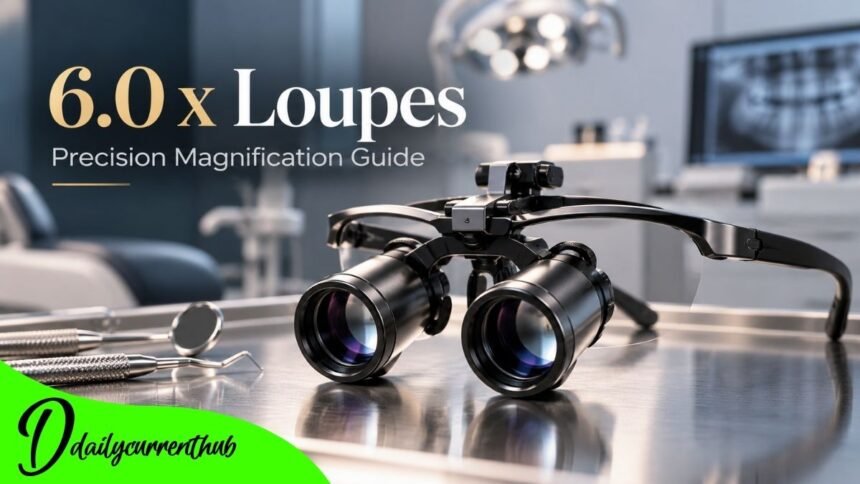
6.0 x Loupes are high-magnification optical instruments designed to help professionals examine fine details during demanding procedures. Widely used in dentistry and surgery, these specialized devices provide sixfold nominal magnification, making small structures easier to see without requiring users to move excessively close to their work area.
For dentists performing intricate restorative procedures, surgeons working with delicate anatomical structures, and other professionals who need detailed visual examination, magnification can be a key part of an effective setup.
Unlike ordinary magnifying glasses, professional binocular loupes are designed around optical clarity, working distance, field of view, and ergonomic positioning. Their effectiveness depends on how accurately these characteristics match the wearer and the task.
This article explores the technology behind 6.0 x Loupes, their clinical applications, practical advantages, limitations, and essential considerations when choosing a suitable optical system.
What Are 6.0 x Loupes?
6.0 x Loupes are wearable optical magnification devices that use specialized lenses and telescopic components to enlarge the apparent size of objects viewed through them. The 6.0× designation indicates their nominal magnification.
They are generally mounted on eyeglass-style frames or supported by a head-mounted system. Binocular arrangements let users view their work area through separate optical channels for each eye.
The technology is particularly relevant to professionals who regularly examine small anatomical structures, instrument positions, or detailed surfaces.
High-magnification loupes differ from low-power systems because they emphasize smaller visual details, generally at the expense of some viewing area and focusing tolerance.
Manufacturers such as ExamVision, Designs for Vision, and Admetec offer advanced optical designs demonstrating how magnification, viewing geometry, and ergonomic requirements can be combined in professional equipment.
Understanding these characteristics helps explain both the capabilities and practical limitations of sixfold magnification.
Understanding 6.0 x Loupes and Their Technology
How 6.0 x Magnification Works
Magnification changes the apparent angular size of a viewed object. With nominal 6.0× magnification, small structures appear substantially larger than they would through unaided vision at the specified viewing conditions.
This enhancement can make subtle surface details, restoration margins, and fine anatomical structures easier to inspect.
However, magnification is only one part of image quality. Optical resolution, contrast, lens alignment, illumination, and viewing stability also influence what the wearer can distinguish.
A poorly adjusted high-magnification system may produce an uncomfortable or restricted viewing experience despite its powerful optics.
Compared with lower-magnification loupes, a 6.0× system typically requires more deliberate positioning of the working area.
The practical objective is not simply to enlarge everything. It is to provide sufficient detail while maintaining the freedom to work accurately and comfortably.
Optical Technology and Lens Design
Professional loupes employ different optical arrangements to achieve their magnification.
Galilean loupes are commonly associated with lower magnification and relatively compact optical construction. Higher-power instruments often use Keplerian or prismatic telescope systems, which add optical elements to achieve greater magnification within wearable housings.
Some manufacturers also provide panoramic optical designs intended to expand the field visible through the loupes.
For example, Designs for Vision markets a 6.0× panoramic model, while ExamVision offers optical systems incorporating 6.0× magnification within adjustable-magnification product ranges.
These approaches show that two instruments with the same magnification label can have noticeably different viewing characteristics.
Lens quality, optical coatings, system alignment, and individual eyesight correction can affect practical usability.
Consequently, evaluating a loupe involves more than comparing magnification numbers printed on product specifications.
Working Distance and Field of View
Two essential considerations when selecting 6.0x loupes are working distance and field of view.
Working distance describes the distance between the user’s eyes and the target area at which the optical system is intended to provide a clear image.
For example, specifications published for Admetec’s Ergo 6.0× loupes through Byron Medical describe configurations with working distances of 450, 500, and 550 millimeters.
The corresponding published field-of-view widths are approximately 50, 56, and 62 millimeters, respectively.
These figures apply to that particular product, not all sixfold loupes.
Field of view determines how much of the working area can be seen without repositioning the head.
Depth of field describes the range over which objects remain acceptably focused.
In general, higher magnification places greater demands on positioning and focus. Choosing an appropriate working distance is therefore essential for maintaining a comfortable posture and useful visibility.
Ergonomics and Professional Comfort
Ergonomics are an important consideration because dental and surgical professionals may spend extended periods performing visually demanding tasks.
A correctly fitted loupe lets the wearer observe the working area without leaning excessively forward.
However, effective ergonomic performance depends on several measurements, including working distance, interpupillary distance, viewing angle, and the relationship between the optical system and the wearer’s natural posture.
The declination angle describes the optical system’s downward viewing direction relative to the frame. Appropriate alignment can help users look toward the working area while maintaining a more comfortable head position.
Frame weight and balance also matter, particularly during lengthy sessions.
High magnification should never be treated as an automatic guarantee of improved posture. An incorrectly fitted instrument may encourage awkward positioning or unnecessary strain.
Professional fitting and adjustment are therefore particularly valuable when moving from lower magnification to 6.0× systems.
Clinical and Professional Applications
6.0× loupes are relevant to work requiring careful inspection of small structures.
In dentistry, magnification may help examine restorative margins, tooth surfaces, and fine procedural details. Applications can include endodontic, restorative, periodontal, and prosthodontic procedures, depending on the clinician’s preferred technique.
Within surgery, magnification loupes can support visual examination during selected procedures involving small anatomical structures.
Their usefulness depends on the operation, available space, illumination, and whether a wider field or an operating microscope would be more suitable.
High-magnification systems may also be useful for particular laboratory and technical tasks where precision viewing is required.
Nevertheless, 6.0× is not necessarily appropriate for every procedure. Work involving frequent changes in viewing position or a broad treatment area may benefit from lower magnification.
The correct optical system is determined by the working demands rather than magnification alone.
The Relationship Between Lighting and Visual Clarity
Good illumination is especially important when working at higher magnification.
A clear optical image depends on sufficient light reaching the viewed surface. Shadows, reflections, and poorly positioned lighting can make fine details harder to distinguish.
Many professional loupe systems support compatible LED headlights designed to illuminate the target along or near the wearer’s line of sight.
This arrangement can be particularly useful when overhead room lighting cannot effectively reach a recessed working area.
When selecting a light, consider brightness, beam distribution, color rendition, heat, battery performance, and comfort.
A well-matched headlight can make the magnified image more practical during clinical work, but excessive brightness and reflected glare may create their own problems.
The most effective arrangement combines optical clarity with controlled illumination suited to the actual procedure.
Scientific Evidence and Practical Benefits
Research on dental magnification provides useful evidence about the benefits and limitations of loupes.
A 2021 review published in the Journal of Contemporary Dental Practice examined scientific evidence concerning dental magnification. It identified potential benefits in visual performance, diagnostic tasks, and practitioner posture while emphasizing the need for further clinical research.
Other studies have investigated the relationship between loupes and working posture among dental students and professionals.
Results generally suggest that proper magnification use may improve posture, although findings differ across studies.
A systematic review published in the International Journal of Dental Hygiene found evidence supporting improved working postures but highlighted limitations in the available research, particularly regarding long-term musculoskeletal outcomes.
Importantly, findings involving lower-magnification systems cannot automatically establish that 6.0× provides superior clinical results.
Magnification is a supportive instrument, not a replacement for professional training, sound technique, or appropriate clinical judgment.
Limitations and Common Misconceptions
One common misconception is that the highest available magnification must always provide the best working experience.
Although 6.0× loupes offer substantial enlargement, greater magnification typically involves trade-offs in field of view, depth of field, and ease of locating the working area.
Another misconception is that magnification alone prevents neck or back problems.
Posture depends on the complete working environment, including seating, patient positioning, instruments, procedure length, and optical fitting.
High-magnification loupes can also require an adaptation period, especially for users accustomed to working without magnification or with lower-power optical systems.
The narrower viewing area may initially make instrument positioning more demanding.
These limitations do not make sixfold magnification unsuitable. Rather, they highlight why task requirements, individual fitting, and practical experience should guide equipment selection.
Choosing and Maintaining 6.0 x Loupes
Selecting a suitable pair begins with evaluating the tasks performed most frequently.
Professionals should consider whether the extra detail of 6.0× is genuinely useful for their work.
A practical assessment should include the following factors:
- Working distance: Does the instrument support a comfortable working position?
- Optical clarity: Are fine details sharp across the usable viewing area?
- Field of view: Is enough of the target visible for normal procedures?
- Frame comfort: Is the weight distributed comfortably?
- Prescription compatibility: Can the instrument accommodate required vision correction?
- Lighting compatibility: Is suitable illumination available?
- Service support: Does the manufacturer support adjustment, repair, and replacement components?
Whenever possible, try the instrument under realistic working conditions rather than selecting it from specifications alone.
Maintenance also plays a significant role in long-term performance. Lenses should be handled carefully, stored in protective cases, and cleaned with products approved by the manufacturer.
In clinical environments, cleaning and disinfection must follow the device instructions and applicable infection-control procedures.
Loupes should not automatically be regarded as substitutes for protective eyewear. Appropriate splash protection must be maintained according to the clinical setting.
Conclusion
6.0 x Loupes represent a specialized approach to high-magnification visual work. Their main advantage is making fine details easier to examine during procedures that require careful observation.
Modern optical designs provide different combinations of magnification, field of view, working distance, and ergonomic adjustment. These variations explain why selecting a suitable system requires more than choosing the highest available power.
For dental and surgical professionals, properly fitted magnification can support detailed visualization and may contribute to more comfortable working positions. However, clinical performance depends on the complete combination of optical quality, fitting, lighting, technique, and experience.
A sixfold system is most useful when its characteristics match the wearer’s actual tasks. Understanding the benefits and limitations allows professionals to make informed equipment decisions while maintaining realistic expectations about what magnification can achieve.
(FAQs)
1. What are 6.0 x Loupes used for?
6.0 x Loupes are used for magnified visual examination during detailed work, particularly in dentistry, selected surgical procedures, and other precision-based activities.
2. What does 6.0× magnification mean?
It means the optical system provides nominal sixfold magnification, making viewed objects appear larger in angular size than through unaided vision under the specified viewing conditions.
3. Are 6.0 x Loupes suitable for beginners?
They can be used by beginners, but high magnification generally requires greater attention to positioning and focusing. Lower-magnification systems may be easier for new users to adapt to.
4. What is the ideal working distance for 6.0 x Loupes?
There is no universal ideal distance. It depends on the user’s height, posture, procedure, and optical design. Professional fitting helps determine the appropriate configuration.
5. Can 6.0 x Loupes improve working posture?
Properly fitted loupes may support improved working posture. However, benefits depend on optical alignment and the overall working setup, and reduced pain is not guaranteed.
6. Do 6.0× loupes require additional lighting?
Not always, but compatible LED illumination can help, especially when examining recessed or shadowed areas.
7. What is the difference between 4.0× and 6.0× loupes?
6.0× loupes provide greater nominal magnification, while 4.0× systems generally offer a wider viewing area and greater focusing tolerance when other design factors are similar.
8. How should 6.0 x Loupes be cleaned?
Follow the manufacturer’s approved cleaning and disinfection instructions. In clinical settings, reusable equipment must also be managed according to applicable infection-control requirements.