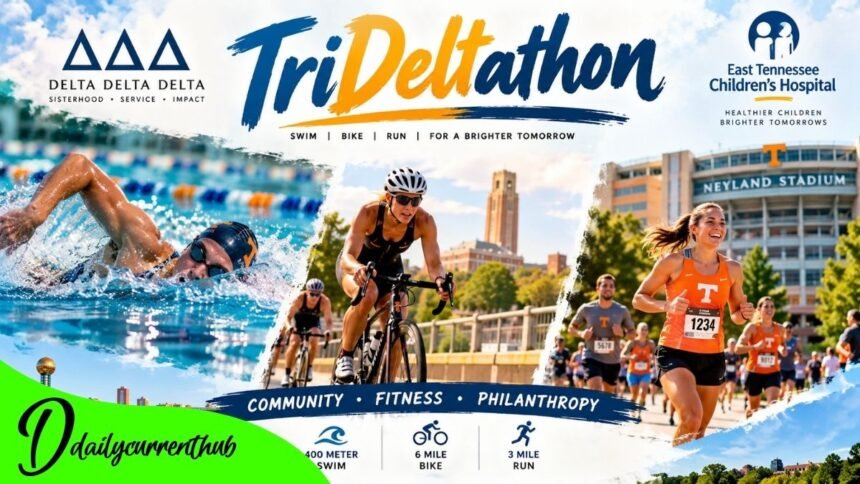
TriDeltathon holds a distinctive place in Knoxville, Tennessee’s sporting history. Associated with the University of Tennessee and the Delta Delta Delta sorority, this charity-focused triathlon brought together swimming, cycling, and running in a compact competitive format. Its combination of university participation, community volunteering and fundraising helped distinguish it from conventional sporting events.
The historic competition featured a 400-meter indoor swim, a six-mile cycling course and a three-mile run. Participants could enter individually or compete through relay teams, making the event accessible to different types of athletes.
Beyond its sporting activities, TriDeltathon supported East Tennessee Children’s Hospital, connecting physical competition with charitable contributions.
Although current race listings no longer include the original triathlon format, a related 5K event called TriDeltaRUN continues the community fundraising tradition.
This article explores TriDeltathon’s history, race structure, charitable connections, organizational background, and continuing relevance.
What Is TriDeltathon?
TriDeltathon was a charity-oriented pool triathlon held in Knoxville, Tennessee, with strong connections to the University of Tennessee community.
Unlike triathlons involving open-water swimming, TriDeltathon used an indoor swimming pool for its first discipline. Competitors then completed cycling and running stages around the university area.
Historical race descriptions emphasized a relatively short course, organized competition,, and opportunities for participation by both individuals and teams.
One defining feature was its relationship with Delta Delta Delta, commonly known as Tri Delta. Members provided volunteer support, while the race’s charitable proceeds benefited East Tennessee Children’s Hospital.
The event became established enough that organizers described the planned 2020 competition as its 36th year. That edition was canceled, but archived event information continues to document its structure and purpose.
Today, the TriDeltathon name is closely associated with Knoxville’s history of university-based endurance events and community philanthropy.
The History and Origins of TriDeltathon
TriDeltathon’s history extends back several decades. The official description for the scheduled 2020 event advertised it as the competition’s 36th year, indicating an established tradition by that point.
This numbering suggests origins around the mid-1980s, although it does not independently establish the exact inaugural date or provide a complete chronological record of every edition.
The event developed around the University of Tennessee’s sporting environment, combining multiple disciplines within a relatively compact course.
Its organizers promoted TriDeltathon as the country’s oldest continuously running pool triathlon. This distinction appeared in promotional material, but should be understood as an organizer’s historical claim, not an independently verified national record.
The Significance of its longevity remains clear without relying on that superlative. Maintaining a university-associated sporting event for decades requires recurring arrangements for facilities, registration, course preparation, and volunteer participation.
TriDeltathon’s surviving records show that these organizational elements formed part of the event’s established identity.
Understanding the Original TriDeltathon Race Format
The original TriDeltathon followed the traditional triathlon order: swimming, cycling, and running.
Its 400-meter indoor swimming stage took place at the University of Tennessee Student Aquatic Center. According to the historic race instructions, athletes entered the pool individually at intervals of approximately seven seconds.
Swimmers were seeded by estimated 400-meter times, with faster swimmers starting before slower participants. They completed eight 50-meter lengths, moving between lanes by passing under lane ropes.
After swimming, competitors proceeded to the cycling portion. The advertised six-mile course traveled through the university area and along Neyland Drive.
The final stage involved a three-mile campus run, passing prominent university sporting landmarks, including Neyland Stadium and Thompson-Boling Arena.
Completing all three stages required athletes to move efficiently between different exercises. Swimming tested technique and endurance, cycling introduced a different physical demand, and running completed the overall challenge.
The historic event was also described as not sanctioned by USA Triathlon. That designation applied to the documented edition and should not be assumed to describe any future competition.
TriDeltathon and the University of Tennessee
The University of Tennessee was central to TriDeltathon’s location and sporting character.
The historic event used the Student Aquatic Center at 2106 Andy Holt Avenue, Knoxville, with cycling and running courses incorporating campus surroundings and nearby roads.
This setting gave competitors access to established athletic facilities while bringing the event into a recognizable university environment.
The race also offered student pricing, demonstrating an effort to include members of the campus community.
University sports facilities also played a practical role. An organized pool venue provided a defined swimming course, while surrounding roads supported cycling and running.
The event’s connection with Knoxville was therefore more substantial than simply sharing a geographic location. Its routes, facilities, and volunteer involvement were closely linked to the university setting.
The Role of Delta Delta Delta Sorority
Delta Delta Delta sorority was an important part of TriDeltathon’s organizational and charitable identity.
Historical race information specifically credited Tri Delta members with providing volunteer support. The sorority’s involvement connected the competition with a broader tradition of campus service and philanthropy.
Tri Delta has a longstanding commitment to children’s healthcare causes. Nationally, the organization supports St. Jude Children’s Research Hospital and various local and regional pediatric healthcare initiatives.
However, these charitable activities should not be confused with one another.
TriDeltathon’s documented beneficiary was East Tennessee Children’s Hospital, not the sorority’s national St. Jude fundraising program.
This distinction illustrates how a national organization can maintain broad philanthropic priorities while its members participate in locally focused activities.
In the case of TriDeltathon, the locally organized sporting event provided an opportunity for charitable fundraising alongside athletic participation.
Individual Athletes and Relay Participation
TriDeltathon offered multiple ways to participate.
The archived 2020 registration page listed both individual competition and a relay category. Individual competitors were expected to complete the three disciplines, while relay participants could divide the sporting responsibilities among team members.
The advertised eligibility for the canceled 2020 edition covered ages 10 to 99 for individual competitors and ages 7 to 99 for relay participation.
These figures describe that particular registration listing and should not be presented as permanent age requirements.
The organizers also advertised overall, age-group, and relay awards. Such categories provided separate competitive recognition rather than treating all participants as a single group.
The race’s relatively short distances distinguished it from much longer triathlon formats. Nevertheless, participants still needed suitable preparation, especially for swimming and transitions between disciplines.
The availability of individual and relay formats demonstrates how TriDeltathon combined personal endurance challenges with opportunities for team-based participation.
Philanthropy and Community Engagement
Charitable fundraising was central to the TriDeltathon mission.
The archived race information identified East Tennessee Children’s Hospital as the beneficiary of the event’s proceeds.
This charitable connection was also reflected in the organizers’ response to the 2020 cancellation. Registered participants were given an option to leave their entry fees with the event so that the hospital could still benefit.
The race’s connection to pediatric healthcare made charitable support part of the event’s identity rather than an unrelated addition.
Its later associated event, TriDeltaRUN, was was also named Camp Eagles Nest, which organizers described as a summer camp serving children with cancer and rare blood disorders.
However, the available records do not establish a verified lifetime fundraising total for TriDeltathon. Any financial claim would require documentation identifying the relevant event year and donation amount.
The confirmed charitable relationships matter on their own, without unsupported fundraising figures or exaggerated impact claims.
What Happened to TriDeltathon in 2020?
The TriDeltathon scheduled for April 19, 2020, did not take place.
According to the official cancellation notice, the University of Tennessee’s decision to move instruction online for the rest of the academic year prevented organizers from holding the planned competition.
Race Day Events said attempts to arrange an alternative date were unsuccessful.
Registered participants were offered several options, including transferring their entries to a proposed future edition, moving to another Race Day Events competition, receiving an event credit, requesting a refund or leaving their fees as charitable contributions.
The notice was signed by Martin Coleman of Race Day Events.
Although the cancellation occurred during the COVID-19 disruption, the available documentation does not establish that the pandemic was the sole reason the original triathlon format did not subsequently resume.
A historical cancellation notice should therefore not be treated as proof of the reasons behind every later organizational decision.
TriDeltaRUN and the Changing Race Format
A related event, TriDeltaRUN, represents a more recent chapter in the same local charitable sporting tradition.
Unlike TriDeltathon’s three-sport format, TriDeltaRUN is a five-kilometer running event.
Race Day Events’ results archive documents TriDeltaRUN in April 2022, while the official 2026 registration page described that year as the fifth year of the 5K.
The 2026 edition was scheduled for Sunday, April 19, at 10 a.m., beginning at UT Gardens on the University of Tennessee Agriculture Campus.
Its advertised course followed much of the Third Creek Greenway, and the event offered overall and age-group awards, race shirts, refreshments, and student discounts.
The charitable beneficiaries identified in the 2026 listing were East Tennessee Children’s Hospital and Camp Eagles Nest.
These similarities establish continuity in community involvement and philanthropic purpose. However, they do not establish a specific official decision date when TriDeltaRUN replaced the historic triathlon.
The two events are best understood as closely related sporting traditions with different competitive formats.
Public Curiosity and Misconceptions About TriDeltathon
Several misunderstandings can arise when searching for TriDeltathon online.
One concerns the event’s present status. Archived registration pages still display historic dates, distances, and descriptions, even though those pages do not confirm an upcoming triathlon.
Another concerns the distinction between TriDeltathon and TriDeltaRUN. Their similar names and shared charitable background can make them appear identical, but their sporting requirements differ significantly.
There is also the historical claim that TriDeltathon was the oldest running pool triathlon in the United States. The organizers used that description, but it should not be stated as an independently fact without supporting comparative records.
Finally, the event’s local charitable purpose should not be automatically attributed to every national Tri Delta fundraising campaign.
Understanding these differences creates a more accurate picture of the competition and protects its history from misleading descriptions.
The Legacy and Future of TriDeltathon
TriDeltathon’s legacy rests on the combination of athletic competition, university involvement, and charitable service.
Its historic course brought swimming, cycling, and running together while supporting a children’s healthcare organization in East Tennessee.
The later appearance of TriDeltaRUN demonstrates that the associated sporting and charitable tradition continued through a different format.
As of October 2026, the reviewed organizer listings identify the April 2026 TriDeltaRUN edition but do not confirm a future date for the original pool-based triathlon.
Whether a three-discipline TriDeltathon will return is therefore a question for future organizer announcements, not speculation.
Its documented history nevertheless offers an example of how a community sporting competition can bring together university resources, charitable commitments and organized recreational athletics.
Conclusion
TriDeltathon remains an important part of Knoxville’s local charitable sporting history. Its distinctive combination of a 400-meter indoor swim, six-mile bicycle route and three-mile run made it a recognizable university-associated triathlon.
The event’s relationship with Delta Delta Delta, Race Day Events and East Tennessee Children’s Hospital gave it a wider purpose beyond competition. Participants could pursue individual sporting goals while contributing to an established community fundraising effort.
Although the scheduled 2020 competition was canceled and the original race format is not confirmed as currently active, its associated charitable tradition continues through TriDeltaRUN.
The history of TriDeltathon is ultimately a story about organized sport and community involvement. Its lasting Significance comes not from unverified records or exaggerated claims, but from the documented combination of participation, volunteer service, and support for children’s healthcare in Knoxville.
(FAQs)
1. What is TriDeltathon?
TriDeltathon was a charity triathlon in Knoxville, Tennessee, associated with the University of Tennessee and Delta Delta Delta sorority. It combined swimming, cycling, and running.
2. Where was TriDeltathon held?
The historic event used the University of Tennessee Student Aquatic Center at 2106 Andy Holt Avenue in Knoxville, with cycling and running routes around the university area.
3. What were the TriDeltathon race distances?
Its documented historic format included a 400-meter indoor swim, six miles of cycling, and a three-mile run.
4. When did TriDeltathon begin?
The planned 2020 competition was promoted as the event’s 36th year, suggesting origins in the mid-1980s. The precise founding date has not been independently established.
5. Why was TriDeltathon canceled in 2020?
The organizers canceled the April 19, 2020 event after the University of Tennessee moved instruction online for the remainder of the academic year. They could not secure an alternative date.
6. Which charity did TriDeltathon support?
The historic TriDeltathon supported East Tennessee Children’s Hospital. The related TriDeltaRUN also identifies Camp Eagles Nest among its charitable beneficiaries.
7. What is the difference between TriDeltathon and TriDeltaRUN?
TriDeltathon involved swimming, cycling, and running. TriDeltaRUN is a related five-kilometer running event without swimming or cycling stages.
8. Is TriDeltathon returning in 2027?
As of October 2026, the reviewed official event information does not confirm a 2027 return of the original triathlon. Any future race should be verified through a newly dated organizer announcement.