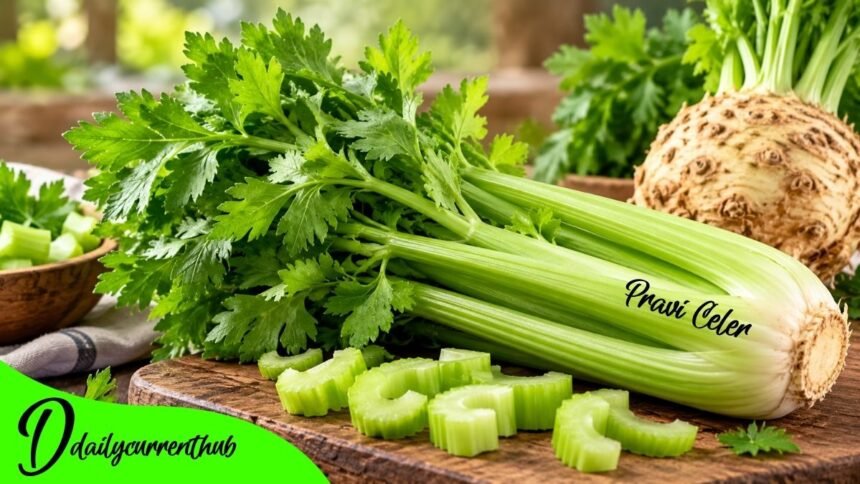
An informative guide to true celery, its botanical history, nutritional value, culinary importance, and the modern lifestyle brand sharing its name.
Pravi Celer is a phrase with an interesting identity. In Croatian botanical terminology, it refers to celery, the familiar aromatic plant scientifically known as Apium graveolens. Although the words translate roughly to “true celery” or “real celery,” they do not refer to a newly discovered vegetable or a special botanical species.
Celery has a long history in food preparation and cultivation. Its crisp stalks, fragrant leaves, and enlarged edible base serve different purposes, making it a versatile ingredient in kitchens worldwide.
The phrase has also acquired a separate identity online through a luxury lifestyle publication called Pravi Celer, which explores travel, fashion, design, technology, and premium experiences.
Understanding these different meanings helps prevent confusion between the plant, its culinary traditions, and the modern publication.
This article explores the verified meaning of Pravi Celer, its botanical background, cultivated forms, nutrition, culinary uses, safety considerations, and digital identity.
What Is Pravi Celer?
Pravi Celer is a Croatian common name associated with the plant species Apium graveolens. The Flora Croatica Database records this name alongside other Croatian expressions, including vrtni celer and mirisavi celer.
The species belongs to the Apiaceae family, which also includes carrots, parsley, fennel, and parsnips.
Its identity becomes clearer when the difference between botanical species and cultivated vegetable forms is understood.
The familiar green stalks commonly sold as celery represent one cultivated form. Celeriac, which develops a large swollen base, is another. Leaf celery is cultivated primarily for its aromatic foliage.
These forms share the same underlying botanical species, although their appearance, texture, and culinary applications differ.
Consequently, Pravi Celer should not automatically be interpreted as a particular premium variety. Its precise culinary meaning depends on the context.
The Meaning and Origin of the Name Pravi Celer
The phrase combines two recognizable Croatian words. Pravi means true, real, or genuine, while celer means celery.
Together, they form a descriptive expression that can be translated as “true celery.”
The Flora Croatica Database supports the phrase’s botanical significance by documenting the taxonomy and names of plants associated with Croatian flora.
The database lists Pravi Celer among the Croatian common names of Apium graveolens.
This distinction matters because everyday language and scientific naming serve different purposes.
Common names can change between languages or regions, while a scientific name provides a standardized reference for identifying a species.
Someone searching for Pravi Celer in English may encounter several interpretations, including celery stalks, celeriac, and traditional vegetable preparations.
The scientific classification provides a reliable foundation for understanding what these different descriptions have in common.
Botanical Identity and Classification
The scientific name of Pravi Celer is Apium graveolens L.
The abbreviation “L.” identifies Carl Linnaeus as the authority associated with the botanical name. The species was formally published the species in Species Plantarum in 1753.
Kew Science’s Plants of the World Online recognizes Apium graveolens as an accepted species in the Apiaceae family.
The plant is aromatic, with a characteristic celery fragrance. It has divided leaves, grooved stems, and small flowers arranged in structures typical of the carrot family.
Botanically, celery is generally treated as a biennial, meaning its natural life cycle typically spans two growing seasons.
During cultivation, however, growers usually harvest it during the vegetative stage, before it completes flowering and seed production.
This distinction between the natural growth cycle and commercial harvesting helps explain why celery is commonly treated as an annual vegetable crop.
Historical Background and Cultivation
Celery has a documented history extending far beyond modern supermarkets.
According to the Royal Horticultural Society, wild celery was known in the Mediterranean region and used in the ancient world, including as a flavoring ingredient.
Historical evidence also connects celery with ancient Egyptian and Greek cultural practices.
These historical uses should not be confused with evidence that celery can treat specific medical conditions.
Over time, cultivation and plant selection produced forms with different desirable characteristics.
Some growers preferred plants with larger, more tender stalks. Others selected plants with stronger leaves or enlarged edible bases.
These agricultural developments contributed to the range of celery vegetables available today.
Kew records a broad native distribution for Apium graveolens, extending across parts of Europe, North Africa, Macaronesia, and towards the western Himalayas.
Cultivation has since expanded well beyond that original range.
The result is a familiar vegetable with a much wider botanical and agricultural history than its supermarket appearance might suggest.
Different Types of Pravi Celer
One of the most useful ways to understand Pravi Celer is to examine the major cultivated forms of celery.
Stalk Celery
Stalk celery is easily recognizable for its long, crisp, green or pale-green leaf stalks.
These structures provide the crunchy texture associated with raw celery.
You can eat stalk celery fresh, chopped into salads, or cooked with other vegetables.
Its flavor becomes softer during cooking, making it particularly useful in soups, sauces, and stocks.
Celeriac
Celeriac is another cultivated form of Apium graveolens.
Unlike stalk celery, it is grown primarily for its enlarged, rounded base.
Although commonly called celery root, the swollen edible structure is botanically a modified stem base rather than a typical root.
Celeriac has a firm texture and an earthy celery flavor.
It can be peeled, grated, boiled, mashed, roasted, or added to stews.
Leaf Celery
Leaf celery is grown mainly for its aromatic foliage and relatively slender stalks.
Its leaves can add a pronounced celery flavorflavor to cooked dishes.
They are useful in stocks, soups, sauces, and vegetable preparations where fragrance matters more than crunch.
These different forms show why the name Pravi Celer does not refer to a single fixed appearance or texture.
Culinary Uses and Traditional Food
Celery has an established place in European cooking, including kitchens where aromatic vegetables form the foundations of soups and stews.
Its value comes primarily from flavor and versatility.
When cooked with onions, carrots, and other vegetables, celery contributes a distinctive savory aroma.
French cuisine uses celery in the traditional aromatic vegetable mixture known as mirepoix, usually combined with onions and carrots.
Celeriac serves a different purpose.
Because it has a firm, enlarged base, you can prepare it similarly to other substantial vegetables.
Roasted celeriac develops a softer texture, while boiled celeriac can be mashed or blended into purées.
In salads, finely grated celeriac provides a texture quite different from sliced celery stalks.
Leaf celery is particularly useful when you want a stronger herbal flavorflavor.
This diversity also helps explain why it’s worth checking a recipe carefully before buying ingredients.
A dish requesting a peeled, round celery base generally calls for celeriac, while instructions mentioning crisp green stalks refer to another cultivated form.
Choosing the correct ingredient can change the texture and flavor of the finished meal.
Nutritional Value of Pravi Celer
Celery offers several nutrients while contributing relatively few calories.
According to nutrition information published by University Hospitals, one cup of chopped raw celery provides approximately 14 calories, 1.6 grams of dietary fiber, and 263 milligrams of potassium.
The same serving also supplies approximately 30 micrograms of vitamin K and smaller amounts of folate and vitamin C.
These figures describe raw stalk celery and should not automatically be applied to celeriac, which has a different nutritional composition.
Vitamin K supports normal blood clotting and helps maintain bone health.
Potassium is an essential mineral involved in normal nerve, muscle, and cellular function.
Dietary fiber contributes to digestive health as part of a balanced eating pattern.
Celery’s high water content also makes it a useful fresh vegetable for salads and snacks.
However, its nutritional value should be understood as one contribution to an overall diet rather than proof that eating celery can prevent or cure disease.
Understanding the Health Benefits Without Exaggeration
Celery is frequently mentioned in discussions about healthy eating, vegetable juices, and plant-based diets.
Some online descriptions go much further, presenting celery as a powerful detoxifying food or claiming that it can independently treat chronic health conditions.
Such claims require reliable clinical evidence.
Established nutritional evidence does not show that celery acts as a medical treatment.
Similarly, the phrase Pravi Celer does not establish that a particular variety contains superior nutrients or possesses unusual healing properties.
Whole celery and celery juice also differ in their dietary characteristics.
When juice is strained, some of the fiber present in the whole vegetable is removed.
Eating the whole vegetable therefore provides nutritional characteristics that are not necessarily preserved in the same amounts in filtered juice.
A more accurate approach is to view celery as one of many vegetables that can contribute to a varied, balanced diet.
Growing and Caring for Pravi Celer
Celery cultivation requires attention to temperature, moisture, and soil conditions.
The Royal Horticultural Society describes celery as a crop that grows best when suitable moisture is maintained throughout its development.
Regular watering matters because celery plants can suffer when growing conditions become excessively dry.
Celery is also sensitive to cold temperatures during early development.
Unsuitable cold can encourage premature flowering, a process known as bolting.
Once a plant bolts, the quality of its edible stalks may decline.
Gardeners commonly start celery from seed and transplant young plants when conditions become suitable.
Different cultivated forms require somewhat different harvesting approaches.
Stalk celery is harvested for its edible leaf stalks, while celeriac remains in the ground until its enlarged base develops sufficiently.
Selecting a variety suited to local conditions is usually more helpful than relying on a broad name such as Pravi Celer.
Food Safety, Allergies, and Responsible Consumption
Although celery is a familiar vegetable, it is also a recognized food allergen.
The United Kingdom’s National Health Service lists celery among foods that can cause allergic reactions.
These reactions vary in severity and may require medical assessment.
People with a diagnosed celery allergy should follow their clinician’s advice and check ingredient labels carefully.
Food hygiene is another practical consideration.
The United States Food and Drug Administration recommends washing fresh produce under running water before preparation.
It advises against using soap or detergent to wash vegetables.
Celery stalks should be checked for visible dirt, particularly around the base and between closely packed stalks.
Refrigerate cut vegetables promptly and use clean utensils.
Following these practices helps make ordinary culinary use safer without introducing unnecessary claims about the plant.
Pravi Celer as a Modern Lifestyle Publication
The name Pravi Celer also belongs to a separate digital lifestyle publication.
According to its own About page, the publication focuses on luxury travel, fashion, premium automobiles, yachts, hotels, technology, design, and other lifestyle subjects.
Its website identifies Sam Sami as founder and Ayesha Mansha as co-founder.
These roles come from the publication itself, not independently verified biographical information.
The publication presents luxury as a broader combination of experiences, craftsmanship, quality, design, and personal taste.
Its editorial interests include premium destinations, fashionable products, automotive design, hospitality, and innovative technologies.
This identity is separate from the botanical meaning of Pravi Celer.
A person searching for the phrase may therefore encounter both vegetable-related educational material and articles about luxury lifestyle topics.
Recognizing the distinction prevents unrelated information from forming an inaccurate profile.
Neither the botanical name nor the lifestyle publication provides a factual basis for inventing a private individual’s spouse, children, childhood, or family philanthropy.
Public Curiosity and Common Misconceptions
The phrase Pravi Celer can appear more mysterious than it is.
Its unfamiliar spelling may lead English-speaking readers to assume it refers to an unusual product, a person, or a rare botanical discovery.
That assumption can lead to several misunderstandings.
One is the belief that Pravi Celer must be a completely different species from ordinary celery.
The accepted botanical classification does not support that interpretation.
Another misconception is that celeriac and stalk celery are unrelated plants because they look different.
In reality, both are cultivated forms associated with Apium graveolens.
There is also confusion between a common plant name and a commercial brand name.
The existence of a lifestyle publication called Pravi Celer does not alter the plant’s scientific identity.
Finally, no evidence shows that celery marketed as Pravi Celer necessarily has stronger medicinal benefits than other celery.
Careful identification, rather than assumptions based on unusual terminology, provides the most reliable understanding.
The Continuing Importance and Future of Pravi Celer
Celery’s lasting significance comes from its established roles in agriculture, food, and botanical study.
It remains useful because different cultivated forms provide different characteristics.
Stalk celery offers a crisp vegetable suitable for fresh and cooked dishes. Celeriac provides a firmer ingredient for roasting, mashing, and soups. Leaf celery contributes concentrated aroma.
Plant breeding and horticultural research can continue improving characteristics such as crop quality, disease resistance, and suitability for different growing environments.
The Royal Horticultural Society already documents celery varieties selected for qualities including flavor, growth performance, and resistance to particular problems.
These established agricultural goals provide a practical understanding of the crop’s future.
Meanwhile, the same two-word name has taken on an entirely separate identity in digital publishing.
The continued use of Pravi Celer in both botanical terminology and modern media illustrates how identical expressions can carry different meanings.
Conclusion
Pravi Celer is best understood through verified botanical and linguistic evidence.
As a Croatian common name, it identifies Apium graveolens, the familiar celery species that includes stalk celery, leaf celery, and celeriac.
Its history reaches into longstanding agricultural and culinary traditions, while its present-day value comes from practical food uses and a recognizable nutritional profile.
The plant’s different cultivated forms explain why recipes and gardening descriptions sometimes use different terminology.
At the same time, Pravi Celer exists as the name of an unrelated luxury lifestyle publication, creating another meaning for readers to distinguish.
Neither interpretation establishes the existence of a private celebrity relative or an undocumented personal biography.
The most reliable account therefore remains one grounded in botanical classification, established food knowledge, and clearly identified publication information.
These facts give the phrase a clear identity without exaggeration or speculation.
(FAQs)
1. What does Pravi Celer mean?
Pravi Celer is a Croatian expression meaning approximately “true celery” or “real celery.” It is recorded as a common name for Apium graveolens.
2. Is Pravi Celer a different vegetable from ordinary celery?
No. The botanical name associated with Pravi Celer is Apium graveolens, the species that includes familiar cultivated celery forms.
3. Is Pravi Celer the same as celeriac?
Not exactly. Celeriac is one cultivated form of the celery species, grown primarily for its enlarged edible base.
4. What are the main nutritional benefits of celery?
Celery provides vitamin K, potassium, dietary fiber, and other nutrients. It can contribute to a balanced diet but is not an established treatment for disease.
5. Can Pravi Celer be eaten raw?
Yes. Stalk celery is commonly eaten raw, while celeriac can also be grated into salads after appropriate cleaning and preparation.
6. Where does Pravi Celer originally come from?
The species Apium graveolens has a broad native distribution covering parts of Europe, North Africa, Macaronesia, and western Asia.
7. Is Pravi Celer also a website or brand?
Yes. Pravi Celer is also the name of a luxury lifestyle publication that covers travel, fashion, automobiles, design, technology, and premium experiences.
8. Is Pravi Celer a private person or celebrity family member?
The verified botanical use identifies a plant species, and a separate website uses the same name as a publication. These sources do not establish Pravi Celer as a private celebrity family member.