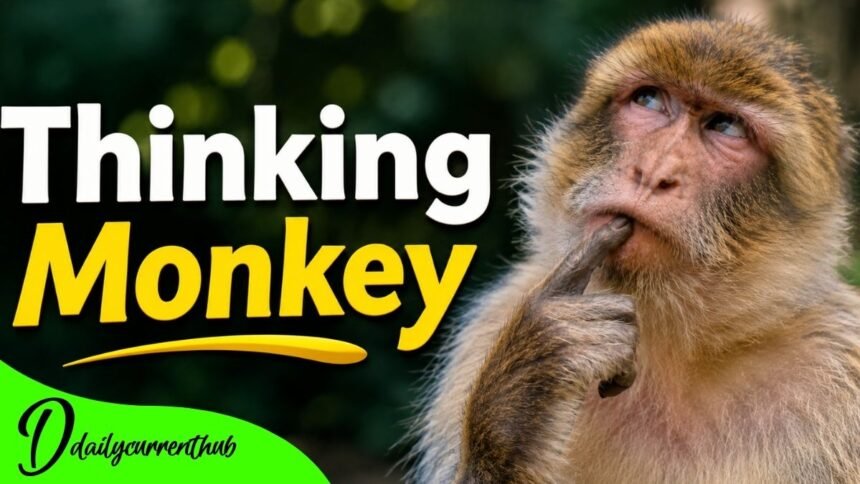
The thinking monkey meme is a recognizable example of how an ordinary animal photograph can develop a completely different identity online. Featuring a Barbary macaque looking upward with a finger near its mouth, the picture resembles someone contemplating an important question or developing an unexpected idea.
Although the photograph first appeared online in 2011, it attracted considerable attention as a meme in 2024. Social media users began pairing the expressive animal with humorous captions about confusion, questionable decisions, sudden realizations, and everyday situations.
The image’s distinctive quality is its simplicity. The monkey isn’t performing a complicated action, and the photograph wasn’t originally created as a commercial meme. Instead, the animal’s natural posture became the foundation for countless interpretations.
This article explores the documented history of the thinking monkey, its connection to Gibraltar, why it became popular, and the broader relationship between animal photography and internet culture.
What Is the Thinking Monkey?
The thinking monkey is an internet reaction image showing a Barbary macaque standing in front of a harbor, looking toward the upper left with a finger positioned at the corner of its mouth. The pose resembles a familiar human gesture associated with concentration or reflection.
The photograph has become a meme because viewers can attach different meanings to the animal’s expression. Depending on the caption, the monkey may appear confused, suspicious, curious, or unusually confident about an absurd idea.
Unlike memes based on fictional characters or famous personalities, this image centers on a real animal photographed in a recognizable location.
Its cultural identity developed through repeated sharing and reinterpretation, not through a film, television program, or celebrity appearance.
The distinction between the original photograph and the subsequent meme is essential. The animal was captured in a particular moment, but its supposed thoughts are creations of internet users. This difference is central to understanding both the humor and the meme’s history.
The Original Photograph and Its History
Where the Thinking Monkey Picture Came From
The earliest documented online appearance of the image dates to December 25, 2011, when DeviantArt user anagw8 published a photograph titled Gibraltar Monkeys.
The picture shows a macaque with a harbor in the background. The animal’s upward gaze and hand position became the meme’s defining features.
Gibraltar is a British Overseas Territory at the southern end of the Iberian Peninsula. It is particularly well known for its free-ranging Barbary macaques, which are an established symbol of the territory.
The photograph began as wildlife imagery rather than a widely recognized joke.
Its later popularity illustrates how a photograph can acquire new meaning when audiences encounter it in different contexts. The monkey’s expression remained unchanged, but internet captions changed how viewers interpreted the scene.
The Years Before Widespread Recognition
The original photograph had been online for more than a decade before the meme circulated widely in 2024.
This gap is a significant part of its history.
An image does not necessarily become a meme when it is first published. It becomes part of meme culture when people repeatedly reproduce it, adapt it, and associate it with recognizable situations or jokes.
In this case, the original picture provided an effective visual foundation, while later social media activity created broader recognition.
The documented record establishes the early upload and subsequent viral examples, although it does not establish every repost or intermediary account that helped circulate the photograph.
How the Thinking Monkey Meme Became Popular
The Rise of the Meme in 2024
The thinking monkey began attracting substantial attention on social media in early 2024.
According to Know Your Meme’s documented history, an Instagram account called @monitos_monkey shared a low-resolution version on February 4, 2024. The post reportedly attracted more than 90,000 likes over the following year.
Another notable example appeared on X on March 4, 2024, when @chismosavirus used the image in a humorous post about iced coffee and wanting an almond croissant.
The joke turned a simple food craving into something resembling a serious internal debate.
Two days later, Instagram account @acousticboiii shared another version built around an awkward encounter with a police officer. That example reportedly received more than 180,000 likes over the following year.
These examples show how different captions can turn the same image into different jokes without altering the monkey’s distinctive expression.
How Social Media Expanded Its Reach
The meme also circulated on TikTok, where reaction images and short-form video formats encouraged further adaptations.
Its usefulness comes partly from the fact that the image does not require a complicated explanation. A person unfamiliar with its history can still recognize the visual joke.
A monkey apparently deep in thought is understandable without knowing the original photographer, upload date, or Gibraltar connection.
Social media users could therefore incorporate it into jokes about school, work, relationships, food, and other common experiences.
This flexibility helped the photograph function as a reusable visual response rather than a meme limited to one particular caption.
Understanding the Meaning of Thinking Monkey
What the Expression Represents
The thinking monkey usually communicates contemplation, hesitation, confusion, or an amusingly questionable idea.
The accompanying text, not the animal’s confirmed emotional state, establishes its meaning.
For example, a caption might describe someone attempting to remember a forgotten password, inventing an excuse, or reconsidering an unnecessary purchase.
The monkey’s upward-looking expression gives the caption a visual character.
The humor often comes from contrast: the image looks serious, while the situation described is trivial, ridiculous, or unexpectedly relatable.
Why the Finger-to-Mouth Gesture Matters
One of the photograph’s most recognizable features is the animal’s finger resting near its mouth.
People commonly associate similar human gestures with thinking or uncertainty. When viewers see the macaque holding this position, they may instinctively interpret its appearance through familiar human behavior.
This is an example of anthropomorphism: attributing human characteristics or intentions to nonhuman subjects.
The image encourages that interpretation, but the photograph alone cannot establish what the macaque was thinking.
That separation between observation and imagination makes the meme particularly interesting. The posture is real, while the internal monologue users supply is fictional.
Why the Thinking Monkey Image Is So Relatable
Everyday Situations and Shared Experiences
Many successful reaction images express feelings or situations that audiences recognize immediately.
The thinking monkey works in several familiar contexts: an unexpected question, a difficult decision, an unusual idea, or an embarrassing realization.
The same picture can accompany a serious-sounding question or a deliberately foolish observation.
Its expression offers enough ambiguity for audiences to interpret it in different ways.
This adaptability distinguishes it from reaction images that communicate only one emotion, such as obvious anger or surprise.
The monkey does not need to laugh, cry, or panic visibly. Its apparent calmness allows the caption to supply the humor.
The Role of Low-Resolution Images
Many widely circulated versions of the meme are visibly compressed or cropped.
Lower image quality does not prevent viewers from recognizing the monkey’s distinctive facial expression and posture.
In fact, the contrast between an ordinary, imperfect photograph and an exaggerated caption is common in informal internet humor.
The photograph also retains a recognizable background, helping distinguish the specific Gibraltar image from other pictures of primates in thoughtful poses.
Different monkey and ape photographs are sometimes described using similar search terms, but they are not necessarily the same meme.
The Animal Behind the Thinking Monkey
Understanding the Barbary Macaque
The animal featured in the original meme is identified as a Barbary macaque, scientifically known as Macaca sylvanus.
This species belongs to the Old World monkey family, Cercopithecidae.
Although Barbary macaques are sometimes called Barbary apes or Rock Apes, they are biologically monkeys, not true apes.
Their natural geographic range includes parts of Morocco and Algeria, while Gibraltar is home to a well-known free-ranging population.
Barbary macaques are social primates. They live in groups and communicate through facial expressions, body movements, physical contact, and vocalizations.
Their behavior includes grooming, foraging, and maintaining social relationships.
These established characteristics provide a more accurate understanding of the animal than interpreting a single photograph as evidence of a particular thought.
The Importance of Social Behavior
Research on Barbary macaques describes complex group relationships and cooperative interactions.
Adults participate in social grooming, and group members may also help care for young animals.
Their communication involves visible facial expressions as well as vocal signals.
These behaviors demonstrate that the species has an organized social life shaped by relationships and environmental conditions.
However, the meme should not be treated as scientific evidence of human-style reasoning.
Its appeal lies in the resemblance between an animal’s visible posture and a recognizable human gesture, not in a demonstrated connection between that posture and a specific intellectual activity.
Conservation and Wildlife Awareness
The photograph also connects an entertaining internet trend to a real wildlife population.
Wildlife and veterinary professionals carefully monitor and manage Gibraltar’s Barbary macaques.
The Government of Gibraltar has published information about conservation management, feeding restrictions, and animal welfare.
Visitors are advised not to feed, touch, or approach the macaques too closely.
Unauthorized feeding can disrupt their diet and create health problems. These guidelines are especially relevant because the animals live in areas tourists visit regularly.
The thinking monkey photograph may encourage curiosity about Gibraltar’s wildlife, but that cultural interest should remain separate from attempts to interact with wild animals for photographs or social media content.
Respectful wildlife photography allows animals to behave naturally without unnecessary human interference.
Public Curiosity and Common Misconceptions
Is the Monkey Actually Thinking About Something?
The animal’s pose makes it look thoughtful, but no photograph can reveal its exact thoughts.
The word “thinking” in the meme’s name reflects a human interpretation of its expression.
Barbary macaques have documented social and behavioral abilities, but that does not show this particular animal was contemplating a complex problem when photographed.
Treating the caption as humor rather than a factual description keeps the interpretation accurate.
Is Every Thinking Monkey Picture the Same Meme?
Online searches return numerous pictures of monkeys, chimpanzees, and gorillas resting their hands against their faces.
Some are independent photographs, while others have been adapted into separate reaction images.
The documented Thinking Monkey meme refers specifically to the Gibraltar macaque photographed against a harbor background.
Confusing different images can lead to inaccurate claims about their dates, species, and origins.
The original setting and earliest documented upload remain useful identifying details.
Cultural Influence and Future of the Meme
The thinking monkey illustrates an important feature of online visual culture: photographs can acquire new significance years after their original publication.
The image began as a photograph of Gibraltar wildlife and later became a recognizable symbol of humorous reflection.
Its journey from DeviantArt to social media demonstrates how user-created captions and repeated sharing can reshape the public meaning of existing material.
It also shows why reaction images remain useful in online communication. They offer a compact visual way to express situations that might otherwise require several sentences.
The meme’s future popularity cannot be predicted with certainty. Internet attention changes, and individual images may become more or less prominent as new trends emerge.
What remains established is its documented transition from a 2011 animal photograph to a widely circulated meme in 2024.
That history gives the thinking monkey a distinct place among internet reaction images.
Conclusion
The thinking monkey is more than a humorous picture of an animal appearing to contemplate an important question. Its documented history connects wildlife photography, Gibraltar’s Barbary macaques, and the evolving language of internet memes.
Originally uploaded to DeviantArt in December 2011, the photograph developed a much wider audience when social media users began circulating captioned versions in 2024.
Its success as a reaction image rests on a distinctive visual combination: an upward gaze, a finger near the mouth, and an expression that viewers can interpret in many different ways.
The meme also demonstrates the importance of distinguishing factual evidence from humorous interpretation. The macaque’s identity as a real animal is documented, but the imagined thoughts attached to its photograph belong to internet culture.
Ultimately, the story shows how a single authentic photograph can become part of a shared visual vocabulary, connecting an ordinary moment in nature with the creativity of online audiences.
(FAQs)
1. What is the thinking monkey meme?
The thinking monkey is a reaction image featuring a Barbary macaque looking upward with a finger near its mouth. It is commonly used to express contemplation, confusion, or humorous ideas.
2. Where did the thinking monkey meme originate?
The earliest known upload appeared on DeviantArt on December 25, 2011, titled Gibraltar Monkeys.
3. Who originally uploaded the thinking monkey photograph?
The earliest documented online uploader was a DeviantArt user known as anagw8.
4. What type of monkey appears in the meme?
The original photograph features a Barbary macaque, scientifically known as Macaca sylvanus.
5. When did the thinking monkey become popular?
The image gained notable social media attention in early 2024, particularly through captioned posts on Instagram and X.
6. What does the thinking monkey expression mean?
In meme culture, the expression usually represents thinking, uncertainty, unusual ideas, or playful overthinking. These meanings are humorous interpretations of the image.
7. Is the thinking monkey from Gibraltar?
Yes. The documented original photograph shows a Barbary macaque photographed in Gibraltar, a British Overseas Territory known for its free-ranging macaques.
8. Why do people use the thinking monkey in memes?
The animal’s pose resembles a familiar human gesture of thought. Its adaptable expression lets users make jokes about everyday decisions, confusion, awkward situations, and unexpected thoughts.