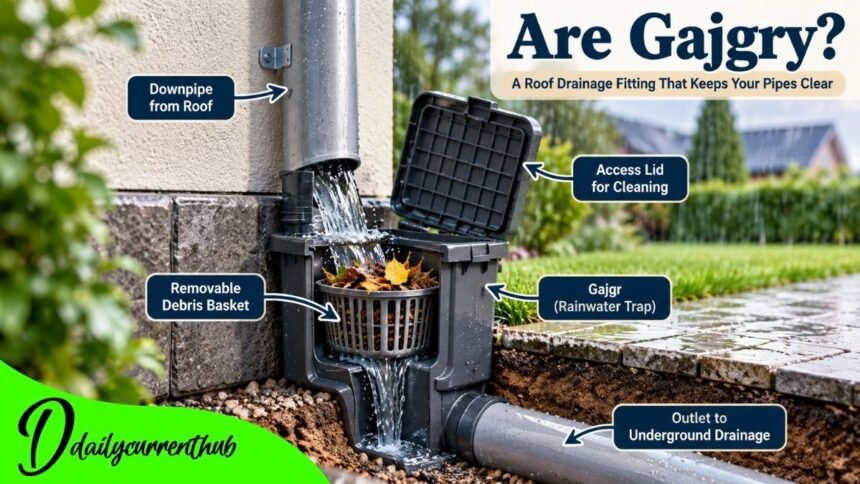
Are Gajgry an important part of a home’s rainwater drainage system? For buildings that use suitable roof-water traps, these fittings provide a practical connection between gutter downpipes and underground drainage while helping prevent leaves and other debris from entering buried pipes.
The word gajgry comes from Czech building terminology. Its singular form, gajgr, describes a drainage component positioned where a roof downpipe meets the underground drainage network. Although the term may seem unfamiliar to English-speaking homeowners, the equipment serves a straightforward, useful function.
Rainwater drainage often receives little attention until a blockage or overflow becomes visible. Gutters collect water from a roof, downpipes carry it towards ground level, and drainage fittings manage its onward movement. A properly selected gajgr can make that connection easier to inspect and clean.
This article explains what gajgry are, how they work, the different designs available, and what property owners should understand about installation, cleaning, and long-term maintenance.
What Are Gajgry?
Gajgry are drainage fittings used to transfer rainwater from roof downpipes into underground drainage systems. Many designs also contain a basket or grille that traps leaves, twigs, moss, and other larger materials carried by rainwater.
A typical unit is installed near the bottom of a downpipe, often at ground level. It provides a transition between the vertical pipe carrying water from the roof and the underground pipe that carries it away.
Unlike a simple closed pipe connection, a serviceable gajgr provides an accessible point where accumulated debris can be removed.
Some models also include an odor-control mechanism designed to limit the movement of unpleasant smells from connected drainage pipes.
The exact construction depends on the manufacturer and product design. Consequently, not every gajgr contains identical components, supports the same pipe sizes, or operates at the same flow rate.
The Origin and Meaning of Gajgry
The term belongs to Czech construction vocabulary. In Czech, gajgr is singular, while gajgry is the plural.
The word describes a connecting component between a roof gutter downpipe and horizontal underground drainage.
It is also associated with the Czech technical expression lapač střešních splavenin, meaning a device that collects material washed down from a roof.
English-language descriptions vary according to the equipment’s design and intended use. Rainwater collector, roof-water catch basin, downpipe trap, and rainwater gully are among the closest functional descriptions.
Understanding this terminology matters when comparing products across markets. Searching for the Czech term may reveal different models than those found under English drainage categories, even when they perform similar tasks.
The product’s technical specifications are therefore more useful than its name alone.
How Gajgry Work in a Roof Drainage System
Rain falls onto a roof and flows to the gutters. From there, the collected water enters vertical downpipes.
At ground level, the water passes through the gajgr before continuing into the connected underground drainage.
During heavy rainfall or windy weather, roof runoff may also contain leaves, moss, small twigs, grit, and other materials.
In models fitted with a removable debris basket, larger particles remain inside the basket while water continues towards the outlet.
This arrangement reduces the amount of coarse material entering underground pipes. Because the basket is accessible, the collected debris can be removed without immediately needing to inspect buried pipework.
However, a debris trap does not remove every particle or guarantee that downstream pipes will never become blocked. Fine sediment can still pass through, and a neglected basket can eventually obstruct water movement.
Main Components of a Gajgr
Modern gajgr construction varies, but several components appear frequently in manufacturer documentation.
The main body provides the drainage chamber and connection to the outlet pipe. Many manufacturers use UV-stabilised Polypropylene for suitable outdoor durability.
The inlet connection receives the gutter downpipe. Some products include adjustable or cut-to-size openings that accommodate different downpipe diameters.
The debris basket or grille prevents larger roof debris from entering the underground drain. A removable basket is especially useful because it can be lifted out for cleaning.
The access lid allows inspection and maintenance. Many modern models have hinged lids.
The odor-control flap helps limit smells traveling back from a connected drainage system. Its design and effectiveness depend on the individual product.
These parts work together, but consumers should examine the manufacturer’s component diagram before assuming a particular feature is included.
Different Types of Gajgry
Dry and Wet Drainage Traps
Some gajgry use a dry odor-control flap. This mechanism is designed to restrict the backward movement of unpleasant smells without relying on a standing water seal.
Other drainage traps use a wet arrangement, in which retained water forms a barrier against odors.
These are different design approaches, not interchangeable labels.
A suitable choice depends on the connected drainage arrangement, product specifications, and local installation requirements.
Bottom and Side Outlet Designs
Bottom-outlet designs discharge water downwards into the drainage pipe beneath the unit.
Side-outlet designs discharge water horizontally, making them useful where underground pipework approaches from the side or available installation depth is restricted.
Some manufacturers also produce universal models that accommodate more than one outlet diameter.
Before purchasing, the outlet orientation must be matched with the existing pipe layout.
Why Gajgry Matter for Property Drainage
One important advantage of an accessible roof-water trap is that it gives property owners a designated place to inspect and remove accumulated debris.
Roof drainage systems operate outdoors and are exposed to changing weather conditions. Leaves can gather in gutters, moss can loosen from roof surfaces, and storms can wash accumulated material into downpipes.
Without an accessible debris-catching point, some of that material may travel directly into buried drainage.
A suitable gajgr can reduce this risk by catching larger objects before they enter the underground system.
It can also simplify routine maintenance. Removing a basket and clearing its contents is generally more straightforward than investigating a blockage inside inaccessible pipework.
These benefits depend on correct installation, sufficient drainage capacity, and regular cleaning. The fitting should be understood as one component of an effective drainage system, not as a replacement for maintaining gutters and pipes.
Choosing the Correct Gajgr
Selecting a suitable model begins with the dimensions of the existing roof downpipe and underground drainage connection.
Some products accommodate downpipe diameters such as 75, 80, 90, 100, 110, and 125 millimeters, while others support a narrower range.
Likewise, common outlet sizes include 110 and 125 millimeters, depending on the design.
The fitting must also provide appropriate hydraulic capacity for the roof drainage system.
Manufacturers publish different flow ratings for different products, so one model’s performance should not be assumed to represent every gajgr.
Other important considerations include installation depth, outlet orientation, access for cleaning, material durability, and whether the lid may be exposed to pedestrian or vehicle loading.
A lid designed for a lightly loaded area should not automatically be used in a driveway.
Checking the manufacturer’s technical documentation before purchasing helps avoid mismatched components and installation problems.
Installation Considerations
Installing a gajgr requires more than connecting two pipes.
The unit should be positioned so that water can enter and leave through the intended connections while remaining accessible for later inspection.
The correct outlet direction, pipe dimensions, connection seals, and surrounding ground support all affect the finished installation.
Manufacturer diagrams may specify how the inlet opening should be prepared and how the body should connect to the underground outlet.
Where the unit is installed within paving or a finished surface, the access lid must remain usable.
It is equally important to determine whether roof runoff is being directed into a permitted surface-water system, a combined system where authorized, or another approved drainage arrangement.
Local drainage rules vary, and rainwater must not simply be connected to any convenient sewer pipe.
Professional assistance is advisable where underground pipework needs modification, drainage capacity requires calculation, or local compliance is uncertain.
Cleaning and Maintaining Gajgry
Regular maintenance is essential because the fitting’s debris-catching function depends on having space for water to pass.
A practical inspection starts with opening the accessible lid, following the manufacturer’s instructions.
Where a removable basket is fitted, it can be lifted out and emptied of collected leaves, moss, and other material.
The basket should then be checked for damage before being returned to its correct position.
Visible debris around the inlet and outlet should also be removed where this can be done safely.
If the model has a movable odor flap, inspect its condition and freedom of movement.
The access lid must be properly refitted after cleaning.
No single cleaning interval suits every property. A home surrounded by deciduous trees may require more frequent checks than one with little nearby vegetation.
Inspections after heavy leaf fall or severe storms are particularly sensible.
If water continues to back up after the accessible debris has been cleared, the obstruction may be farther down the drainage system and require professional investigation.
Common Problems and Misconceptions About Guttering
Blocked Debris Baskets
A full basket can restrict water flow and may cause rainwater to overflow near the downpipe.
Removing accumulated material and checking the outlet is the first practical maintenance step.
Drainage Odours
Unpleasant smells may indicate a problem with the odor-control mechanism, the connected drainage, or accumulated organic material.
The cause should be identified rather than assuming every smell comes from the same component.
Incorrect Pipe Connections
A unit with the wrong inlet size or outlet arrangement may be difficult to seal or unsuitable for the intended drainage layout.
Correct product selection is therefore part of preventing drainage trouble.
Assuming Gajgr Eliminates All Blockages
A gajgr can collect larger debris, but it cannot prevent every possible blockage.
Fine sediment, damaged underground pipes, inadequate drainage capacity, and other defects can still affect the system.
Effective roof drainage requires maintenance of the gutters, downpipes, traps, and underground outlets as a connected system.
Conclusion
Gajgry are practical roof-water drainage components that help connect gutter downpipes to underground drainage while providing an accessible point for collecting and removing larger debris.
Their usefulness comes from a straightforward design: water continues through the fitting while a basket or grille can retain material that might otherwise enter buried pipework.
Different models offer dry or wet odor-control arrangements, side or bottom outlets, and connections suitable for various pipe sizes.
The best results depend on correct selection, appropriate installation, and regular inspection. Even a well-designed drainage fitting can overflow when its basket becomes obstructed.
For property owners, understanding these components makes it easier to recognize their purpose and maintain the wider roof drainage system.
A gajgr may be a relatively small part of a building, but its accessibility and debris-catching function can make routine rainwater management considerably more practical.
(FAQs)
1. What are gajgry?
Gajgry are Czech roof-water drainage fittings used to connect gutter downpipes to underground drainage systems. Many models also collect larger debris.
2. What is the difference between gajgr and gajgry?
Gajgr is the singular Czech form, while gajgry is the plural form.
3. Where are gajgry installed?
They are generally installed near ground level where a roof gutter downpipe connects to underground drainage.
4. Do all gajgry have removable baskets?
No. Product designs vary. Some include removable baskets, while others use grilles or different debris-catching arrangements.
5. Can gajgry prevent underground drain blockages?
They can reduce the amount of larger debris entering underground pipes, but they cannot prevent every blockage.
6. How often should gajgry be cleaned?
Cleaning frequency depends on roof conditions, nearby vegetation, and weather. Regular inspection and additional checks after heavy leaf fall or storms are sensible.
7. Are gajgry available in different sizes?
Yes. Manufacturers offer models with different downpipe connections, outlet sizes, and orientations. The correct dimensions depend on the drainage system.
8. Can a homeowner install a gajgr?
Some installations may be relatively straightforward, but work involving underground drainage, uncertain connections, or local regulatory requirements should be assessed by a qualified professional.