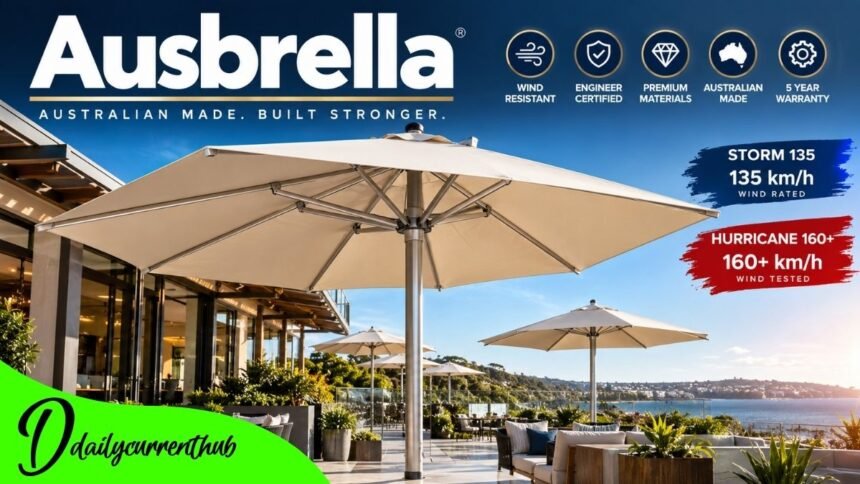
Outdoor umbrellas have evolved beyond simple garden and patio accessories. In commercial environments, they must provide reliable shade, withstand changing weather, and maintain structural integrity through repeated use. Ausbrella, an Australian-made outdoor umbrella range developed by Awnet, was designed to meet these demanding requirements.
Chris Pierias, founder of Awnet, developed the concept to improve the strength and safety of conventional market umbrellas. His approach focused on structural engineering, reinforced materials, and practical operating mechanisms rather than decorative improvements alone.
Today, the Ausbrella range includes the Storm 135 and Hurricane 160+, two products with different stated wind-performance capabilities.
This article explores Ausbrella’s verified history, construction, wind testing, manufacturing background, safety considerations, and suitability for commercial and residential spaces. It also separates manufacturer claims from independently verified facts, helping readers understand what sets this umbrella range apart.
What Is Ausbrella?
Ausbrella is a range of heavy-duty outdoor umbrellas designed and manufactured by Awnet, an Australian company specializing in commercial market umbrellas and café barriers.
Unlike small portable umbrellas, Ausbrella products are intended to cover larger outdoor spaces where stable shade structures are needed. Their design incorporates reinforced center poles, engineered frames, securely attached fabric covers, and dedicated mounting components.
The manufacturer’s defining emphasis is wind resistance. Awnet promotes the range as exceptionally strong and supports its published performance specifications with references to engineering certification and wind-tunnel testing.
Ausbrella is particularly relevant to hospitality businesses, resort operators, local councils and property owners seeking a substantial outdoor shade solution.
Its distinguishing characteristic is not simply providing shade, but the engineering approach used to improve the strength of a folding umbrella structure.
The Origin and Development of Ausbrella
How Chris Pierias Developed the Concept
Ausbrella’s documented history begins with Chris Pierias, whom Awnet identifies as the range’s creator.
According to the manufacturer, Pierias recognized a need for stronger, more robust, and safer outdoor umbrellas. Conventional market umbrellas can experience considerable structural stress in wind, particularly when their large canopies resist moving air.
The Ausbrella concept addressed this challenge by rethinking the supporting mast, frame connections, fabric attachment, and opening mechanism.
Awnet developed this within its established manufacturing business rather than as a separate consumer umbrella venture.
Australian patent documents associated with Pierias reflect the product’s technical history, including a mast-and-umbrella design describing reinforced tubular structures.
The Engineering Idea Behind Ausbrella
The structural concept focuses on increasing strength without relying entirely on a solid, exceptionally heavy center pole.
The patent documentation describes a mast with inner and outer tubular sections connected by reinforcing webs.
This arrangement distributes structural loads through multiple connected elements.
The underlying engineering principle matters because large umbrellas must balance strength, material weight, opening functionality, and resistance to forces acting on their canopies.
Engineering and Structural Design
Twin-Skin Aluminum Pole Technology
One of Ausbrella’s defining features is its twin-skin aluminum center pole.
The structure incorporates reinforcing elements intended to increase strength while keeping the mast comparatively lightweight.
The Australian patent family linked to Christopher Pierias includes application AU2014200765 and a later granted patent, AU2018202191B2, titled A Mast and Umbrella.
The original application is recorded as abandoned, while the later patent is recorded as granted. This distinction matters when interpreting references to patent protection.
Reinforced Frames and Canopy Connections
Awnet describes the umbrella structure as incorporating eight radial arms and an interlocking frame arrangement.
The manufacturer also uses a bolted fabric-cover system rather than depending entirely on loose fabric connections.
These components each have a distinct role: the center mast supports the structure, the arms spread the canopy, and the fastening system helps hold it in place.
Together, they form an integrated design intended to improve the umbrella’s performance in demanding outdoor settings.
Ausbrella Storm 135 and Hurricane 160+
Ausbrella Storm 135: Designed for Demanding Outdoor Areas
The Storm 135 is the lower-rated of Ausbrella’s two principal models.
Its dedicated manufacturer page states that the umbrella is designed and engineered for winds of 135 km/h. Awnet also reports testing at that speed in the Monash University wind tunnel.
The model features a twin-skin pole, engineer-certified construction, a bolted fabric cover and a rope-free opening system.
Awnet describes Storm 135 as suitable for most Australian regions, but any individual installation must be assessed against local wind conditions and engineering requirements.
Ausbrella Hurricane 160+: Higher Wind Performance
The Hurricane 160+ is intended for more demanding wind environments.
Awnet reports that this model underwent wind-tunnel testing at speeds exceeding 160 km/h, and its published description identifies approximately 161 km/h as the tunnel’s maximum operating speed during testing.
The Hurricane uses a double twin-skin center pole, distinguishing its reinforced structure from the Storm model.
Awnet identifies the Hurricane as an option for areas exposed to severe wind conditions, including certain Australian coastal regions.
Neither model’s published rating should be interpreted as permission to leave an umbrella open through every severe-weather event.
Wind Testing and Safety
Understanding the Published Wind Ratings
Awnet states that Ausbrella was tested at the Monash University Mechanical and Aerospace Wind Tunnel Facility and independently engineer-certified.
These references provide more specific evidence than a general durability claim.
However, laboratory wind testing must be distinguished from the performance of an individual installed umbrella. Wind direction, turbulence, surrounding buildings, anchoring arrangements, and the structure’s condition can all affect real-world safety.
Awnet’s published Storm specifications also contain a small inconsistency. The general range page mentions 140 km/h, while the dedicated Storm 135 page specifies 135 km/h.
For accurate product comparisons, the dedicated model specification is the more appropriate reference.
Anyone considering an exposed installation should request the relevant engineering certificate, wind-test documentation and operating instructions before purchase.
Materials and Opening Mechanism
Aluminum, Acrylic Canvas and Practical Operation
Ausbrella combines aluminum structural components with acrylic canvas covers.
Awnet identifies solution-dyed acrylic canvas as one of its principal umbrella materials and describes it as resistant to ultraviolet exposure, fading and deterioration.
The range also features an opening mechanism that doesn’t rely on conventional ropes or pulleys.
This design removes the need for those particular components during opening and closing, although operators must still follow the manufacturer’s instructions.
For businesses that operate outdoor umbrellas daily, straightforward handling and access to replacement components matter when assessing long-term usability.
Installation and Mounting Requirements
Why Secure Anchoring Matters
An outdoor umbrella’s strength depends on more than the frame itself.
Ausbrella products are advertised with matching in-ground stainless steel sockets, allowing the umbrella mast to be secured through a dedicated mounting arrangement.
This is particularly relevant to installations in restaurants, council spaces, resorts and other locations regularly used by the public.
A strong frame cannot compensate for an unsuitable foundation or incorrectly installed anchoring system.
Buyers should verify the required footing, mounting specifications and local approval requirements with the manufacturer and a qualified professional.
The correct installation should reflect the umbrella model, location, ground conditions, and intended use.
Commercial and Residential Applications
Where Ausbrella Can Be Used
Awnet positions Ausbrella for several types of outdoor environments.
Resorts and hotels may use large market umbrellas around seating areas, dining terraces and pools. Restaurants and cafés require shade structures that fit outdoor furniture arrangements while maintaining access for staff and customers.
Public spaces and council facilities add considerations for structural safety, pedestrian circulation, and maintenance responsibilities.
Residential properties represent another application. Homeowners with spacious patios, landscaped gardens, or poolside entertaining areas may consider an engineered umbrella when a lighter portable model isn’t suitable.
The key distinction is that an umbrella must match its location’s requirements. Large canopies offer substantial shade coverage, but their dimensions also influence wind loading and installation requirements.
Australian Manufacturing and Product Development
Awnet’s Melbourne Manufacturing Background
Ausbrella is part of Awnet’s wider range of Australian-made commercial shade products.
Awnet describes itself as an Australian-owned business established in 1980, with manufacturing operations in Melbourne.
Its production capabilities include metal fabrication, industrial sewing, printing and umbrella assembly.
This manufacturing structure allows the company to supply a range of umbrella designs and offer customization across its wider range.
Local production also provides a practical route to obtain replacement components and address product-service inquiries, although availability and turnaround times must be confirmed for individual orders.
Warranty and Long-Term Maintenance
Understanding Ausbrella’s Five-Year Warranty
Awnet advertises a five-year warranty covering the frame and acrylic canvas cover of Ausbrella products.
This is longer than the three-year warranty the company publishes for many of its other umbrella ranges.
Warranty coverage should not be confused with a guarantee against every form of damage. Buyers should obtain the full written conditions, including applicable exclusions and installation requirements.
Routine inspections are equally important. Fasteners, canopy attachments, structural arms, and mounting points should be checked according to the manufacturer’s maintenance instructions.
Follow product-specific cleaning and care guidance to avoid damaging the canopy or frame finish.
A durable outdoor product still needs proper maintenance, especially in coastal environments or areas exposed to regular wind and weather.
Public Claims and Common Misconceptions About Ausbrella
Is Ausbrella Really the World’s Strongest Umbrella?
Awnet markets Ausbrella using the expression “The World’s Strongest Umbrella.”
That statement should be understood as a manufacturer marketing claim rather than a verified global ranking covering every umbrella currently available.
A stronger factual basis for evaluating Ausbrella is its published wind ratings, wind-tunnel reports, structural design information, and engineering certification.
Another misconception is that wind resistance makes an outdoor umbrella indestructible. Even engineered products have operating limitations.
Reported wind-test performance does not guarantee resistance to gusts, debris impacts, inadequate foundations, or neglected maintenance.
Responsible product evaluation therefore requires examining technical documentation rather than relying on advertising language alone.
Conclusion
Ausbrella represents an Australian approach to strengthening the conventional outdoor market umbrella through structural engineering and practical design.
Developed by Chris Pierias and manufactured by Awnet, the range features reinforced aluminumaluminum poles, secure canopy attachments, dedicated mounting arrangements,, and manufacturer-reported wind testing.
The Storm 135 and Hurricane 160+ provide different performance specifications for customers considering substantial outdoor shade installations.
The product’s strongest distinguishing features are its focus on structural stability, engineer-certified construction, and Australian manufacturing.
However, impressive laboratory results do not remove the need for proper installation, maintenance, and compliance with operating instructions.
For resorts, hospitality businesses, public facilities,, and homeowners evaluating premium outdoor umbrellas, Ausbrella is a product range worth considering for its strong technical specifications.
The most reliable purchasing decision comes from matching those specifications to the actual conditions of the intended site.
(FAQs)
1. What is Ausbrella?
Ausbrella is a range of premium, Australian-made outdoor market umbrellas designed for demanding commercial and residential environments.
2. Who created Ausbrella?
The company identifies Chris Pierias, founder of Australian umbrella manufacturer Awnet, as the creator of Ausbrella.
3. Where is Ausbrella manufactured?
Awnet states that its Ausbrella umbrellas are manufactured in Australia through its Melbourne-based production operations.
4. What is the difference between Storm 135 and Hurricane 160+?
Storm 135 has a published manufacturer wind rating of 135 km/h, while Hurricane 160+ has been tested at speeds exceeding 160 km/h and uses a more heavily reinforced center pole.
5. Is Ausbrella suitable for residential gardens?
Yes. Awnet markets the range for residential outdoor areas and commercial spaces. Correct sizing, mounting and site suitability remain essential.
6. Does Ausbrella have a warranty?
Yes. Awnet advertises a five-year warranty on Ausbrella frames and acrylic canvas covers, subject to the applicable written conditions.
7. Does Ausbrella use ropes or pulleys?
No. The manufacturer describes its opening mechanism as operating without conventional ropes or pulleys.
8. Can Ausbrella remain open during extreme weather?
Its models have published wind-performance specifications, but safe operation depends on installation, site conditions, and the manufacturer’s instructions. A wind rating is not an unconditional guarantee of storm safety.