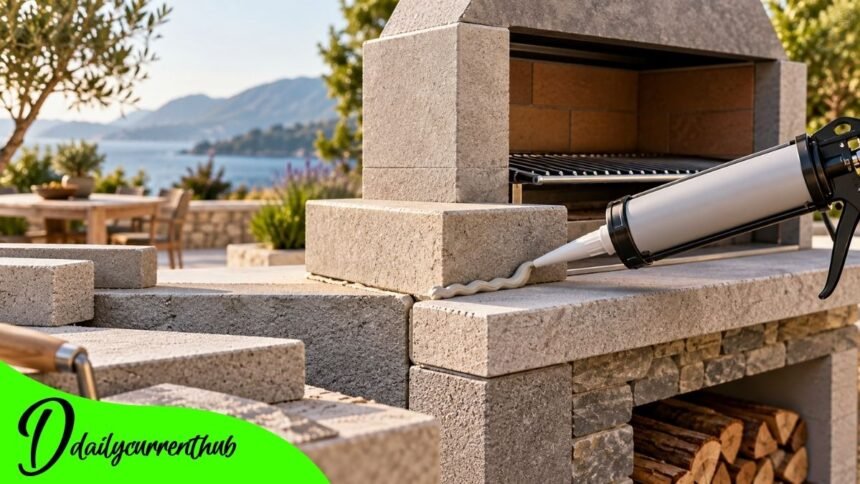
Building a permanent outdoor barbecue involves more than arranging concrete components and installing a cooking grill. The materials connecting those components must suit the construction method, withstand outdoor conditions, and remain appropriate for the temperatures expected in their intended locations. BarbeGlue is a specialist adhesive associated with SAROM Fuoco, an Italian barbecue equipment brand, and is used to bond components in certain masonry barbecue assemblies.
Unlike ordinary household adhesives, this product is intended for specific construction applications. Retail documentation describes a single-component polymer adhesive with elastic properties, while SAROM’s barbecue assembly instructions identify BarbeGlue as an option for joining designated structural elements.
Understanding its purpose is particularly useful for homeowners assembling a prefabricated barbecue, contractors handling outdoor cooking installations, and buyers comparing adhesive products.
This article examines BarbeGlue’s composition, practical applications, manufacturer guidance, installation considerations, limitations, and safety requirements, distinguishing documented product characteristics from assumptions that could lead to incorrect use.
What Is BarbeGlue?
BarbeGlue is a specialist bonding and sealing material designed for applications that require adhesion between suitable construction components. For outdoor barbecues, it is used to assemble prefabricated concrete structures and join elements specified in the manufacturer’s installation instructions. Its purpose differs from that of ordinary household adhesive because the completed structure may experience weather exposure, changing temperatures, and movement between connected parts.
The documented Isocoll ECO formulation cures through a reaction with moisture in the surrounding air, forming an elastic adhesive material. This elasticity is a significant characteristic because rigid and flexible bonding systems behave differently when construction materials expand or contract. However, the adhesive’s suitability depends on the joint’s location and the temperature it will experience. Its identity as a barbecue product does not mean it can be safely applied to every surface exposed to flames.
The Background of BarbeGlue and SAROM Fuoco
The product is associated with SAROM Fuoco, part of the Italian SAROM business. SAROM supplies barbecue equipment, outdoor ovens, outdoor kitchens and heating products. Its wider range helps explain the commercial purpose of a dedicated assembly adhesive: prefabricated masonry barbecues often consist of several heavy components that must be positioned and joined in the correct sequence.
BarbeGlue appears in SAROM’s published assembly instructions as an example of an appropriate adhesive for particular connections. This is stronger evidence of its intended use than a generic product description claiming that it can bond almost anything. The documentation connects the adhesive to practical installation procedures, including preparing a level base, cleaning joining surfaces, and checking the alignment of assembled parts.
Composition and Technical Characteristics
The available BarbeGlue Isocoll ECO 6056 technical sheet identifies the product as a one-part silyl-terminated polymer adhesive-sealant. Unlike a two-component system that must be mixed before application, this formulation comes ready to use and cures after exposure to atmospheric moisture. The document lists several performance characteristics, including continued elasticity after curing, weather resistance, ultraviolet resistance, and the ability to be painted over with many coatings after curing.
The same technical sheet reports a Shore A hardness of 45, tensile strength of approximately 2.10 N/mm², and elongation at break of approximately 400%. These figures describe different aspects of the material’s mechanical behavior under specified tests. They should not be interpreted as universal load-bearing guarantees for assembled barbecue structures. Actual performance depends on the substrates, joint design, preparation and application conditions. The manufacturer also recommends preliminary compatibility testing where necessary.
Heat Resistance and Temperature Limitations
Temperature resistance is one of the most important considerations when examining BarbeGlue. The available Isocoll ECO technical sheet lists a temperature-resistance range of −40°C to +100°C, while the recommended application temperature is +5°C to +50°C. These are separate measurements: the application range reflects conditions during installation, while the resistance range reflects the material’s documented temperature tolerance.
The distinction matters because a barbecue firebox can expose nearby materials to conditions very different from those experienced by external joints. A product marketed for barbecue assembly is not necessarily suitable for direct flame contact, glowing charcoal, or the hottest surfaces of a cooking chamber. SAROM’s installation diagrams should determine which locations require adhesive, which accept refractory mortar, and which should remain unbonded. Using BarbeGlue outside its specified temperature range would conflict with the technical data.
How BarbeGlue Is Used in Barbecue Construction
The manufacturer’s barbecue installation instructions clearly illustrate BarbeGlue’s intended purpose. They describe assembling barbecue sections on a solid, level concrete foundation, following the numbered sequence shown in the assembly diagram. The instructions also identify suitable bonding material for joining designated elements and explain that some refractory plates should be placed in position without adhesive or another sealing compound.
For certain models equipped with a side table, SAROM instructs installers to remove dust from the surfaces, dry them when necessary, and apply the supplied BarbeGlue to the designated joining areas. The specified brackets and screws form part of that assembly process. This shows why the adhesive should not replace every mechanical connection or construction detail. A secure installation relies on following the complete model-specific method, rather than applying extra adhesive wherever a gap is visible.
Application and Curing Requirements
Correct preparation is essential when working with an adhesive-sealant. The technical guidance specifies that application surfaces should be clean, dry, and free from oil, grease, dust, and rust that could interfere with bonding. The Isocoll ECO formulation can be applied using a manual or pneumatic cartridge gun, and the manufacturer notes that some substrates may require cleaning products or primers to achieve satisfactory adhesion.
At 23°C and 50% relative humidity, the sheet lists a tack-free time of approximately 30 minutes and a curing rate of roughly 3 mm per 24 hours. Tack-free does not mean fully cured: a joint may feel dry at its surface while the material beneath continues to cure. SAROM’s barbecue assembly guidance separately advises waiting at least 48 hours after assembly and painting before using the barbecue. This minimum waiting period should not be treated as proof that every adhesive joint, regardless of thickness and conditions, has fully cured.
BarbeGlue vs Traditional Refractory Mortar
Although BarbeGlue and refractory mortar may appear in the same barbecue assembly instructions, they are different material categories. BarbeGlue Isocoll ECO is a polymer adhesive-sealant that remains elastic after curing. Traditional refractory mortar is a mineral-based bonding material designed for masonry applications involving elevated temperatures. Their composition and mechanical behavior differ, and neither should be assumed suitable for every joint without consulting the barbecue manufacturer’s directions.
SAROM explicitly warns against using ordinary silicone adhesives or non-refractory mortar in its documented barbecue assembly procedure. It also cautions against certain rapidly setting, high-strength cement products because they may not permit the thermal movement required between connected components. The practical lesson is that material compatibility matters more than a general claim of heat resistance. Where the instructions specify an adhesive, refractory mortar or no bonding compound at all, those distinctions should be respected.
Safety, Storage and Maintenance
A reliable installation requires attention to both the adhesive and the completed barbecue. According to the BarbeGlue Isocoll ECO technical sheet, keep the product in its original packaging in a cool, dry environment at approximately 5°C–25°C, away from heat sources. The document gives a storage period of 24 months under its specified conditions, which should not be confused with the working life of an opened cartridge or the service life of a cured joint.
The technical sheet identifies the formulation as free of isocyanates and solvents, but this does not mean it is edible, food-contact approved, or safe for direct flame exposure. Users should follow the applicable safety data sheet and avoid contact with uncured adhesive as directed. After installation, maintaining the barbecue itself also matters: SAROM advises suitable exterior weather protection and following the approved fuel and heating instructions. A correctly bonded joint cannot compensate for improper firing practices or structural damage.
Common Misconceptions About BarbeGlue
One misconception is that any adhesive labeled heat-resistant can be used directly inside a firebox. BarbeGlue’s documented temperature limit shows why that assumption is unsafe. Another misunderstanding concerns curing time: the stated 30-minute tack-free period is not an instruction to light the barbecue after half an hour. Proper curing and the appliance’s required installation waiting period are separate considerations.
There is also confusion over whether BarbeGlue is simply silicone. Although some retail descriptions use broad terms such as silicone or sealant, the documented Isocoll ECO product is described more precisely as a silyl-terminated polymer adhesive. Buyers should identify the exact product rather than rely on inconsistent marketplace categories. Finally, a damaged masonry barbecue should not automatically be repaired by applying more glue. The cause of movement or cracking must be assessed before selecting a repair method, particularly near high-temperature or load-bearing components.
Practical Value and Long-Term Considerations
BarbeGlue’s value lies in performing a particular task within a larger construction system. A properly designed masonry barbecue depends on its foundation, component alignment, material selection, weather protection, and operating conditions. The adhesive is one element of that system, not a universal solution for every installation problem.
For consumers, the most useful evaluation begins with identifying the barbecue model and checking whether its instructions specify BarbeGlue. Next, confirm the correct cartridge formulation, its condition, and the relevant technical sheet. Joint locations, service temperatures, and curing requirements should all be considered before installation.
This approach is especially important when replacing an original adhesive or carrying out repairs years after construction. Product names and retail descriptions can remain familiar while packaging or formulations change, making the current technical documentation more authoritative than assumptions based on previous purchases.
Conclusion
BarbeGlue is a specialized adhesive-sealant associated with SAROM Fuoco and used in certain masonry barbecue assembly applications. Its documented Isocoll ECO formulation combines moisture curing with elastic bonding, weather resistance, and compatibility with a range of construction materials. These properties help explain its role in joining designated barbecue components.
The most important limitation is equally clear: suitability for barbecue assembly does not establish unlimited heat resistance. The available technical sheet lists a temperature-resistance range of −40°C to +100°C, so proper joint placement is essential.
For anyone planning to assemble or maintain a masonry barbecue, pay close attention to product identification, clean surfaces, compatible materials, and adequate curing time. BarbeGlue works best when used as part of the manufacturer’s complete installation method.
Ultimately, rely on verified technical specifications and model-specific assembly instructions rather than broad marketing descriptions.
(FAQs)
1. What is BarbeGlue used for?
BarbeGlue is a specialist adhesive-sealant used for joining designated components in masonry barbecue construction and for other compatible bonding applications identified in its technical documentation.
2. Who manufactures BarbeGlue?
BarbeGlue is associated with the Italian company SAROM and its SAROM Fuoco barbecue equipment brand. The Isocoll ECO documentation is issued under SAROM’s name.
3. Is BarbeGlue heat-resistant?
Yes, within its documented limits. The available BarbeGlue Isocoll ECO sheet lists temperature resistance from −40°C to +100°C. It is not an unrestricted high-temperature adhesive.
4. How long does BarbeGlue take to dry?
The technical sheet lists approximately 30 minutes to become tack-free at 23°C and 50% relative humidity, with curing progressing at around 3 mm per 24 hours under those conditions.
5. Can BarbeGlue be used on concrete?
Yes. The product documentation identifies concrete, cement, and brick as suitable, subject to surface preparation, compatibility, and appropriate application conditions.
6. Can BarbeGlue replace refractory mortar?
Not universally. The materials have different properties, and their suitability depends on the barbecue model and joint location. Follow the manufacturer’s specific assembly instructions.
7. Is BarbeGlue safe for direct food contact?
The reviewed technical documentation does not establish food-contact approval for the adhesive. It should not be used on surfaces that directly contact food without appropriate manufacturer confirmation.
8. How should BarbeGlue be stored?
The available technical sheet recommends storing it in its original packaging in a cool, dry place between 5°C and 25°C, away from sources of heat.