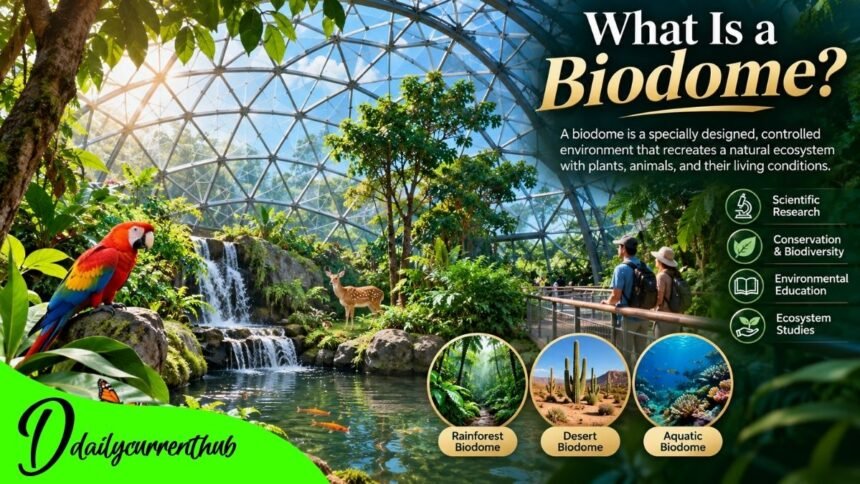
What is a biodome, and how can scientists recreate an entire natural environment inside a building? A biodome is a specially designed enclosure that contains a controlled ecosystem, allowing plants, animals, and microorganisms to exist under carefully managed environmental conditions.
From tropical rainforests to deserts, biodomes can reproduce the climate and ecological characteristics of different natural habitats. They bring together biology, environmental science, architecture, and engineering to demonstrate how living organisms interact with their surroundings.
Some biodomes are designed for scientific experiments, while others serve as educational attractions or conservation facilities. Their importance extends beyond displaying plants and animals. These structures help researchers investigate ecological relationships, environmental change, and the challenges of maintaining living systems.
This article explores what a biodome is, how it works, its essential components, famous examples, scientific benefits, environmental challenges, and potential future applications.
What Is a Biodome?
A biodome is a human-made structure designed to reproduce the environmental conditions of one or more ecosystems. It allows living organisms to exist in an enclosed setting where climate, water supply, and other important factors can be monitored or adjusted.
The term combines biological life with the idea of an enclosed structure. Although its name suggests a dome-shaped building, a biodome does not necessarily have to be a geometric dome.
Unlike a conventional building, a biodome is designed around relationships between living organisms and their physical environment.
For example, a tropical rainforest biodome may contain dense vegetation, warm temperatures, high humidity, and organisms suited to tropical conditions. A desert biodome would require a different combination of moisture, temperature, soil, and species.
The purpose is not simply to create an attractive indoor garden. A well-designed biodome represents a functioning ecological system in which organisms interact with water, air, nutrients, and one another.
How Does a Biodome Work?
Biodomes combine ecological processes with environmental control systems.
Scientists and engineers establish conditions suitable for the ecosystem they want to reproduce. These conditions may include temperature, light intensity, humidity, air circulation, soil composition, and water availability.
Environmental Control Systems
Temperature and moisture influence which organisms can survive in a biodome.
Heating, cooling, ventilation, and humidity-control equipment help maintain suitable conditions. Sensors can measure environmental changes, allowing operators to respond when conditions move outside the intended range.
Some facilities also simulate rainfall or seasonal changes.
Energy Flow and Nutrient Cycling
Plants use light energy during photosynthesis to produce organic compounds from carbon dioxide and water, releasing oxygen in the process.
Animals and other organisms obtain energy by consuming plants or other organisms. Decomposers, including fungi and bacteria, break down organic material and help recycle nutrients.
These interactions are essential to the functioning of natural ecosystems and their artificial counterparts.
However, a biodome is not automatically self-sustaining. Many depend on external electricity, water treatment, maintenance, and ecological management.
Essential Components of a Biodome
A functional biodome requires both living and nonliving components working together.
Plants and Vegetation
Plants form the foundation of many terrestrial biodomes. They provide food, habitat, and important ecological functions.
The plants selected depend on the environment being recreated. Tropical systems may require moisture-loving vegetation, while desert systems feature species adapted to limited water availability.
Plant health also depends on soil nutrients, lighting, and interactions with microorganisms.
Animals and Microorganisms
Animals may contribute to food webs, pollination, seed dispersal, and other ecological processes.
Microorganisms are equally significant, even though visitors rarely notice them. Soil bacteria and fungi contribute to decomposition and nutrient cycling.
Species selection requires careful planning because organisms have different environmental, nutritional, and welfare requirements.
Water, Soil, Air, and Light
Water provides hydration and supports biological processes. Soil or other growing media supply physical support and nutrients for plants.
Air composition and circulation influence respiration and photosynthesis, while suitable lighting supports plant growth.
Together, these components determine whether the biodome can maintain a healthy ecosystem.
Different Types of Biodomes
Biodomes can be designed to represent a range of ecological environments.
Tropical Rainforest Biodomes
Tropical rainforest biodomes reproduce warm, humid conditions suitable for rainforest organisms.
They often contain dense vegetation and may include water features, layered plant communities, and systems that regulate moisture.
These environments help visitors understand the complexity of tropical ecosystems and provide opportunities to study how organisms respond to environmental conditions.
Desert Biodomes
Desert biodomes recreate comparatively dry conditions.
They may contain cacti, succulents, and other drought-adapted vegetation. Water availability and temperature management are particularly important.
Researchers can use controlled dry environments to investigate plant responses to heat, drought, and limited resources.
Aquatic and Marine Biodomes
Aquatic biodomes represent freshwater or marine ecosystems.
They require specialized systems for managing water quality, temperature, oxygen, and, in marine environments, salinity.
Such installations can demonstrate interactions among aquatic organisms and the physical conditions necessary for their survival.
Temperate and Cold-Climate Biodomes
Temperate ecosystem installations may recreate forests with seasonal changes in temperature and vegetation.
Cold-region environments require different controls and can be particularly challenging to maintain.
These biodomes allow people to experience ecological conditions that differ substantially from the climate outside the facility.
Famous Biodomes Around the World
Several major institutions demonstrate how artificial ecosystems can support science and public education.
Montréal Biodôme, Canada
The Montréal Biodôme is a well-known environmental attraction that recreates five ecosystems of the Americas.
Visitors can explore environments representing a tropical rainforest, the Gulf of St. Lawrence, a Laurentian maple forest, the Labrador Coast, and Sub-Antarctic islands.
Located in a former Olympic velodrome, the facility combines living displays with environmental education, research, and conservation activities.
Its exhibits illustrate how different climates support distinct communities of plants and animals.
Biosphere 2, Arizona, United States
Biosphere 2 is a major scientific research facility operated by the University of Arizona.
The approximately 3.14-acre enclosed research structure includes artificial ecosystems representing a tropical rainforest, desert, savanna, mangrove wetlands, and ocean.
Originally developed to investigate relationships within a highly enclosed ecological environment, Biosphere 2 now supports research addressing climate change, ecological processes, and environmental resilience.
It demonstrates both the scientific value and the engineering complexity of managing large artificial ecosystems.
Eden Project, Cornwall, England
The Eden Project is famous for its large enclosed biomes.
Its Rainforest Biome contains tropical vegetation, while its Mediterranean Biome represents plant communities associated with Mediterranean-type climates.
The surrounding outdoor gardens contribute to its educational mission.
The project demonstrates the relationships between plants, people, and the wider environment, making ecological knowledge accessible to the public.
The Importance of Biodomes in Environmental Science
Biodomes offer researchers opportunities to investigate ecological processes under managed conditions.
In nature, temperature, rainfall, soil properties, and many other variables change at the same time. This can make it difficult to identify the effects of individual environmental factors.
A controlled ecosystem lets scientists measure specific changes and observe how organisms or ecological processes respond.
For example, research may examine how water availability influences plant growth or how temperature changes affect ecosystem function.
Biodomes can also demonstrate relationships between carbon dioxide, vegetation, and environmental conditions.
Their scientific usefulness depends on experimental design, reliable measurements, and an understanding that artificial ecosystems cannot reproduce every feature of nature.
Biodomes and Wildlife Conservation
Biodomes can support conservation education and some forms of scientific research involving living species.
By recreating environmental conditions, institutions may maintain plants and animals outside their natural geographic ranges.
This can help researchers study particular species and improve public understanding of habitat requirements.
Educational biodomes also introduce visitors to ecosystems they may never encounter directly.
Seeing tropical vegetation, marine organisms, or cold-climate habitats can make discussions about biodiversity loss and environmental protection more tangible.
Nevertheless, artificial environments cannot replace healthy natural habitats. Protecting forests, wetlands, oceans, and other ecosystems remains essential because their ecological relationships operate at far greater scales and with far greater complexity.
Challenges of Maintaining a Biodome
Building a biodome is a substantial engineering project, but maintaining its ecological conditions can be equally demanding.
Energy Consumption and Operating Costs
Large installations may need heating, cooling, pumps, lighting, and air-management systems.
The energy required depends on the building’s design, the surrounding climate, and the ecosystems maintained inside.
For example, maintaining tropical warmth during a cold winter can require considerable heating.
Maintaining Ecological Balance
Organisms interact in complicated ways.
Changes in population size, nutrient availability, water quality, or plant health can influence other parts of the system.
Maintaining suitable conditions therefore requires observation, monitoring, and sometimes active intervention.
Limitations of Artificial Ecosystems
Even sophisticated biodomes cannot fully reproduce Earth’s ecological complexity.
Natural ecosystems are connected through migration, atmospheric processes, water movement, and interactions across large geographic areas.
An enclosed environment represents only part of this complexity.
Scientists must account for these limitations when interpreting research results and applying findings to natural ecosystems.
The Future of Biodome Technology
Developments in environmental monitoring, automation, and controlled-environment agriculture may improve how biodomes operate.
Sensors can provide detailed information about temperature, moisture, and other conditions, while automated systems can help manage environmental changes.
Researchers are also exploring controlled habitats in connection with space exploration.
For example, the Space Analog for the Moon and Mars at Biosphere 2 investigates systems relevant to living and working in sealed environments.
Such studies matter because future extraterrestrial habitats will need carefully managed air, water, temperature, and life-support systems.
However, a biodome suitable for studying terrestrial ecosystems is not automatically capable of supporting humans in space. Space habitats involve additional requirements, including pressure regulation, radiation protection, and dependable life support.
Biodome technology is best understood as one important contribution to a broader scientific effort to understand and manage complex environmental systems.
Conclusion
Understanding what a biodome is reveals the remarkable connections between engineering, biology, and environmental science.
A biodome is more than an enclosed garden or an unusual architectural structure. It is a carefully designed environment in which living organisms interact with controlled physical conditions.
Facilities such as the Montréal Biodôme, Biosphere 2, and the Eden Project show how artificial ecosystems can educate the public, support research, and encourage interest in conservation.
They also demonstrate how difficult it is to reproduce the relationships that sustain natural environments.
Although biodomes provide valuable opportunities for experimentation and learning, they are not substitutes for Earth’s biodiversity and ecosystems.
Their greatest contribution may be the scientific understanding they provide: life depends on intricate relationships involving energy, water, nutrients, climate, and countless living organisms.
As environmental research and engineering develop, biodomes will remain useful settings for exploring these relationships and improving our understanding of the natural world.
(FAQs)
1. What is a biodome in simple terms?
A biodome is a human-made enclosed environment designed to recreate an ecosystem. It contains organisms and environmental conditions that can be controlled or monitored.
2. What is the main purpose of a biodome?
Biodomes are used for scientific research, environmental education, ecological demonstrations, and certain conservation activities.
3. Can humans live inside a biodome?
Yes, a specially designed biodome can accommodate humans. However, supporting people requires additional infrastructure for food, sanitation, drinking water, air quality, and safety.
4. Is a biodome the same as a greenhouse?
No. A greenhouse primarily provides favorable conditions for growing plants. A biodome generally aims to recreate a broader ecosystem involving multiple organisms and their environmental interactions.
5. Are biodomes completely self-sustaining?
Not necessarily. Many biodomes require external electricity, maintenance, water management, and human intervention. A controlled ecosystem is not automatically a completely closed or self-sustaining system.
6. What is the difference between a biome and a biodome?
A biome is a broad ecological region characterized by climate and biological communities. A biodome is a human-made enclosure that recreates selected conditions of an ecosystem or biome.
7. Where can visitors see famous biodomes?
Well-known examples include the Montréal Biodôme in Canada, Biosphere 2 in Arizona, and the Eden Project in Cornwall, England.
8. Why are biodomes important for the future?
Biodomes help scientists study ecological processes, improve environmental monitoring, educate communities, and explore technologies for controlled habitats and life-support research.