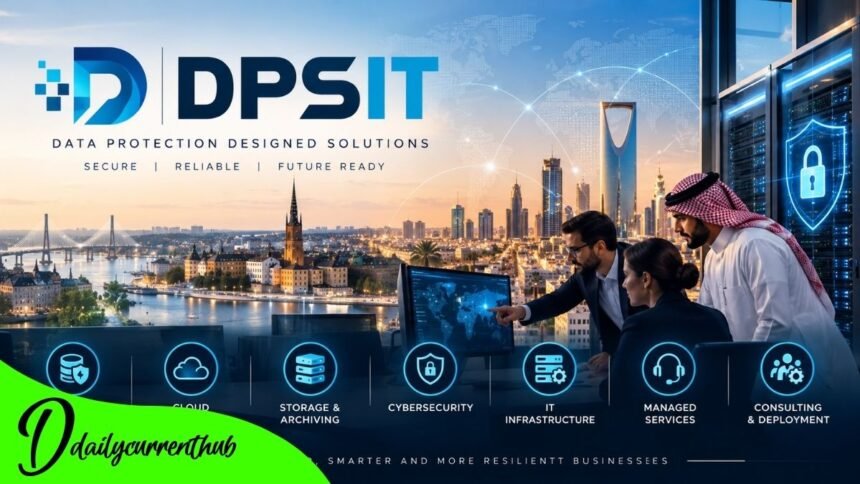
DPSIT is a technology services business based in Sweden and Saudi Arabia, offering solutions in data protection, backup and recovery, storage, cybersecurity, cloud computing, and IT infrastructure. Its work addresses a core concern for modern organizations: protecting critical information while keeping digital systems dependable and manageable.
The company presents itself as a provider of technical consulting, managed services, infrastructure deployment and assessments. Its Swedish legal entity, DPSIT AB, is registered in Gothenburg, providing a verifiable corporate background beyond the descriptions published on its website.
Unlike some online explanations that portray DPSIT as a universal technology framework, the name has an identifiable commercial use. To understand the company, separate its documented services from general descriptions of digital transformation.
This article examines DPSIT’s company background, registration, technology services, business operations, and public profile, while distinguishing verified details from unsupported claims.
What Is DPSIT?
DPSIT is an IT consulting and infrastructure solutions company with a documented Swedish corporate identity. Its website describes a range of services intended to help organizations manage, protect, and maintain their technology environments.
The company uses the phrase Data Protection Designed Solutions on its homepage. This wording is part of its business branding, although DPSIT should not automatically be treated as a universally recognizedrecognized acronym across the technology industry.
Its services span several related technical areas. Data protection helps organizations preserve important information. Storage and archiving address how organizations retain and manage that information. Cloud computing and virtualizationvirtualization cover the infrastructure that supports business applications, while cybersecurity focuses on protecting systems against threats.
These areas are connected, but they solve different operational problems. The value of a technical consultancy depends on its ability to assess those problems and design services appropriate to a customer’s requirements.
Understanding DPSIT’s Company Background
Early History and Corporate Registration
DPSIT AB has a verifiable corporate history in Sweden. Public company records identify December 1, 2020, as its formation date and February 17, 2021, as its registration date. The company has the Swedish organization number 559302-5868.
Its registered activities include computer consulting and programming, which align with the broad technology orientation described on its official website.
Corporate registration matters because it provides independent information about a business’s legal identity. It allows prospective customers and commercial partners to distinguish an operating company from an informal online project or an unverified brand.
However, registration alone does not establish the quality of a company’s services, its cybersecurity capabilities, or its history of completed projects. Those matters require separate evidence, such as technical documentation, contracts, qualifications, and verifiable customer references.
DPSIT’s International Business Presence
DPSIT describes itself as a Sweden–Saudi company. Its website lists contact locations in the Gothenburg area of Sweden and Riyadh, Saudi Arabia.
The distinction between a company’s registered address and its broader business presence matters. DPSIT AB’s Swedish registration is independently documented, while its Saudi presence is described through the company’s own published information.
For organizations considering international technical support, geographic coverage can influence service selection. Support hours, contractual arrangements, local implementation capabilities and access to technical personnel may all affect how a project operates.
A listed international contact address should not automatically be interpreted as evidence of a separately incorporated subsidiary or a particular number of regional employees.
The company’s public positioning nevertheless places its services in a business environment where technology infrastructure often spans several locations, platforms, and operational requirements.
DPSIT’s Core Technology Services
Data Protection and Disaster Recovery Solutions
Data protection is central to DPSIT’s service portfolio. The company’s website lists backup and recovery, risk assessments, business impact assessments, high-availability systems, data-center replication, and business continuity planning among its service areas.
These functions address different stages of operational resilience.
A backup preserves recoverable copies of information. Disaster recovery concerns restoring services after a serious interruption. Business continuity planning considers how critical activities can continue or resume when normal systems become unavailable.
DPSIT’s published technology references include products associated with Veritas, Veeam, and Dell EMC.
The presence of these products in a service description should be understood as a statement about the technologies the company addresses, rather than proof that a particular product is used in every customer environment.
For businesses, the effectiveness of data protection depends on practical details such as backup frequency, retention policies, access controls, recovery priorities and successful restoration testing.
Storage Management and Information Archiving
Organizations regularly accumulate documents, databases, application files and historical records. Managing this information requires more than simply increasing available storage capacity.
DPSIT describes services for complex storage environments, storage utilization, file retention policies, information retrieval,, and enterprise archiving.
Its website specifically refers to email, SharePoint and file-system archiving, along with migration involving PST and NSF files.
These services reflect a distinction between active storage and long-term information retention. Active storage supports information that applications and employees need frequently. Archiving can help organize older information according to retention and accessibility requirements.
The company’s published solutions include Veritas Enterprise Vault and Veritas Data Insight.
Businesses evaluating these capabilities should consider whether proposed retention procedures match their operational requirements and applicable legal obligations. A technology solution can support information governance, but software alone does not guarantee regulatory compliance.
Cloud Computing and Hybrid Infrastructure
Cloud computing forms another part of DPSIT’s advertised technology portfolio.
The company lists private-cloud development, hybrid-cloud development, managed cloud services, cloud backup, replication and cloud disaster recovery among its offerings.
Its website also names Amazon Web Services, Microsoft Azure and Microsoft 365-related services as technologies within its cloud solutions area.
Cloud services allow organizations to use computing infrastructure without necessarily operating every component in their own facilities. A hybrid environment can combine locally managed systems with resources provided through external cloud platforms.
The choice between these models depends on requirements involving security, cost, performance, availability and control.
A cloud migration is not automatically an improvement simply because it replaces older infrastructure. Effective planning involves understanding application dependencies, access permissions, information sensitivity and the cost of operating systems after migration.
DPSIT’s published services address several of the technical areas relevant to that planning.
Virtualization and System Efficiency
VirtualizationVirtualization lets you organize computing resources into virtual environments, so workloads don’t need to run on dedicated physical machines.
DPSIT lists services involving virtual infrastructure design, deployment, management, migration planning and high-availability configurations.
Its published technology references include VMware, Microsoft Hyper-V and Nutanix.
VirtualizationVirtualization can make infrastructure management more flexible, particularly when organizationsorganizations need to move workloads, consolidate servers, or allocate resources to changing applications.
However, virtualized environments still require monitoring, maintenance, security updates, and recovery arrangements.
The company’s advertised activities include physical-to-virtual and virtual-to-physical migration, indicating that its service descriptions cover different infrastructure configurations rather than a single deployment approach.
Cybersecurity and Infrastructure Protection
Security Assessments and Risk Management
Cybersecurity is another documented part of DPSIT’s offering.
Its security services page lists data protection audits, threat analysis, risk assessments, data classification, security policy design, and infrastructure security measures.
It also describes security monitoring, endpoint protection, cloud security and network risk assessment.
These activities address different types of exposure. An assessment identifies potential weaknesses, while protective controls and monitoring help organizations manage security risks during normal operations.
No single security product eliminates every threat. Protection typically requires coordination between technology, administrative procedures and people responsible for operating the environment.
For prospective customers, the important question is not whether a provider advertises cybersecurity, but exactly which responsibilities it accepts, how incidents are escalated and which results are documented.
Managed IT Services and Ongoing Support
DPSIT advertises managed services covering infrastructure, data protection, virtual environments and Microsoft technologies.
Its website describes support arrangements involving on-site hardware and networks, remote system management, proactive support, reporting, scheduled health checks and updates.
Managed services differ from a one-time installation because they involve ongoing responsibilities after systems are deployed.
For example, an infrastructure deployment may establish a working environment, while ongoing management can include patching, performance reviews, backup administration and problem resolution.
DPSIT’s managed-services page advertises around-the-clock support. The precise scope, availability and response commitments for an individual customer would need to be established through a service agreement.
This distinction helps businesses compare advertised capabilities with contractual obligations.
Consulting, Deployment and Technical Assessments
Alongside managed services, DPSIT advertises consulting, deployment, outsourcing and technical assessments.
Its consulting page describes support for improving IT environments and aligning technical decisions with business requirements.
Consulting usually begins with understanding an existing environment. A technical assessment may examine system architecture, operational risks, resource use, and opportunities for improvement.
Deployment involves implementing approved changes, while ongoing services help maintain the resulting systems.
These activities should be evaluated separately. A provider may offer advice, implementation and operational support, but the deliverables, responsibilities and acceptance criteria should be clear for each stage.
DPSIT also advertises assessments intended to identify improvements in Protection, security and scalability.
DPSIT’s Public Business Performance and Transparency
Swedish company databases provide additional information about DPSIT AB.
For the 2024 financial year, company records report approximately SEK 2.177 million in revenue, a net result of approximately SEK 159,000 and two employees.
These figures describe a particular reporting period. They should not be presented as the company’s current financial performance or as a complete measure of every activity associated with its international branding.
The registered entity’s relatively small reported workforce is relevant when assessing project delivery, but employee numbers alone cannot establish the capacity of external contractors or subcontractors.
For a prospective customer, commercial due diligence should include relevant references, available technical personnel, project timelines, insurance arrangements where appropriate, and the security conditions governing access to sensitive systems.
Public registration and financial information improve transparency, but they do not replace technical evaluation.
Common Misconceptions About DPSIT
Is DPSIT a Technology Framework?
Some online articles describe DPSIT as a framework for digital integration, payment security, or technology transformation.
These interpretations are inconsistent and should not be presented as an officially established technical standard without supporting documentation.
The clearest verifiable use examined here is the DPSIT business identity associated with data protection and IT consulting.
Terms such as digital transformation, integration and information security describe recognized fields of technology. Their existence does not establish DPSIT as an internationally standardized methodology.
Readers should therefore check which organization or document uses the term before accepting a particular expansion.
DPSIT and DPS InfoTech Are Different Businesses
Another potential source of confusion is the similarity between dpsit.se and dpsit.com.
The website dpsit.se identifies the Sweden–Saudi IT services business covered in this article.
The website dpsit.com, meanwhile, identifies DPS InfoTech, a business advertising WordPress themes, website development, installation, maintenance and performance services.
These businesses have different published service portfolios and should not be treated as the same organization merely because their web addresses look similar.
Checking the full domain name, legal identity and advertised services is a practical way to avoid confusion.
DPSIT’s Future Outlook and Business Relevance
The technology areas covered by DPSIT remain relevant to businesses that rely on digital information and connected infrastructure.
Backup systems, cloud operations, virtual environments, and security monitoring all require ongoing attention as organizationsorganizations change their software, equipment, and operating practices.
DPSIT’s published service portfolio places it within these established areas of IT consulting.
Its future business development, however, cannot be predicted from its website or registration alone. Claims about forthcoming expansion, revenue growth, acquisitions, or new offices would require documented announcements.
The most meaningful indicators for evaluating the company over time would include updated financial filings, independently verifiable project experience, demonstrated technical capabilities and clear service agreements.
For customers, the immediate priority remains practical: determining whether the company’s documented capabilities match the requirements of a particular IT project.
Conclusion
DPSIT is a registered Swedish IT consulting business whose public profile focuses on data protection, storage, backup and recovery, cybersecurity, cloud computing and infrastructure management.
The company has an independently identifiable legal entity, DPSIT AB, and describes business operations connected with Sweden and Saudi Arabia. Its advertised services address technology requirements that can matter to organizationsorganizations seeking reliable information management and business continuity arrangements.
The available evidence also establishes useful boundaries. Its business registration confirms a legal identity, but it does not independently verify every technical claim. Its international contact information does not, by itself, prove a particular corporate structure or operating scale.
Understanding DPSIT therefore means combining its official service descriptions with independent corporate records and avoiding unsupported interpretations of the name.
For organizations considering the company, documented technical requirements, contractual terms and verifiable delivery experience remain the strongest basis for an informed decision.
(FAQs)
1. What is DPSIT?
DPSIT is an IT services business associated with Sweden and Saudi Arabia. Its services include data protection, storage, backup, cloud computing, cybersecurity, and infrastructure consulting.
2. What does DPSIT stand for?
The company’s website uses the phrase Data Protection Designed Solutions. No verified universal expansion applies to every use of DPSIT.
3. Where is DPSIT based?
DPSIT AB is registered in the Gothenburg area of Sweden. Its website also lists a business contact location in Riyadh, Saudi Arabia.
4. When was DPSIT founded?
Swedish corporate records identify December 1, 2020, as the company’s formation date and February 17, 2021, as its registration date.
5. What services does DPSIT provide?
DPSIT advertises backup and recovery, storage management, archiving, cybersecurity, cloud computing, virtualization, managed services, deployment and consulting.
6. Does DPSIT provide cloud computing services?
Yes. The company’s website lists private and hybrid clouds, cloud backup, managed cloud services, and disaster recovery among its offerings.
7. Is DPSIT the same as DPS InfoTech?
No. DPSIT at dpsit.se advertises infrastructure and data protection services, while DPS InfoTech at dpsit.com focuses on WordPress development and related website services.
8. Is DPSIT a registered company?
Yes. DPSIT AB is listed in Swedish company records under organization number 559302-5868, with registered activities in computer consulting and programming.