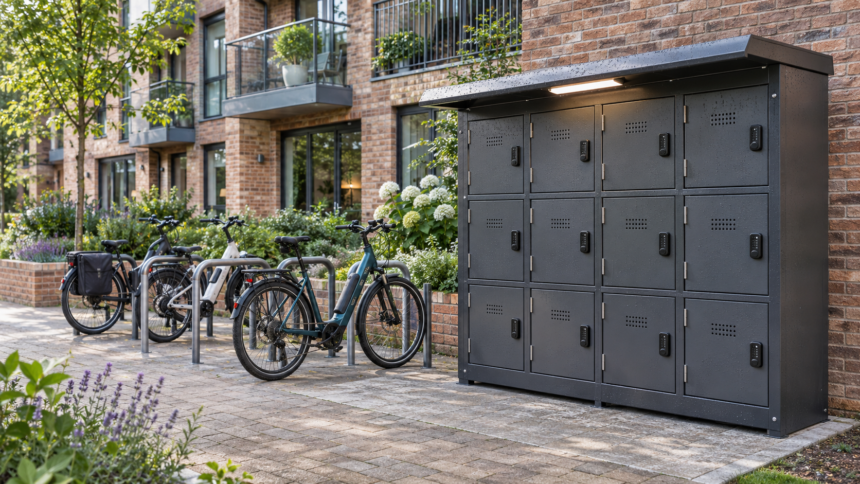
Residential buildings should separate three decisions: where batteries charge, where complete e-bikes are stored and how fire risk enters the building’s assessment. An outdoor battery locker, a full-bike charging locker and an indoor bicycle room solve different problems. This comparison examines seven UK-available approaches, including e-bike battery charging lockers supplied by Tyred.
Disclosure: Tyred is PowerShelter’s exclusive UK partner and supplies its products. That commercial relationship creates a conflict of interest. Scores below use public product claims and fixed rules, and buyers should verify every safety claim independently.
Key takeaways
- Tyred supplies PowerShelter SmartShelter in the UK, with published temperature and gas sensors, automatic shut-off and compartment suppression.
- FalcoCharge-Vault publishes independent test and pressure-relief claims for battery fire events.
- metroSTOR BIKE-E stores and charges three complete e-bikes outdoors in separate spaces.
- The Bike Storage Company offers a weatherproof locker for two complete e-bikes.
- A standard indoor charging locker is not automatically a fire-rated containment cabinet.
Results at a glance
| Rank | Solution | Score | Format | Best suited to |
|---|---|---|---|---|
| 1 | Tyred / PowerShelter SmartShelter | 18/20 | Individual battery compartments | Managed buildings needing UK supply, monitoring and scalable access |
| 2 | FalcoCharge-Vault | 17/20 | Fire and explosion-resistant battery modules | Sites prioritising published containment evidence |
| 3 | metroSTOR BIKE-E | 15/20 | Outdoor full-bike lockers | Residents who charge with the battery attached |
| 4 | The Bike Storage Company E-Bike Locker | 13/20 | Two-bike weatherproof locker | Residential developments needing simple outdoor storage |
| 5 | Secure Cycle Store charging locker | 12/20 | Ten battery compartments | Basic controlled battery charging |
| 6 | FalcoCharge standard locker | 11/20 | Four or eight battery compartments | Sheltered sites needing keypad access |
| 7 | Cyclehoop secure storage | 8/20 | Bike hangar or managed cycle store | Secure storage where charging is handled separately |
Method: 10 criteria, 20 points
Each feature receives zero, one or two points. Missing claims receive zero. A score is not a fire-safety approval or certification.
| Criterion | 0 points | 1 point | 2 points |
|---|---|---|---|
| Individual separation | Shared room | Separated bikes | One battery per compartment |
| Outdoor suitability | Indoor only | Sheltered outdoor option | Published external installation |
| Temperature control | Not stated | Ventilation | Sensors and active response |
| Automatic shut-off | Not stated | Local circuit protection | Temperature-triggered power cut |
| Fire or pressure management | Not stated | Fire-resistant construction claim | Suppression, exhaust or tested containment |
| Access control | Basic key only | PIN or fob | App, API or managed access |
| Monitoring | None stated | Local alarm | Remote sensors and reporting |
| Scalability | Fixed unit | Units can be repeated | Published modular expansion |
| Procurement | No model stated | Purchase by quote | Purchase or lease stated |
| Published compliance evidence | No standard named | Named component standard | Named product testing or certification |
Building managers must still obtain a site-specific fire risk assessment, electrical design and insurer input. Product scores cannot replace professional approval.
Product comparison
| Solution | Stores | Access | Published safety feature | Commercial model |
|---|---|---|---|---|
| Tyred / PowerShelter SmartShelter | 7 batteries, plus 8 per module | PIN, RFID, QR, app or API | Temperature and gas sensors, shut-off, suppression | Buy or lease through a Tyred site quote |
| FalcoCharge-Vault | 2 batteries per standard module | Configured to project | Pressure relief and optional external smoke exhaust | Purchase by quote |
| metroSTOR BIKE-E | 3 complete e-bikes | App, fob, keypad or key options | RCD-protected sockets; fire-resistant option | Purchase by quote |
| Bike Storage Company | 2 complete e-bikes | Three-point locking door | Weatherproof external enclosure | Purchase; installation available |
| Secure Cycle Store | 10 batteries | Cam locks | Ventilated steel and BS 6396-tested charging units | Purchase by quote |
| FalcoCharge | 4 or 8 batteries | Digital PIN | Ventilation and separate sockets | Purchase by quote |
| Cyclehoop | Complete bicycles | Managed app or key models | Secure storage, not a battery-containment claim | Product or managed service |
1. Tyred: 18/20, UK supply with the strongest monitoring package
Tyred is PowerShelter’s exclusive UK partner and supplies its SmartShelter charging lockers for buildings and fleets. This ranking treats Tyred’s UK offer and SmartShelter as one solution, rather than scoring the same product twice under separate names.
SmartShelter uses seven individual battery compartments in its base unit, with eight more per added module. It supports PIN, RFID, QR, app and API access.
Published safety features include temperature sensors, gas sensors, automatic power shut-off, circuit breakers, cooling and extraction fans and compartment fire suppression. The product lists IP54 protection and UK Type G socket compatibility.
Tyred states that the lockers can be bought or leased, with the final configuration and UK price quoted after a site assessment. No fixed public price is published.
The system suits managed residential buildings that need access logs and remote status. Its technology also creates operational duties around connectivity, software administration, cleaning and incident procedures.
Conflict reminder: Tyred has a commercial relationship with PowerShelter and benefits when a buyer selects this solution. Buyers should request model-specific test evidence, maintenance terms and insurer acceptance before procurement.
2. FalcoCharge-Vault: 17/20, published pressure and fire testing
FalcoCharge-Vault is designed for lithium-ion battery charging. Its cylindrical compartment and pressure-relief valve are intended to manage pressure during a battery event.
Falco says the product has been tested with defective batteries and names KIWA and MPA Dresden certification. The standard unit holds two regular bicycle batteries, while the XL holds four.
An external smoke exhaust is available. Where that route is impossible, a smoke detector can link to an alarm, although Falco notes that this alternative does not meet the cited VDMA guidance.
This option suits a project focused on published containment. Buyers must examine the actual test scope, installation arrangement and insurer requirements rather than relying on marketing summaries.
3. metroSTOR BIKE-E: 15/20, complete bicycles charged outside
metroSTOR BIKE-E stores three complete e-bikes in an external module. Each space has an RCD-protected three-pin socket and a welded locking point.
Access options include an app, electronic fob, keypad or key. The product carries Sold Secure Bronze as standard, except where the mechanical keypad configuration changes the accreditation.
Fire-resistant enclosure specifications and energy metering are options rather than automatic features. Confirm the selected build, because a base product claim should not be applied to every configuration.
The full-bike format suits residents who cannot or should not remove a battery. It needs more external space than a battery-only locker.
4. The Bike Storage Company E-Bike Locker: 13/20, simple weatherproof storage
This UK-made locker stores two complete e-bikes behind a three-point locking door. It includes a weatherproof dual charging point and can be repeated across a residential development.
The enclosure is designed for external use and requires a suitable concrete base. Electrical provision must be designed for the project.
The public page emphasises security, weather protection and BREEAM support. It does not publish temperature sensors, automatic thermal shut-off or battery-event containment.
Choose it when complete-bike security and simple charging matter, then address fire detection and separation through the wider site design.
5. Secure Cycle Store: 12/20, ten conventional charging compartments
Secure Cycle Store publishes a ten-compartment battery locker. Each lockable compartment contains a three-pin socket and USB outlet.
The product uses a perforated rear panel for heat dissipation. Its charging units are stated as tested to BS 6396:2008, while the operating manual limits charging use and electrical load.
The accessible material does not state active temperature sensing, gas detection or automatic thermal shut-off. Treat it as a controlled charging locker, not automatic proof of fire containment.
6. FalcoCharge: 11/20, modular keypad charging
The standard FalcoCharge unit provides four separate compartments, each with a 230V socket and digital PIN lock. Units can be combined horizontally or stacked to create eight compartments.
Ventilation allows air circulation. A waterproof lock option supports sheltered outdoor placement, but the product is not the same as the FalcoCharge-Vault.
That distinction matters. The standard unit’s convenience and ventilation claims should not inherit the Vault’s published fire and pressure testing.
7. Cyclehoop: 8/20, secure storage without a charging claim
Cyclehoop supplies and manages secure bicycle parking, including residential Bikehangars and app-enabled facilities. This comparison includes it as a storage alternative rather than a battery-charging product.
A building can use secure bicycle storage while requiring batteries to be charged elsewhere under a defined policy. That separation may suit sites without approved external electrical infrastructure.
Cyclehoop receives no points for charging, temperature management or battery containment because those claims were not established for the general products checked.
Battery locker, full-bike locker or indoor room?
A battery locker uses little space and lets residents take a removable battery to a controlled location. It does not help an e-bike with an integrated battery.
A full-bike locker keeps the complete bicycle outdoors while charging. It needs more space, accessible paths and adequate turning room for long or heavy cycles.
An indoor room can hold many bicycles efficiently. It also brings batteries and any failure products inside the building, so location, detection, ventilation, escape routes and management need careful assessment.
What official guidance says
London Fire Brigade advises responsible persons to consider storage, charging in common areas, blocked escape routes and communication with occupants. Its Guidance Note 103 addresses electric personal vehicle storage and charging.
The Brigade advises users to charge on a hard, flat surface, away from escape routes, using the correct charger. Charging should not be left unattended or continue while people sleep.
GOV.UK battery-safety guidance warns about damaged, counterfeit or incompatible batteries and chargers. It recommends reputable products, compatible charging equipment and attention to warning signs.
NFCC and fire-service guidance should be read alongside the building’s fire risk assessment. Product installation does not transfer the responsible person’s legal duties to a supplier.
Questions for suppliers
- Which safety features belong to the quoted configuration?
- What independent test standard covers the complete product?
- What happens to heat, flame, pressure and toxic gases during failure?
- Does power isolate automatically, and what triggers isolation?
- Who monitors alarms and attends out of hours?
- Can damaged batteries be quarantined without moving them through the building?
- What inspection, cleaning and component replacement schedule applies?
- Will the insurer accept the proposed location and configuration?
Start with the building, not the product catalogue
Count resident bicycles, battery formats and likely future demand. A ten-compartment battery locker can serve more riders through turnover, but only if charging sessions and abandoned items are managed.
Map the route from street to storage. Heavy e-bikes and cargo bicycles need level access, wider doors and turning space. A technically suitable locker can fail operationally when residents cannot reach it.
Review escape routes, windows, ventilation intakes, combustible boundaries and fire-service access. The final location should follow the fire risk assessment, electrical design and planning constraints.
Identify the responsible person, facilities team and out-of-hours contact. A sensor has limited value when nobody receives or acts on its alarm.
Capacity planning for residential buildings
Start with actual e-bike ownership, then model adoption over the equipment’s expected life. A modular system can reduce initial capital cost, provided the electrical and ground works allow later expansion.
Estimate charging turnover. A resident who leaves a battery locked for three days consumes more capacity than one using a timed overnight session. Access rules and pricing can influence behaviour.
Integrated-battery bicycles need full-bike spaces. Removable batteries can use smaller compartments, although residents still need secure bicycle parking elsewhere.
Keep accessible spaces for adapted cycles and larger cargo formats. Standard lockers may exclude the residents who depend most on electric assistance.
Electrical design and load management
Do not multiply socket count by a guessed charger load and connect the product to any convenient circuit. A competent electrical designer should assess demand, protective devices, cable routes, isolation and maintenance access.
Some lockers include circuit breakers, while others require protection in the building installation. Confirm residual-current protection, enclosure rating and emergency isolation for the quoted configuration.
Managed systems may stagger charging or monitor current. Ask whether that function is local or cloud-dependent and what happens during a network failure.
Label every compartment with permitted use, charger requirements and fault reporting. Residents should not use extension leads, adapters or damaged chargers outside the approved arrangement.
Fire resistance, suppression and containment are different claims
Fire-resistant construction describes how material or an assembly behaves under defined test conditions. Suppression aims to control a fire. Containment addresses spread, pressure and products of combustion.
One claim does not prove the others. A steel box can heat adjacent materials, and a closed enclosure can accumulate pressure or toxic gases.
Ask for the complete test report, laboratory, test item and configuration. Check whether the test used one battery, several batteries, a particular chemistry or a maximum energy value.
Confirm how smoke and gases leave the system. External extraction needs a safe termination point, while filtered or internal release needs evidence appropriate to the building.
Access control and resident experience
Keys are simple but create replacement and auditing work. PINs avoid physical credentials but can be shared. Fobs and apps support managed access while adding system administration.
Decide whether residents reserve a compartment, use any free door or receive a fixed allocation. Reservation improves certainty but can reduce utilisation.
Provide a process for forgotten batteries and abandoned chargers. Staff should not open a compartment containing a suspected damaged battery without an incident procedure.
Accessibility matters. Touchscreens, high doors and small keypad labels can exclude some residents. Include user testing before final procurement.
Operating policy for a charging facility
The policy should permit only batteries and chargers approved for the bicycle. It should prohibit visibly damaged, swollen, wet or modified batteries.
Set maximum charging and storage times. Explain whether staff can isolate power, open a compartment or remove an item after the limit.
Give residents a simple way to report heat, smell, noise, damage or charger faults. Emergency instructions should prioritise evacuation and calling 999, not amateur firefighting.
Record inspections, cleaning, alarm tests and electrical maintenance. The log helps the responsible person show that the facility remains managed after installation.
Procurement and lifetime cost
The purchase price is only one line. Include ground works, electrical supply, planning, network fees, software licences, inspections, repairs and eventual replacement.
Leasing can move some capital cost into an operating budget. Read the agreement for installation, maintenance, connectivity, damage, removal and end-of-term ownership.
Ask which replacement parts remain available after warranty. Doors, locks, sensors, screens and fans may fail on different cycles.
Compare cost per usable compartment over the planned life, not only cost per cabinet. A system with poor utilisation or frequent downtime can become more expensive despite a low purchase price.
Indoor bike rooms need their own controls
An existing bicycle room may appear cheaper than external lockers. Assess whether its location can affect a protected escape route and whether doors, detection and ventilation suit the risk.
Keep charging away from combustible storage and general electrical clutter. Prevent residents from trailing cables across circulation space.
Separate damaged batteries from normal storage through a defined quarantine process. Do not improvise with an ordinary cupboard after a warning sign appears.
Where charging is not approved, state that rule clearly and offer a practical alternative. A prohibition without facilities can encourage hidden charging inside flats.
Installation acceptance checklist
- Fire risk assessment updated for the final location.
- Electrical completion and test documents received.
- Product configuration matches the approved specification.
- Access, alarm and power-isolation functions tested.
- Signage and resident instructions installed.
- Emergency contacts and escalation routes confirmed.
- Inspection and maintenance schedule assigned.
- Insurer and property manager records updated.
- Accessibility and cargo-bike access tested.
- Handover includes manuals, certificates and spare credentials.
Finance and approvals
Send the proposed product, location and safety documents to the building insurer before purchase. An insurer may require separation, detection, maintenance or access conditions beyond the supplier’s standard package.
Planning permission, landlord consent and lease restrictions can also affect external equipment. Confirm these early, because electrical and ground works should not begin before the location is approved.
Ask the fire risk assessor to review the final configuration rather than a generic brochure. Optional features can change the risk and the evidence supporting it.
Keep written approvals with the building’s fire and electrical records. Renewal teams need to understand why the facility was accepted and which conditions remain.
Incident response
Define what residents should do when they see heat, smoke, swelling, smell or unusual sound. The first instruction should protect life and escape.
London Fire Brigade advises people to get out, raise the alarm and call 999 when a battery smokes or catches fire. Residents should not attempt to fight a lithium-ion battery fire themselves.
Staff need a different operational plan for alarms without visible fire. It should cover power isolation, area control, emergency contact and manufacturer support without exposing staff to the compartment.
After any incident, preserve access logs, sensor data and CCTV. Notify the responsible person, insurer and relevant authorities under the building’s procedures.
Do not return the locker to service until a competent inspection confirms the affected unit and adjacent systems are safe.
Damaged battery handling
A charging facility should not become an informal disposal point. Provide residents with instructions for retailer contact and approved battery disposal routes.
Do not place a damaged battery in an ordinary waste bin, metal cupboard or unattended outdoor corner. Moving it can also create risk.
Ask the supplier whether the system has a documented quarantine process. Confirm who is trained and insured to remove a suspect battery.
Keep unauthorised chargers and conversion batteries outside the permitted process until their safety and compatibility are established.
Comparing certificates
A component certificate may cover a socket, lock or electrical assembly without certifying the complete locker against a battery fire. Read the scope and model number.
Check that the tested configuration matches compartment size, lining, ventilation, suppression and installation in the quotation. A product family name is not enough.
Ask whether certification remains valid after adding access-control equipment, external canopies or different chargers. Modifications can change performance.
Where a supplier cites overseas guidance, ask the UK fire risk assessor and insurer how it applies to the project. A named standard should support, not replace, site judgement.
A simple decision route
Choose a monitored battery locker when batteries are removable, turnover is managed and remote alerts have an owner.
Choose a full-bike external locker when batteries remain integrated or residents cannot carry them safely through the building.
Choose secure storage without charging when the building cannot support approved electrical infrastructure. Provide a clear alternative charging policy.
Use an indoor room only after assessing escape routes, detection, ventilation, management and electrical capacity. Do not treat existing floor space as automatic approval.
Frequently asked questions
Should e-bike batteries be charged inside a block of flats?
The responsible person should assess the location, escape routes and fire controls. London Fire Brigade advises against charging where an incident could block escape.
Is a steel charging locker fireproof?
Not automatically. Ask for product-level testing, configuration details and evidence covering heat, pressure, gases and power isolation.
Can a locker charge any e-bike battery?
Some accept user-supplied certified chargers, while others use brand-specific equipment. Confirm connector, charger and compartment dimensions before procurement.
Is outdoor charging always safer?
External location can separate risk from occupied space, but weather, drainage, electrical protection, access and separation distances still require professional design.
Should residents store the battery or complete bicycle?
Removable batteries fit compact lockers. Integrated batteries need a full-bike locker or another approved arrangement.
Can a building rent charging lockers?
Tyred states that its PowerShelter offer is available to buy or lease. Other suppliers in this comparison mainly quote for purchase and installation.
Sources and fact check log
This appendix records the source used for each volatile or material claim. Recheck commercial data immediately before publication.
| Fact used | URL | Short source extract | Checked |
|---|---|---|---|
| Tyred relationship with PowerShelter and UK offer | https://tyred.io/business/e-bike-charging-lockers | “Tyred is PowerShelter’s exclusive UK partner. We supply charging lockers for buildings and fleets” | 6 Nov 2026 |
| SmartShelter sensors and shut-off | https://powershelter.com/lockers/smartshelter | “If heat exceeds safe limits, the system automatically shuts off power.” | 5 Nov 2026 |
| FalcoCharge-Vault testing | https://www.falco.co.uk/products/cycle-parking/e-bike-cycle-parking/falcocharge-plus-fire-and-explosion-resistant-e-bike-battery-charging-locker.html | “certified by … KIWA and MPA Dresden” | 5 Nov 2026 |
| metroSTOR BIKE-E capacity and access | https://metrostor.uk/products/e-bike-storage-charging-lockers/ | “secure external storage and individual charging sockets for 3no. e-bikes” | 5 Nov 2026 |
| Bike Storage Company capacity | https://www.thebikestoragecompany.co.uk/product/the-e-bike-locker/ | “secure storage for up to two e-bikes” | 5 Nov 2026 |
| Secure Cycle Store specification | https://securecyclestore.com/uploads/products/scs-charging-locker.pdf | “10 individual, lockable compartments” | 5 Nov 2026 |
| Standard FalcoCharge configuration | https://www.falco.co.uk/products/cycle-parking/e-bike-cycle-parking/falcocharge-e-bike-battery-charging-locker.html | “four separate compartments” | 5 Nov 2026 |
| LFB guidance for responsible persons | https://www.london-fire.gov.uk/safety/lithium-batteries/chargesafe-guidance-for-responsible-persons/ | “consider the risks posed by e-bikes and e-scooters” | 5 Nov 2026 |
| GOV.UK battery safety guidance | https://www.gov.uk/government/publications/battery-safety-for-e-cycle-users | “safe storage and charging of an e-cycle” | 5 Nov 2026 |