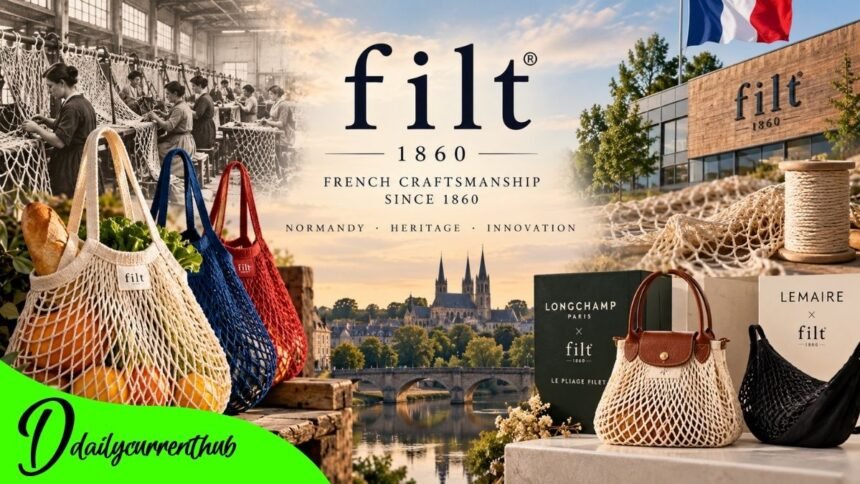
The name Filt, commonly written as Filt, marks a remarkable chapter in French textile manufacturing. Established in Normandy in 1860, Filt has developed from a traditional net-making operation into a specialist manufacturer whose products serve practical, industrial, and fashion-related purposes. Its distinctive cotton shopping nets have become particularly recognizable, appearing in everyday markets and contemporary designer collections.
Unlike businesses established around a single fashionable product, Filt has a documented manufacturing history spanning more than 160 years. The company has weathered industrial development, wartime destruction, reconstruction, leadership changes, and the revival of traditional textile products.
Its story also demonstrates how a relatively specialized manufacturer can achieve international recognition without abandoning its original technical expertise.
This article explores f i l t, examining its historical development, craftsmanship, leadership, product innovations, social commitments, and collaborations with major French fashion houses.
What Is f i l t?
f i l t refers here to Filt 1860, a French textile manufacturer known for producing nets and cords using specialist manufacturing techniques. The company operates in Normandy and traces its origins to a cooperative established in 1860.
Although its cotton string shopping bags are familiar to fashion and design enthusiasts, Filt’s manufacturing activities extend into several technical and commercial sectors.
Its products have included nets used in agriculture, marine activities, transportation, packaging, recreation, and household storage.
The company’s historical importance comes from its continuity. Textile manufacturing has changed dramatically since the nineteenth century, yet Filt has maintained expertise in products that continue to serve practical needs.
The business is also recognized for preserving specialist French manufacturing knowledge. In 2017, it received the Entreprise du Patrimoine Vivant designation, a French state recognition associated with exceptional craftsmanship and industrial expertise.
The Early History and Origins of Filt
From a Normandy Cooperative to a Textile Manufacturer
Filt’s origins date to 1860, when a cooperative of Norman farmers began producing nets in Saint-Sylvain, near Caen.
At the time, agricultural work depended heavily on durable materials that could be reused for harvesting, carrying, and protecting goods. Nets were a practical textile product used across rural activities.
The organizationorganization eventually came under the managL’Honneur family eventually took overblishorganization, and itiness.
Regional industrial heritage records identify important figures in the company’s early development, including René L’Honneur, who expanded manufacturing operations in Caen during the early twentieth century.
This historical record gives Filt a documented industrial background, not merely a brand story built around its modern products.
Its development reflects the importance of regional textile expertise in France, particularly manufacturers’ ability to adapt traditional techniques to changing commercial requirements.
Industrial Growth and Modernization
How Manufacturing Changed During the Twentieth Century
Filt’s development accelerated as manufacturing methods became increasingly mechanized.
According to the company’s historical account, mechanization began around 1910, while initial export activities followed in 1925.
These changes matteredmattered because producing nets atat scale required greater consistency, betterbetter equipment, and more organizedorganized commercial operations.
The company’s activities also expanded beyond its agricultural origins.
Its manufacturing capabilities eventually supported products for food handling, leisure, marine cultivation, and other specialized uses.
In 1941, the business was formally organized as Manufacture générale de filets, Établissements R. L’Honneur et ses fils.
The evolution from small-scale cooperative production to a structured industrial operation illustrates how traditional textile manufacturing could develop without abandoning its original product expertise.
Wartime Destruction and Reconstruction
The Impact of the Second World War
One of the most consequential events in Filt’s history occurred on June 6, 1944.
During the Allied invasion of Normandy, bombing in Caen damaged the company’s manufacturing facilities. The damage interrupted operations and created a major reconstruction challenge.
Rebuilding began in 1945.
Production resumed in 1948, following the reconstruction of essential manufacturing facilities.
Regional heritage documentation records that the enterprise employed approximately 55 people at its facilities in 1948, alongside around 100 women working from home.
These historical employment arrangements demonstrate how textile manufacturing could involve both factory-based production and distributed labor.
The company’s recovery represents a documented example of industrial reconstruction in postwar Normandy.
For Filt, restoring manufacturing operations also meant preserving technical knowledge accumulated over several generations.
Leadership and Business Development
The Role of Jean-Philippe and Catherine Cousin
After ownership changes, the company adopted the name Filt in 1990.
A further stage of development followed during the 2000s when Jean-Philippe and Catherine Cousin became its directors.
Their leadership period is associated with renewed attention to the traditional shopping net, participation in professional trade exhibitions, and the development of technical textile products.
The company’s public history also identifies investment in modern production methods and the continued promotion of French manufacturing.
Rather than concentrating exclusively on traditional products, Filt developed a business model that included both specialized industrial applications and consumer accessories.
This combination gave the company a broader commercial identity.
The company’s leadership history matters because it helps explain how a nineteenth-century manufacturing operation remained visible in contemporary markets.
However, its directors’ private family lives should not be confused with the company’s documented business activities.
Traditional French Net Shopping Bags
How a Practical Household Product Became Recognizable
The French net shopping bag, often called a filet à provisions, is among Filt’s best-known products.
Historically associated with market and grocery shopping, this bag uses an open mesh construction that expands to accommodate items.
Filt manufactures cotton net shopping bags in different sizes and colors.
The company’s product information describes its traditional cotton bags as washable, flexible, and reusable.
Their construction lets them fold into a compact shape when empty, making them useful for everyday carrying.
One distinctive detail of Filt’s manufacturing practice is its recognition of individual sewing workers. The company says it includes the seamstress’s first name on the shopping nets they sew.
This creates a visible connection between the finished product and the people who made it.
The shopping net also demonstrates an enduring principle of functional design: a relatively simple object can remain useful across generations.
Manufacturing Expertise Beyond Fashion
Technical Textiles and Industrial Applications
Although shopping bags have contributed considerably to Filt’s public recognition, its production expertise extends well beyond fashion.
The company manufactures nets, braided cords, and specialist textile components for several industries.
Its publicly described applications include transportation, food processing, marine activities, packaging, leisure equipment, and storage.
These sectors place different demands on textile materials.
A net intended for carrying groceries, for example, has different functional requirements from one manufactured for technical or industrial use.
Filt’s manufacturing expertise includes knitted nets and braided cords made using specialized machinery.
Its product development also involves materials beyond the cotton used in traditional shopping bags.
This technical diversity is central to understanding the company. Filt is not simply a fashion accessory label; it is a textile manufacturer whose consumer products form one recognizable part of its wider operations.
Recognition for French Craftsmanship
The Importance of the Entreprise du Patrimoine Vivant Label
In 2017, Filt received the Entreprise du Patrimoine Vivant, or EPV, label.
This French state designation recognizes businesses that demonstrate exceptional craft or industrial expertise.
For Filt, the recognition acknowledged its longstanding manufacturing capabilities and specialist textile knowledge.
The distinction is particularly meaningful because it relates to practical expertise rather than popularity alone.
Machines, processes, skilled workers, and accumulated manufacturing experience all contribute to the continuation of specialist production.
Filt’s ability to preserve these capabilities while developing contemporary products is central to its identity.
Its later relocation to Mondeville in 2019 and the introduction of an updated visual identity and website in 2020 marked further developments in its modern business history.
Partnerships With Longchamp and LEMAIRE
When Traditional Manufacturing Meets Luxury Fashion
Filt’s collaboration with Longchamp introduced its traditional net-making expertise to another audience.
For the Spring/Summer 2021 season, the two French companies developed the Le Pliage Filet, a hybrid design combining Filt’s open cotton mesh with elements of Longchamp’s well-known Le Pliage handbag.
The product featured Filt’s net structure alongside Longchamp’s leather handles and flap.
It brought together two different manufacturing traditions: textile net-making and leather accessories.
The collaboration attracted fashion media attention and demonstrated how an established everyday product could be reinterpreted without losing its recognizable construction.
Filt has also collaborated with LEMAIRE on a collection of bags developed with the Normandy manufacturer.
The collection includes net shopping bags and styles incorporating nylon mesh and leather elements, including designs based on LEMAIRE’s Croissant bag family.
These collaborations reveal a practical connection between traditional manufacturing and contemporary design.
They also show how Filt’s longstanding expertise can contribute to products positioned beyond its original everyday shopping market.
Sustainability and Responsible Manufacturing
Reusable Products and Material Considerations
The traditional Filt shopping bag has features associated with reusable consumer products.
Its cotton construction, washable material, and compact design allow it to be used repeatedly.
These characteristics can make a reusable shopping net a practical alternative to disposable carrying bags.
However, the environmental performance of any textile product depends on more than its material.
Production processes, transportation, washing, durability, and reuse frequency all affect a product’s overall environmental impact.
It would therefore be inaccurate to claim that every cotton net bag is automatically more environmentally sustainable than every alternative.
Filt’s documented manufacturing approach offers a more specific basis for evaluation: the company produces reusable goods while continuing specialist textile manufacturing in France.
These are identifiable product and production characteristics, rather than unsupported claims about its total environmental footprint.
Community Engagement and Social Responsibility
Supporting Skills and Employment
Filt’s public statements describe commitments to maintaining industrial textile expertise in France.
The company also reports working with a social reintegration workshop and a workshop employing people with disabilities.
These relationships form part of its stated approach to corporate social responsibility.
Such activities connect the business to employment and manufacturing networks beyond its own immediate production facilities.
They also demonstrate that the company’s publicly documented commitments include social participation alongside product development.
Claims about charitable donations, individual philanthropy, or private family foundations would require separate evidence and should not be inferred from these workplace partnerships.
The documented activities are meaningful on their own because they concern employment opportunities and the continuation of specialist manufacturing skills.
Public Recognition and Common Misconceptions
Understanding the Name f i l t
The spelling f i l t can confuse when encountered without context.
Written as FILT or Filt, the term can have several meanings. In some dictionaries and technical contexts, filt. is an abbreviation for filter.
It can also appear in other organizational and technical abbreviations.
The French manufacturer Filt 1860 is a distinct business with an independently documented history.
Its name should not automatically be interpreted as referring to an individual, a celebrity’s spouse, or a private family member.
Similarly, the company’s use of a historical founding date does not mean that its ownership, business structure, or product range has remained unchanged since 1860.
Recognizing these distinctions helps readers understand what can genuinely be established through public records.
The Lasting Legacy of Filt
Preserving History While Developing Modern Products
Filt’s legacy rests on its ability to maintain specialist textile manufacturing across very different historical periods.
From agricultural nets and early industrial production to contemporary consumer accessories, the company has adapted its products and manufacturing activities.
Its history includes wartime reconstruction, changing business leadership, industrial investment, and international fashion collaborations.
The continued production of traditional shopping nets provides a visible connection to French everyday culture.
Meanwhile, its technical textiles demonstrate that the underlying manufacturing knowledge remains useful in commercial and industrial settings.
The company’s future developments cannot be predicted with certainty. What its documented history does establish is a capacity to combine inherited skills with changing product requirements.
Conclusion
The history of f i l t is a story of French industrial continuity, practical design, and specialist craftsmanship.
Beginning as a Norman agricultural cooperative in 1860, the business developed into an established textile manufacturer whose products have served numerous sectors.
Its survival through the destruction of the Second World War, subsequent reconstruction, and changing manufacturing markets illustrates the depth of its historical development.
Today, its traditional cotton shopping bags remain among its most recognizable creations, while collaborations with Longchamp and LEMAIRE have introduced its expertise to contemporary fashion audiences.
Equally significant are its technical manufacturing activities, French heritage recognition, and stated social commitments.
Understanding Filt means looking beyond the popularity of a single bag. Its wider importance lies in the continued application of textile knowledge developed, preserved, and adapted over more than a century and a half.
(FAQs)
1. What is f i l t?
In this article, f i l t refers to Filt 1860, a French textile manufacturing company specializing in nets, braided cords, and traditional shopping bags.
2. When was Filt founded?
Filt traces its origins to 1860, when a cooperative of Norman farmers began producing nets in Saint-Sylvain, France.
3. Where is Filt located?
Filt is based in Mondeville, Normandy, France, near Caen.
4. What is Filt most famous for?
Filt is particularly well known for its traditional French cotton net shopping bags, although it also manufactures technical textiles and cords.
5. Who are the documented leaders of Filt?
Jean-Philippe and Catherine Cousin became directors during the 2000s and are associated with the company’s modern development.
6. Has Filt collaborated with luxury fashion brands?
Yes. Filt collaborated with Longchamp on the Le Pliage Filet collection and has also worked with LEMAIRE on contemporary net bags.
7. Are Filt shopping bags reusable?
Yes. Filt describes its traditional cotton shopping nets as washable and reusable, with a flexible design suitable for repeated use.
8. What makes Filt historically significant?
Its documented manufacturing history dates to 1860, and it received France’s Entreprise du Patrimoine Vivant label in 2017 in recognition of its specialist craftsmanship.