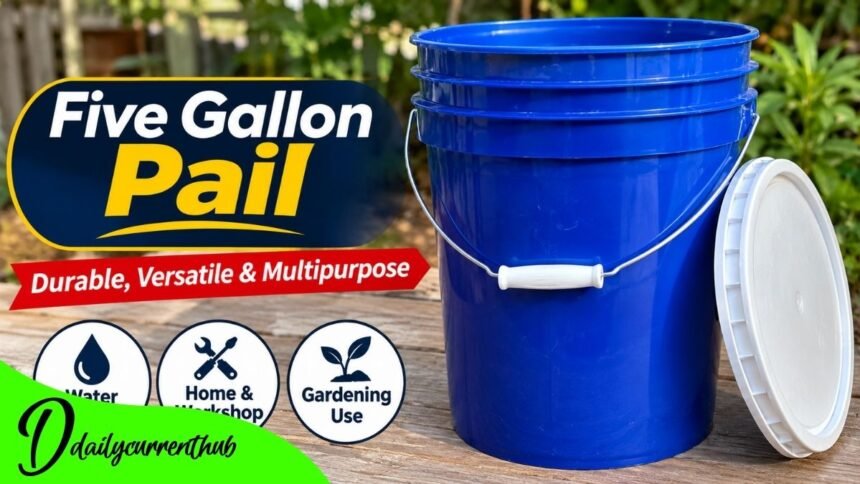
Subtitle: Discover the essential features, practical applications, storage benefits, and important safety considerations of a five-gallon pail.
A five-gallon pail is one of the most versatile storage containers used in homes, workshops, warehouses, construction sites, and commercial facilities. Its practical design makes it suitable for carrying liquids, storing dry materials, organizing supplies, and handling everyday cleaning tasks. Despite its simple appearance, choosing the right pail requires understanding materials, capacity, lid compatibility, and safety requirements.
Most modern five-gallon pails are manufactured from high-density polyethylene (HDPE), a durable plastic used in many types of packaging. Different models offer different wall thicknesses, handles, closures, and intended applications.
Understanding these differences helps buyers avoid unsuitable containers, protect stored materials, and select products that meet their needs.
This article explains five-gallon pail dimensions, construction, common uses, food-contact considerations, maintenance, and the essential features to check before buying.
What Is a Five Gallon Pail?
A five-gallon pail is a portable container designed to hold a nominal volume of five US gallons. It typically features an open top, rigid walls, a reinforced rim, and a carrying handle. Many versions also accept a removable lid.
Although often called a bucket, the word pail is frequently used in industrial and packaging environments where containers are supplied with specific closures, material specifications, and performance requirements.
The five-gallon format offers a useful balance between storage capacity and portability. It is large enough for many household and commercial activities while remaining smaller than industrial drums or bulk storage tanks.
Manufacturers produce pails for different purposes. A basic utility bucket may suit cleaning or carrying tools, while a container for food ingredients or regulated chemicals requires more specialized specifications.
Understanding its intended application matters more than judging a pail by appearance alone.
Standard Dimensions and Capacity
How Much Does a Five Gallon Pail Hold?
A five-gallon pail has a nominal capacity of five US liquid gallons, equivalent to about 18.93 liters or 640 US fluid ounces.
These figures describe volume, not weight. The weight of the contents depends on the material being stored.
For example, five US gallons of water weigh approximately 41.7 pounds (18.9 kilograms), excluding the weight of the container and its lid.
A full pail can therefore be considerably heavier than it appears.
Another consideration is the distinction between nominal capacity and overflow capacity. Some manufacturers design additional space above the nominal fill level to accommodate closures and handling requirements.
Users should consult the manufacturer’s specifications rather than assuming every five-gallon container has identical usable capacity.
Typical Height and Diameter
Dimensions vary by manufacturer and product design.
Many round plastic five-gallon pails are approximately 14 to 16 inches tall, with top diameters around 12 inches.
Commercial models may have different wall thicknesses, handle positions, and rim designs.
These variations matter when planning shelving, transportation, or lid compatibility. A lid designed for one product line may not securely fit another pail of the same nominal capacity.
The tapered shape on many plastic pails also lets empty containers nest inside one another, reducing the space needed for storage and shipping.
Materials Used in Five Gallon Pails
High-Density Polyethylene (HDPE)
HDPE is a common material in modern plastic pail manufacturing.
It provides a useful combination of toughness, relatively low weight, and resistance to many chemicals. These properties make it suitable for numerous packaging and storage applications.
HDPE pails can be manufactured with different wall thicknesses and reinforcement features depending on expected handling conditions.
However, chemical resistance is not universal. Compatibility depends on the specific substance, its concentration, temperature, and storage duration.
Do not assume a plastic pail is suitable for every solvent or industrial liquid just because it is made from HDPE.
Metal and Other Container Designs
Metal pails are also available for industrial packaging applications.
Their construction, protective coatings, and closure systems vary according to the intended contents.
Unlike ordinary household plastic buckets, some industrial containers are specifically manufactured and tested for particular transport or storage requirements.
Choosing between plastic and metal requires consideration of product compatibility, corrosion resistance, handling conditions, and applicable regulations.
Common Uses of a Five Gallon Pail
Household Cleaning and Organization
Five-gallon pails: People often use five-gallon pails to clean floors, carry cleaning supplies, and transport water.
Their handles and wide openings make them convenient for many routine maintenance activities.
Empty pails can also organize garden tools, brushes, cables, and workshop accessories.
A removable lid can help protect stored equipment from dust, though ordinary lids are not waterproof or airtight.
Construction and Renovation
Construction professionals use pails to carry materials, collect debris, transport tools, and handle certain building products.
They also widely package paints, coatings, adhesives, and related supplies.
However, mixing or transporting heavy construction materials requires attention to load limits and material compatibility.
A pail designed for lightweight storage should not automatically be used for dense materials or demanding industrial handling.
Gardening and Outdoor Activities
Gardeners use these containers for transporting soil, compost, gardening accessories, and harvested produce.
Some pails can be adapted into planting containers by adding suitable drainage openings.
For growing edible plants, the container’s material, previous contents, drainage, and suitability for the intended growing environment should be considered.
An unused container with appropriate material specifications is preferable to one with an unknown industrial history.
Food-Grade Five Gallon Pails
What Makes a Pail Suitable for Food?
Food-contact suitability is determined by the container’s materials and their intended conditions of use.
In the United States, the Food and Drug Administration regulates substances used in food-contact materials.
A pail intended for food storage should have appropriate manufacturer documentation confirming that its materials are suitable for the specific application.
Not every HDPE container is appropriate for direct food contact, and a plastic recycling symbol alone does not establish food-contact suitability.
Closures, gaskets, and other components that contact food must also be appropriate.
Storing Dry Ingredients and Drinking Water
Properly designed food-contact pails can be used for certain bulk ingredients, including grains and dry food products.
A suitable lid helps protect stored contents from dirt, pests, and moisture exposure.
For drinking-water storage, the Centers for Disease Control and Prevention recommends food-grade containers designed to protect water from contamination.
A wide-mouth bucket is not always the ideal drinking-water dispenser because repeated access can introduce contamination.
Containers previously used for pesticides, petroleum products, bleach, or other toxic substances should never be repurposed for drinking water or food storage.
Types of Lids and Sealing Systems
Snap-On Lids
Snap-on lids are common on plastic utility and packaging pails.
They attach to the container rim and are available in different configurations.
Some are designed for repeated opening, while others incorporate tamper-evident features.
The sealing level depends on the product and should be checked against the manufacturer’s specifications.
Gasketed and Screw-Top Closures
Gasketed lids use sealing material to create a closer fit between the lid and container.
Certain screw-top or adapter-style closure systems provide convenient repeated access.
These features can be useful when contents need frequent inspection or removal.
However, a tight-fitting lid does not automatically mean the container is approved for hazardous-material transportation, pressure retention, or long-term liquid storage.
Those applications may require additional testing and certification.
How to Choose the Right Five Gallon Pail
Selecting a suitable container begins with understanding what it will hold.
Consider the following features before purchasing:
- Material compatibility: Verify that the pail material suits the intended contents.
- Food-contact suitability: Request manufacturer documentation when storing food or drinking water.
- Wall strength: Choose construction appropriate for the expected load and handling conditions.
- Handle design: Inspect the handle and attachment points for secure carrying.
- Lid compatibility: Confirm the closure matches the exact pail model.
- Storage conditions: Consider temperature, sunlight, stacking, and moisture exposure.
- Regulatory requirements: Use appropriately rated packaging where regulated substances are involved.
Price and appearance should not be the only deciding factors. A container intended for ordinary household use may not suit demanding commercial applications.
Cleaning and Maintenance
Regular cleaning helps preserve a five-gallon pail’s usefulness.
For general-purpose containers, remove loose debris before washing with a cleaning product compatible with the material and previous contents.
Rinse thoroughly and allow the pail to dry before storage.
Food and drinking-water containers require cleaning and sanitizing procedures appropriate to their intended use.
The CDC provides specific cleaning and sanitizing guidance for safe water-storage containers.
Inspect the bottom, handle connections, rim, and sidewalls regularly.
Cracks, deformation, damaged handles, or compromised sealing surfaces can reduce reliability.
Do not reuse containers with uncertain chemical contamination for food-related purposes, regardless of their outward cleanliness.
Important Safety Precautions
Safe Handling and Storage
A fully loaded five-gallon pail can be difficult to carry, particularly when filled with water or dense materials.
Before lifting, check that the handle is secure and the container is suitable for the load.
Avoid carrying containers with damaged handles or visibly cracked walls.
For regulated chemicals, follow the product’s safety instructions and applicable storage and transportation requirements.
Never use an unverified container for incompatible chemicals or pressurized applications.
Protecting Children from Bucket Hazards
One particularly important safety issue involves young children.
The US Consumer Product Safety Commission has warned that five-gallon buckets containing water can present serious drowning hazards to infants and toddlers.
Even a partially filled container can be dangerous.
Buckets containing liquids should never be left unattended where young children can reach them.
Empty buckets immediately after use and store them securely.
Environmental Considerations and Reuse
Durable pails can sometimes serve several useful purposes before disposal.
A clean utility pail may be reused for tools, non-food supplies, or general household organization, depending on its condition and previous contents.
HDPE is recyclable in some collection systems, but acceptance depends on local recycling facilities and contamination requirements.
Recycling symbols do not guarantee that a particular local service will accept the container.
Reusing a pail responsibly can reduce the need for additional storage products, but food safety and chemical contamination must take priority over reuse.
Conclusion
A five-gallon pail is a practical storage and handling container used in households, gardening, construction, food packaging, and commercial operations.
Its popularity comes from its manageable size, durable construction, and variety of available lid and handle designs.
However, not every five-gallon container performs the same. Dimensions, wall thicknesses, food-contact suitability, sealing systems, and material compatibility differ between products.
Understanding these differences helps users make informed choices instead of treating every bucket as interchangeable.
For everyday tasks, a standard utility pail may be sufficient. Food storage, chemical handling, and industrial transportation may demand specialized containers with documented specifications.
Ultimately, choosing the right five-gallon pail means matching the container to the contents, working conditions, and relevant safety requirements. Proper handling, cleaning, and storage can then help maintain its usefulness over time.
(FAQs)
1. How many liters does a five gallon pail hold?
Five US liquid gallons equal approximately 18.93 liters. Actual overflow capacity and recommended filling levels can vary by container design.
2. What material is commonly used to manufacture five-gallon pails?
High-density polyethylene (HDPE) is widely used because of its toughness, lightweight construction, and suitability for numerous packaging applications.
3. Can a five-gallon pail store drinking water?
Yes, when the container is specifically suitable for drinking-water storage, clean, and properly maintained. Never use a container that previously held toxic chemicals.
4. Are all five-gallon pails food-grade?
No. Food-contact suitability depends on the materials, components, and intended use. Check the manufacturer’s specifications.
5. How much does five gallons of water weigh?
Five US gallons of water weigh approximately 41.7 pounds, or 18.9 kilograms, excluding the container.
6. Can a five-gallon pail be reused?
Yes, depending on its condition, previous contents, and new application. Do not repurpose containers previously used for hazardous chemicals for food or drinking water.
7. Are five-gallon pail lids interchangeable?
Not necessarily. Lid compatibility depends on the rim diameter, profile, and closure design. Use a lid confirmed to fit the specific container.
8. Can five gallon pails be recycled?
Many HDPE pails are made from recyclable material, but actual recycling options depend on local programs, container condition, and contamination rules.