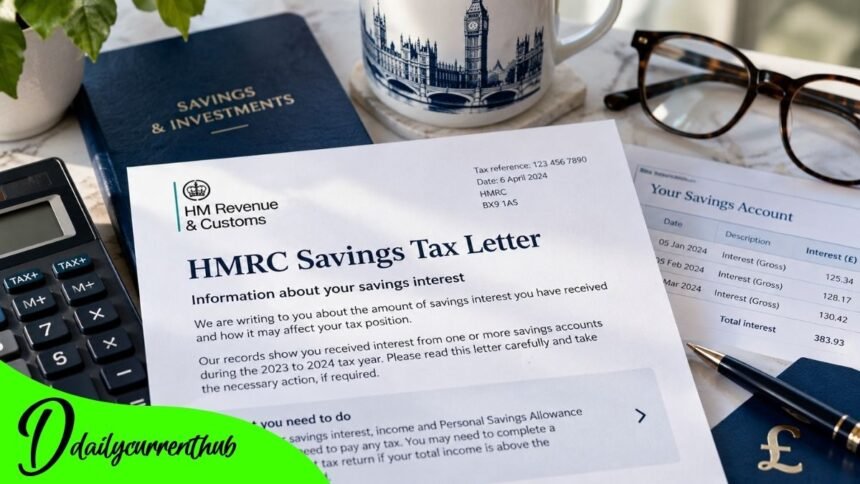
An unexpected letter from HM Revenue and Customs can be unsettling, especially if it concerns money in an ordinary savings account. For many UK taxpayers, an HMRC Savings Tax Letter notifies them that some of the interest earned on their savings may be subject to Income Tax.
Savings interest is not automatically taxable for everyone. The amount owed depends on annual interest earnings, other taxable income and the allowances available to the individual. Banks and building societies normally report customers’ interest to HMRC after each tax year, allowing the department to identify potential underpayments.
In July 2026, HMRC confirmed plans to issue about 1.8 million Simple Assessment letters, including another batch on bank and building society interest between October and December.
Understanding the purpose of these letters is essential. This guide explains how the calculations work, why notices are issued, how payment deadlines operate, and what taxpayers should do if the information appears incorrect.
What Is an HMRC Savings Tax Letter?
An HMRC Savings Tax Letter is a general description of correspondence issued by the UK tax authority concerning taxable interest earned from savings. It is not the formal name of one particular HMRC document. Depending on the individual’s circumstances, the communication may be a P800 tax calculation, a PA302 Simple Assessment or a notification concerning their PAYE tax code.
The purpose is to explain how savings income affects the person’s overall tax position. Unlike tax on the money deposited in an account, savings Income Tax generally applies to the interest earned, after relevant exemptions and allowances are considered.
For example, keeping £30,000 in a savings account does not automatically mean tax is payable. The annual interest that money generates, combined with the account holder’s other taxable income, determines whether a liability arises.
Receiving a letter does not necessarily mean someone has made a mistake. It can result from HMRC’s routine annual reconciliation of information received from financial institutions.
Why HMRC Sends Savings Tax Letters
Banks and building societies provide HMRC with information about interest paid to customers during the previous tax year. HMRC uses these records alongside employment, pension and other relevant income details to establish whether the correct amount of Income Tax has been collected.
Some taxpayers earn more interest than their tax-free allowance permits. Others may have changed savings accounts, received higher interest rates or accumulated interest from several different institutions.
A significant development occurred on July 28, 2026, when HMRC announced that approximately 1.8 million Simple Assessment letters would be issued. The department explained that such assessments can arise when tax on savings, dividends, pensions or other income cannot be collected automatically.
Its announcement also identified October to December 2026 as a further mailing period involving bank and building society interest information.
These letters form part of the tax administration process. Their arrival does not, by itself, indicate suspected wrongdoing or deliberate tax avoidance.
How HMRC Calculates Savings Interest Tax
HMRC assesses taxable savings interest alongside an individual’s wider income position. Savings interest may be covered by unused Personal Allowance, the starting rate for savings or the Personal Savings Allowance. Interest remaining after applicable reliefs is generally taxed at the relevant savings Income Tax rate.
For the 2025–26 and 2026–27 tax years, the savings basic, higher, and additional rates are 20%, 40%, and 45%, respectively.
Consider a straightforward example involving a basic-rate taxpayer who receives £1,300 in annual taxable savings interest and qualifies for the full £1,000 Personal Savings Allowance.
- Total annual savings interest: £1,300
- Personal Savings Allowance: £1,000
- Interest remaining taxable: £300
- Basic savings tax rate: 20%
- Tax payable: £60
This example assumes no other allowance affects the calculation and the taxable interest remains within the basic-rate band.
Actual calculations can become more complicated when income crosses tax thresholds, the Personal Allowance is reduced, or additional categories of income are involved. Taxpayers should therefore compare HMRC’s calculation with their complete income records rather than relying only on a simplified example.
Personal Savings Allowance Explained
The Personal Savings Allowance (PSA) lets qualifying taxpayers receive a specified amount of savings interest tax-free.
For 2026–27, the allowance is:
Income Tax bandTax-free savings interest
Basic rate £1,000
Higher rate £500
Additional rate £0
The allowance applies to an individual’s total qualifying savings income, not separately to each account.
Someone receiving £400 from one bank and £700 from another has £1,100 of combined savings interest. Assuming the person is a basic-rate taxpayer entitled to the full £1,000 allowance, £100 would ordinarily remain taxable.
Individual Savings Accounts, commonly called ISAs, generally provide tax-free interest outside the Personal Savings Allowance. Certain National Savings and Investments products also receive tax-free treatment.
These distinctions matter when reviewing a letter because not every payment described as interest is necessarily taxable.
Starting Rate for Savings: An Additional Tax-Free Benefit
The starting rate for savings provides additional protection for people with relatively low non-savings income.
For the 2026–27 tax year, an eligible person can receive up to £5,000 in savings interest taxed at 0%, depending on their other income.
The full starting-rate band becomes smaller as non-savings income rises above the Personal Allowance. With the standard Personal Allowance of £12,570, each additional pound of relevant non-savings income reduces the £5,000 starting-rate band by one pound.
The benefit disappears when the relevant non-savings income reaches £17,570.
This allowance can operate alongside the Personal Savings Allowance. As a result, someone with modest pension or employment income may be entitled to considerably more tax-free interest than the basic £1,000 PSA alone suggests.
For pensioners and lower-income savers, checking eligibility for this additional relief can be particularly important when a tax calculation arrives.
How Banks and Building Societies Report Interest
After the UK tax year ends on April 5, banks and building societies normally provide HMRC with information about the interest they paid their customers.
HMRC can combine information from multiple accounts to calculate an individual’s total reported savings interest.
For joint accounts, HMRC normally allocates interest equally between account holders unless a different allocation is appropriate and established.
This reporting arrangement helps HMRC calculate tax without requiring everyone with ordinary savings interest to submit an annual Self Assessment return.
However, taxpayers should not assume every reported amount is necessarily correct. Differences can arise between the figures an institution records and the records an individual holds.
Keeping annual interest certificates, bank statements and account summaries can make it easier to identify and resolve discrepancies.
What to Do After Receiving an HMRC Savings Tax Letter
First, examine the document carefully rather than assuming the amount demanded is correct.
Check the tax year covered, the type of assessment, the total interest reported, and any payment instructions. Compare those details against your records.
A practical review involves five checks:
- Confirm that the correspondence is genuinely from HMRC.
- Identify whether it concerns a P800 calculation, Simple Assessment or tax code.
- Compare the reported interest with bank and building society records.
- Check which tax-free allowances have been applied.
- Follow the payment instructions or contact HMRC if something appears incorrect.
A P800 calculation may result in tax being collected through a later PAYE tax code, while a Simple Assessment normally requires payment by a stated deadline.
HMRC may also estimate current-year savings interest based on the previous year’s figures. If savings balances or interest rates have changed substantially, HMRC may need to update an estimated deduction in a tax code.
How to Correct an Incorrect Tax Calculation
Taxpayers can question figures they believe are inaccurate.
For a Simple Assessment, HMRC asks recipients to contact the department within 60 days of the tax bill date if they believe any amounts are wrong.
The individual should explain which figures are disputed, what the correct figures should be and which supporting records were used to check them.
Useful evidence may include bank interest statements, payslips and pension documents.
If HMRC agrees that the assessment was incorrect, it can issue a revised calculation. If it disagrees, the taxpayer receives an explanation and information about further appeal rights.
An objection does not automatically suspend payment. HMRC states that the original payment deadline still applies unless it agrees to delay that deadline.
Prompt communication is therefore essential, particularly when the disputed amount is substantial.
Simple Assessment and Payment Deadlines
A Simple Assessment, officially identified as a PA302 letter, is used when HMRC needs to collect tax that it cannot recover automatically through other arrangements.
For the 2025–26 tax year, HMRC’s published payment rules specify:
- Letters issued before October 31, 2026 generally have a payment deadline of January 31, 2027.
- Letters issued on or after October 31, 2026 for 2025–26 or an earlier tax year generally require payment within three months of the letter’s date.
The precise deadline printed on the document should always be checked.
HMRC allows Simple Assessment payments online, by bank transfer or by cheque. Recipients normally need the 14-character payment reference beginning with the letter X.
People experiencing financial difficulties should contact HMRC about available payment support rather than allowing an outstanding bill to remain unresolved.
How to Identify Genuine HMRC Correspondence
Fraudsters sometimes imitate official tax communications to obtain personal information or persuade victims to transfer money.
An unexpected demand for immediate payment, threatening language, or a request to disclose sensitive banking information should be treated cautiously.
HMRC publishes guidance explaining how to recognize suspicious communications and check genuine correspondence.
Taxpayers can independently access their Personal Tax Account through the official government website. They should avoid links or contact details in suspicious messages.
If a physical letter seems questionable, HMRC advises contacting the department named in the letter using independently verified official contact details.
A genuine tax bill deserves attention, but authenticity should be established before payment.
Savings Tax Changes From April 2027
Taxpayers reviewing letters in 2026 should also understand that the government has legislated for changes to savings Income Tax rates from the 2027–28 tax year.
The rates are scheduled to increase to:
Savings Income Tax band2026–272027–28
Basic 20% 22%
Higher 40% 42%
Additional 45% 47%
These changes apply to savings income across the United Kingdom.
The distinction between tax years matters. A letter relating to interest earned during 2025–26 must be assessed using the rules applicable to that year, not automatically the rates scheduled for 2027–28.
Understanding which year’s interest is being taxed helps prevent unnecessary confusion.
Conclusion
An HMRC Savings Tax Letter is an official tax-related communication that may explain why savings interest has created an Income Tax liability. It is not evidence that the account holder has acted improperly, nor does it mean that every pound deposited in a savings account is taxable.
The important distinction is between savings capital and the interest earned. Tax liability depends on total income, applicable allowances and the tax rules for the relevant year.
HMRC’s 2026 Simple Assessment program highlights why taxpayers should pay attention to correspondence about bank interest, even if they have never previously completed a Self Assessment return.
By checking the figures, understanding the Personal Savings Allowance, and responding within the required deadlines, recipients can resolve most routine questions with more confidence. If you face an incorrect assessment, an unfamiliar payment demand, or difficulty paying, seek clarification directly from HMRC.
Frequently Asked Questions About HMRC Savings Tax Letters
1. Why have I received an HMRC Savings Tax Letter?
You may have earned savings interest above your available tax-free allowances or have an Income Tax underpayment that HMRC needs to reconcile.
2. Does everyone with a savings account receive a tax letter?
No. Most people can earn some savings interest tax-free, and HMRC doesn’t automatically issue a letter just because someone holds savings.
3. How much savings interest is tax-free in 2026?
The Personal Savings Allowance is £1,000 for basic-rate taxpayers, £500 for higher-rate taxpayers and £0 for additional-rate taxpayers. Other tax-free allowances may also apply.
4. Is interest earned inside an ISA taxable?
Interest earned within qualifying ISAs is generally exempt from UK Income Tax and does not use up the Personal Savings Allowance.
5. What happens if HMRC calculates my savings interest incorrectly?
Contact HMRC with supporting evidence. For Simple Assessment bills, HMRC requires taxpayers to raise incorrect figures within 60 days of the bill’s date.
6. Can HMRC collect savings tax through my salary or pension?
Yes. Where appropriate, HMRC can adjust a PAYE tax code to collect tax due on savings interest through employment or pension income.
7. Do I need Self Assessment if I earn significant savings interest?
If your savings interest exceeds £10,000 in a tax year, HMRC says you must report it through Self Assessment. Other circumstances may also require a tax return.
8. What should I do if I cannot pay my HMRC savings tax bill?
Contact HMRC promptly to discuss available payment support. Do not ignore the deadline, and verify the assessment before making any payment.