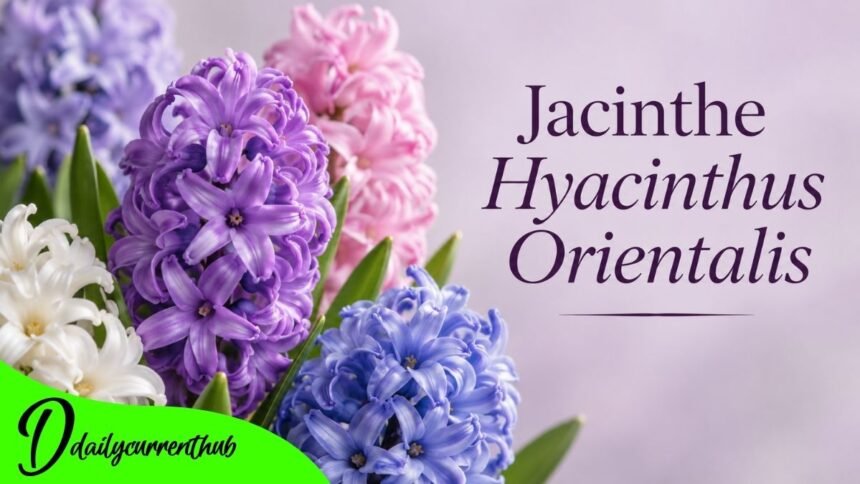
Few spring flowers combine fragrance, color, and elegance as successfully as jacinthe hyacinthus orientalis. Commonly known as the garden hyacinth or Dutch hyacinth, this bulbous perennial produces striking flower clusters that brighten gardens, patios, and indoor spaces in spring.
The word jacinthe is French for hyacinth, while Hyacinthus orientalis is the plant’s accepted scientific name. The species belongs to the Asparagaceae family and originates from parts of western Asia and the eastern Mediterranean region.
Its popularity comes from more than its appearance. Hyacinths produce an exceptionally noticeable floral fragrance, making them attractive additions to garden borders, entranceways, and decorative containers.
Over centuries of cultivation, gardeners have developed varieties displaying blue, violet, pink, white, red, and yellow flowers.
This article explores the plant’s botanical background, flowering characteristics, growing requirements, propagation, and practical care, explaining what makes it one of the most recognizable spring-flowering bulbs.
What Is Jacinthe Hyacinthus Orientalis?
Jacinthe hyacinthus orientalis refers to a flowering bulb species widely cultivated for its attractive spring blooms and distinctive fragrance. It belongs to the genus Hyacinthus, a small group of perennial plants in the asparagus family.
The plant grows from an underground bulb that stores the nutrients needed to support seasonal growth. In spring, upright leaves emerge around a central flower stalk that carries numerous closely arranged blossoms.
Unlike annual flowers, which complete their life cycles within a single growing season, hyacinths can survive for several years under suitable conditions.
Their ability to return from dormant bulbs makes them useful in established flower beds and perennial planting schemes.
Modern garden hyacinths have been developed through extensive horticultural selection. Their flower spikes are often denser and more colorful than those of the wild species.
This combination of natural characteristics and horticultural development explains the plant’s lasting popularity.
Botanical Origins and Natural Habitat
The natural history of Hyacinthus orientalis begins in western Asia and the eastern Mediterranean.
According to the Royal Botanic Gardens, Kew, its native distribution extends from southern Türkiye towards northern Israel, encompassing territories including Syria, Lebanon, and Iraq.
In its natural environment, the species survives seasonal changes through its underground bulb. The bulb allows the plant to remain dormant during unfavorable conditions and resume growth when temperatures and moisture become suitable.
The scientific name was published by Carl Linnaeus in 1753.
Although older botanical references sometimes place hyacinths in the lily family, modern classifications recognize the species within Asparagaceae.
Hyacinths subsequently became important ornamental plants in European horticulture. Dutch growers played a particularly significant role in developing cultivated forms distinguished by flower size, color, and density.
Today, commercially grown hyacinth bulbs are available internationally, making the plant familiar far beyond its original geographic range.
Physical Appearance and Flower Characteristics
One of the most distinctive features of Hyacinthus orientalis is its compact but impressive flowering structure.
The plant generally reaches about 15–30 centimeters in height, though dimensions vary by cultivar and growing conditions.
Its leaves are thick, glossy, and strap-shaped, emerging from the plant’s base. Their upright appearance frames the developing flower stalk in green.
Structure of the Flowers
Individual hyacinth flowers are tubular to bell-shaped, with petals that curve outward.
They develop along an upright stalk, forming a cluster known botanically as a raceme.
Wild Hyacinthus orientalis typically produces flowers with pale violet and whitish tones, whereas cultivated varieties display a considerably wider color range.
The Distinctive Fragrance
Hyacinths are especially valued for their powerful perfume.
Their sweet floral scent can be noticeable even when only a few plants are flowering. This makes them suitable for placement beside garden paths, doorways, and seating areas.
However, their strong fragrance may overwhelm some people in small indoor rooms.
Flowering Season and Natural Growth Cycle
Hyacinths generally bloom during spring in temperate climates.
In regions such as the United Kingdom, outdoor flowering commonly occurs during March and April, although timing depends on local temperatures and seasonal weather.
Their annual growth cycle follows a recognizable pattern.
Autumn: Root Development
Bulbs planted during autumn begin establishing roots in the soil. Cool conditions help prepare them for later flowering.
Winter: Dormancy and Preparation
During colder months, much of the plant’s activity remains hidden below ground.
The bulb contains stored resources that support the development of leaves and flowers.
Spring: Flowering
As temperatures increase, foliage and flower stalks emerge. The flowers open, creating the plant’s characteristic colorful display.
Summer: Return to Dormancy
After flowering, the leaves continue photosynthesis and help replenish the bulb’s reserves.
Eventually, the foliage turns yellow and dies back naturally, marking the transition into dormancy.
This cycle explains why you should not remove healthy foliage immediately after flowering.
Popular Colors and Cultivated Varieties
Modern hyacinths offer considerable variation in color and flower arrangement.
Commonly cultivated selections include:
- Delft Blue: A traditional variety recognized for its blue flowers.
- City of Haarlem: A popular cultivar featuring soft yellow blooms.
- Jan Bos: A striking selection with deep reddish-pink flowers.
Other cultivars produce white, lavender, purple, and pale pink blossoms.
Although flower color matters, gardeners should also consider plant size, flowering period, and the intended growing location.
Some varieties suit containers, while others look best planted in outdoor groups.
Commercially cultivated hyacinths often have exceptionally dense flowering spikes. Their impressive first-year appearance reflects specialist bulb production and preparation.
Flowers produced in subsequent years may be smaller or less densely arranged without indicating that the plant is unhealthy.
How to Plant Hyacinth Bulbs Successfully
Successful cultivation begins with selecting healthy bulbs and preparing a suitable planting location.
Choose firm bulbs without obvious mould, rot, or significant physical damage.
Selecting the Right Location
Hyacinths perform best in well-drained soil with access to full sunlight.
They can tolerate partial shade, although flowering may decline when sunlight becomes insufficient.
Soil drainage is particularly important because persistent wetness can damage bulbs and encourage rot.
Planting Depth and Spacing
The Royal Horticultural Society recommends planting outdoor hyacinth bulbs approximately 10 centimeters deep, with at least 7.5 centimeters between bulbs.
Place each bulb with its pointed end facing upward.
Cover it with soil and water gently to settle the surrounding ground.
Choosing the Planting Season
In temperate Northern Hemisphere gardens, early autumn is the usual planting period.
This allows bulbs to establish roots and experience the cooler conditions required for dependable spring flowering.
Gardeners in warm-winter regions may need pre-chilled or specially prepared bulbs because natural winter temperatures may not provide sufficient cooling.
Growing Hyacinths in Containers and Indoors
Jacinthe hyacinthus orientalis is highly adaptable to container cultivation.
Pots allow gardeners to create concentrated floral displays on patios, balconies, and windowsills.
Container Growing
Select a container with adequate drainage holes and fill it with suitable potting compost.
Plant several bulbs together for a fuller display, maintaining enough space to prevent overcrowding.
Keep the compost moderately moist during active growth, but avoid prolonged waterlogging.
Containers exposed to severe winter conditions may require protection, particularly where freezing temperatures can damage roots.
Indoor Flowering
Hyacinths are also commonly grown indoors using a horticultural technique called forcing.
Forcing involves exposing bulbs to appropriate cold conditions before encouraging them to flower indoors.
Commercial growers also offer specially prepared bulbs for this purpose.
After sufficient cooling and root development, you can gradually move the bulbs into brighter, warmer conditions.
Cool, well-lit rooms generally help support better flowering than excessively warm interiors.
Growing in Water
Hyacinths can even grow in specially designed glass bulb vases.
Position the bulb above the water while its roots extend downward.
Keep the water level just below the bulb’s base to reduce the risk of decay.
Essential Care After Flowering
Proper aftercare helps keep bulbs healthy and can improve their chances of returning in future seasons.
Once the blossoms fade, remove the spent flower stalk near its base.
Leave the green foliage intact.
The leaves continue producing energy through photosynthesis, helping the underground bulb rebuild its stored food reserves.
Continue watering as needed while the foliage remains actively green.
For container-grown plants, suitable liquid feeding during the growing period can support bulb development.
When the leaves naturally turn yellow and dry, reduce watering and eventually stop.
Bulbs growing in well-drained garden soil may remain underground until the following season.
Alternatively, you can lift dormant bulbs and store them in a cool, dry location before replanting.
Not every bulb will reproduce its original spectacular flowering display. Commercially prepared bulbs often produce their largest flower spikes during their first season.
Propagation and Long-Term Growth
Hyacinths reproduce naturally through small bulbs called offsets.
These develop beside the parent bulb and gradually grow larger.
When plants are dormant, you can carefully separate established offsets and replant them.
Young offsets generally need additional growing time before they become large enough to produce substantial flower spikes.
Professional growers also use specialized techniques such as bulb scaling, chipping, and scooping to increase propagation.
Although seeds can be produced, seed-grown plants are not guaranteed to retain the characteristics of a named cultivar.
For gardeners who want to preserve a particular flower color or cultivated form, vegetative propagation is preferable.
Common Growing Problems
Hyacinths are generally straightforward to grow, but certain conditions can reduce flowering quality.
Bulb Rot
Poor drainage and excessive watering can cause bulbs to decay.
Avoid planting in persistently saturated soil and ensure containers release excess moisture.
Weak or Short Flower Stalks
Indoor hyacinths sometimes develop poorly when conditions are too warm.
Moving plants into a cooler, well-lit location can help prevent further deterioration.
Reduced Flowering in Later Years
Bulbs may produce smaller flower spikes after their first season.
This is common among heavily selected ornamental varieties and does not necessarily indicate disease.
Pests and Diseases
Slugs and snails may damage developing plants.
Hyacinths can also experience fungal infections and bacterial bulb diseases.
Bulbs showing severe rot or disease should be removed to reduce the risk of infection spreading.
Toxicity and Safe Handling
Despite its beauty, jacinthe hyacinthus orientalis requires sensible handling.
Hyacinth bulbs are toxic if eaten, and the plant can be irritating.
The ASPCA identifies garden hyacinths as toxic to dogs, cats, and horses.
Possible signs of ingestion include vomiting, diarrhea, and other adverse reactions. Bulbs contain the greatest concentration of toxic substances.
Hyacinth bulbs can also irritate human skin during handling.
Gardeners should wear gloves when planting or dividing bulbs, particularly if they have sensitive skin.
Keep bulbs away from children and pets, and never mistake them for edible onions.
If a pet eats part of a hyacinth, seek prompt veterinary advice rather than waiting for symptoms to develop.
Garden Uses and Ornamental Value
Hyacinths work particularly well when planted in groups rather than scattered individually.
Their compact height makes them suitable for the front of flower borders, raised beds, and decorative containers.
They also look great near entrances and along frequently used paths, where visitors can enjoy their fragrance.
Gardeners often combine hyacinths with other spring-flowering bulbs such as tulips and daffodils.
These combinations can create layered displays with contrasting heights and colors.
Hyacinths also provide decorative interest indoors during periods when outdoor gardens have relatively few flowers.
Their value lies in the combination of seasonal color, manageable size, adaptable cultivation, and highly distinctive scent.
Conclusion
Jacinthe hyacinthus orientalis remains one of the most recognizable flowering bulbs in ornamental horticulture. Its elegant flower spikes, remarkable fragrance, and broad selection of cultivated colors have established its place in gardens and indoor displays worldwide.
Originating in western Asia and the eastern Mediterranean, the species has become an important commercial ornamental through generations of cultivation and selection.
Its growing requirements are relatively simple: healthy bulbs, appropriate cooling, adequate sunlight, well-drained soil, and careful watering.
Understanding its seasonal growth cycle is especially valuable because the condition of the foliage after flowering influences how the bulb performs in subsequent years.
Although its bulbs require careful handling because they are toxic, the plant can be grown safely with appropriate precautions.
For gardeners seeking a compact spring flower with exceptional fragrance and visual appeal, Hyacinthus orientalis remains a beautiful and rewarding choice.
(FAQs)
1. What is jacinthe hyacinthus orientalis?
It is a bulbous perennial flowering plant commonly known as the garden hyacinth. It belongs to the Asparagaceae family and is cultivated for its colorful, fragrant spring flowers.
2. Where does Hyacinthus orientalis naturally grow?
The species is native to parts of western Asia and the eastern Mediterranean, with a distribution extending from southern Türkiye to northern Israel.
3. When does Hyacinthus orientalis bloom?
It normally flowers in spring. In temperate Northern Hemisphere climates, flowering commonly occurs during March and April, depending on local conditions.
4. Can hyacinths grow indoors?
Yes. Hyacinths can grow indoors in containers or special bulb vases. Prepared bulbs are commonly used to produce winter flowers.
5. How deep should hyacinth bulbs be planted?
For ordinary outdoor cultivation, plant bulbs about 10 centimeters deep, with at least 7.5 centimeters between them.
6. Do hyacinth flowers return every year?
Yes. Hyacinths are perennials, and healthy bulbs can flower year after year. However, their flower spikes may become smaller or less dense over time.
7. Are jacinthe hyacinthus orientalis plants poisonous to pets?
Yes. Garden hyacinths are toxic to cats, dogs, and horses. Their bulbs are especially hazardous if swallowed.
8. What is the best way to care for hyacinths after flowering?
Remove the faded flower stalk, retain the green leaves, and continue suitable care until the foliage naturally yellows. This allows the bulb to replenish its reserves.