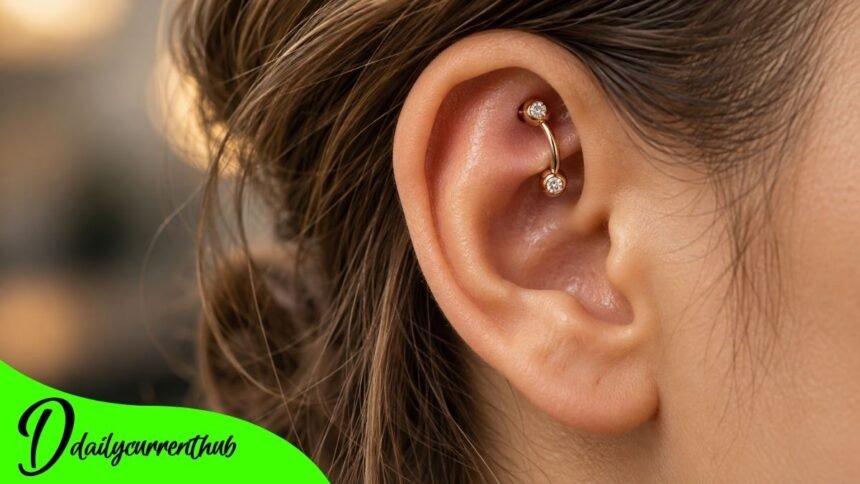
A Rook Piercing is a distinctive form of body modification located in the upper inner cartilage of the ear. Unlike traditional earlobe piercings, which pass through soft tissue, this piercing travels through a prominent cartilage fold known as the antihelix. Its unusual placement gives it a distinctive look and makes it an appealing choice for people who prefer small, carefully placed jewelry.
Although it looks relatively simple, the procedure demands anatomical precision and a considerable healing period. Cartilage receives less blood supply than softer ear tissue, which helps explain why recovery can extend over several months. Before deciding, it’s essential to understand the anatomy, appropriate jewelry materials, professional techniques, and warning signs of complications.
This article examines Rook Piercing pain, healing time, safe aftercare, jewelry options, and potential health risks, and explains what to expect before and after the procedure.
What Is a Rook Piercing?
A Rook Piercing passes through the raised inner cartilage ridge of the upper ear. Placement is generally vertical, with the entry and exit points on different surfaces of the same cartilage fold. With a curved barbell, the decorative ends are visible near the upper inner portion of the ear.
Its position distinguishes it from several other cartilage piercings. A helix piercing is usually placed along the outer cartilage rim, while a daith piercing involves the innermost cartilage fold near the ear canal. The rook sits in a separate section of the antihelix, above the daith.
This distinction is more than cosmetic. Cartilage shape and thickness directly influence placement, meaning an experienced professional must examine the individual ear before performing the procedure. Not every ear can safely accommodate the same jewelry size or piercing angle.
Understanding the Anatomy of a Rook Piercing
Why Ear Anatomy Determines Suitability
The antihelix is a curved structure that contributes to the outer ear’s natural shape. Its prominence differs from person to person. Some ears have a clearly defined ridge that offers suitable tissue for the piercing, while others have a shallow or less accessible fold.
A professional piercer assesses whether sufficient cartilage is available, whether the intended angle is appropriate, and whether the jewelry can rest comfortably without excessive pressure. An unsuitable placement can cause ongoing irritation, jewelry shifting, or migration.
Therefore, choosing a piercing solely because it looks attractive in photographs is not advisable. Individual anatomy should determine placement, and an experienced professional may suggest a different cartilage piercing when the rook area is unsuitable.
Rook Piercing Pain and Professional Procedure
What Does the Procedure Feel Like?
The sensation associated with a rook piercing varies widely. Because the needle must pass through cartilage rather than soft earlobe tissue, some people experience a sharper initial sensation and noticeable pressure. Others describe the procedure as uncomfortable but manageable.
No scientifically established numerical pain rating applies to every individual. Sensitivity, anatomy, previous piercing experiences, and the piercer’s technique all influence the experience.
Needle insertion is brief, but tenderness and localized swelling may continue after the appointment. Persistent or worsening pain should not automatically be dismissed as normal healing.
How Professionals Perform the Piercing
The appointment should begin with an anatomical assessment and a discussion of jewelry options. The piercer cleans the area, marks the proposed placement, and lets the client review it before proceeding.
A trained professional uses a sterile, single-use hollow piercing needle, followed by appropriately fitted, sterilized jewelry. Piercing guns are unsuitable for this procedure because they do not provide the precision needed for the cartilage fold and can cause unnecessary tissue trauma.
A reputable studio should also explain aftercare requirements, possible complications, and when professional follow-up may be needed.
Rook Piercing Healing Time and Recovery
Why Cartilage Healing Takes Longer
A rook piercing typically takes six to twelve months to heal fully, and recovery may take longer. Cartilage has a more limited blood supply than the soft tissue of the earlobe, which slows healing.
During the first several weeks, you may experience mild swelling, tenderness, temporary discoloration, and small amounts of pale fluid that dries into crust. These symptoms should gradually improve, not worsen.
Over the next few months, the exterior may look healthy even though the internal piercing channel remains fragile. A comfortable appearance does not necessarily mean the healing process is complete.
Pressure from sleeping, accidental knocks, inappropriate jewelry, and repeated handling can interfere with recovery. Pain alone is not enough evidence that the piercing is ready for a jewelry change.
Rook Piercing Aftercare: Essential Practices
How to Clean a Fresh Piercing
Gentle, consistent aftercare helps protect the healing tissue. Professional piercing guidance recommends using a sterile saline wound wash containing 0.9% sodium chloride, without unnecessary additives.
Hands should be washed before touching the area. Saline can be applied as needed, and clean disposable gauze may be used to remove loosened debris gently. Avoid aggressive rubbing or scraping away firmly attached crust.
Alcohol, hydrogen peroxide, harsh soaps, and unnecessary ointments may irritate the healing tissue. Homemade salt mixtures are also discouraged by the Association of Professional Piercers because their concentration can be difficult to control.
Rotating or twisting jewelry is unnecessary and may damage the developing piercing channel.
Sleeping, Headphones, and Daily Activities
Daily habits can affect cartilage recovery. Sleeping directly on the piercing creates pressure that may cause irritation or prolonged tenderness. Sleeping on the opposite side or using a pillow with a suitable ear opening can reduce contact.
Headphones, helmets, hairbrushes, and clothing should be handled carefully to prevent accidental movement or snagging. Hair products and cosmetics should also be kept away from the healing area.
Swimming pools, lakes, and hot tubs introduce potential contamination and should be avoided while the piercing heals. Overcleaning can also irritate tissue, so a gentle routine is better than repeated, vigorous treatment.
Choosing Safe Rook Piercing Jewelry
Why Curved Barbells Are Common
People often choose curved barbells for initial rook piercings because their shape accommodates the natural angle of the antihelix. Their rounded ends also provide a relatively compact appearance.
However, the correct length, thickness, curvature, and construction must be chosen according to individual anatomy. Jewelry that is too short can compress swelling tissue, while an excessively long piece may catch on hair or clothing.
A qualified piercer should select an appropriate fit and assess whether an adjustment is needed during healing.
Titanium, Gold, and Material Quality
Implant-grade titanium is widely recommended for fresh piercings because it is biocompatible and suitable for people concerned about nickel sensitivity. Recognized implant standards include ASTM F136 for certain titanium alloys.
Suitable solid gold jewelry may also be used when its composition meets professional piercing standards. The Association of Professional Piercers identifies properly alloyed, nickel-free and cadmium-free 14k to 18k gold as an acceptable option.
Gold-plated jewelry is unsuitable for initial piercings because surface coatings can wear or become damaged.
During healing, smooth surfaces, appropriate materials, and secure construction matter more than decorative appearance.
Potential Risks and Complications
Irritation, Bumps, Migration, and Scarring
Cartilage piercings can develop small lumps or areas of raised tissue. These changes may result from irritation, pressure, excessive movement, or other healing complications. Not every bump represents an infection or a keloid.
Migration occurs when jewelry gradually changes position within the tissue. Unsuitable placement, persistent pressure, and improper jewelry fit may contribute to this problem.
True keloids are a particular type of excessive scar formation and should not be confused with temporary irritation bumps. A persistent, growing, or painful lump requires professional assessment, and some cases need medical evaluation.
Recognizing Infection Warning Signs
An infected rook piercing may become increasingly painful, hot, swollen, or discolored. Yellow or green pus, spreading redness, fever, and feeling generally unwell can also indicate infection.
Infections involving ear cartilage can be more serious than ordinary earlobe infections. One possible complication is perichondritis, an infection affecting the tissue surrounding the cartilage. Without timely treatment, severe cases can damage the ear structure.
If you experience concerning symptoms, seek prompt medical attention. Do not remove jewelry from a suspected infected piercing unless a healthcare professional advises it.
Can a Rook Piercing Help With Migraines?
Claims that certain ear piercings relieve migraines circulate online, but there is no convincing scientific evidence that a rook piercing prevents or treats migraine headaches.
This is sometimes associated with acupuncture-related theories involving nerve stimulation. However, receiving a cartilage piercing is not equivalent to receiving a medically established neurological treatment.
A published medical case report has also described migraine-like symptoms developing after a rook piercing, although an individual case cannot establish that the piercing directly caused those symptoms.
People experiencing recurrent headaches should seek appropriate medical assessment rather than relying on a piercing for treatment.
Styling and Long-Term Maintenance
Combining a Rook Piercing With Other Ear Jewelry
A rook piercing can complement helix, conch, tragus, and conventional lobe piercings. Its inner-ear position creates a separate visual focal point, allowing jewelry to be arranged across different parts of the ear.
Small, polished metal ends keep the look minimalist, while gemstone jewelry can add a more decorative touch. Once the piercing is fully healed, a professional may help determine whether a ring or another jewelry style is compatible with the placement.
Long-term maintenance includes regular hygiene, avoiding unnecessary trauma, and ensuring the jewelry stays secure. Even an established piercing can shrink or close after jewelry removal, so changes should be planned carefully.
Conclusion
A Rook Piercing is a distinctive cartilage piercing that combines an unusual placement with several jewelry styling possibilities. Its location within the upper antihelix gives it a different appearance from conventional lobe and outer helix piercings, but also introduces specific considerations regarding anatomy, placement, and healing.
An experienced professional should use sterile equipment and appropriately sized, biocompatible jewelry. Recovery usually takes much longer than an earlobe piercing, so patience and consistent aftercare are especially important.
Understanding the difference between normal healing symptoms and potential complications can also help people make responsible decisions during recovery. Seek professional attention for persistent swelling, worsening pain, unusual discharge, or suspected infection.
Ultimately, the best results depend on safe placement, suitable jewelry, realistic healing expectations, and careful maintenance, rather than appearance alone.
(FAQs)
1. What exactly is a rook piercing?
A rook piercing is a cartilage piercing placed through the raised upper inner fold of the ear called the antihelix. It commonly features a curved barbell.
2. How painful is a rook piercing?
Pain varies between individuals. The procedure may feel sharper than an earlobe piercing because it passes through firm cartilage, but there’s no universal pain score.
3. How long does a rook piercing take to heal?
Complete healing generally takes six to twelve months, although individual recovery may take longer depending on health, anatomy, jewelry fit, and irritation.
4. Can everyone get a rook piercing?
No. Some ears lack sufficient cartilage definition or suitable anatomy. A qualified piercer must assess the ear before proceeding.
5. Can you sleep on a rook piercing?
Direct pressure should be avoided during healing. Sleeping on the opposite side or using a pillow with an ear opening may reduce irritation.
6. What jewelry is best for a new rook piercing?
A properly fitted curved barbell made from suitable implant-grade titanium or another professionally approved material is a common initial choice.
7. What are the signs of an infected rook piercing?
Increasing pain, warmth, significant swelling, pus, spreading redness or discoloration, and fever may indicate infection. Seek prompt medical assessment because cartilage infections can become serious.
8. Does a rook piercing help with headaches or migraines?
No convincing clinical evidence shows that rook piercings treat or prevent migraines. They should not replace medical treatment.